



环境的氧化作用是加速裂纹扩展的重要因素。目前,关于真空环境和空气环境中高温合金疲劳裂纹扩展行为的差异性已有诸多研究[3~8]。真空中,高温下的裂纹扩展速率主要影响因素为蠕变,断裂模式多为穿晶断裂;空气中裂纹扩展则是基于蠕变和氧化的共同作用,断裂模式为沿晶断裂,且空气中的疲劳裂纹扩展速率显著高于真空[3~8]。Jiang等[3]认为,多数情况下,晶界氧化对疲劳失效起着关键作用,O元素在裂纹尖端区域的扩散行为与其扩散系数、扩散时间和可用的扩散路径密切相关,O元素扩散量的增加会加速疲劳裂纹扩展。此外,高温合金在空气中的疲劳裂纹扩展速率通常高出真空一个数量级,且蠕变对疲劳裂纹扩展过程的影响远小于氧化作用[4]。但在高温合金实际服役过程中,O累积程度是不断加剧的,而O累积程度对晶界损伤的影响规律以及表征方法等方面的研究却鲜有报道。
目前,高温合金疲劳裂纹扩展中O的作用机理主要有2种:(1) 应力/应变诱导晶界氧化(stress/strain assisted grain boundary oxidation,SAGBO)机制,即在高温下O元素扩散至晶界,与合金中的其他元素(如Ni、Co、Ti、Al等)[9]发生氧化反应生成脆性氧化物,由于应力或应变作用,脆性氧化物破碎并导致晶界开裂[10,11];(2) 动态脆化(dynamic embrittlement,DE)机制,即O元素通过扩散偏聚到裂纹尖端附近的晶界,降低晶界的结合力,并在外加载荷的作用下使晶界分离,引起晶界开裂[12~14]。晶界中存在少量O元素即可对材料性能造成极大影响。O作为轻元素,在能谱分析时通常会受到干扰,导致实验检测结果误差较大,因此通常难以定量评估晶界上的O累积程度。
为了系统研究镍基高温合金在服役温度范围内O累积程度对晶界损伤的表观影响规律,设计了一种分析O累积程度影响的实验方法,以探究高温合金中不同O累积程度的表征方式和本质原因。对GH4738合金进行不同温度、时间的时效实验以导入不同的O累积程度变量,之后通过室温疲劳裂纹扩展实验分析O累积程度对晶界损伤的影响及其表征方式,并结合分子动力学计算,分析高温合金氧致晶界损伤的内在机理,以期完善高温合金氧化机理分析体系,为高温合金的失效分析和服役温度下的安全使用提供实验和理论依据。
1 实验材料
实验所用GH4738合金的化学成分(质量分数,%)为:C 0.046,Cr 19.26,Mo 4.40,Al 1.42,Ti 3.10,Co 13.55,Zr 0.060,B 0.040,Fe 0.67,Ni余量。合金经真空感应熔炼(VIM) +真空自耗重熔(VAR)双联工艺冶炼。钢锭经开坯锻造至直径80 mm的棒材,然后对其进行固溶和时效处理,热处理制度为:1080 ℃、4 h、空冷 + 845 ℃、24 h、空冷 + 760 ℃、16 h、空冷。
采用CMT5204GLW高精度疲劳裂纹扩展试验机进行疲劳裂纹扩展实验,实验在室温((23 ± 3) ℃)下进行,以排除温度和实验环境中的O2对合金的二次影响。依据JB/T 8189—1999标准并参照ASTM E647—81标准制备标准紧凑拉伸(CT)试样,如图1所示。疲劳波形设定如下:施加最大载荷(5650 N)时保持时间为5 s、施加最小载荷(280 N)时保持时间为2 s,以恒定的速率进行加载和卸载。采用直流电位降法测量裂纹长度,通过标记不同裂纹前沿长度对应的电位来连续测量裂纹的平均长度。CT试样的应力强度因子范围(ΔK)存在标准解,根据ASTM E647—81标准,其计算公式为:
图1

图1
疲劳裂纹扩展(FCG)紧凑拉伸(CT)试样尺寸及显微组织试样取样位置示意图
Fig.1
Schematic of compact tensile (CT) specimen dimension for fatigue crack growth (FCG) test (unit: mm) and sampling position for microstructure observation (Red arrow indicate the direction of crack growth and fracture)
式中,ΔP为实验所用最大载荷与最小载荷之差,B为试样厚度,W为试样宽度,a为裂纹长度(包括初始10 mm的预制裂纹),
采用线切割切取尺寸为5 mm × 5 mm × 5 mm的试样。试样进行打磨抛光至表面无明显划痕,随后在20%H2SO4 + 80%CH3OH溶液(体积分数)中电解抛光,并在150 mL H3PO4 + 10 mL H2SO4 + 5 g CrO3溶液中进行电解侵蚀。将疲劳断口试样放入丙酮或酒精溶液中超声波清洗5~10 min以去除表面杂质,然后吹干。采用JEOL-7600F型扫描电子显微镜(SEM)对试样进行显微组织形貌观察和断口分析,并通过JEOL-7600F SEM的二次电子成像模式,从预制裂纹处开始,沿着裂纹扩展方向依次拍照,将照片拼接,随后量取裂纹长度,并根据
采用LAMMPS软件[18]进行分子动力学方法计算。Ni-Ni相互作用通过Mishin等[19]开发的嵌入原子势(embedded atom method,EAM)表示,Ni-O相互作用通过Lennard-Jones势(LJ势)表示,LJ势是表示金属与非金属元素之间势函数关系的常用方法[20],可用于表示基体原子与掺杂原子之间的相互作用[21]。计算步骤如下:首先,对Ni元素的fcc单胞结构进行弛豫,得到其晶格常数为0.3517 nm,该数值与文献[22]中的晶格常数(0.3518 nm)相近;随后,通过Atomsk软件[23]搭建Ni元素的Σ5[001](210)晶界模型;在此基础上,采用最速下降(steepest descent,SD)法对构建的模型进行能量最小化处理,能量停止容差为1.0 × 10⁻¹²,力停止容差为1.0 × 10⁻¹²,最大迭代次数为1.0 × 10⁵,计算力或能量的最大次数为1.0 × 10⁵。
2 实验结果与讨论
2.1 O累积程度对GH4738合金疲劳性能的影响
由于低浓度轻元素难以检测,因此O元素扩散至金属内部的实验测定较为困难[24],扩散至金属内部的O含量通常也难以定量表征。本工作通过在空气环境服役温度范围内进行时效实验,模拟合金在高温环境服役过程中的使役氧化情况,并通过设置温度和时间2个变量,实现对合金O累积程度的调控。实际服役时,高温环境会使合金发生蠕变、氧化等复杂反应,而在室温下对时效后的试样进行疲劳裂纹扩展实验,可单独分析不同O累积程度合金的疲劳性能,忽略其他因素的影响。
图2

图2
650 ℃时效不同时间后GH4738合金的室温疲劳裂纹扩展曲线
Fig.2
Room temperature FCG curves of GH4738 alloy aged at 650 oC for different time (a—crack length, N—number of cycle, da / dN—fatigue crack growth rate, ΔK—stress intensity factor range)
(a) FCG cycle curves
(b) FCG rate curves
当时效温度升高至700 ℃时,合金的O累积程度相应提升。图3为700 ℃时效不同时间后GH4738合金的室温疲劳裂纹扩展曲线。可见,时效500 h后,合金疲劳的寿命略有下降;时效1000 h后,疲劳寿命显著下降至10585 cyc,降幅达23%。与650 ℃时效相同时间相比,疲劳寿命的衰减更为显著。如图3b所示,当ΔK = 40 MPa·m1/2时,时效1000 h后合金的疲劳裂纹扩展速率(2.14 × 10⁻⁴ mm/cyc)较未时效合金(9.84 × 10-5 mm/cyc)提高了约117%,增幅大于650 ℃时效,说明随着时效时间的延长和时效温度的升高,O累积程度的加剧会使疲劳裂纹扩展速率提升。
图3

图3
700 ℃时效不同时间后GH4738合金的室温疲劳裂纹扩展曲线
Fig.3
Room temperature FCG curves of GH4738 alloy aged at 700 oC for different time
(a) FCG cycle curves
(b) FCG rate curves
图4为在更接近服役上限温度(730 ℃)时效后合金的室温疲劳裂纹扩展曲线。如图4a所示,随着时效时间的延长,疲劳寿命迅速下降,相较于未时效合金,时效500 h后合金的疲劳寿命(13301 cyc)降低约3%,时效1000 h后疲劳寿命(9649 cyc)降低约30%,时效1500 h后疲劳寿命(8701 cyc)降低约36%,降幅远大于较低温度时效的情况。如图4b所示,当ΔK = 40 MPa·m1/2时,与未时效合金相比,时效500 h后疲劳裂纹扩展速率变化不大,时效1000 h后出现明显增加,时效1500 h后疲劳裂纹扩展速率上升至2.64 × 10⁻⁴ mm/cyc,增加了168%。此外,疲劳裂纹扩展速率曲线的快速扩展区也发生明显变化。时效1500 h后,裂纹快速扩展区的应力强度因子范围从80 MPa·m1/2降至52 MPa·m1/2,这表明长期时效使合金的断裂韧性逐渐降低。上述结果表明,在730 ℃下,随着时效时间延长,材料O累积程度增加,导致合金疲劳寿命降低和疲劳裂纹扩展速率迅速增加。且随着时效温度的升高,O累积程度随之增加,同样会使合金的疲劳性能下降。
图4
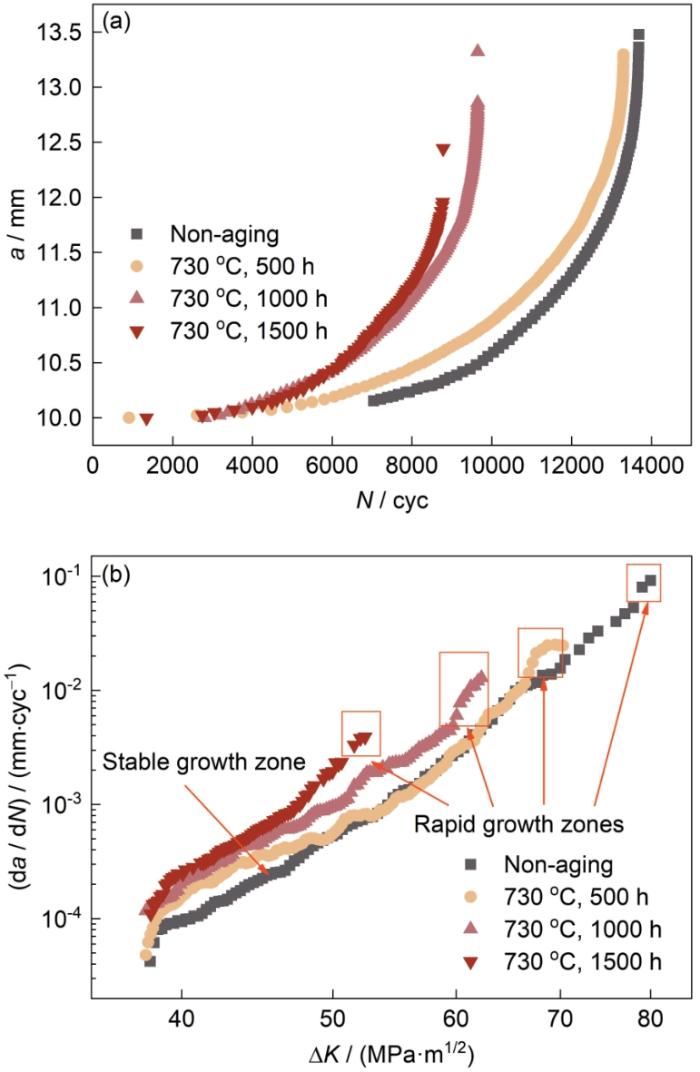
图4
730 ℃时效不同时间后GH4738合金的室温疲劳裂纹扩展曲线
Fig.4
Room temperature FCG curves of GH4738 alloy aged at 730 oC for different time
(a) FCG cycle curves
(b) FCG rate curves
延长时效时间和提高温度均可增加GH4738合金的O累积程度。由650、700、730 ℃时效后室温疲劳裂纹扩展实验可知,随着O累积程度加剧,疲劳裂纹扩展寿命逐渐降低,疲劳裂纹扩展速率增加。合金在高温时效过程中,除氧化外还可能发生显微组织变化,同样会导致疲劳性能降低。在服役温度范围内,GH4738合金具有较好的组织热稳定性[26,27],其在730 ℃长期时效3000 h后组织仍保持稳定,且具有较高的屈服强度和抗疲劳性能[28]。图5为700 ℃时效1000 h前后GH4738合金中γ′相的形貌。可见,时效后γ′相的尺寸和分布均未发生明显变化,各试样中γ'相的平均直径都约为100 nm,且时效后晶界碳化物形貌未发生显著变化,与赵薇等[26]实验结果一致。本工作选取的时效温度(650~730 ℃)远低于合金的固溶温度和中间处理温度,因此合金的晶粒尺寸和晶界碳化物未发生变化。姚志浩等[29]研究表明,GH4738合金在750 ℃时效500 h后硬度下降不明显。杨成斌等[30]研究表明,GH4738合金在650、700 ℃下时效5000 h后室温强度和高温强度变化不明显,甚至高于未时效状态,塑性有所降低。综上所述,在650、700 ℃时效后,GH4738合金疲劳性能的降低主要是O元素的作用而不是显微组织和力学性能降低所致。虽然在高温(730 ℃)下超长时间(> 3000 h)时效会使该合金力学性能有所下降,但本工作最长的时效时间为1500 h,结合该合金组织稳定性特征(如γ'相粗化缓慢,碳化物未发生明显变化,未发生有害相变等)未发生明显变化,可以认为在本工作温度和时间范围内,GH4738合金的显微组织变化不大。进而可以推断,时效后合金疲劳裂纹扩展速率和寿命的差异主要是由O累积程度不同导致的。
图5

图5
700 ℃时效前后GH4738合金中γ'相形貌的SEM像
Fig.5
SEM images of γ' phase morphologies in GH4738 alloy
(a) non-aging
(b) aged at 700 oC for 1000 h
上述讨论阐述了GH4738合金在服役温度范围内长期时效后,O累积程度对室温疲劳寿命和裂纹扩展速率的影响规律。具体而言,O累积程度随时效温度的升高及时间延长而加剧,进而导致裂纹扩展速率增加,疲劳寿命降低。
2.2 氧致晶界损伤的表征
图6

图6
650 ℃时效前后GH4738合金室温疲劳断口形貌的SEM像
Fig.6
SEM images of room temperature fatigue fracture morphologies of GH4738 alloy without age treatment (a) and aged at 650 oC for 500 h (b) and 1500 h (c) (ag—crack growth length. Dashed lines represent the transition points where the fracture completely changes from transgranular fracture to intergranular fracture, the same below)
图7

图7
700 ℃时效前后GH4738合金室温疲劳断口形貌的SEM像
Fig.7
SEM images of room temperature fatigue fracture morphologies of GH4738 alloy without age treatment (a) and aged at 700 oC for 500 h (b) and 1500 h (c)
图8

图8
730 ℃时效前后GH4738合金室温疲劳断口形貌的SEM像
Fig.8
SEM images of room temperature fatigue fracture morphologies of GH4738 alloy without age treatment (a) and aged at 730 oC for 500 h (b), 1000 h (c), and 1500 h (d)
图6为650 ℃时效前后GH4738合金室温疲劳裂纹扩展的拼接断口形貌,图中虚线表示断口完全转变为沿晶断裂的转折点。总体而言,断口在裂纹初始扩展的低应力区域表现出穿晶断裂特征,其表面较平整,伴有河流状花纹及解理面;随着裂纹进一步扩展,断裂模式逐渐转变为穿晶和沿晶的混合断裂,并最终完全转变为沿晶断裂模式。值得注意的是,时效不同时间后,断口由穿晶断裂转变为沿晶断裂所对应的ΔK转折点有所差异。对于未时效合金,ΔK达到约110 MPa·m1/2后才完全转变为沿晶断裂;1500 h时效后,完全沿晶转折点处的ΔK约为103 MPa·m1/2,较未时效时提前了6%。
时效温度升高后,GH4738合金的O累积程度上升。图7为700 ℃时效前后合金室温疲劳裂纹扩展的拼接断口形貌。同样地,与未时效合金断口形貌相比,时效后合金的沿晶断裂模式更早出现,完全沿晶断裂转折点出现的位置同样更趋近于起裂端。时效1000 h后,试样沿晶断裂转折点处的ΔK约为82 MPa·m1/2,较未时效的合金提前约25%。
图8为730 ℃时效前后合金室温疲劳裂纹扩展的拼接断口形貌。与未时效合金相比,随着时效时间的延长,晶界氧化现象不断加剧,完全沿晶断裂的转折位置逐渐趋近于起裂端。时效1500 h后,沿晶断裂出现的位置更靠近起裂端,完全转变为沿晶断裂转折点处的ΔK约为66 MPa·m1/2,约提前了40%,且整体断口表面起伏明显增大,沿晶断裂特征更加明显。730 ℃时效1500 h后试样断口的完全沿晶转折点较650 ℃时效1500 h断口提前了约40%,730 ℃时效1000 h后试样断口的完全沿晶转折点较700 ℃时效相同时间试样提前了约12%,说明随着温度升高,O累积程度增加,完全沿晶断裂转折点更靠近起裂端,出现在应力水平更低的位置,晶界氧化损伤现象更明显。
综上所述,通过室温疲劳裂纹扩展实验,并结合断口形貌观察,可得到裂纹扩展由穿晶模式完全转变为沿晶模式的转折点。该转折点对应的ΔK可用于表征和评估高温合金的氧致晶界损伤的程度。晶界的O累积损伤程度越高,疲劳断口裂纹扩展越快转变为完全沿晶模式。Pfaendtner和McMahon[12]研究表明,当实验条件从高温转变为室温时,断口裂纹扩展出现由沿晶向穿晶的转变,且穿晶区域的O含量较低,同样证明了断口裂纹扩展变化趋势可以反映晶界氧致损伤的程度。
2.3 氧致晶界损伤的理论分析
为从理论上阐述氧致晶界损伤的机理,采用分子动力学方法从纳观尺度进一步分析。由于Ni的Σ5[001](210)对称倾斜晶界的能量为Ni中特殊晶界能量的中间值[31,32],是具有代表性的大角度晶界,因此主要对Σ5[001](210)晶界进行研究,与文献[33,34]使用的晶界模型一致,如图9所示。Chen等[35]和Xiao等[36]研究表明,O原子更倾向在晶界的八面体间隙中存在。因此在晶界上的八面体间隙中加入O原子,如图9c所示。构建的晶界模型在3个方向上均使用周期性边界条件以避免表面效应的影响,从而提高计算效率。此外,垂直于晶界方向上的模型足够长并在上下两端分别设置真空层,以消除上下端面之间的作用力。对体系采用Nose-Hoover热浴法控制温度,先在正则系综(NVT)下预平衡5 ps,再在等温等压系综(NPT)下进行长时间(25 ps)平衡,之后计算体系势能的平均值。
图9

图9
Ni的Σ5[001](210)晶界结构及间隙O原子位置
Fig.9
Lattice models for Ni Σ5[001](210) grain boundary (GB) (a) and Ni free surface (FS) which represent that the Ni Σ5[001](210) grain boundary is completely broken (b), and the interstitial O atom sites (c) (Red ball represents substitution position of O atom, blue balls represent Ni atoms)
理想分离功(Wsep)是控制界面机械强度的基本热力学物理量,晶界的分离功可以被解释为晶界的理想断裂强度,它表示一个晶界在没有其他晶体缺陷参与的情况下完全解离成为两个自由表面(即发生晶间断裂)所需的能量,与晶界结合能为相反数。根据经典的Rice-Wang模型[37],晶界分离功的计算公式如下:
式中,EFS为一个晶界断裂后新产生的两个自由表面的总能量,EGB为晶界模型的总能量,S为晶界模型横截面积。在实际计算过程中,通过LAMMPS软件沿晶界将晶界模型分开,并设置足够大的真空层,避免上下两个表面之间原子的相互影响,构建出分离的晶界结构(图9b)。晶界分离功的正值和负值分别表示对晶界的强化和弱化作用。通常而言,元素偏析引起晶界强化/弱化具有如下两种作用机理:(1) 电子效应,偏析原子改变晶界附近原子间的键强度;(2) 尺寸效应,大尺寸原子造成晶格畸变,从而导致晶界结合能减弱[38,39]。目前已有许多研究使用晶界分离功表示晶界的强化作用。Xue等[34]基于晶界分离功研究了Ni的Σ5[001](210)晶界中合金元素偏析引起的晶界能和晶界分离功变化,认为晶界能降低表示热力学稳定性下降,而晶界分离功的升高表示断裂强度升高。Razumovskiy等[40]通过计算Ni的Σ5[001](210)晶界中4d和5d过渡族元素掺杂后的偏析能和分离功,认为添加Zr、Hf、Nb、Ta和B有助于提高高温合金的高温力学性能。
图10

图10
Ni的Σ5[001](210)晶界分离功与温度的关系
Fig.10
Grain boundary separation work of Ni Σ5[001](210) grain boundary as a function of temperature (No O represents Ni model, 1O-8O represent adding 1-8 O atoms into the octahedral gaps near the grain boundaries of the Ni model, respectively)
总体而言,晶界分离功随温度的变化趋势呈现出先稳定,后在一个温度区间迅速下降,最终趋于平稳的特征。如图10所示,在600~700 ℃范围内,随温度升高,晶界分离功迅速下降,即在此温度区间Ni的Σ5[001](210)晶界发生明显弱化。对于纯Ni而言,当温度低于600 ℃时,其整体性能较为稳定,而一旦温度超过700 ℃,Ni体系趋于不稳定,并伴随晶界的弱化现象。
如图10所示,在Ni的Σ5[001](210)晶界的八面体间隙中加入O原子使晶界分离功迅速降低,-273.15 ℃时O原子数从0增至8个,晶界分离功由1.391 J/m2逐渐降至1.356 J/m2,说明O的加入会使晶界继续弱化,且O含量增加会使晶界弱化程度加剧。在Ni的Σ5[001](210)晶界中加入8个O原子(原子分数为0.08%)后,26.85 ℃时晶界分离功下降了约0.103 J/m2;温度升高至926.85 ℃后,其降幅更为显著,达到约0.286 J/m2,即高温条件下O元素对晶界的弱化作用更为突出。这与李昕等[42]的第一性原理计算结果相似,他们认为氧致晶界损伤的主要原因是结构畸变和电荷密度分布改变。理论计算得出的氧致晶界损伤影响规律与实验结果相吻合,即随着O累积程度加剧,晶界更易弱化和分离,沿晶断裂模式转折点的位置发生变化。
随着O含量的增加,晶界分离功整体呈线性下降的趋势,拟合后晶界分离功与O原子数的关系如图11a所示,大部分数据点均落在90%置信区间内,该线性拟合具有较好的显著性。随着温度升高,拟合直线斜率的绝对值逐渐增大,即晶界分离功下降速率逐渐增加,晶界的弱化现象加速并加剧。
图11
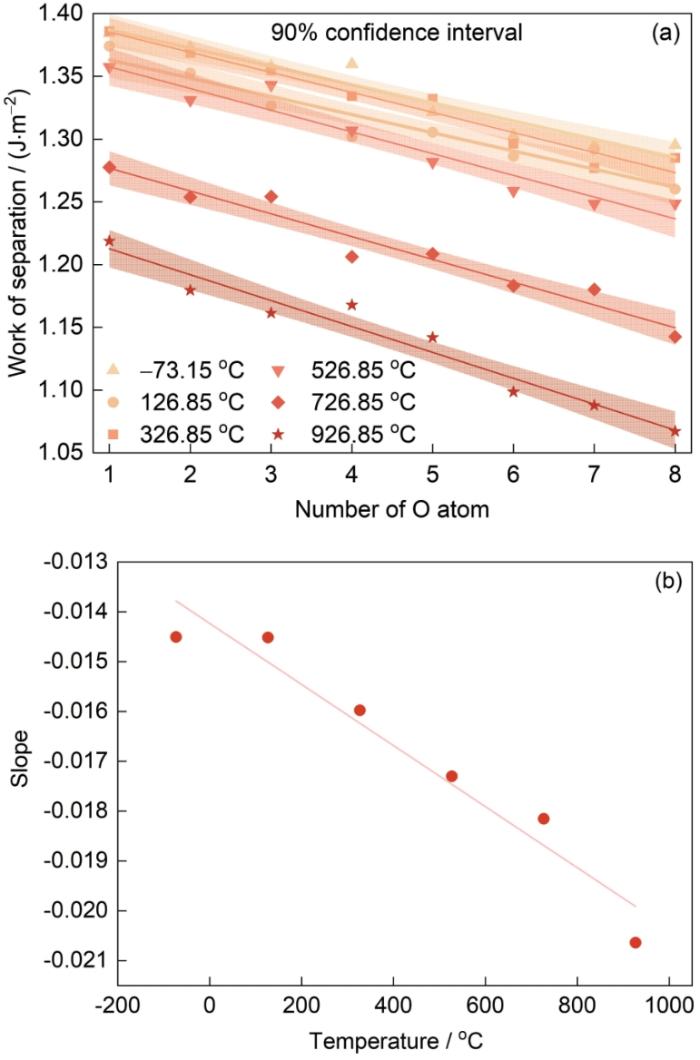
图11
Ni的Σ5[001](210)晶界分离功与O浓度的关系
Fig.11
Grain boundary separation work of Ni Σ5[001](210) grain boundary as a function of O concentration
(a) original relationship
(b) relationship between temperature and slope in Fig.11a
3 结论
(1) 通过室温疲劳裂纹扩展实验,并结合整个断口形貌观察及分析,可有效评估GH4738合金O累积导致晶界损伤情况,该方法具有可靠性和可操作性。
(2) 高温合金的氧致晶界损伤程度可通过室温下疲劳断口由穿晶模式完全转变沿晶模式转折点对应的ΔK表征和评估。晶界O累积损伤程度越高,疲劳断口越早出现完全沿晶模式。
(3) 实验结果结合理论计算分析可较好地阐述O元素对Ni Σ5[001](210)晶界分离功的降低作用。随着O原子浓度升高,晶界弱化现象更为显著。晶界分离功随O原子浓度增加呈线性下降趋势,温度越高,晶界分离功下降速率越快。
参考文献
Research on the phenomenon and mechanisms of rapid crack propagation in the higher zone of service temperature range for nickel-based superalloys
[D].
镍基高温合金服役温度范围高温区裂纹急速扩展的现象和本质研究
[D].
Investigation on deoxidation of Ni-base superalloy
[J].
镍基高温合金脱氧的研究
[J].
Grain size effects in a Ni-based turbine disc alloy in the time and cycle dependent crack growth regimes
[J].
Critical assessment 21: Oxygen-assisted fatigue crack propagation in turbine disc superalloys
[J].
Fatigue crack growth in polycrystalline in 718 superalloy
[J].
Effect of environment on fatigue crack growth of Ni-based superalloys In-738LC and In-939 at 850 oC
[J].
环境对镍基超合金In-738LC和In-939在850 ℃下疲劳裂纹增长的影响
[J].
The effect of environment on the high temperature low cycle fatigue behaviour of cast nickel-base IN-738 alloy
[J].
Effect of environment on the low cycle fatigue behaviour of cast nickel-base superalloy IN738LC
[J].
Grain boundary oxidation effect of GH4738 superalloy on fatigue crack growth
[J].
The low cycle fatigue (LCF) experiments of nickel-based turbine disc alloy GH4738 have been carried out at different temperatures in air to investigate the influence of temperature on fatigue crack growth (FCG) behavior of GH4738 alloy. The FCG curves (da/dN-ΔK and a-N) and their regularity have been obtained. The results show that there is a sensitive range of temperature in which the fatigue life for GH4738 decreases sharply. The microstructures and fracture surface morphologies of the GH4738 samples tested at different temperatures were observed by FE-SEM, and changes of the mechanical properties of GH4738 at high temperature were also taken into account through modifying the stress intensity factor amplitude, ΔK. The interruption experiments were carried out at 700 ℃ and room temperature, respectively, to investigate the crack growth mode and oxidation degree at the crack tip and grain boundary of the samples. And the essential reason of temperature influence on FCG behavior of GH4738 was discussed. The result showed that as the temperature increases, the fatigue crack growth rate (FCGR) of GH4738 accelerates, the fracture surface tends to coarse, and the failure mode converts from a mixed transgranular and intergranular fracture to totally intergranular fracture. The fatigue crack growth lifetime decreases remarkably at 650~700 ℃, existing a temperature-sensitive region under ΔK=40 MPam1/2 and 30~40 μm grain size conditions, which is mainly caused by the oxidation at elevated temperature, independent of the microstructure and mechanical property. Oxygen diffuses into the grain boundary through crack tip and slip band, or penetrates directly into the grain boundary, reacts with active elements (Co, Ti, Al) and generates brittle oxides. These brittle oxides result in weakening of grain boundary and significant decrease of fatigue property of GH4738.
晶界氧化对GH4738高温合金疲劳裂纹扩展的作用
[J].
Oxidation ahead of a crack tip in an advanced Ni-based superalloy
[J].
On the role of plastic relaxation in stress assisted grain boundary oxidation
[J].
Oxygen-induced intergranular cracking of a Ni-base alloy at elevated temperatures—An example of dynamic embrittlement
[J].
Oxidation assisted intergranular cracking in 718 nickel superalloy: On the mechanism of dynamic embrittlement
[J].
Brittle intergranular fracture of a Ni-base superalloy at high temperatures by dynamic embrittlement
[J].
Multilayer structure of DZ445 Ni-based superalloy formed by long time oxidation at high temperature
[J].Nickel-based superalloys have been widely used in aero engines and gas turbines because of their excellent high-temperature strength and exceptional oxidation resistance. The oxidation resistance is obtained using the thermal barrier coatings and alloying elements. In the previous investigations, the oxidation time of the nickel-based superalloys has been focused on hundreds of hours. However, in practice, the superalloys last far longer. This study investigated the superalloy DZ445's oxidation behavior at 900oC for 300-2600 h. An oxidation film with a four-layer structure is formed after oxidation at 900oC for 500 h and above. The outermost layer is primarily composed of NiCr2O4, Cr2O3, and TiO2. The subouter layer consists of CrTaO4 and TiO2, and the subinner layer consists of Al2O3, NiCr2O4, and NiO. The innermost layer is primarily Al2O3. The appearances of the subouter layer and subinner layer greatly reduce the oxidation rate of the alloy, which is represented by the dramatic increase in the oxidation kinetics equation exponent and a sharp reduction of the oxidation rate constant. The formation of subouter layer changes the oxidation mechanism from outward diffusion of alloy elements to O-inward diffusion. When the subinner layer is formed, the oxidation behavior is controlled using the outward diffusion of Ni and Cr and the O-inward diffusion. The multilayer structure gave the alloy an excellent oxidation resistance capacity.
DZ445镍基高温合金高温长时间氧化形成的多层膜结构
[J].研究了高Cr / Al比和中Ta含量的DZ445镍基高温合金在900℃下300~2600 h的氧化行为。结果表明,900℃氧化≥ 500 h,氧化膜呈现多层结构,最外层氧化物相为NiCr<sub>2</sub>O<sub>4</sub>、Cr<sub>2</sub>O<sub>3</sub>和TiO<sub>2</sub>,次外层为CrTaO<sub>4</sub>和TiO<sub>2</sub>,次内层为Al<sub>2</sub>O<sub>3</sub>、NiCr<sub>2</sub>O<sub>4</sub>和NiO,最内层主要是Al<sub>2</sub>O<sub>3</sub>。次外层和次内层的出现使得合金氧化速率降低,表现为动力学方程的指数大幅度增加和氧化速率常数急剧下降。这2层的出现也使得合金氧化机理发生转变,次外层形成后氧化过程由合金元素Cr、Ti、Ni向外扩散转变为由Al的向外扩散和O的向内扩散所控制;次内层形成后,氧化过程转变为Ni、Cr的向外扩散和O的向内扩散所控制。这种多层氧化膜结构使得DZ445合金表现出优异的抗氧化能力。
Research advances in high temperature corrosion of Ni-Cr alloys in CO2-rich environments
[J].
Ni-Cr合金在富CO2气氛中的高温腐蚀研究进展
[J].
The role of metallic grain boundary in high temperature oxidation
[J].
金属晶界在高温氧化中的作用
[J].扼要阐述了金属材料晶界在纯金属与合金高温氧化中的 作用.指出金属中晶界面积增加(晶粒尺寸减小)有3种效应:改善合金抗氧化性能的有益的正 效应,相反为负效应以及双重效应.讨论了金属晶界扩散动力学基本方程的参数,如Tamman 温度及晶粒尺寸对其影响、晶粒形状因子(q)、晶界偏聚因子(s)、晶界夹角(θ)对晶界 扩散的影响.最后介绍了晶界作为高速扩散通道对合金晶间内氧化的重要作用.
Fast parallel algorithms for short-range molecular dynamics
[J].
Interatomic potentials for monoatomic metals from experimental data and ab initio calculations
[J].
Study on lightweight and strengthening effect of carbon nanotube in highly ordered nanoporous nickel: A molecular dynamics study
[J].The mechanical behavior of nanocomposites consisting of highly ordered nanoporous nickel (HONN) and its carbon nanotube (CNT)-reinforced composites (CNHONNs) subjected to a high temperature of 900 K is investigated via molecular dynamics (MD) simulations. The study indicates that, out-of-plane mechanical properties of the HONNs are generally superior to its in-plane mechanical properties. Whereas the CNT shows a significant strengthening effect on the out-of-plane mechanical properties of the CNHONN composites. Compared to pure HONNs, through the addition of CNTs from 1.28 wt‰ to 5.22 wt‰, the weight of the composite can be reduced by 5.83‰ to 2.33% while the tensile modulus, tensile strength, compressive modulus and compressive strength can be increased by 2.2% to 8.8%, 1% to 5.1%, 3.6% to 10.2% and 4.9% to 10.7%, respectively. The energy absorption capacity can also be improved due to the existence of CNTs. Furthermore, the MD simulations provide further insights into the deformation mechanism at the atomic scale, including fracture in tension, pore collapse in compression and local changes in lattice structures due to stacking faults.
Enhancing understanding metal matrix composites through molecular dynamics simulation: A comprehensive review
[J].
The effect of segregated sp-impurities on grain-boundary and surface structure, magnetism and embrittlement in nickel
[J].
Atomsk: A tool for manipulating and converting atomic data files
[J].
Measuring oxygen solubility in Ni grains and boundaries after oxidation using atom probe tomography
[J].
On the physical nature of the Paris law
[J].
对裂纹扩展规律Paris公式物理本质的探讨
[J].
High-temperature microstructure stability of GH4169, GH4169plus and GH4738 alloy
[J].
GH4169、GH4169plus和GH4738高温合金组织稳定性
[J].
Mechanical properties and microstructure evolution of WASPALOY after long exposure
[J].
WASPALOY合金长期时效过程中的组织演变和性能变化
[J].
Gamma prime phase evolution during long-time exposure for GH738 superalloy
[J].
GH738高温合金长期时效过程中γ′相演变规律
[J].
Effect of long-term aging on microstructure and properties of GH4738 superalloy
[J].
长期时效对GH4738合金组织性能的影响
[J].
Ductile versus brittle behaviour of crystals
[J].
Embrittlement of interfaces by solute segregation
[J].
Decohesion energy of Σ5(012) grain boundaries in Ni as function of hydrogen content
[J].
Segregation behavior of alloying elements at Ni Σ5[001](210) symmetrical tilt grain boundary in nickel-based superalloys and their stabilization and strengthening mechanisms for the grain boundary
[J].
Role of grain boundary character on oxygen and hydrogen segregation-induced embrittlement in polycrystalline Ni
[J].
First-principle studies of oxidation effects on grain boundary strength in nickel
[J].
Fundamental studies on stress-corrosion cracking in iron and underlying mechanisms
[J].
Effects of transition metal elements and O on grain boundary energy and strength of Co by first-principles study
[J].
First principles calculations of cohesive energy of fission-product-segregated grain boundary of UO2
[J].
First-principles-aided design of a new Ni-base superalloy: Influence of transition metal alloying elements on grain boundary and bulk cohesion
[J].
Analysis of the alloying system in Ni-base superalloys based on ab initio study of impurity segregation to Ni grain boundary
[J].
Theoretical calculation and analysis of the effect of oxygen atom on the grain boundary of superalloy matrices Ni, Co and NiCr
[J].As advanced aero engines and heavy-duty gas turbines require high service temperatures, how to maintain better performance and damage tolerance of superalloys at high service temperatures has emerged as a critical issue in the application of superalloys. Previous research has shown that temperature rise has no effect on the crack growth rate of alloys placed in a vacuum. However, in air, fatigue crack growth rate is observed to significantly depend on temperature. According to the sample fracture, which is an oxide-covered intergranular fracture, oxygen atoms significantly affect the performance of superalloys. As first-principle calculation method has advanced rapidly in recent years, it can eliminate the effect of irrelevant impurity atoms on the weakening of grain boundaries and establish a pure grain boundary system. Thus, this method is an ideal analysis tool for this research. The ideal tensile test combined with ideal separation work and charge density difference of the grain boundary in nickel-based superalloy under different oxygen concentrations, was performed using the first-principle calculation method. The internal reason for the weakening of the Ni grain boundary due to oxygen is given. A similar comparative analysis of Co and NiCr grain boundaries was also performed. Further, the cause of the oxidation and weakening of the grain boundaries is explained. The results demonstrate that the high electronegativity of O atoms weakens the Ni—Ni metal bond at the grain boundary due to the lack of charge. Further, in the stretching process, when the tensile strain reaches 0.10, the strain of the oxygen-containing Ni grain boundary is entirely provided by the Ni—Ni bond present at this boundary. The presence of oxygen significantly accelerates the fracture failure process of the Ni grain boundary. In addition, Co-based alloy has higher strength after grain boundary oxidation and has better oxidation resistance weakening performance than Ni; however, the strain of fracture is small. Although the NiCr-based grain boundary strength is the weakest, the mechanical properties after oxidation are relatively stable. The reason for the weakening of the Ni grain boundary due to oxidation is attributed to structural distortion caused by oxygen atoms, whereas the weakening of Co- and NiCr-based grain boundary due to oxidation is primarily related to changes in the charge density distribution.
O原子对高温合金基体Ni、Co和NiCr晶界作用的理论计算分析
[J].


