



涡轮叶片需要在高温、高压、复杂应力及腐蚀性环境中长时间工作,因而对叶片材料的组织和性能提出了很高的要求,目前镍基单晶高温合金是燃气轮机涡轮叶片的首选[1~3]。单晶叶片具有优异的高温强度、抗蠕变及抗疲劳性能[4,5]。然而,在单晶叶片制备过程中,容易产生杂晶[6]、再结晶[7]、小角度晶界、雀斑[8,9]等多种晶粒缺陷,这些缺陷降低了涡轮叶片的良品率和使用性能[2,9]。雀斑通常发生在厚大叶片的榫头等区域,表现为在叶片表面呈链状分布、尺寸细小的等轴晶[8,9]。高温合金在定向凝固过程中,温度梯度是形成雀斑的关键因素。当温度梯度较低时,溶质对流的程度加剧,进而引发雀斑[10,11]。航空发动机单晶叶片尺寸相对较小,定向凝固时易于散热,温度梯度相对较高,因此雀斑形成倾向较低。而重型燃气轮机涡轮叶片尺寸较大,散热困难,导致温度梯度较低而形成雀斑。并且,为满足重型燃气轮机效率提升的需求,更高级别的重型燃机(从F级、G/H级到J级)和更多级数的涡轮叶片(1级、2级乃至3级)均趋于应用更大尺寸的单晶/定向叶片,其定向凝固时散热更加困难,温度梯度进一步降低,溶质对流亦随之增强。与此同时,涡轮叶片选材趋向于采用承温能力更高、难熔元素含量更高、偏析程度更大的合金,这也增强了叶片定向凝固时内部溶质对流的程度。因此,重型燃气轮机单晶/定向涡轮叶片大尺寸设计和高含量难熔元素合金选材,致使其定向凝固时具有较低的温度梯度和较强烈的溶质对流,从而使叶片的雀斑缺陷控制面临着巨大挑战[8,10],雀斑缺陷控制成为重型燃机大尺寸单晶/定向叶片制备的一项关键技术。
目前,对雀斑的研究主要集中在形成机制、模型判据、影响因素及控制技术等方面。关于雀斑形成机制,普遍认为雀斑的形成过程为“元素偏析→溶质对流→枝晶碎臂”,并通过同步辐射、原子探针等表征手段证实了元素偏析和溶质对流的存在,同时也开展了宏观溶质对流通道和微观枝晶生长(元胞自动机和相场)的数值模拟研究,但关于枝晶碎臂形成雀斑的解释仍有争议。雀斑的形成判据及预测通常聚焦于个别主导因素构建,但受限于模型机制、边界条件及计算算力等影响,尚不能满足于大尺寸叶片(> 300 mm)快速、精准的预测模拟。科研人员研究了试样形状对雀斑形成的影响,然而报道中“小尺寸、拉速≤ 1.5 mm/min、高W/Re合金”与工程实际中“大叶片、拉速≥ 2.0 mm/min、低W/Re合金”的凝固条件存在显著差异。大尺寸叶片因定向凝固温度梯度较低而形成雀斑,主要缘于大叶片散热困难和设备冷却能力有限,这也导致有效控制雀斑的方法比较有限。本文系统阐述和解析了近几十年来定向凝固高温合金雀斑缺陷的研究进展,并对未来高温合金雀斑缺陷的研究方向进行了探讨和展望。
1 形成机制
1970年,Giamei和Kear[9]研究了镍基高温合金定向凝固过程中的雀斑缺陷,发现在Udimet 700合金和Mar-M200合金铸件表面出现了大量雀斑缺陷,且雀斑缺陷呈链状分布。成分分析结果表明,雀斑缺陷位置偏析较为严重,在定向凝固过程中糊状区出现密度反转,Mar-M200合金糊状区上下方的密度差可达0.640 g/cm3。据此,提出了溶质对流引起雀斑缺陷的形成理论,即枝晶间的元素偏析使得糊状区液相密度减小,在浮力的作用下向上对流,对流的熔体引起枝晶断裂形成雀斑缺陷。研究者相继补充完善了对流冲刷枝晶所致雀斑的形成机制,主要包括三个部分:(1) 元素偏析[12],高温合金在定向凝固过程中,W和Re等负偏析元素富集于枝晶干,而Al等正偏析元素富集于枝晶间;(2) 溶质对流[13,14],成分偏析造成糊状区上方未凝固的液相密度大于糊状区枝晶间的液相密度,这种上重下轻的密度分布使W、Re与Al元素之间产生通道式对流,并形成通道偏析;(3) 枝晶碎臂[11,15,16],通道内强烈的溶质对流促使枝晶臂熔断、偏转甚至断裂,这些枝晶碎臂最终形成了链状分布的细小等轴晶,即雀斑(见图1[16])。
图1

图1
重型燃气轮机大叶片雀斑形貌与形成示意图[16]
Fig.1
Freckle defects and its formation mechanism of the large-sized industrial gas turbine blade[16] (a-c) freckle chains (showed by arrows) (a), dendritic crystal (b), and orientation images (c) of freckle chains (IPF—inverse pole figure) (d) schematic of formation mechanism of freckle defects
1.1 元素偏析
高温合金中通常包含10余种合金元素,在定向凝固过程中不同的元素在合金中的分布不同。合金元素在枝晶干与枝晶间之间的偏析程度可以用元素i的偏析系数(Ki )表示,Ki = Ci,dendrite / Ci,indentrite,式中,Ci,dendrite和Ci,indentrite分别为元素i在枝晶干和枝晶间的质量分数或原子分数,测量和计算时单位需统一。若Ki > 1,元素偏析在枝晶干,即为负偏析;若Ki < 1,元素偏析在枝晶间,即为正偏析。
1.1.1 W、Re、Al、Ta元素
W、Re、Al、Ta具有显著的偏析特性,且是造成上下熔体密度差的主要元素。Amouyal和Seidman [12]采用原子探针准确地表征了ME-15合金(Ni-15.1Al-7.73Cr-7.31Co-1.97Ta-0.9Mo-0.75W-0.46Re-0.67C-0.05Hf,原子分数,%)中的元素偏析现象(图2[12]),其中基体单晶枝晶干(single crystal-dendritic cores,SC-DC)、基体单晶枝晶间(single crystal-inter-dendritic regions,SC-ID)、雀斑枝晶干(freckle-dendritic cores,F-DC)、雀斑枝晶间(freckle-inter-dendritic regions,F-ID)的元素含量显著不同,密度相对较小的轻元素Al为正偏析,富集于基体枝晶间(图2f[12]),密度相对较大的重元素W、Re为负偏析,富集于基体枝晶干(图2g[12]),致使上下熔体存在密度差,促进了通道偏析的产生,进而导致雀斑形成。密度相对较大的重元素Ta则为正偏析,富集于基体枝晶间(图2g[12]),起到减小密度差的作用,降低雀斑形成倾向。Tin等[17]通过多种合金对比实验,同样表明W、Re具有促进雀斑形成、Ta具有抑制雀斑形成的作用。
图2

图2
雀斑电镜组织与原子探针组分分析[12]
Fig.2
Freckle defects: microstructure in electron microscopy and composition obtained by atom probe tomography (APT)[12]
(a) SEM image displaying the four regions of interest (ROIs): the dendritic cores in the single crystal (SC-DC) and in the freckles (F-DC); the inter-dendritic regions in the SC (SC-ID) and in the freckles (F-ID)
(b-e) 3D APT reconstructions of samples lifted-out from the four ROIs
(f, g) Al, Cr, Co, Mo, Ta, W, and Re element concentrations in four ROIs
1.1.2 Cr、Mo元素
图3

1.1.3 Hf元素
Hf在高温合金中的添加量较低,且添加目的并非调控雀斑形成倾向。Amouyal和Seidman[12,19]在ME-15合金(Hf原子分数为0.05%,质量分数为0.15%)雀斑枝晶干未发现Hf,但发现基体单晶枝晶干的Hf倾向于富集到γ,认为Hf具有降低雀斑形成的潜力。Wang等[16]在247LC-DS合金(Hf质量分数为1.4%)叶片中采用能谱仪(EDS)检测到Hf为正偏析元素,倾向存在于枝晶间,这与Ta的作用类似,即高密度正偏析抑制雀斑形成。包超君等[20]针对SX系列合金(Hf质量分数为0.12%~0.18%)提出了雀斑形成倾向因子(P),定量分析了各元素对糊状区液相密度的影响,得出单位含量下(质量分数1%) Hf对雀斑的抑制作用最强,Ta次之。文献[16]和文献[20]的研究结果相互吻合。但是,因Hf整体含量较少,对雀斑产生显著影响的实验目前尚鲜见报道。
1.1.4 C元素
1.2 溶质对流
1.2.1 实验研究
高温合金在定向凝固过程中,由溶质浓度梯度和液态金属流动共同作用形成通道式溶质对流,表现为通道区域化学成分与基体存在较明显差异,因而叫作通道偏析,这里的通道则被称为偏析通道或对流通道。图4[11,13,21]为不同材料定向凝固过程中通道偏析的实验观测。由于高温合金凝固过程中难以直接观测熔体对流情况,早期Copley等[11]开展了NH4Cl水溶液的定向凝固实验,在质量分数为30%的NH4Cl水溶液底部采用液氮经铜盘冷却,凝固形成自下而上生长的柱状枝晶。在定向凝固过程中形成了向上的射流,进一步的实验结果表明,将模具及底部铜盘倾斜20°放置,使糊状区固/液界面为倾斜状,射流的方向仍平行于重力方向,且射流倾向于在糊状区最高处形成(见图4a1和a2[11])。Sarazin和Hellawell[21]研究了Pb-Sn、Pb-Sb和Pb-Sn-Sb合金定向凝固过程中雀斑缺陷的形成,结果表明,在雀斑缺陷形成过程中,首先在铸锭底部形成较多的偏析通道,接着,偏析通道之间相互竞争,多个偏析通道之间可能会合并,随着凝固过程的进行,偏析通道数量逐渐减少,实验得到的Pb-2%Sb (质量分数,下同)合金铸锭横截面偏析通道如图4b1和b2[21]所示,距离底部40 mm的横截面上偏析通道较多(约7个),随着距离底部高度增加,偏析通道显著减少(约3个)。这一结果表明,随着凝固过程进行,溶质对流形成的雀斑缺陷在向上发展一定距离后可能会终止。近期有研究[13]利用同步辐射直接观测到了高温合金CMSX-4定向凝固过程中羽状偏析与冷却速率的关系(图4c1和c2[13])。随着冷却速率由2 ℃/min增大到8 ℃/min,凝固过程中固/液界面上方的白色羽状偏析通道减弱(如图4c1和c2[13]中白色箭头所示)。Shevchenko等[22]采用同步辐射技术对Ga-25%In合金定向凝固过程进行了观测并得到了类似的结果。
图4
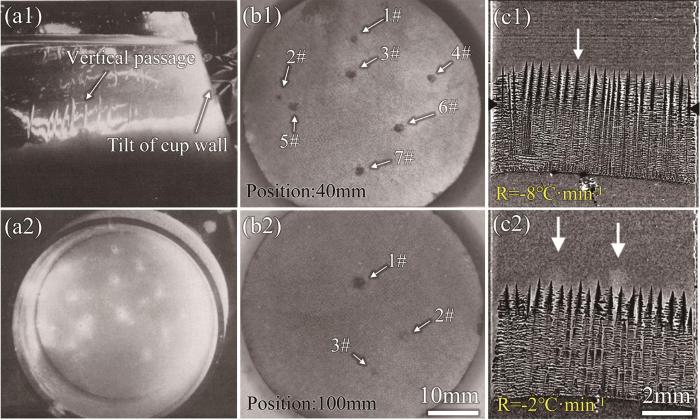
Fig.4
Experimental observation of channel segregation (a1, a2) upward jet flow parallel to gravity direction in NH4Cl solution (a1) and jet flow on the top side (a2)[11] (b1, b2) segregation channels (indicated by arrows) in Pb-2%Sb alloy (mass fraction, the same below) in different sections[21] (c1, c2) solute plumes during directional solidification of CMSX-4 alloy[13] (R—cooling rate, white arrows show the dendrite tips)
上述实验研究表明,定向凝固过程中偏析道通常在温度梯度较低的时候形成,偏析通道具有与重力方向平行的特点,多个偏析通道之间会相互竞争至消失或合并。
1.2.2 模拟研究
由于定向凝固实验中的温度梯度、凝固速率等参数难以准确控制,常规实验只能得到定向凝固结束时试样中的雀斑缺陷形貌和分布,无法直接观察雀斑缺陷的形成和演化过程,也难以对雀斑缺陷形成因素的影响进行定量分析。而同步辐射技术受限于试样的厚度,目前只能对薄片试样的凝固过程进行观测,无法对大尺寸试样的凝固过程进行观测。因此,研究者建立了定向凝固过程中宏观溶质及微观枝晶的数学模型,并采用数值模拟的方法对雀斑缺陷的形成和演化进行深入研究。
图5

图5
定向凝固过程中溶质通道偏析数值模拟[14,23,30]
Fig.5
Simulation results of channel segregation during directional solidification
(a1, a2) velocity field (a1) and normalized concentration field (a2) of Ti element in CMSX2 alloy[23] (Cmix—mixture concentration, Cin—initial concentration)
(b1, b2) isosurfaces of liquid volume fraction (Color of streamtraces indicates mixture concentration of Sn, with corresponding levels shown in the upper color bar) (b1) and segregation channels of Sn (b2) during directional solidification of Pb-10%Sn[14]
(c1, c2) velocity field and segregation channels[30] (fs—solid volume fraction, ul—velocity of the melt, t—time, Teut—eutectic temperature)
Felicelli等[14]对Pb-Sn二元合金定向凝固过程中雀斑缺陷的形成开展了三维模拟研究,如图5b1和b2[14]所示。结果表明,雀斑缺陷的形成与热溶质对流引起的局部重熔现象密切相关。通道倾向于在模具壁面形成,且通道出口处出现了“火山口”形状的强对流区域。Felicelli[25]和Frueh等[26]通过数值模拟研究了Pb-Sn合金在垂直定向凝固过程中雀斑缺陷的形成机制。模拟结果表明,在较低的凝固速率下,糊状区内更容易形成偏析通道。偏析通道更倾向于在壁面位置形成,这与Gu等[27]得到的实验结果具有一致性。Ren等[28,29]采用Eulerian两相模型对CMSX-4镍基高温合金定向凝固过程中通道偏析的形成开展了三维模拟研究。结果表明,通道偏析的形成与热溶质对流引起的溶质富集和流体流动扰动密切相关,在铸件内部形成的偏析通道则更容易受到溶质对流的扰动而消失。
最近,Zhang等[30]提出了一种新的数字孪生方法,将辐射传热模拟得到的叶片温度场作为边界条件输入到基于体积平均的多相凝固模型[31]中,模拟了叶片定向凝固过程的流动场及液相分数分布,预测的雀斑缺陷位置与实验结果具有较好的一致性(图5c1和c2[30])。随后,Zhang等[32]通过引入枝晶破碎机制,成功预测了高温合金铸件中杂晶和雀斑的形成。该方法在工业级涡轮叶片的铸造模拟中表现出良好的应用前景,但计算成本仍然较高。Liu等[33]提出了一种新的基于Rayleigh数(Ra)的数学模型,通过量化几何效应(如壁面附着效应、截面变化效应和阴影效应)来预测镍基单晶高温合金CMSX-4和WZ30铸件中的雀斑缺陷。该模型在处理复杂几何形状和大规模工业应用时,在计算速度、资源消耗及并行计算能力方面仍需加强。
上述模拟研究表明,高温合金在温度梯度较低时容易形成通道式对流,合金内部的偏析通道易消散,壁面上的偏析通道容易保留,借助模拟偏析通道的手段来预测雀斑形成规律具有良好的应用前景。
(2) 微观枝晶生长过程中的对流。现有溶质对流模型虽能够较好地模拟偏析通道的形成和演化,对雀斑缺陷形成的工艺范围能够做出有效预测,但由于雀斑缺陷起源于枝晶生长过程的溶质对流及其相互作用,溶质对流模型中基于宏观体积平均方法的传热传质模型难以揭示雀斑形成的微观机制。为此,研究者开发了具有耦合对流效应的枝晶生长模型,以深入探究雀斑缺陷的微观形成机理。
① 元胞自动机。科研人员先后基于元胞自动机模拟了通道偏析与枝晶重熔、枝晶变形及晶界的关联性。Yuan和Lee[34]建立了枝晶生长与溶质对流耦合的元胞自动机模型,对Pb-Sn合金凝固过程中雀斑缺陷的形成机理进行了模拟研究。结果表明,在Pb-Sn合金中,枝晶间富集的溶质在对流的作用下重熔一次枝晶臂和二次枝晶臂,且重熔效应会进一步促进偏析通道的发展。Kao等[35]对Ga-25%In合金定向凝固过程中雀斑缺陷的形成开展了大规模模拟研究。结果表明,偏析通道内富集的溶质会局部重熔相邻的枝晶。当侧向温度梯度为正值时(等温线为凸形),偏析通道倾向于出现在区域中间位置,且偏析通道之间存在竞争;当侧向温度梯度为负值时(等温线为凹形),偏析通道倾向于出现在外侧,即与两侧壁面相邻位置。随后,Karagadde等[36]研究了Ga-In合金定向凝固雀斑缺陷的形成,结果表明,雀斑形成过程包含两个阶段:第一阶段,对流速率较小,但波动较大;第二阶段,对流发展至稳定阶段,如图6[36]所示。
图6

由于元胞自动机模型属于锐利界面模型,凝固过程中枝晶生长形貌的模拟精度受到网格各向异性误差的影响,难以定量分析枝晶生长。为此,一些研究学者采用相场模型进行模拟研究。
为进一步提高计算速度,Watanabe等[42]和Sakane等[43]提出了基于自适应网格的相场-格子Blotzmann模型的GPU并行求解算法,可应用于耦合流动的枝晶生长过程模拟。此外,Guo等[44,45]提出了基于自适应网格的并行求解算法。Yang等[46]采用Steinbach等[47]和Eiken等[48]提出的多相场模型,结合Pandat软件计算得到的高温合金相变热力学数据,基于进一步发展的高精度插值算法[49],对CMSX-4合金定向凝固过程的雀斑缺陷进行了模拟研究。结果表明,在高温合金定向凝固过程中,较为强烈的溶质对流会产生重熔,并促进枝晶的异常分枝,枝晶表现出明显的非对称生长形貌,如图7[46]所示。尽管采用了GPU并行求解算法,各个算例的模拟仍需10~20 d。
图7

图7
相场模拟:CMSX-4定向凝固枝晶形貌及溶质分布[46]
Fig.7
Phase field simulation results of dendrite morphology and solute concentration distribution during directional solidification of CMSX-4 alloy[46]
(a) dendrite deflection (G—temperature gradient, a—crystal growth direction)
(b) dendrite remelt and protrude (c) dendrite branch and overgrowth
需要强调的是,通道偏析与雀斑形成密切相关。但是,通道偏析的形成不一定导致雀斑缺陷的产生,通道偏析与雀斑形成之间缺少一个关键环节——晶核的来源,晶核源于枝晶碎臂或是新形核还需进一步研究。
1.3 枝晶碎臂
1.3.1 实验研究
在各种材料的凝固过程中,枝晶碎臂现象并不算罕见,例如大型钢锭凝固后期柱状晶向等轴晶转化过程中就可能存在枝晶碎臂。Pollock和Murphy[10]发现定向凝固高温合金在柱状晶向等轴晶过渡时枝晶臂起到促进作用,同时也指出当温度梯度较低时存在形核的可能性。Yasuda等[50]采用原位技术观测Al-Cu合金时,发现枝晶碎臂和新形核这两个因素对组织演化均具有重要作用。Copley等[11]和Ruvalcaba等[51]分别在NH4Cl实验(图8a1和a2[11])和Al-Cu合金原位实验[51]中发现了枝晶碎臂,但未分析枝晶碎臂如何继续演化。在原位观测Ga-In合金凝固前沿通道附近[52]和同步辐射观测高温合金残余液相[13]时,均发现了一些细小等轴晶,但未观测到晶核的来源。如图8b1和b2[52]所示,同步辐射技术观测到Ga-25%In合金在温度梯度为0.3~0.7 K/mm时,定向凝固前沿出现了两个长大的等轴晶(箭头位置),受限于同步辐射装置的空间分辨率,未能观测到该等轴晶的形核。考虑到糊状区枝晶的重熔效应,这些等轴晶可能来自熔断的枝晶臂,但也不排除是新形核的可能性。事实上,在NH4Cl、Al-Cu合金、Pb-Sn合金等材料研究过程中,只是发现了某条件下的枝晶碎臂,或是单纯的溶质通道,类似高温合金中溶质通道内链状分布、细小等轴晶的雀斑组织比较少见。
图8

Fig.8
Isolated dendrites near solidification front
(a1, a2) convergence grain boundary (a1) and fractured dendrites (a2) in NH4Cl solution[11] (White arrow indicates the direction of the convective jet eroding the mushy zone)
(b1, b2) occurrence of isolated grains at time of 115 s (b1) and 135 s (b2) during directional solidification of Ga-25%In alloy by synchrotron radiation observation[52] (Numbers 1 and 2 represent grains)
1.3.2 模拟研究
除枝晶碎臂实验研究之外,科研人员还开展了枝晶碎臂的模拟研究。Gu等[27]在预设枝晶臂存在的前提下,模拟了某高温合金的枝晶碎臂运动和重熔现象,但未研究初始枝晶碎臂的形成机制。随后,Soar等[53]提出了一种结构力学与元胞自动机耦合的数学模型,用于模拟重力作用下产生变形时枝晶生长过程,该方法有望应用于考虑枝晶间对流引起的枝晶变形和断裂的预测,从而可进行凝固过程中雀斑缺陷形成的直接模拟。另有学者在Ga-In合金[36]及二元合金(仿高温合金)[54]模拟中认为一些枝晶是雀斑,但是并未得到这些枝晶的取向演化结果。因此,虽然已经有关于枝晶碎臂形成的研究报道,但尚未证实枝晶碎臂与雀斑之间存在确切关系,在特定的工艺条件下,高温合金中的雀斑由新形核晶粒产生的可能性仍然存在,例如成分过冷对于晶体形核生长及缺陷形成具有重要影响。针对高温合金的多元素成分特征和大叶片较低的凝固温度梯度状态,成分的变化导致合金局部凝固温度发生改变的作用也不容忽视[10,55]。
2 模型判据
为了预测定向凝固过程中雀斑缺陷的形成,研究者建立了一系列雀斑缺陷形成判据,这些判据主要考虑了凝固条件(如温度梯度、抽拉速率)、凝固过程糊状区的密度变化等因素。
2.1 冷却速率判据
Schadt等[56]以CMSX-4合金为例,统计了不同形状的定向凝固试样的雀斑缺陷,采用热电偶对试样特征位置进行了测温,采用有限元方法对试样凝固过程温度场进行了模拟,得到了雀斑缺陷形成的冷却速率判据:
式中,G为温度梯度,v为凝固速率,C为常数。当定向凝固达到稳态时,可以近似认为v等于抽拉速率(vp)。G与v的乘积即为冷却速率。根据Schadt等[56]的实验结果,当冷却速率小于临界值(0.14 K/s)时会形成雀斑缺陷,如图9[56]所示;但当冷却速率在0.08~0.14 K/s之间时,为雀斑形成的转变区。在这一工艺区间内,雀斑缺陷的形成更容易受到铸件几何结构的影响。而Pollock等[15]的SX1合金定向凝固实验结果表明,产生雀斑缺陷的冷却速率临界值为0.1 K/s。这与Schadt等[56]的结果较为接近,但存在一定偏差,这可能是受合金成分的影响。Li等[57]基于突变截面试样的定向凝固实验结果,给出了基于固/液凹界面倾斜角度的判据(G-1·v-1.5·sin2θ > ξ,其中,v为枝晶生长速率,θ为固/液界面倾斜角度,ξ为常数),然而很多研究[58~60]表明雀斑形成于凝固界面凸出的高点位置。总之,基于雀斑是在温度梯度较低的情况下形成,从前面阐述的实验和模拟中也可知温度梯度直接影响偏析对流程度,且在工程实际中雀斑也发生在散热困难的大叶片上面,因此这类判据具有继续研究的价值。
图9

2.2 基于回归分析的经验判据
Tin和Pollock[61]对镍基高温合金定向凝固铸件中形成的超过470个雀斑缺陷数量进行统计,包含SX、ME和CE系列合金在内的43种成分。采用回归分析的方法得到了雀斑缺陷数量与糊状区密度差、一次枝晶臂间距及相变温度之间的经验判据。
对不含C的镍基高温合金,其经验判据为:
式中,Φ为雀斑缺陷数量,Δρ / ρ为归一化的糊状区密度差,Δρ为成分偏析引起的密度变化(溶质富集液体与主体液体之间的密度差),ρ为合金的主体液相密度,λ1和λ*分别为一次枝晶臂间距的实验值及其整个工艺区间内的临界值。
对含C的镍基高温合金,在凝固过程中析出的碳化物对雀斑缺陷形成产生影响。对应的经验判据为:
式中,TL为液相线温度,TMC为碳化物析出温度,TNi为纯Ni的熔点。
2.3 Rayleigh数判据
式中,Ramax为糊状区Rayleigh数的最大值,Racrit为临界Rayleigh数。当Ramax < Racrit时,不会产生雀斑缺陷。
Rayleigh数描述了糊状区密度差引起的浮力与枝晶间黏性阻力的比值,并考虑了糊状区的渗透性,Beckermann等[63]给出的Ra定义为:
式中,h为糊状区的深度,定义为从固/液界面(一次枝晶尖端)向下测得的深度;g为重力加速度常数;
如图10[64]所示,Madison等[64]利用切片重构了三元合金Ni-Al-W (Ni-6.5Al-9.5W,质量分数,%)和René N4合金的糊状区三维形貌,依此建立并计算了糊状区速度场,从3D数据集中提取不同位置的渗透率并计算了局部Rayleigh数(Rah),该参数用于量化并预测镍基单晶高温合金定向凝固过程中枝晶间液体流动失稳倾向。由于对流不稳定性及诱发缺陷(如雀斑)萌生于局部,只需糊状区内某一微小区域首先满足失稳条件(即该处Rah超过临界值),研究显示这些基于实测三维结构精确计算的局部Rah值比传统经验公式预测值高2~3倍。结果表明,三元合金Ni-Al-W比René N4合金表现出更高的Rayleigh数,这不仅源于溶质密度反转,还因为Ni-Al-W合金在固相分数低于0.4的糊状区区域具有显著更高的渗透率,为流体流动提供了更通畅的通道,使得Ni-Al-W合金中糊状区对流失稳的倾向性远高于René N4。
图10

另外,Beckerman等[63]结合热力学计算得到的SX-1、Mar-M247和Waspaloy合金在温度梯度为10 K/cm、凝固速率为0.01 cm/s时的Ramax分别为0.5、0.2和0.09。这一计算结果表明,Waspaloy合金定向凝固过程中雀斑缺陷的形成倾向显著低于另外两种合金。结合Pollock等[15]的实验结果,Beckermann等[63]给出的SX-1合金的Racrit为0.25。系列的实验和模拟结果均表明,Rayleigh数判据能够较为有效地评估雀斑缺陷的形成倾向。包超君等[20]提出了一种基于合金成分的雀斑缺陷形成判据,该判据在Rayleigh数判据的基础上进行简化,侧重于评估各个合金元素成分变化对雀斑缺陷形成倾向的影响。
综上所述,已经研究基于雀斑形成机制构建了以温度场或溶质场的模型判据,对雀斑形成机制进行了量化表征,并对小尺寸试样(叶片)进行了缺陷预测。但目前关于大尺寸叶片预测模拟的研究报道较少,大尺寸叶片雀斑缺陷分布、预测及控制是目前亟待解决的关键问题。
3 影响因素及控制技术
表1 雀斑形成的影响因素
Table 1
| Category | Impact factor | ||||
|---|---|---|---|---|---|
| Temperature | Blade design | Dimensions | Cross-section | Curvature | |
| field | (Abrupt change, gradual change) | ||||
| Preparation | Mold positioning | Solidification rate | Mold parameters | ||
| process | (Withdrawal rate, | (Structure and temperature) | |||
| temperature gradient) | |||||
| Solute field | Alloy | W, Re | Al | Ta | |
| composition | (Heavy elements with | (Light elements with | (Heavy elements with | ||
| negative segregation) | positive segregation) | positive segregation) | |||
| Solidification | Gravity | Magnetic field | Crystal characteristics | ||
| conditions | (Orientation and grain | ||||
| boundaries) | |||||
3.1 温度场
叶片尺寸和结构是影响温度场的关键因素,例如重型燃气轮机大叶片(尺寸)的榫头部位(结构)因散热困难而易出现雀斑。此外,抽拉速率和组模角度等工艺参数也会影响温度场分布。温度场对雀斑形成起主导作用,从工程实际方面讲,大叶片因散热困难、温度梯度较低而易形成雀斑;从雀斑形成机理方面讲,温度梯度变化直接影响溶质偏析对流的强度。
3.1.1 叶片设计
如表1所示,叶片设计中主要涉及以下几个因素。
(2) 截面。变截面设计包括阶梯试样(截面突变)、内缩外扩试样(截面渐变)等多种结构形式。Ma等[58]采用阶梯试样和内缩外扩试样研究了雀斑形成规律(图11[58,66])。图11a[58]显示沿着凝固方向横截面积逐阶增大试样,雀斑的形成存在潜伏期(ΔZ)。图11b[66]显示沿着凝固方向横截面积逐阶减小试样,不存在潜伏期而直接形成雀斑,但雀斑扩展程度有限,不会长满(区域B有雀斑,区域C没有雀斑)。在定向凝固过程中辐射是主要散热方式,截面增大试样的初始部位的辐射面积(图11a[58]中红色箭头所示)明显大于竖直平面(图11a[58]中蓝色箭头),因此该部位温度梯度高,雀斑形成倾向小。而截面减小试样的初始位置由于被下面台阶遮挡,辐射线基本只能是平行的(图11b[66]中绿色箭头所示),散热条件很差,温度梯度低,从而易形成雀斑。随着抽拉的进行,辐射线角度增大、数量增多(图11b[66]中黄色箭头所示),温度梯度增大,雀斑形成倾向随之减小(图11b[66]中的C区无雀斑)。如图11c[66]所示,自下而上试样外扩表面雀斑倾向小于内缩表面,其辐射散条件差异显著,外扩试样的辐射角系数明显大于内缩试样(内缩试样红色辐射线较少),散热条件良好,温度梯度高,雀斑形成倾向小。也有学者研究了几何形状与通道偏析的关联性。Monde等[67]和Zhang等[68]采用二元合金体积平均模型和Al-7.0%Si合金两相模型研究了收缩型试样中宏观偏析与对流通道的形成关系,这种对比溶质通道的研究前提是进一步确认温度梯度的一致性。此外,当粗糙度较小时对雀斑没有显著影响,当试样粗糙度较大时对雀斑有一定的抑制作用[69],实际上已属于变截面结构。
图11
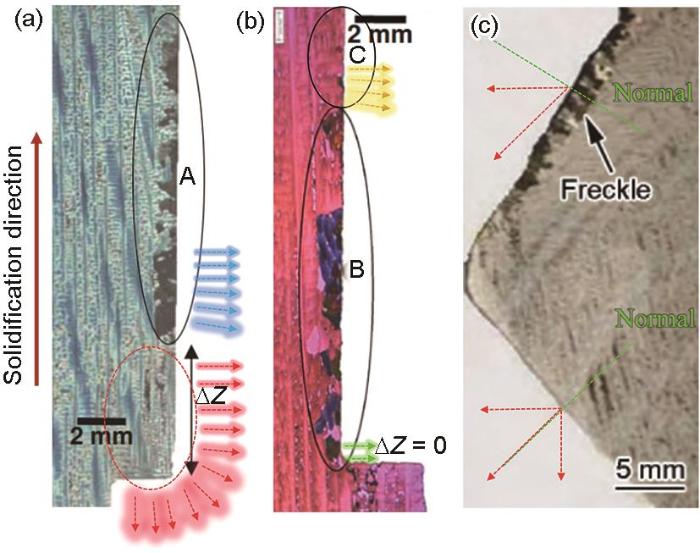
Fig.11
Freckle distributions of sample with varied cross-sections (a, b) samples with increased section (a) and decreased section (b)[58] (ΔZ indicates the incubation distance for the freckle onset after varying the specimen diameter. A, B, and C represent the freckle chains. Yellow, red, green, and blue arrows represent radiation lines) (c) freckle chains on sample with increased and decreased sections[66]
3.1.2 制备工艺
如表1所示,制备工艺主要涉及以下几个因素。
(1) 组模角度。早期雀斑在直径4 inch (101.6 mm)的Mar-M200合金中发现并被报道[9],后来用于研究雀斑的试样尺寸普遍较小。目前小试样的研究[58~60]表明:雀斑倾向于发生在试样内侧。而大叶片的研究[70]表明:雀斑倾向于发生在叶片外侧。雀斑的分布情况与温度场密切相关,小叶片抽拉时同一水平高度内侧先冷却[30,58,59],大叶片抽拉时同一水平高度外侧先冷却[70],可见2种叶片抽拉过程中的温度场差异比较显著,但小叶片、大叶片相同的是雀斑倾向于形成在凝固时固/液界面高点位置。在大叶片一组单件置于小型底盘中间的实验性研究[71]中,其凝固温度场不涉及组模角度。整体上符合工程实际工艺条件的大叶片报道很少。与此同时,小试样的研究采用了高W、Re含量单晶合金,进一步促进了雀斑形成,工程实际中重型燃气轮机大叶片很少采用含Re > 4%的合金。已报道部分雀斑试样的尺寸、抽拉速率及合金成分特征如表2[9,30,58~60,72,73]所示。可见,雀斑在小样品内侧形成的规律不完全适用于重型燃气轮机大叶片,重型燃气轮机大叶片定向凝固过程中的雀斑缺陷分布规律仍需要开展针对性的实验和模拟研究,以指导大叶片雀斑控制技术。
表2 已报道部分雀斑试样的尺寸、抽拉速率及合金成分特征[9,30,58~60,72,73]
Table 2
| Content of W, Re, and Al in nickel-based alloys* | Dimension | Withdrawal rate | Ref. |
|---|---|---|---|
Mar-M200: 13.2W-4.9Al... Udimet700: 4.19Al... | ϕ101.6 mm | - | [9] |
| CMSX-4: 6W-3Re-5.6Al... | Thickness: 10 mm | 1, 6 mm·min-1 (Intense freckle occurs at a rate of 1 mm·min-1) | [72] |
| DD33: 6W-4Re-6Al... | Thickness: 0.6-10 mm (Freckles tendency inward) | 1, 3, 6 mm·min-1 (Intense freckle occurs at a rate of 1 mm·min-1) | [59] |
| CMSX-4: 6W-3Re-5.6Al... | 20 mm × 40 mm × 50 mm | 1.2, 4.2 mm·min-1 (Intense freckle occurs at a rate of 1.2 mm·min-1) | [73] |
| CMSX-4: 6W-3Re-5.6Al... | Nearly ϕ20 mm (Freckles tendency inward) | 1 mm·min-1 | [58] |
| PW1483: 1.81W-3.63Al... | Nearly ϕ15 mm (Freckles tendency inward) | 1 mm·min-1 | [60] |
| 6.52W-4.89Re-5.69Al... | 60 mm × 25 mm × 150 mm (Freckles tendency inward) | 1.5 mm·min-1 | [30] |
(2) 凝固速率。凝固速率与抽拉速率、冷却速率密切相关。抽拉速率是一个简单有效的调控手段,但在高速凝固技术(high rate solidification,HRS)条件下调控能力受限。液态金属冷却(liquid metal cooling,LMC)具有更高的温度梯度,可实现更高效的冷却凝固。
① 抽拉速率。采用HRS法单晶制备时,表2[9,30,58~60,72,73]中雀斑严重的小试样抽拉速率均在1.5 mm/min以下。Han等[59]通过实验浇注、任莹[72]通过数值模拟得到类似的研究结果:抽拉速率为1 mm/min时较6 mm/min时雀斑发生得严重,提高抽拉速率可以减小雀斑。Qin等[73]的浇注实验表明,抽拉速率为1.2 mm/min时较4.2 mm/min时雀斑发生得严重。如果通过提高抽拉速率可以降低雀斑形成倾向,那么雀斑控制就不是一个难题。但事实上,工程实际中叶片抽拉速率一般在2~6 mm/min,而这些小试样的雀斑基本形成在抽拉速率≤ 1.5 mm/min条件下,与重型燃机叶片的尺寸和抽拉速率均存在差异,小尺寸试样在较低的抽拉速率下限制了冷却速率,随着抽拉速率提升,就可以实现快速冷却。然而,重型燃气轮机叶片尺寸远大于这些小试样,其尺寸厚,蓄热量大,仅提高抽拉速率难以实现高效冷却。因此,上述研究报道中“小试样、拉速≤ 1.5 mm/min、高W/Re合金”与工程实际中“大叶片、拉速≥ 2.0 mm/min、低W/Re合金”的凝固条件存在明显差异,因而对大叶片中雀斑形成规律和控制手段的指导性尚需验证。
② 冷却速率。LMC采用低熔点合金Sn或Al作为冷却介质进行定向凝固[74~76]。采用锡冷LMC法制备重型燃气轮机大尺寸叶片的研究报道相对较多,其定向凝固过程的温度梯度显著提高,研究[74,75]表明,LMC温度梯度是HRS的3倍以上,可通过提高温度梯度解决雀斑。但是,Sn存在对高温合金的污染及力学性能的损伤问题[74,75],针对Sn污染高温合金机制及预防措施的研究尚不充分。俄罗斯采用铝冷LMC法批量生产了系列航空发动机单晶叶片,Al是大多数镍基高温合金中的一种元素,在使用Al作为冷却介质进行LMC法定向凝固时,Al造成的污染通常不会是一个严重的问题。但是,欧美并未采用铝冷LMC法进行重型燃气轮机大尺寸叶片的批量生产,我国近期尝试进行用于大尺寸叶片铝冷LMC设备及工艺的研发工作[76]。截至目前,LMC法(锡冷、铝冷)制备重型燃气轮机大尺寸叶片的实际工程应用鲜见报道。
(3) 型壳参数
如表1所示,型壳参数主要包括以下方面。
① 型壳温度。型壳的材料、整体厚度、局部结构及保温温度是定向凝固过程中重要的工艺参数。Wang等[77]采用DD9合金浇注试样,对比了型壳温度在1570和1510 ℃时雀斑的形成倾向,发现1570 ℃时雀斑形成的较少,较高型壳温度可使温度梯度得到提高,糊状区高度减小,雀斑形成倾向降低。值得注意的是,当型壳保温温度设置为1570 ℃时,重型燃气轮机叶片整个模组型壳及合金的重量约100 kg,抽拉时间2~3 h,合金液渗漏、型壳鼓胀及表面化学反应的控制难度大幅增加,这对型壳性能提出了非常高的要求。而且,型壳温度升高对温度梯度提高作用有限,仅能减少雀斑而不能完全消除。因此,这种措施在工程实际中的可行性、有效性尚不能判定。
② 型壳结构。研究[78]表明,可通过在横向突变结构下方安置石墨块增加导热效率,改变型壳局部结构和材质以控制雀斑形成。但这一改进方案有两点需要讨论:一是这种小试样合金的体量小、型壳薄,而重型燃气轮机大叶片合金的体量大、型壳较厚,石墨也只是被动传导热量,在重型燃气轮机大叶片中的实施效果需要进一步验证;二是适用于批量生产的技术可行性,在型壳制备中增加石墨块是否具有良好的工艺可操作性尚需论证。
3.2 溶质场
3.2.1 合金成分
不同成分合金的雀斑形成倾向性差异显著,虽然不同成分合金也存在凝固温度、比热容等差异而影响温度场,但体现在溶质对流的影响更直观,因此,将合金成分归集在溶质场影响因素。前文已简述各元素作用,基于雀斑形成机制中元素偏析和溶质对流条件,对其发生具有显著影响的元素见表3。
表3 影响溶质对流的主要合金元素
Table 3
| Effect | Density/segregation | Element |
|---|---|---|
| Promote | Heavy elements/negative segregation | Re, W |
| Light elements/positive segregation | Al | |
| Inhibit | Heavy elements/positive segregation | Ta |
| Light elements/negative segregation | - |
3.2.2 凝固条件
若要独立于温度场之外、单独讨论溶质对雀斑的影响,这种情况在研究中并不多见。这是因为在工程实际中,一旦叶片的结构尺寸和凝固工艺确定,其形成的温度场也随之确定,两者通常耦合在一起。本节简述并讨论了重力场、磁场及晶体特征等凝固条件对溶质场的影响。
(1) 重力。采用向下定向凝固(DWDS)和向上定向凝固(Bridgman法)工艺铸造单晶高温合金CMSX-4试样,两者的Re、W、Al元素偏析行为是相同的。然而,由于生长方向相反,在DWDS过程中枝晶间富集Al的糊状区刚好在液相上方,不会出现密度反转,避免了单晶试样形成雀斑[79]。DWDS法基于溶质场调控避免了雀斑产生,从原理角度是非常有效的解决方案,但应用时需要考虑该技术的可行性及可能诱发的问题。正向生长时型壳是放置在水冷铜盘上,而倒置生长型壳是挂扣在水冷盘上,型壳需承受整个大叶片模组的重量来完成高温下长时间抽拉,这对型壳性能提出了巨大挑战。另外,带冠叶片在定向凝固过程中总存在一个上表面(叶冠或缘板),虽然这个上表面与叶身相连可以得到补缩,但往往会出现疏松[80],目前关于倒置生长无补缩时的疏松情况尚不明确。
(2) 磁场。在定向凝固过程中,在铸型外部施加行波磁场(行波磁场是一种交变磁场,其磁感应矢量在空间可沿特定方向进行移动),通过产生的Lorentz力影响熔体内部流动行为。当该力方向与由溶质不均引起的浮力方向相反时,能够有效抑制枝晶间的热溶质对流,从而降低雀斑缺陷的形成倾向。研究[81]表明,在CMSX-4合金的定向凝固中,施加适当强度的向下行波磁场可使雀斑数量显著减少。这种现象与Lorentz力的趋肤效应密切相关:由于交变磁场的趋肤效应,Lorentz力在铸件表面区域显著大于心部,从而有效地抑制了导致雀斑形成的液相流动。需指出的是,当前实验所用试样尺寸、凝固工艺参数与实际工业条件下的大型铸件存在差异,因此该方法对实际大型铸件雀斑缺陷的抑制效果,以及适用于工程尺度的大型强磁场设备设计及实现可行性,仍有待进一步研究和论证。
综上所述,由雀斑形成影响因素推演的控制技术,在工程实际中可直接应用的较少。小尺寸试样提高抽拉速率可降低雀斑形成倾向,且雀斑易发生在模组内侧,不能完全代表大叶片情况,因而对于大叶片,提高抽拉速率、注意调控模组内侧雀斑的控制手段或策略,尚不能确认为有效的雀斑控制技术;雀斑在变截面、变曲率及不同合金成分条件下的分布情况,对大叶片设计及选材具有一定参考意义;型壳温度、型壳局部结构对重型燃气轮机大尺寸叶片制备中雀斑的调控效果需进一步验证;LMC法(锡冷、铝冷)通过提高温度梯度消除雀斑,对于大叶片制备具有非常高的潜在应用价值,但需全面提高应用技术成熟度;反向生长避免密度反转、附加磁场抵消对流浮力等技术方案从原理上可以控制雀斑,但目前在工程实际大叶片制备中尚未应用。因此,目前大叶片雀斑控制依然缺少有效的技术手段。雀斑形成的根本原因是大叶片凝固温度梯度低,然而提高大叶片温度梯度的方法非常有限。小尺寸试样与大叶片的凝固条件存在差异,雀斑的控制需进一步从大叶片本身着手开展实验及模拟研究。
4 总结与展望
高温合金雀斑缺陷研究历经50年之久,基本理论在20世纪已经构建,随着先进的表征手段和超级计算机的进步,雀斑元素偏析、溶质对流、枝晶碎臂、模拟预测等研究更加准确、细化和可视化,对雀斑形成机理更加深入,也不断探索了新型控制技术。然而,重型燃机不断发展迭代,叶片尺寸愈大、承温愈高,标准愈严苛,现有雀斑形成机理和控制技术研究尚不能完全指导工程实践。科研方面,以枝晶碎臂解释雀斑形成的实验或模拟研究不足;工程方面,雀斑在大叶片中的快速准确预测及有效可靠的控制技术依然是个挑战,这两个方面也是当下及未来的实际需求和重点研究方向。因此,有必要从大尺寸叶片或大尺寸典型结构件着手进行凝固实验和原位动态表征,获得大叶片定向凝固雀斑形成规律和边界条件,基于实际工程边界条件建立多物理场模型,实现从枝晶到叶片的跨尺度数值模拟及缺陷预测。当下学者们基于物理信息的深度机器学习,尝试进行了CMSX-4合金[83]、Al-Cu合金[84]定向凝固枝晶间距等研究,随着人工智能(AI)技术的不断进步,未来有望基于大量定向凝固基础数据,结合机器学习模型的持续训练和优化,实现对跨尺度、复杂边界条件下雀斑形成过程的深入理解和精准控制。同时,通过多模态实时数据分析和自适应调控,推动各类凝固缺陷的协同抑制,最终迈向单晶叶片智能制造的新阶段。本文将理论研究与工程实践相结合,综述和解析了雀斑研究现状,讨论和展望了雀斑未来研究方向,总结如下。
(1) 普遍将雀斑形成过程解释为“元素偏析→溶质对流→枝晶碎臂”,其中,W、Re、Al、Ta元素偏析和通道式溶质对流得到原子探针、同步辐射等技术手段的证实,而枝晶碎臂与雀斑形成的直接关系尚未被证实,考虑到高温合金多组元和大叶片低温度梯度的因素,某些特定情况也可能存在雀斑形核。
(2) 偏析通道的分布与雀斑形成规律密切相关,宏观溶质对流和微观枝晶生长中的对流在计算精度、速度及准确性上进步显著,但是针对大尺寸叶片(F级以上重型燃气轮机)的模拟计算依然是个挑战。
(3) 将雀斑影响因素归结于温度场和溶质场进行讨论,叶片结构和工艺条件首先影响的是温度场,研究表明较低的温度梯度促进溶质对流的产生,是大叶片形成雀斑的根本条件,而讨论溶质场影响时,需注意温度梯度一致性的前提。
(4) 小试样中的雀斑倾向于在模组内侧和低拉速(≤ 1.5 mm/min)条件下形成,不能完全代表大叶片中雀斑的形成规律。液态金属冷却提高了温度梯度、反向生长和附加磁场控制了密度反转,这些从基础原理上可抑制雀斑的形成,但其工程技术可行性尚需充分验证。
(5) 关于雀斑普遍研究的“小尺寸、拉速≤ 1.5 mm/min、高W/Re合金”与工程实际中“大叶片、拉速≥ 2.0 mm/min、低W/Re合金”的凝固条件存在差异,其形成规律和调控手段也有所不同。因此,符合工程实际的大尺寸叶片雀斑快速预测及控制技术亟待深入研究。
(6) 雀斑研究需从大叶片工艺窗口、叶片分区域缺陷容限评估及高温合金选材等多维度协同控制,并探索大叶片凝固动态数据表征和多物理场模型构建,实现从枝晶到叶片的跨尺度数值模拟。深入探究雀斑形成的机理,实现对大尺寸叶片快速、准确的预测和有效防控,是当前及未来的重要需求和研究方向。
参考文献
Development and turbine engine performance of three advanced rhenium containing superalloys for single crystal and directionally solidified blades and vanes
[J].
Turbine inlet temperatures over the next few years will approach 1650°C (3000°F) at maximum power for the latest large commercial turbofan engines, resulting in high fuel efficiency and thrust levels approaching 445 KN (100,000 lbs.). High reliability and durability must be intrinsically designed into these turbine engines to meet operating economic targets and ETOPS certification requirements. This level of performance has been brought about by a combination of advances in air cooling for turbine blades and vanes, design technology for stresses and airflow, single crystal and directionally solidified casting process improvements, and the development and use of rhenium (Re) containing high γ′ volume fraction nickel-base superalloys with advanced coatings, including full-airfoil ceramic thermal barrier coatings. Re additions to cast airfoil superalloys not only improves creep and thermo-mechanical fatigue strength, but also environmental properties including coating performance. Re dramatically slows down diffusion in these alloys at high operating temperatures. A team approach has been used to develop a family of two nickel-base single crystal alloys (CMSX-4® containing 3 percent Re and CMSX®-10 containing 6 percent Re) and a directionally solidified, columnar grain nickel-base alloy (CM 186 LC® containing 3 percent Re) for a variety of turbine engine applications. A range of critical properties of these alloys is reviewed in relation to turbine component engineering performance through engine certification testing and service experience. Industrial turbines are now commencing to use this aero developed turbine technology in both small and large frame units in addition to aero-derivative industrial engines. These applications are demanding, with high reliability required for turbine airfoils out to 25,000 hours, with perhaps greater than 50 percent of the time spent at maximum power. Combined cycle efficiencies of large frame industrial engines are scheduled to reach 60 percent in the U. S. ATS programme. Application experience to a total 1.3 million engine hours and 28,000 hours individual blade set service for CMSX-4 first stage turbine blades is reviewed for a small frame industrial engine.
Creep resistance of CMSX-3 nickel base superalloy single crystals
[J].
The development of columnar grain and single crystal high temperature materials through directional solidification
[J].
Mechanical properties of conventionally cast, directionally solidified, and single-crystal superalloys
[J].
Control of liquidus isotherm shape during solidification of Ni-based superalloy of single crystal platforms
[J].
Nucleation of recrystallisation in castings of single crystal Ni-based superalloys
[J].
Stabilization of thermosolutal convective instabilities in Ni-based single-crystal superalloys: Carbon additions and freckle formation
[J].
On the nature of freckles in nickel base superalloys
[J].
The breakdown of single-crystal solidification in high refractory nickel-base alloys
[J].
The origin of freckles in unidirectionally solidified castings
[J].
An atom-probe tomographic study of freckle formation in a nickel-based superalloy
[J].
Impact of solute flow during directional solidification of a Ni-based alloy: In-situ and real-time X-radiography
[J].Understanding the impact of thermo-solutal convection during alloy solidification is of central importance in the casting industry. Convective flow generated from density variations in the liquid is at the origin of many casting defects, such as chemical segregations and freckles, to which Ni-based superalloys used in jet engines are known to be highly sensitive. In this article, we present experimental results obtained during directional solidification of a CMSX-4 single crystal superalloy observed in-situ by means of synchrotron X-radiography at the European Synchrotron Radiation Facility (ESRF, Grenoble, France). The use of a high-temperature directional solidification furnace, an intense monochromatic beam and a high-speed X-ray sensitive camera allowed the direct observation of the development of solute flow to be performed during dendritic growth of a Ni-based alloy. The transient stage leading to the formation of a dendrite network and the interaction with the concomitantly developing convective pattern are studied. The impact of solute flow on the dendrite growth velocity is characterized for three cooling rates. Measurements of dendrite tip positions show that the convective flow above the solidification front induces a periodic oscillation of the dendrite growth velocity and that the oscillation amplitude decreases for higher cooling rates. The development of residual liquid areas is observed on the sides of the sample. Fragmentation of dendrite parts occurs during the solidification of the residual liquid areas and leads to the formation of spurious grains. The experimental results are analyzed by using a Rayleigh number-based model, highlighting the need for direct simulations in the future. (C) 2020 Acta Materialia Inc. Published by Elsevier Ltd.
Three-dimensional simulations of freckles in binary alloys
[J].
Grain defect formation during directional solidification of nickel base single crystals
[A].
New vision of convection induced freckle formation theory in nickel-based superalloys by electron microscopy
[J].
Carbon additions and grain defect formation in high refractory nickel-base single crystal superalloys
[A].
A castability model based on elemental solid-liquid partitioning in advanced nickel-base single-crystal superalloys
[J].
The role of hafnium in the formation of misoriented defects in Ni-based superalloys: An atom-probe tomographic study
[J].
Modeling of constituent-based freckle predictor for nickel-base superalloys
[J].
一种基于镍基高温合金成分的雀斑预测模型
[J].
Channel formation in Pb-Sn, Pb-Sb, and Pb-Sn-Sb alloy ingots and comparison with the system NH4Cl-H2O
[J].
Observation of segregation freckle formation under the influence of melt convection
[J].
Modeling of micro- and macrosegregation and freckle formation in single-crystal nickel-base superalloy directional solidification
[J].
Simulation of channel segregation during directional solidification of In-75 wt pct Ga. qualitative comparison with in situ observations
[J].
Simulation of freckles during vertical solidification of binary alloys
[D].
Predicting freckle-defects in directionally solidified Pb-Sn alloys
[J].
Motion and remelting of dendrite fragments during directional solidification of a nickel-base superalloy
[J].
Thermal-solutal-fluid flow of channel segregation during directional solidification of single-crystal nickel-based superalloys
[J].
Insight into the sensitivities of freckles in the directional solidification of single-crystal turbine blades
[J].
Digital twin for directional solidification of a single-crystal turbine blade
[J].
Using a three-phase deterministic model for the columnar-to-equiaxed transition
[J].
Modelling freckles and spurious grain formation in directionally solidified superalloy castings
[J].Segregation channels with misoriented spurious grains, known as freckles, are an unacceptable casting defect in superalloy turbine blades. A digital-twin method to predict segregation channels was proposed in our previous studies; however, the formation of spurious grains was ignored. Here, we extend the digital twin methodology by incorporating dendrite fragmentation, which is recognized as the predominant mechanism in the formation of spurious grains. The flow-induced fragmentation process has been refined to account for the timing of dendrite pinch-off. A three-phase mixed columnar-equiaxed solidification model was used to track the motion of the crystal fragments. Directional solidification experiments for superalloy casting were conducted in an industrial-scale Bridgman furnace, and the distribution of spurious grains in the freckles was metallographically analysed. Excellent simulation-experiment-agreement was achieved. Based on this study, the formation of spurious grains within the segregation channels is mainly caused by the flow-driven fragmentation mechanism. Experimentally measured freckles can be reproduced only if the timing of the dendrite pinch-off is considered.
Freckle prediction model incorporating geometrical effects for Ni-based single-crystal superalloy components
[J].
A new mechanism for freckle initiation based on microstructural level simulation
[J].
Thermal dependence of large-scale freckle defect formation
[J].
3-D microstructural model of freckle formation validated using in situ experiments
[J].
Phase-field-lattice Boltzmann studies for dendritic growth with natural convection
[J].
Numerical testing of quantitative phase-field models with different polynomials for isothermal solidification in binary alloys
[J].
A phase-field-lattice Boltzmann method for modeling motion and growth of a dendrite for binary alloy solidification in the presence of melt convection
[J].
Acceleration of phase-field lattice Boltzmann simulation of dendrite growth with thermosolutal convection by the multi-GPUs parallel computation with multiple mesh and time step method
[J].
Large-scale phase-field lattice Boltzmann study on the effects of natural convection on dendrite morphology formed during directional solidification of a binary alloy
[J].
Large-scale flow simulations using lattice Boltzmann method with AMR following free-surface on multiple GPUs
[J].
Parallel GPU-accelerated adaptive mesh refinement on two-dimensional phase-field lattice Boltzmann simulation of dendrite growth
[J].
An implicit parallel multigrid computing scheme to solve coupled thermal-solute phase-field equations for dendrite evolution
[J].
Phase field study of the tip operating state of a freely growing dendrite against convection using a novel parallel multigrid approach
[J].
Study of dendrite growth with natural convection in superalloy directional solidification via a multiphase-field-lattice Boltzmann model
[J].
A phase field concept for multiphase systems
[J].
Multiphase-field approach for multicomponent alloys with extrapolation scheme for numerical application
[J].
A high precision extrapolation method in multiphase-field model for simulating dendrite growth
[J].
In situ observation of nucleation, fragmentation and microstructure evolution in Sn-Bi and Al-Cu alloys
[J].
In situ observations of dendritic fragmentation due to local solute-enrichment during directional solidification of an aluminum alloy
[J].
Chimney formation in solidifying Ga-25wt pct in alloys under the influence of thermosolutal melt convection
[J].
The integration of structural mechanics into microstructure solidification modelling
[J].
Solute enrichment induced dendritic fragmentation in directional solidification of nickel-based superalloys
[J].
A Prismatic substructure formed during the solidification of metals
[J].
New aspects of freckle formation during single crystal solidification of CMSX-4
[A].
Prediction of freckle formation in directionally solidified CMSX-4 superalloy
[J].
Some new observations on freckle formation in directionally solidified superalloy components
[J].
Investigation on freckle formation and evolution of single-crystal nickel-based superalloy specimens with different thicknesses and abrupt cross-section changes
[J].
Investigation of mechanism for formation of freckle during directional solidification of Ni base single crystal superalloy
[J].
镍基单晶高温合金定向凝固雀斑形成机理研究
[J].
Predicting freckle formation in single crystal Ni-base superalloys
[J].
Instabilities of the liquid and mushy regions during solidification of alloys
[J].The solidification of melts can be profoundly influenced by convection. In alloys, compositional convection can be driven by solute gradients generated as one component of the alloy is preferentially incorporated within the solid, even when the thermal field is stabilizing. In this paper, two modes of compositional convection during solidification from below are uncovered using a linear-stability analysis: one, which we shall call the ‘mushy-layer mode’, is driven by buoyant residual fluid within a mushy layer, or porous medium, of dendritic crystals; the other, which we shall call the ‘boundary-layer mode’ is associated with a narrow compositional boundary layer in the melt just above the mush-liquid interface. Either mode can be the first to become unstable depending on the thermodynamical and physical properties of the alloy. The marginally stable eigenfunctions suggest that the boundary-layer mode results in fine-scale convection in the melt above the mushy layer and leaves the interstitial fluid of the mushy layer virtually stagnant. In contrast, the mushy-layer mode causes perturbations to the solid fraction of the mushy layer that are indicative of a tendency to form chimneys, which are vertical channels of reduced or zero solid fraction that have been observed experimentally. Particular attention is focused on the mushy-layer mode and its dependence upon the thermodynamical properties of the alloy. The results of this analysis are used to make a number of interpretations of earlier experimental studies such as the observations that some systems are less prone to form chimneys and that the regions of melt in these systems evolve to supersaturated conditions, while the melt evolves to unsaturated conditions once chimneys have formed. In addition, good quantitative agreement is found between the results of the linear-stability analysis and the experimental results of Tait & Jaupart (1992) for the onset of the mushy-layer mode of convection.
Development of a freckle predictor via Rayleigh number method for single-crystal nickel-base superalloy castings
[J].
Fluid flow and defect formation in the three-dimensional dendritic structure of nickel-based single crystals
[J].
Freckle defect formation near the casting interfaces of directionally solidified superalloys
[J].Freckle defects usually appear on the surface of castings and industrial ingots during the directional solidification process and most of them are located near the interface between the shell mold and superalloys. Ceramic cores create more interfaces in the directionally solidified (DS) and single crystal (SX) hollow turbine blades. In order to investigate the location of freckle occurrence in superalloys, superalloy CM247 LC was directionally solidified in an industrial-sized Bridgman furnace. Instead of ceramic cores, Alumina tubes were used inside of the casting specimens. It was found that freckles occur not only on the casting external surfaces, but also appear near the internal interfaces between the ceramic core and superalloys. Meanwhile, the size, initial position, and area of freckle were investigated in various diameters of the specimens. The initial position of the freckle chain reduces when the diameter of the rods increase. Freckle area follows a linear relationship in various diameters and the average freckle fraction is 1.1% of cross sectional area of casting specimens. The flow of liquid metal near the interfaces was stronger than that in the interdendritic region in the mushy zone, and explained why freckle tends to occur on the outer or inner surfaces of castings. This new phenomenon suggests that freckles are more likely to occur on the outer or inner surfaces of the hollow turbine blades.
Freckle formation during directional solidification of complex castings of superalloys
[J].
定向凝固的复杂形状高温合金铸件中的雀斑形成
[J].通过实施工业条件下的定向凝固实验, 对复杂形状的高温合金铸件中的雀斑进行了检测和分析, 揭示了这种凝固缺陷产生的几个新特点. 结果表明, 雀斑易于产生在铸件的棱角部位而不是平滑表面上, 称之为棱角效应; 铸件外形台阶式地突然扩张和缩小会分别抑制和促进雀斑形成, 称之为台阶效应; 雀斑易于产生在向内倾斜而不是向外倾斜的铸件表面上, 称之为斜面效应; 叶片曲率为正的外凸曲面出现严重的雀斑缺陷, 而曲率为负的内凹曲面却毫无雀斑, 此现象称之为曲率效应. 实验中还发现雀斑不但出现在铸件的外表面, 插入型芯也会诱导铸件内部雀斑的产生, 这说明糊状区的液体流动具有强烈的附壁效应, 不管这种壁面是处在铸件外部还是内部. 通过分析可以确认, 正是这种附壁效应在各种具体形状特征下发挥作用, 导致了上述关于雀斑生成的各种效应.
Binary alloy solidification and freckle formation: effect of shrinkage induced flow on solutal instability and macro-segregation
[J].
Geometrical effect on macrosegregation formation during unidirectional solidification of Al-Si alloy
[J].
The influence of surface roughness on freckle formation in directionally solidified superalloy samples
[J].
Effect of withdrawal rate on freckle formation of large-size directional solidified nickel-based superalloy blades
[J].
A design of non-uniform thickness mould for controlling temperature gradient and S/L interface shape in directionally solidified superalloy blade
[J].
Numerical simulation of freckle defects in nickel-based superalloys
[D].
镍基高温合金雀斑缺陷数值模拟研究
[D].
Effects of convection patterns on freckle formation of directionally solidified nickel-based superalloy casting with abruptly varying cross-sections
[J].
Material and processing technology of directionally solidified blade in heavy duty industrial gas turbines
[J].
重型燃气轮机定向结晶叶片的材料与制造工艺
[J].
Directional solidification of large superalloy castings with radiation and liquid-metal cooling: A comparative assessment
[J].
Liquid metal cooling furnace for large-sized single crystal blades
[J].
用于大尺寸叶片的液态金属冷却单晶炉
[J].
Effects of shell mold heating temperature on microstructures and freckle formation of single crystal superalloys
[J].
Investigation on local cooling in reducing freckles for directionally solidified superalloy specimens with abruptly varying cross-sections
[J].
Investigation of segregation and density profiles in the mushy zone of CMSX-4 superalloys solidified during downward and upward directional solidification processes
[J].
Study on formation mechanism of casting defects in directionally solidified blades of DZ22B superalloy
[J].
DZ22B高温合金定向凝固叶片铸造缺陷的形成机理研究
[J].
Effect of traveling magnetic field on freckle formation in directionally solidified CMSX-4 superalloy
[J].
Numerical simulation of dendrite growth and solute convection during directional solidification of superalloy
[J].
高温合金定向凝固过程中枝晶生长与溶质对流数值模拟
[J].
Microstructure informatics: using computer vision for the characterization of dendrite growth phenomena in Ni-base single crystal Superalloys
[J].


