



对航空器而言,减轻重量可以减少燃料消耗、增加载重和航程,从而显著节省成本与资源,而减少材料的密度被认为是航空器减重很有效的方式。Al-Li合金具有密度低、比强度和比刚度高、高/低温性能好等优点,在航空航天领域得到广泛应用。2195 Al-Li合金是第三代Al-Li合金,具有超高强度、卓越的低温性能及优良的可锻性与可焊性,已经替代了传统合金而成功应用在航天飞机的超轻燃料箱上并实现了7500磅的减重[1,2,3,4]。Al-Li合金通常需要经过锻造、轧制等一系列热加工过程来获得不同种类的半成品,而热加工会显著影响材料的微观组织与力学性能[5,6],因此研究Al-Li合金热加工过程中的流变应力特征和微观组织结构变化规律对于优化变形参数及控制材料性能具有重要意义。韩冬峰等[7]对2195 Al-Li合金进行了高温等温压缩并得到了合金本构方程,Wang等[8]对2397 Al-Li合金进行了热压缩实验并讨论了其动态再结晶机制。传统的圆柱压缩易受摩擦影响而出现“鼓肚”现象[9],对流变应力的测定与微观组织表征均有影响,而采用平面应变压缩,压缩样品的应力状态、变形状态及热传导等更接近轧制,对流变应力的测定也更加精确[10]。目前,通过平面应变压缩研究2195 Al-Li合金热变形行为与微观组织的成果仍然很少。
众所周知,铝合金在热加工过程中组织会发生加工硬化和动态软化2种变化,动态软化主要包括动态回复和动态再结晶。动态再结晶有利于细化组织,消除缺陷和提高材料性能,被认为是最重要的组织演变之一[11]。动态再结晶还有利于减弱合金的各向异性,这对于长期受各向异性制约的Al-Li合金而言意义重大[12,13]。铝合金是高层错能的金属,通常认为铝合金容易发生动态回复,在大的应变量下形成连续动态再结晶,且充分的动态回复会抑制不连续动态再结晶的发生[14]。铝合金的动态再结晶对变形条件非常敏感,通过热模拟压缩实验研究铝合金的动态软化行为已有一些成果。研究[15,16,17]发现,动态回复一般都是铝合金主要的动态软化机制,动态回复与动态再结晶可以共同造成动态软化。Sun等[15]发现7075铝合金经过压缩后出现典型的连续动态再结晶,在高温低应变速率下再结晶增加,且有几何动态再结晶形成。Yang等[18]发现2099 Al-Li合金在热加工中主要形成典型的不连续动态再结晶。杨胜利等[19]和陈学海等[20]研究了铝合金的再结晶动力学并建立了动态再结晶模型,Xiang等[21]和Yin等[22]分别研究了1460 Al-Li合金和Al-Cu-Li合金的热变形行为与微观组织演变。然而,铝合金在一定的变形条件下有可能同时发生多种类型的动态再结晶[23],目前变形条件对不同类型的动态再结晶分别有何影响还研究较少,此外通过平面应变压缩实验对2195 Al-Li合金动态再结晶的研究也很少涉及。
本工作通过平面应变压缩实验与微观组织表征,研究了2195 Al-Li合金不同变形条件下的动态再结晶行为,以期对合金的热加工工艺与组织控制有一定的指导意义。
1 实验方法
实验采用2195 Al-Li合金铸锭,其化学成分(质量分数)为:Cu 4.12,Li 1.02,Mg 0.44,Ag 0.4,Zr 0.11,Fe 0.05,Al余量,采用440 ℃、16 h+490 ℃、20 h的双极均匀化工艺。将均匀化状态的合金加工为20 mm×15 mm×10 mm的试样,在Gleeble-3500热模拟试验机上进行等温平面应变压缩实验。试样以5 ℃/s速率分别加热到350、400、450和500 ℃并保温3 min,在0.01、0.1和1 s-1的应变速率下进行真应变为0.916 (变形量60%)的平面应变压缩,压头宽度为5 mm,压缩后立即水淬以保留变形组织。表征试样的切割和分析位置如图1所示。电子背散射衍射(EBSD)样品经表面机械打磨与电解抛光后,通过TESCAN MIRA3场发射扫描电镜(SEM)对变形组织进行表征并使用Channel 5软件对取向数据进行处理。透射电镜(TEM)样品薄片经机械打磨和电解双喷减薄后,在TECNAI G2 F20 TEM上观察组织,加速电压200 kV。
图1

图1
试样分析位置
Fig.1
Schematic of observing areas (RD, TD, ND represent rolling, transverse and normal directions, respectively; EBSD—electron backscatter diffraction; TEM—transmission electron microscope)
2 实验结果与讨论
2.1 动态再结晶临界条件
合金在变形温度350~500 ℃、应变速率(
图2

图2
2195 Al-Li合金真应力-应变曲线
Fig.2
True stress-true strain curves of 2195 Al-Li alloy deformed at the strain rates of
研究[25]表明,通常动态再结晶在峰值应力之前就已经发生,不同变形条件下动态再结晶的临界条件不同,说明不同变形参数下动态再结晶的难易程度不同,因此在相同应变下不同变形参数的再结晶微观组织也有区别。Jonas等[26]通过研究动态再结晶动力学发现,通过对7次或更高次多项式拟合后的应力-应变曲线的塑性变形部分作θ-σ图,曲线的切点所对应的应力即为动态再结晶临界应力σc,到达该应力的应变即为该变形条件下的临界应变(εc),其中
图3

图3
2195 Al-Li合金θ-σ与(d2θ/dσ2)-σ曲线
Fig.3
Curves of θ-σ (a~c) and (d2θ/dσ2)-σ (d) of 2195 Al-Li alloy (θ—work hardening rate, σ—stress, σc—critical stress, σs—saturation stress)
(a)
图4
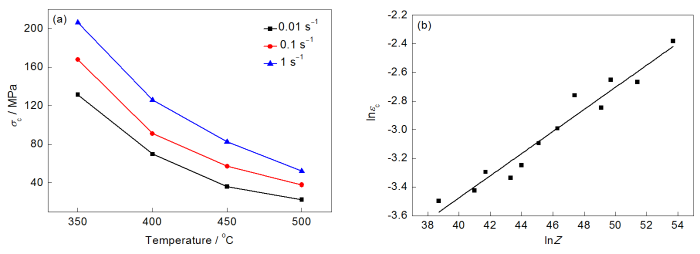
图4
2195 Al-Li合金的再结晶临界应力曲线及lnεc-lnZ关系图
Fig.4
σc curves under different deformation parameters (a) and relationship of lnεc-lnZ (b) of 2195 Al-Li alloy (Z—Zener-Hollomon parameter, εc—critical strain)
变形温度与应变速率的综合效果可以用Zener和Hollomon提出的温度补偿应变速率因子(Z参数)来表示[27],表达式为:
式中,Q为变形激活能,R为气体常数,T为变形温度。合金热变形的Q值可以通过计算合金的本构方程得到,对于较为广泛的应力范围,由Sellars和McTegart[28]所建立的带有双曲正弦函数的本构方程比较适用,表达式为:
表1 各变形条件下的lnZ值
Table 1
Strain rate / s-1 | Temperature / ℃ | |||
|---|---|---|---|---|
| 350 | 400 | 450 | 500 | |
| 0.01 | 49.1 | 45.1 | 41.7 | 38.7 |
| 0.1 | 51.4 | 47.4 | 44.0 | 41.0 |
| 1 | 53.7 | 49.7 | 46.3 | 43.3 |
可以看出,应变速率的升高和变形温度的降低都会导致Z值升高,lnεc随lnZ的增大而升高,近似成线性关系,对图4b的结果进行线性拟合,可得lnεc与lnZ之间存在lnεc=0.07714lnZ-6.56105直线关系,线性拟合的相关系数约为0.95,根据此关系也可以预测其它Z值条件下的再结晶临界应变。由此可见,随着Z值的降低,即变形温度的升高和应变速率的降低,动态再结晶临界应变减少。文献[19,20]在Al-Cu-Li合金和7085铝合金中也发现了相同趋势的直线关系,刘娟等[30]在建立镁合金新的再结晶动力学模型中也发现了类似的趋势,这说明动态再结晶更容易在低的Z值时发生。此外,由文献[19,20]中所得再结晶动力学模型中也可以看出,动态再结晶发生后,同一应变量下的动态再结晶分数随Z值的降低而升高,并且达到完全再结晶所需的应变量随Z值的减小而降低,这也可以说明动态再结晶在低Z值的变形条件下进行得更加充分。由图2可以看出,随着变形温度的升高和应变速率的降低,峰值应力与稳态流变时的应力降低,并且达到峰值应力与稳态流变时的应变也减少,合金的流变过程缩短,这些变化可能也与更充分的动态再结晶有关。流变行为是材料组织演变的综合反映,因此还需通过微观组织表征分析各变形参数下的动态再结晶行为。
2.2 不同变形参数下动态再结晶微观组织的EBSD像
lnZ为38.7、41.0、41.7、44.0、46.3、47.4 (对应变形条件500 ℃ 0.01 s-1、500 ℃ 0.1 s-1、450 ℃ 0.01 s-1、450 ℃ 0.1 s-1、450 ℃ 1 s-1、400 ℃ 0.1 s-1)的微观组织EBSD像如图5所示。其中黑色线条表示取向差大于15°的大角晶界,晶粒的颜色根据其取向的3个Euler角按比例分配红、绿、蓝而得到,图5a和f中右侧部分为左侧方框区域的放大图。可以看出,所有变形状态下的变形晶粒均表现为沿轧制方向(RD)伸长的典型带状变形组织。在低的Z值下,变形晶粒的晶界平直而清晰,厚度较大且分布均匀;而在高的Z值下,带状变形晶粒的分布更加集中,厚度更小且分布不均匀,变形组织出现明显的流变集中(flow localization)现象,且随着Z值的升高,流变集中现象更加严重。Murty等[31]在研究2219铝合金压缩量为75%的平面应变压缩中,也发现从压缩表面至试样心部的应变由0变化至4,即越靠近心部应变越大。流变集中现象主要由剪切带集中造成,变形过程中的局部温度升高会更容易形成绝热剪切带而促进流变集中[32],在高Z值的变形条件下,合金变形的温度低,变形时间短,热量难以及时耗散而更容易出现热量集中导致局部温度升高[21],从而引起流变集中现象,随着Z值的进一步升高这种现象也更加明显。此外,动态软化进行得不均匀也是流变集中形成的原因[18]。在流变集中的区域,带状变形晶粒的厚度更小且晶粒破碎明显,说明在流变集中的区域发生的变形更大,这也导致合金的变形抗力增加,因此在高的Z值下更严重的流变集中也是造成流变应力较高的原因。
图5

图5
2195 Al-Li合金变形组织的EBSD像
Fig.5
Electron backscatter diffraction (EBSD) images of 2195 Al-Li alloy deformed at different lnZ (CDRX—continuous dynamic recrystallization, GDRX—geometric dynamic recrystallization, DDRX—discontinuous dynamic recrystallization)
Color online
(a) lnZ=38.7 (b) lnZ=41.0 (c) lnZ=41.7 (d) lnZ=44.0 (e) lnZ=46.3 (f) lnZ=47.4
动态回复是2195 Al-Li合金热加工时的主要软化机制[16],但铝合金在热加工时也会发生动态再结晶。由图5可以看出,所有变形条件下的微观组织中都可以观察到动态再结晶的形成,动态再结晶进行得并不完全且含量在不同变形条件也不相同。由图5a中lnZ为38.7时的微观组织可以观察到,此时动态再结晶晶粒较多且尺寸较大,主要分布在变形晶粒的晶界附近,尤其是三角晶界区域,形成典型的链状结构,也有少数再结晶形成于变形晶粒内部。随着Z值升高,动态再结晶更加微弱,但在高的Z值时,变形组织发生明显流变集中的区域同样在晶界附近有再结晶形成,如图5f所示。动态再结晶的形成机制并不单一,变形晶粒的晶界附近与晶粒内部的再结晶形成机制可能并不相同;此外,晶界附近动态再结晶的形成机制可能也不一致,因此有必要对再结晶的类型进行判断。
动态再结晶主要有不连续动态再结晶、连续动态再结晶和几何动态再结晶这3种方式[33],其中不连续动态再结晶有典型的形核与长大过程,连续动态再结晶主要由小角晶界转变为大角晶界形成,几何动态再结晶与变形晶粒破碎有关。原始晶界尤其是三角晶界处是不连续动态再结晶理想的形核位置,而几何动态再结晶是因为锯齿状的弓出晶界相接触使晶粒破碎产生新的晶粒,同样也主要分布在晶界附近,但是与不连续动态再结晶相比仍有不同之处。几何动态再结晶是原始晶粒变形至晶粒厚度为2倍左右的亚晶尺寸时才发生的晶粒细化现象[34],因此厚度较大的变形晶粒很难出现几何动态再结晶;几何动态再结晶需要变形晶粒沿晶粒伸长方向破碎[35];并且几何动态再结晶的晶粒尺寸细小,一般为2~3倍的亚晶尺寸[35]。如图5f中lnZ值为47.4时的变形组织中可以观察到有明显的由变形晶粒沿伸长方向破碎产生的新晶粒,如箭头8~10所指晶粒,以及箭头11处可以观察到弓出晶界即将接触。全Euler角图中晶粒的颜色表示取向,可以看出,新晶粒的取向基本相同,说明晶界附近沿RD方向分布的一系列新晶粒由同一变形晶粒的破碎产生。可以看出以这种方式形成的新晶粒主要形成于厚度很小的带状变形晶粒,变形晶粒的厚度与新晶粒的尺寸相当。Henshall等[36,37]认为发生几何动态再结晶时的晶界取向差通常会呈双峰分布,这是由于随着变形中原始晶粒的伸长与窄化,原始晶界通过几何动态再结晶会形成更多的大角晶界。图6a所示为图5f中晶界的取向差分布,大部分晶界为小角晶界。由于变形组织并不均匀,为了观察厚度较小的带状变形晶粒的取向差情况,对图5f中虚线之间的区域进行晶界取向差分布的统计,结果如图6b所示。可以看出,取向差分布呈现明显的双峰特征,大角晶界相对含量远高于图6a,因此可以判断,由于在该变形条件下流变集中的增加,流变集中区域的晶粒伸长与窄化的程度升高,形成了几何动态再结晶且大角晶界的相对含量升高。不连续动态再结晶主要由晶界处具有一定尺寸的亚晶通过晶界弓出而形核并长大为新的晶粒[38],新晶粒的形成也和位错的逐渐积累有关[39],研究[35]发现其晶粒尺寸也明显大于几何动态再结晶,如图5a中箭头1~4所指晶粒和亚晶。而连续动态再结晶通常由变形晶粒内形成新的小角晶界以及小角晶界取向差逐渐增大而转变为大角晶界形成[40],如图5a中箭头5~7所指的晶粒和亚晶,可明显观察到晶界取向差的逐渐转变。
图6
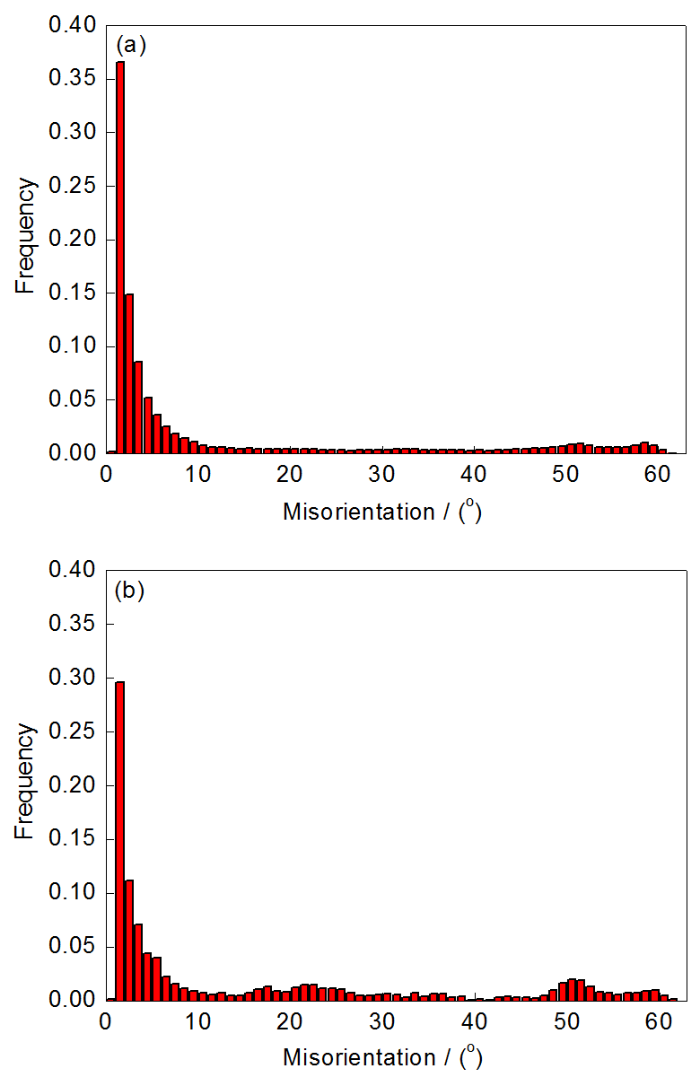
图6
图5f中晶界的取向差分布
Fig.6
Boundary misorientation angle distribution histograms of Fig.5f(a) whole image (b) the zone between dotted lines
借助Image Pro Plus软件,对图5各个变形条件下的微观组织中已经形成的动态再结晶的晶粒尺寸与面积进行测量,并根据以上对各类动态再结晶的判断方法,判断每个动态再结晶晶粒分别属于何种再结晶机制,据此统计计算出各个种类的动态再结晶分数以及所有动态再结晶的平均晶粒尺寸,所得结果如图7所示。可以看出,随着lnZ的升高,动态再结晶平均晶粒尺寸减少,再结晶分数总体呈下降趋势,仅在lnZ为44.0~46.3间出现了略微的上升;4个lnZ值较低的变形条件(38.7、41.0、41.7、44.0)下,变形组织同时含有不连续和连续2种类型的动态再结晶,且均以不连续动态再结晶为主,连续动态再结晶含量都很微弱;在高的lnZ值的变形条件(46.3、47.4)下,还出现了几何动态再结晶,随着lnZ进一步升高,几何动态再结晶的体积分数升高,而连续动态再结晶的含量仍很微弱。
图7
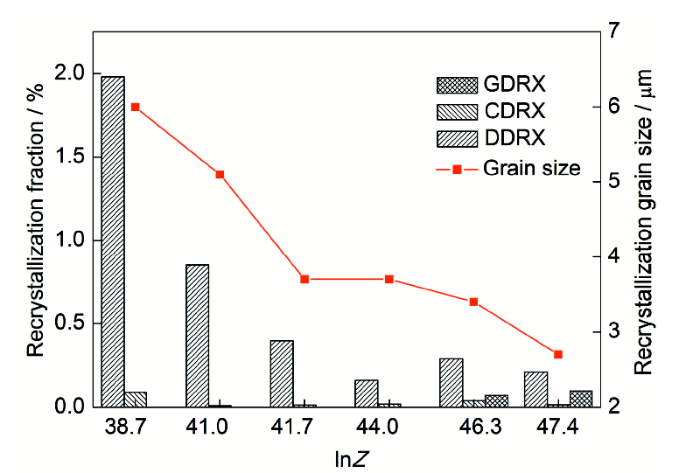
图7
各类动态再结晶的体积分数与再结晶平均晶粒尺寸
Fig.7
Volume fraction and average grain size of dynamic recrystallization
总体而言,随着lnZ的升高,动态再结晶体积分数降低,且再结晶晶粒的平均尺寸也减少,这说明随着lnZ值的升高,动态再结晶的形核与长大均减弱。在低lnZ的变形条件下,变形温度高且应变速率低。位错和晶界的迁移能力对温度非常敏感,在高的变形温度下,位错与晶界的迁移速率更快,大角晶界更容易发生弓出和迁移形成不连续动态再结晶晶核,再结晶形核后也能更快生长。位错也可以通过湮灭与多边形化而重组为更加均匀和完善的亚晶组织,达到更充分的动态回复效果。Gourdet和Montheillet[40]在提出连续动态再结晶的模型中认为动态回复是连续动态再结晶的一个阶段,因此更充分的动态回复也可以促进连续动态再结晶的形成。此外,更低的应变速率使得再结晶有充分的时间形核与长大,因此在低lnZ的变形条件下连续动态再结晶与不连续动态再结晶的形核与长大过程均得到了促进,动态再结晶体积分数高。但是由于lnZ较低时变形晶粒厚度更大,因此很难出现几何动态再结晶[33]。相比之下,更高的lnZ时变形温度更低且应变速率更高,位错和晶界的迁移能力较差,且合金的变形时间更短,连续与不连续动态再结晶更难形核与长大。然而,lnZ越高,变形组织的流变集中现象越严重,流变集中区域所受应变更大,变形晶粒的厚度更小,因此当lnZ升高到一定程度时变形晶粒的大角晶界开始接触使晶粒破碎而出现几何动态再结晶,动态再结晶含量会出现少量上升,而且随着lnZ进一步升高几何动态再结晶会更加明显,如图7中lnZ由44.0升高至47.4所示,再结晶分数略微升高后仍呈现随lnZ升高而降低的趋势,而几何动态再结晶分数却有所上升,这说明几何动态再结晶在高的lnZ条件下才出现并且lnZ越高几何动态再结晶越充分。此外,lnZ由44.0升高至46.3后,其它2种类型的再结晶分数也有少量升高,而再结晶平均晶粒尺寸仍然减少,说明lnZ升高之后动态再结晶晶粒数目增加,而晶粒长大更不充分,这可能是由于高的lnZ下流变集中严重,流变集中区域密集的晶界在形成几何动态再结晶的同时也更频繁地发生小角晶界向大角晶界的转变及大角晶界的弓出,促进其它2种动态再结晶的形成,然而再结晶晶粒的长大不充分,因此再结晶尺寸仍然减小,再结晶分数略微的提升主要由于再结晶晶粒数目的增加。可以看出,连续动态再结晶的含量在各个试样中都很微弱,对动态再结晶的体积分数始终都贡献不大。这是由于连续动态再结晶涉及小角晶界向大角晶界的逐渐转变,需要更大的应变和更均匀渐变的过程才得以充分进行[41],而不连续动态再结晶和几何动态再结晶都含量明显,其中不连续动态再结晶为主要再结晶类型。
2.3 微观组织TEM结果
合金在lnZ为41.7~51.4时(对应变形条件450 ℃ 0.01 s-1、450 ℃ 0.1 s-1、400 ℃ 0.1 s-1、400 ℃ 1 s-1、350 ℃ 0.1 s-1),变形组织的TEM明场像如图8所示。在lnZ值为41.7时,组织中位错密度低,晶界区域平直清晰,且变形晶粒内部可以明显观察到基体的一部分与周围逐渐开始出现取向差,如图8a箭头所指区域,呈现出连续动态再结晶的特征,此外还有少量的针状第二相颗粒析出,根据相关研究[45],由图中针状第二相的形貌以及其高分辨像(图9)可以判断其为T1 (Al2CuLi)相。lnZ升高至44时,变形晶粒内部可以观察到明显的位错缠结,位错密度升高,晶界处有较大尺寸的亚晶和链状的不连续动态再结晶形成,同时T1相含量也有少量增加。随着lnZ进一步升高,位错密度继续增加,晶界区域更加模糊,在晶界弓出的区域形成的亚晶不明显且尺寸较小,T1相的含量明显升高。此外还可以观察到在lnZ为47.4时,由于晶界的弓出,宽度较小的变形晶粒两侧的晶界即将接触,变形晶粒有破碎形成几何动态再结晶的趋势,如图8f中箭头所指区域。
图8
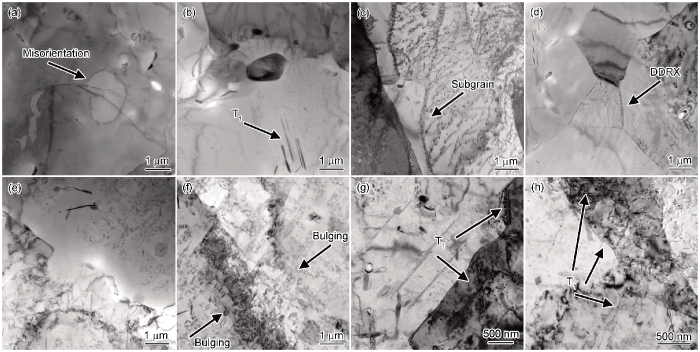
图8
2195 Al-Li合金变形组织的TEM像
Fig.8
TEM images of 2195 Al-Li alloy deformed at different lnZ
(a, b) lnZ=41.7 (c, d) lnZ=44.0 (e, f) lnZ=47.4 (g) lnZ=49.7 (h) lnZ=51.4
图9

可以看出,TEM结果表现出的合金微观组织演变规律与EBSD一致,即随着Z值的降低,位错密度减少,动态回复与动态再结晶进行得更充分。此外,TEM结果还说明合金在变形过程中有T1相析出,随着Z值的升高,析出T1相的含量也明显升高,文献[16,21]在2195与1460 Al-Li合金的热变形组织中也发现了同样现象。由图8g和h可以观察到T1相在晶界上析出,析出的T1相会对晶界造成钉扎作用,阻碍晶界的迁移,从而抑制动态再结晶的形成。Yin等[22]发现Al-Cu-Li合金中亚晶界与位错的迁移也会受到第二相的钉扎作用而受到阻碍,因此在高的Z值下变形时更多T1相的析出可能也是动态再结晶不容易发生的原因。有研究[6,46]发现,析出相颗粒周围会形成取向梯度,从而促进再结晶的发生,然而,目前仍缺少准确的实验结果来详细阐述动态再结晶过程中粒子促进形核的现象[23],本工作TEM结果也未发现T1相颗粒明显促进动态再结晶的形成,相关的影响还需要进一步研究。
3 结论
(1) 2195 Al-Li合金热压缩时发生动态再结晶的临界应变εc随着Z值的降低而降低,动态再结晶在低的Z值下进行得更充分,不连续动态再结晶是主要的再结晶类型,而连续动态再结晶的含量比较微弱。
(2) 随着Z值的升高,流变集中现象增加,几何动态再结晶在Z值升高到一定程度时才出现,并且随着Z值的进一步升高而增加,几何动态再结晶的出现会引起晶粒数目增加而使再结晶程度略有上升。
(3) 连续动态再结晶与不连续动态再结晶更容易在低的Z值下形成,在高Z值的变形条件下更多的T1相析出可能也是阻碍动态再结晶形成的原因。
参考文献
Recent developments in advanced aircraft aluminium alloys
[J].
Aluminium alloys have been the primary material for the structural parts of aircraft for more than 80years because of their well known performance, well established design methods, manufacturing and reliable inspection techniques. Nearly for a decade composites have started to be used more widely in large commercial jet airliners for the fuselage, wing as well as other structural components in place of aluminium alloys due their high specific properties, reduced weight, fatigue performance and corrosion resistance. Although the increased use of composite materials reduced the role of aluminium up to some extent, high strength aluminium alloys remain important in airframe construction. Aluminium is a relatively low cost, light weight metal that can be heat treated and loaded to relatively high level of stresses, and it is one of the most easily produced of the high performance materials, which results in lower manufacturing and maintenance costs. There have been important recent advances in aluminium aircraft alloys that can effectively compete with modern composite materials. This study covers latest developments in enhanced mechanical properties of aluminium alloys, and high performance joining techniques. The mechanical properties on newly developed 2000, 7000 series aluminium alloys and new generation Al i alloys are compared with the traditional aluminium alloys. The advantages and disadvantages of the joining methods, laser beam welding and friction stir welding, are also discussed.
Alloying and microstructural evolution of Al-Li alloys
[J].评述了铝锂合金的发展历程和应用以及我国铝锂合金研究所取得的成果。阐述了第3代铝锂合金的成分、微观组织和性能特点,讨论了合金化元素在调控铝锂合金微观组织进而改善性能方面的作用。大量研究表明,这些合金化元素可改变铝锂合金中原有析出相的大小、形状、分布,或刺激新强化相的析出,也可以细化晶粒、控制再结晶和晶粒取向。时效析出过程的本质和动力学在很大程度上取决于合金化元素之间的交互作用和合金原子的团簇化过程。
铝锂合金的合金化与微观组织演化
[J].评述了铝锂合金的发展历程和应用以及我国铝锂合金研究所取得的成果。阐述了第3代铝锂合金的成分、微观组织和性能特点,讨论了合金化元素在调控铝锂合金微观组织进而改善性能方面的作用。大量研究表明,这些合金化元素可改变铝锂合金中原有析出相的大小、形状、分布,或刺激新强化相的析出,也可以细化晶粒、控制再结晶和晶粒取向。时效析出过程的本质和动力学在很大程度上取决于合金化元素之间的交互作用和合金原子的团簇化过程。
Simulation on flow stress of multi-pass hot deformation of 2195 Al-Li alloy
[J].采用G1eeble-1500热模拟实验机,对2195铝锂合金变形温度为360~520℃,应变速率为0.001-1.0s^-1的单道次热压缩及变形温度为320℃和360℃,应变速率为0.1s^-1,道次间隔时间30-180s的双道次热压缩的流变应力及静态软化规律进行了模拟研究。通过对幂指数应力函数中系数A和β与应变关系的分析,以及采用平均软化法考虑前一道次变形的残余应变对后一道次变形的影响,建立了2195铝锂合金多道次热变形的流变应力方程。
2195铝锂合金多道次热变形流变应力的模拟研究
[J].采用G1eeble-1500热模拟实验机,对2195铝锂合金变形温度为360~520℃,应变速率为0.001-1.0s^-1的单道次热压缩及变形温度为320℃和360℃,应变速率为0.1s^-1,道次间隔时间30-180s的双道次热压缩的流变应力及静态软化规律进行了模拟研究。通过对幂指数应力函数中系数A和β与应变关系的分析,以及采用平均软化法考虑前一道次变形的残余应变对后一道次变形的影响,建立了2195铝锂合金多道次热变形的流变应力方程。
Progress in structural materials for aerospace systems
[J].
Effect of temperature and strain rate on hot deformation behavior and microstructure of Al-Cu-Li alloy
[J].
Dynamic restoration mechanism and physically based constitutive model of 2050 Al-Li alloy during hot compression
[J].61The experimental evidence for the DPN of σ phase in Al–Cu–Li alloys was found.61The PSN-DRX due to the large Al–Cu–Mn particle was observed.61A novel method was proposed to calculated the stress multiplier α.
Flow stress of high-strength weldable 2195 aluminium-lithium alloy during hot compression deformation
[J].在Gleeble 15 0 0热模拟实验机上 ,采用高温等温压缩 ,0 .0 0 1~ 10s-1,变形温度为 36 0~ 5 2 0℃ ,对2 195铝锂合金在高温压缩变形中的流变应力行为进行了研究 ,分析了其高温变形的物理本质。结果表明 :在应变速率为 1s-1(变形温度为 5 2 0℃ )和应变速率为 0 .1、0 .0 1、0 .0 0 1s-1(变形温度为 36 0~ 5 2 0℃ )时 ,2 195铝锂合金热压缩变形流变应力出现了明显的峰值应力 ,表现为连续动态再结晶特征 ;在其它变形条件下存在较为明显的稳态流变特征 ;可采用Zener Hollomon参数的双曲正弦函数来描述 2 195铝锂合金高温变形时的流变应力行为 ;在获得的流变应力σ解析表达式中 ,A、α和n值分别为 2 .5 6 9× 10 17s-1、0 .0 12 4 8MPa-1和 5 .94 ;热变形激活能Q为 2 5 0 .4 5kJ/mol。
高强可焊2195铝-锂合金热压缩变形的流变应力
[J].在Gleeble 15 0 0热模拟实验机上 ,采用高温等温压缩 ,0 .0 0 1~ 10s-1,变形温度为 36 0~ 5 2 0℃ ,对2 195铝锂合金在高温压缩变形中的流变应力行为进行了研究 ,分析了其高温变形的物理本质。结果表明 :在应变速率为 1s-1(变形温度为 5 2 0℃ )和应变速率为 0 .1、0 .0 1、0 .0 0 1s-1(变形温度为 36 0~ 5 2 0℃ )时 ,2 195铝锂合金热压缩变形流变应力出现了明显的峰值应力 ,表现为连续动态再结晶特征 ;在其它变形条件下存在较为明显的稳态流变特征 ;可采用Zener Hollomon参数的双曲正弦函数来描述 2 195铝锂合金高温变形时的流变应力行为 ;在获得的流变应力σ解析表达式中 ,A、α和n值分别为 2 .5 6 9× 10 17s-1、0 .0 12 4 8MPa-1和 5 .94 ;热变形激活能Q为 2 5 0 .4 5kJ/mol。
A new dynamic recrystallisation model of an extruded Al-Cu-Li alloy during high-temperature deformation
[J].The high-temperature deformation behaviour and microstructure evolution of an extruded Al-Cu-Li alloy were investigated by compression tests conducted at various temperatures (613, 673 and 733K) with various strain rates (0.001, 0.01, and 0.1s-1). The results indicated that the deformation activation energy increased from 208.7kJ/mol to 255.7kJ/mol with an increase in strain from 0.1 to 0.7. The electron backscatter diffraction maps indicated that a dynamic recrystallisation occurred during the high-temperature deformation. Two types of recrystallisation mechanisms, grain boundary bulging and a grain boundary transformation from low misorientation to high misorientation, were considered as the mechanisms for controlling the formation of the recrystallised grains. A new dynamic recrystallisation model containing these two mechanisms was proposed to describe the microstructure evolution of the extruded Al-Cu-Li alloy. At the early stage of the deformation, the recrystallised grains were formed by grain boundary bulging along the original grain boundaries. With increasing strain, recrystallised grains were gradually generated in the deformed grains due to the transformation from low angle boundaries to high angle boundaries.
Correcting the stress-strain curve in hot compression process to high strain level
[J].Erratum to: METALLURGICAL AND MATERIALS TRANSACTIONS A, Vol. 40A, No. 4, April 2009, pp. 982–90 DOI: 10.1007/s11661-009-9783-7 In Table02I of the original article, the weight percentages of P and S are incorrect. The correct weight percent of P is 0.002, and the correct weight percent of S is 0.0047.
Study on plane strain physical compression technology
[J].介绍一种新型大试样平面应变压缩技术。在总结目前模拟技术不足的基础上,提出了大试样平面应变压缩技术的实验方法,设计了整机的结构,阐述了设备的特点与功能。通过工控机对温度、压力以及位移的数据采集,可以实现热轧带钢的不同工艺参数模拟。最后以纯铁为实验,实现了大试样多道次平面应变过程。实验表明:这种大试样平面应变技术能满足材料开发以及工艺优化对组织和力学性能分析的要求。
平面应变压缩技术的研究
[J].介绍一种新型大试样平面应变压缩技术。在总结目前模拟技术不足的基础上,提出了大试样平面应变压缩技术的实验方法,设计了整机的结构,阐述了设备的特点与功能。通过工控机对温度、压力以及位移的数据采集,可以实现热轧带钢的不同工艺参数模拟。最后以纯铁为实验,实现了大试样多道次平面应变过程。实验表明:这种大试样平面应变技术能满足材料开发以及工艺优化对组织和力学性能分析的要求。
A new kinetics model of dynamic recrystallization for magnesium alloy AZ31B
[J].The classical kinetics models of dynamic recrystallization (DRX) in the form of Avrami function describe the development of DRX process to a large extent; however, because of the characteristics of exponent function, the conventional models cannot exactly exhibit the development speed of DRX process. Based on this analysis, a new kinetics model of DRX was proposed, which represents the ‘slow–rapid–slow’ property of DRX development. According to the new model, the development process of DRX can be divided into three phases: slow-beginning phase, rapid-increasing phase and slow-rising-to-balance phase. Because the turning point between the second phase and the third one corresponds to the inflexion from the faster velocity of DRX development to the slower one, the strain at this moment can be considered as the most appropriate and economic strain that guarantees fine grains and saves energy consumption. Take a typical metal characterized by DRX magnesium alloy AZ31B for instance, the Gleeble-1500 thermomechanical simulation compression tests were conducted together with microscopic examination, according to which the model parameters were determined. Statistics shows that the experimental results are in good agreement with the predicted values, which validates the accuracy of the new kinetics model.
Study on the anisotropy of 2195 Al-Li alloy
[J].通过拉伸力学性能测试和断口形貌分析,研究了2195铝锂合金冷轧薄板的各向异性随时效时间变化的规律。结果发现:在150℃时效条件下,峰值时效前,随时效时间的增加,合金的各向异性程度逐渐下降,过时效时合金的各向异性比峰值时效时有所增加;延伸率各向异性大于强度各向异性。150℃/24h时效时,与轧向成0°和45°方向试样的断裂机理不同,存在断裂方式的各向异性。最后对该合金各向异性的主要形成机理进行了初步探讨。
2195铝锂合金的各向异性研究
[J].通过拉伸力学性能测试和断口形貌分析,研究了2195铝锂合金冷轧薄板的各向异性随时效时间变化的规律。结果发现:在150℃时效条件下,峰值时效前,随时效时间的增加,合金的各向异性程度逐渐下降,过时效时合金的各向异性比峰值时效时有所增加;延伸率各向异性大于强度各向异性。150℃/24h时效时,与轧向成0°和45°方向试样的断裂机理不同,存在断裂方式的各向异性。最后对该合金各向异性的主要形成机理进行了初步探讨。
Fabrication methods to manufacture isotropic Al-Li alloys and products for space and aerospace applications
[J].After a description of the evolution of Al-Li alloys, this paper first reviews the subject of anisotropy in mechanical properties of Al-Li wrought products. In plane, through thickness and axisymmetric flow anisotropies present in Al-Li wrought products are defined. The root causes for these anisotropies are discussed. Pros and cons arising from anisotropic products are then discussed in the context of designing and manufacturing for space and aerospace structures. Numerous attempts aimed to reduce anisotropy in rolled and extruded products are summarized. It is concluded that `isotropic' Al-Li products can be manufactured via the selection of appropriate process, composition and processing parameters
Dynamic and post-dynamic recrystallization under hot, cold and severe plastic deformation conditions
[J].The evolution of the new microstructures produced by two types of dynamic recrystallization is reviewed, including those brought about by severe plastic deformation (SPD). The microstructural changes taking place under these conditions and the associated mechanical behaviors are described. During the conventional discontinuous dynamic recrystallization (dDRX) that takes place at elevated temperatures, the new grains evolve by nucleation and growth in materials with low to medium stacking fault energies (SFE). On the other hand, new ultrafine grains can be produced in any material irrespective of the SFE by means of SPD at relatively low temperatures. These result from the gradual transformation of the dislocation sub-boundaries produced at low strains into ultrafine grains with high angle boundaries at large strains. This process, termed in situ or continuous dynamic recrystallization (cDRX), is still not perfectly understood. This is because many SPD methods provide data concerning the microstructural changes that take place but little information regarding the flow stress behavior. By contrast, multi-directional forging (MDF) provides both types of data concurrently. Recent studies of the deformation behavior of metals and alloys under SPD conditions, carried out using MDF as well as other SPD methods, are synthesized and the links between the microstructural and mechanical observations are examined carefully. Some models for grain formation under SPD conditions are discussed. Next, the post-dynamic recrystallization behavior, i.e. that of annealing after both dDRX and cDRX, is described. The differing annealing behaviors result from the differences in the natures of the deformed microstructures. Finally, an integrated recrystallization model for these phenomena, i.e. dynamic and static recrystallization of both the continuous and discontinuous types, is presented and discussed.
Softening mechanism and microstructure evolution of as-extruded 7075 aluminum alloy during hot deformation
[J].Hot deformation behavior and microstructure evolution rule of as-extruded 7075 aluminum alloy have been investigated based on the thermal compression experiment and quantitative metallographic test. It was found that the dynamic recovery was the main softening mechanism, along with the dynamic recrystallization in the local area within the deformation temperature range of 300-450 degrees C and strain rate range of 0.01-10 s(-1). Deforming below 350 degrees C, only dynamic recovery occurred with a typical subgrain structure, above 350 degrees C, dynamic recrystallization happened in local area. The dynamic recrystallized grain size increased with the increase of temperature, and decreased as strain rate increasing, showing typical characteristics of continuous dynamic recrystallization. At a higher deformation temperature and a lower strain rate, geometric dynamic recrystallizetion occurred. A larger strain resulted in more dynamic recrystallization. The second phase particles in the alloy would hinder the slip of grain boundaries, while would promote continuous dynamic recrystallization. (c) 2014 Elsevier Inc. All rights reserved.
Hot deformation behavior and microstructure of AA2195 alloy under plane strain compression
[J].The hot deformation behavior of Al-Cu-Li alloy was studied under plane strain compression in the temperature range of 400–50002°C and strain rate of 0.01–1002s 61021 . The related microstructure was studied by optical microscopy, electron back-scattered diffraction and transmission electron microscope. The results showed that the stress decreased significantly with the increase of temperature and decrease of strain rate. However, stress increase was found after peak stress at strain rate of 0.0102s 61021 and deformation temperature 440–50002°C. Constitutive equation based on the hyperbolic sine equation was established and the apparent activation energy of plane strain compression was estimated to be 226.702KJ/mol. Precipitates decreased and finally disappeared with decreasing Z value, having an impact on the softening mechanism. Plate-shaped particles and precipitate zones restrained the proceeding of dynamic recovery but increased store energy for discontinuous dynamically recrystallization nuclei. Therefore, recrystallization nuclei more obviously occurred in the sample with higher ln Z value than the one with lower ln Z value at close ln Z value. The microstructure of all deformed specimens was composed of elongated grains and new quasi-equiaxed grains. However, the basic deformation mechanism was dynamic recovery. The mechanism of recrystallization nuclei transformed discontinuous dynamic recrystallization into continuous dynamic recrystallization with the decreasing Z values.
Effects of strain rate on flow stress behavior and dynamic recrystallization mechanism of Al-Zn-Mg-Cu aluminum alloy during hot deformation
[J].The flow behavior, microstructure evolution and softening mechanism of an AA7085 aluminum alloy are investigated by isothermal hot compression tests at 450°C with the strain rates of 0.001s611and 0.1s611. Optical microscopy (OM), electron back-scattered diffraction (EBSD) and transmission electron microscopy (TEM) are used to characterize microstructure evolution during deformation. The results reveal that the flow stress curves exhibit a single peak and then two types of flow stress curves are found in the present study. Microstructure characterization reveals that dynamic recovery (DRV) and recrystallization (DRX) occur in the both conditions. The microstructure discrepancy becomes significant with increasing strain rate after a certain strain level (ε≥0.3). In the case of 0.001s611, the dynamic recovery is thought to precede continuous dynamic recrystallization. As the strain rate increased, the absence of dynamic recovery provides enough stored energy for discontinuous dynamic recrystallization (DDRX), resulting in a retardation in the occurrence of continuous dynamic recrystallization (CDRX).
EBSD analysis on restoration mechanism of as-extruded AA2099 Al-Li alloy after various thermomechanical processes
[J].61Processing map is established for an as-extruded AA2099 Al-Li alloy.61Stored energy calculation is performed to discriminate restoration mechanisms.61DDRX is confirmed to occur in specimens with low Zenner-Holloman parameters.61Power dissipation efficiency is demonstrated to relate to the restoration mechanisms.
Dynamic recrystallization kinetics and nucleation mechanism of Al-Cu-Li alloy based on flow behavior
[J].对Al-Cu-Li合金进行温度300~500℃、应变速率0.001~10s^-1的等温热压缩,分析合金的流变行为:结合TEM和EBSD研究合金热变形过程中的组织演变。结果表明:合金流变曲线分为3个阶段:加工硬化阶段、过渡阶段和稳态变形阶段;变形温度越高,流变应力达到动态平衡所需应变量越小。基于应变硬化率(θ)与流变应力(σ)之间的关系,确定动态再结晶的临界应变(ε_c);不同热变形条件下的临界应变(ε_c)与峰值应变(ε_p)之比为0.30342~0.92828;临界应力(σ_c)与峰值应变(σ_p)之比为0.88492~0.99782。引入最大软化率应变(ε^*)和中间变量Z/A,建立ε_c和ε~*与Z/A的关系表达式。构建Al-Cu-Li合金动态再结晶动力学模型,模型表明,温度越高或应变速率越低,越有利于促进动态再结晶分数的增加;显微组织分析结果与模型预测规律一致。Al-Cu-Li合金动态再结晶形核机制主要为晶界突出形核机制、亚晶合并长大机制以及粒子促进形核机制,随温度升高和应变速率的降低,晶内亚晶合并长大机制得到加强。
基于Al-Cu-Li合金流变行为的动态再结晶动力学与形核机制
[J].对Al-Cu-Li合金进行温度300~500℃、应变速率0.001~10s^-1的等温热压缩,分析合金的流变行为:结合TEM和EBSD研究合金热变形过程中的组织演变。结果表明:合金流变曲线分为3个阶段:加工硬化阶段、过渡阶段和稳态变形阶段;变形温度越高,流变应力达到动态平衡所需应变量越小。基于应变硬化率(θ)与流变应力(σ)之间的关系,确定动态再结晶的临界应变(ε_c);不同热变形条件下的临界应变(ε_c)与峰值应变(ε_p)之比为0.30342~0.92828;临界应力(σ_c)与峰值应变(σ_p)之比为0.88492~0.99782。引入最大软化率应变(ε^*)和中间变量Z/A,建立ε_c和ε~*与Z/A的关系表达式。构建Al-Cu-Li合金动态再结晶动力学模型,模型表明,温度越高或应变速率越低,越有利于促进动态再结晶分数的增加;显微组织分析结果与模型预测规律一致。Al-Cu-Li合金动态再结晶形核机制主要为晶界突出形核机制、亚晶合并长大机制以及粒子促进形核机制,随温度升高和应变速率的降低,晶内亚晶合并长大机制得到加强。
Microstructure evolution and dynamic recrystallization model of 7085 aluminum alloy during hot deformation
[J].通过等温压缩实验,系统研究热变形参数(变形温度、应变速率及应变量)对7085铝合金热变形组织演变的影响。结果表明:升高变形温度以及降低应变速率,均有利于7085铝合金的动态再结晶发生,导致变形后的7085铝合金位错密度降低,再结晶晶粒尺寸增大;随着应变量的增加,变形后的合金位错密度降低,动态再结晶体积分数增大。采用线性回归方法建立包括峰值应变方程、临界应变方程、动态再结晶动力学方程以及动态再结晶晶粒尺寸方程的7085铝合金动态再结晶模型。
7085铝合金的热变形组织演变及动态再结晶模型
[J].通过等温压缩实验,系统研究热变形参数(变形温度、应变速率及应变量)对7085铝合金热变形组织演变的影响。结果表明:升高变形温度以及降低应变速率,均有利于7085铝合金的动态再结晶发生,导致变形后的7085铝合金位错密度降低,再结晶晶粒尺寸增大;随着应变量的增加,变形后的合金位错密度降低,动态再结晶体积分数增大。采用线性回归方法建立包括峰值应变方程、临界应变方程、动态再结晶动力学方程以及动态再结晶晶粒尺寸方程的7085铝合金动态再结晶模型。
Hot deformation behavior and microstructure evolution of 1460 Al-Li alloy
[J].
Processing maps and microstructural evolution of isothermal compressed Al-Cu-Li alloy
[J].The hot deformation behavior of an Al-Cu-Li alloy was studied by isothermal compression in the temperature range of 573-773 K with strain rates of 0.01-10 s(-1) on a Gleeble-3500 thermo-mechanical simulator. The microstructural evolution during hot deformation was investigated by optical microscope (OM) and transmission electrical microscope (TEM). The results show that the flow stress increases with decreasing deformation temperature and increasing strain rate. Processing maps at the strains of 0.3-0.8 are obtained by isothermal compression data and exhibit two flow instability domains (573-648 K at 0.014-1.5 s(-1) and 698-773 K at 0.3-10 s(-1)) and two peak efficiency domains (723-773 K at 0.01-0.1 s(-1) and 573-623 K at 0.01-0.03 s(-1)). The strain has a significant effect on the peak efficiencies, and the peak efficiencies increase almost linearly as the strain increases. Dynamic recrystallization takes places at high temperatures (673-773 K) and low strain rates (0.01-0.1 s(-1)). The second phases precipitating dynamically during hot deformation pin dislocations and boundaries of subgrains and restrain the occurrence of dynamic recrystallization, resulting in a higher temperature for dynamic recrystallization. According to the processing maps and microstructural observation, the optimized processing condition of hot deformation for Al-Cu-Li alloy is at 723-773 K and 0.01-0.1 s(-1). Crown Copyright (C) 2013 Published by Elsevier B.V. All rights reserved.
A review of dynamic recrystallization phenomena in metallic materials
[J].61Three types of dynamic recrystallization processes occurring during hot deformation are reviewed.61The mechanisms of these three types of dynamic recrystallization processes are discussed in detail.61Physically based numerical models for all the three dynamic recrystallization process are reviewed.61Topics for further investigation on dynamic recrystallization are recommended.
Serrated flow in aluminium alloys containing lithium
[J].Serrated-flow characteristics have been studied in binary Al Li-alloys with different compositions. Load-elongation curves seem divided into two sections of which the first is weakly, the second heavily, serrated. The initial weak serrations, which diminish with ageing, arise probably from the interaction of dislocations with lithium atoms in solid solution. It is proposed that the larger serrations which appear later on the load-elongation curve (if the elongation to necking is large enough to allow them to develop), and which increase in size with progressive ageing, are connected with shearable -precipitates. The effects of zirconium and magnesium additions to Al Li-alloys on serrations have also been investigated. These elements do not change the basic mechanisms of serrated flow. However, the apparent activation energies as calculated for the alloy containing magnesium from the onset strains do not make much sense, because two elements contribute now to serrated flow, and the situation becomes complex.
Initiation of dynamic recrystallization in constant strain rate hot deformation
[J].
The Avrami kinetics of dynamic recrystallization
[J].Twenty-six flow curves determined under dynamic recrystallization (DRX) conditions on 11 different steels were analyzed. The double-differentiation method was used to define the critical strain ε c for initiation of DRX. The “athermal” hardening parameter h and the dynamic recovery parameter r were evaluated from the work-hardening behavior prior to ε c. The saturation stresses σ sat pertaining to the unrecrystallized regions as well as the associated work-hardening curves, σ recov, were derived in this way. The net softening attributable to DRX was then defined as the difference between the σ recov and experimental curves. Avrami plots were prepared from all 26 sets of data. The time exponents were all in the neighborhood of 3.0; however, the strain rate and temperature dependences differed considerably from their static values. The dependence of the time of half-softening, t 50, on strain rate and temperature is used to predict the DRX curves expected under industrial conditions.
Effect of strain rate upon plastic flow of steel
[J].An experiment has been designed to check a previously proposed equivalence of the effects of changes in strain rate and in temperature upon the stress‐strain relation in metals. It is found that this equivalence is valid for the typical steels investigated. The behavior of these steels at very high rates of deformation may, therefore, be obtained by tests at moderate rates of deformation performed at low temperatures. The results of such tests are described. Aside from changing the isothermal stress‐strain relation, an increase of strain rate tends to change the conditions from isothermal to adiabatic. It is found that at low temperatures, the adiabatic stress‐strain relation in the plastic range is radically different from the isothermal, having an initial negative rather than a positive slope. This initial negative slope renders unstable homogeneous plastic deformation.
On the mechanism of hot deformation
[J].Publication » On the mechanism of hot deformation.
Flow behavior and microstructure of 2195 Al-Li alloy during plane strain compression
[J].通过Gleeble-3500热模拟机在350~500℃温度范围对2195铝锂合金进行平面应变压缩实验,应变速率为0.01~1 s-1,变形量60%.研究合金在高温下的流变行为并通过背散射电子衍射(EBSD)和X射线衍射(XRD)揭示了微观组织的演变规律.结果表明:流变应力随应变速率的增加而升高,而随着温度的升高流变应力降低,并且达到峰值应力和稳态流变时所需的应变也减少,建立含有双曲正弦关系的本构方程并得到合金的变形激活能Q为278.208 kJ/mol;随着Zener-Hollomon参数值的增加,合金的流变集中增加,合金的软化机制主要是动态回复,此外还有动态再结晶形成,动态再结晶主要为不连续动态再结晶,而连续动态再结晶和几何动态再结晶均容易在较低Z值和较高Z值下形成;变形组织中含有大量的轧制织构,变形晶粒主要为S{123}〈634 〉 、Brass{011}〈211〉 、Copper{112}〈111〉 和Goss{011}〈100〉这4种取向.
2195铝锂合金平面应变压缩的流变行为与微观组织
[J].通过Gleeble-3500热模拟机在350~500℃温度范围对2195铝锂合金进行平面应变压缩实验,应变速率为0.01~1 s-1,变形量60%.研究合金在高温下的流变行为并通过背散射电子衍射(EBSD)和X射线衍射(XRD)揭示了微观组织的演变规律.结果表明:流变应力随应变速率的增加而升高,而随着温度的升高流变应力降低,并且达到峰值应力和稳态流变时所需的应变也减少,建立含有双曲正弦关系的本构方程并得到合金的变形激活能Q为278.208 kJ/mol;随着Zener-Hollomon参数值的增加,合金的流变集中增加,合金的软化机制主要是动态回复,此外还有动态再结晶形成,动态再结晶主要为不连续动态再结晶,而连续动态再结晶和几何动态再结晶均容易在较低Z值和较高Z值下形成;变形组织中含有大量的轧制织构,变形晶粒主要为S{123}〈634 〉 、Brass{011}〈211〉 、Copper{112}〈111〉 和Goss{011}〈100〉这4种取向.
A new one-parameter kinetics model of dynamic recrystallization and grain size predication
[J]., the kinetics model for Mg alloy AZ31B characterized by DRX for instance was built and parameters were determined. Microscopic examination shows that the experimental results are in good agreement with the predicted values, which validates the accuracy of the new kinetics model.Then combined with grain size of DRX model, the kinetic model built under steady state conditions was rewritten as superimposed step form to apply in the prediction of grain size under unsteady state conditions. The simulated data accord with the experimental results by means of quantitative metallography, which verified the rationality of the superimposed prediction method.
新的单参数动态再结晶动力学建模及晶粒尺寸预测
[J]., the kinetics model for Mg alloy AZ31B characterized by DRX for instance was built and parameters were determined. Microscopic examination shows that the experimental results are in good agreement with the predicted values, which validates the accuracy of the new kinetics model.Then combined with grain size of DRX model, the kinetic model built under steady state conditions was rewritten as superimposed step form to apply in the prediction of grain size under unsteady state conditions. The simulated data accord with the experimental results by means of quantitative metallography, which verified the rationality of the superimposed prediction method.
Microstructure and micro-texture evolution during large strain deformation of aluminium alloy AA 2219
[J].
Flow localization in an Al-2.5Mg alloy after severe plastic deformation
[J].AA5052 was subjected to severe plastic deformation using the equal channel angular pressing (ECAP) technique. The microstructure, quantified using electron backscattered diffraction, showed that ECAP refined the grain size, increased the fraction of high angle boundaries (from 0.46 to 0.75) and increased total boundary area per unit volume of AA5052. ECAP increased the flow stress from about 325 to 425MPa and strain rate sensitivity from 0.005 to 0.012 and reduced strain hardening exponent from 0.34 to 0.25. Shear localization in the ECAP as well as unpressed AA5052 was studied using hat-shaped samples deformed at both quasi-static strain rates in a screw-driven machine and dynamic strain rates in a split-Hopkinson bar. The shear band formation in the hat-shaped sample was narrow and well defined for the ECAP condition as compared to the unpressed condition where the shear band was broad and diffuse, implying an increased propensity for shear localization as compared to the unpressed condition. The microstructure within the shear band of the ECAP condition sample showed that the boundary area per unit volume decreased as compared to that away from the shear band.
An experimental study of the recrystallization mechanism during hot deformation of aluminium
[J].Discontinuous dynamic recrystallization (involving nucleation and grain growth) is rarely observed in metals with high stacking fault energies, such as aluminium. In this metal, two other types of recrystallization have been observed: continuous dynamic recrystallization (CDRX, i.e. the transformation of subgrains into grains); and geometric dynamic recrystallization (due to the evolution of the initial grains). The main purpose of this work was to bring clearly into evidence and to better characterize CDRX. Uniaxial compression tests were carried out at 0.7 T m and 10 2 s 1 on three types of polycrystalline aluminium: a pure aluminium (1199), a commercial purity aluminium (1200) and an Al-2.5wt.%Mg alloy (5052), and also on single crystals of pure aluminium. In addition, 1200 aluminium specimens were strained in torsion. The deformed microstructures were investigated at various strains using X-ray diffraction, optical microscopy, scanning electron microscopy and electron back-scattered diffraction. Observations of the single crystalline samples confirm that subgrain boundaries can effectively transform into grain boundaries, especially when the initial orientation is unstable. In the case of polycrystalline specimens, after separating the effects of the initial and new grain boundaries, it turns out that CDRX operates faster in the 1200 aluminium compared to the two other grades. Moreover, it appears that the strain path does not alter noticeably the CDRX kinetics.
New developments in geometric dynamic recrystallization
[J].The concept of geometric dynamic recrystallization (GDX) originated in 1980s with work on elevated-temperature deformation aluminum to large strains. In this case, substantial grain refinement occurs through a process of grain elongation and thinning leading to a dramatic increase in grain boundary area. The grain boundaries become serrated as a result of subgrain (low angle) boundary formation. Pinching off and annihilation of high-angle grain boundaries occurs as the original grains thin to about twice the subgrain diameter to and a “steady-state” structure. This concept has since been carefully verified in pure Al, as well as Al–Mg alloys deforming in the three-power regime. Large strain deformation of Al single crystals is also consistent with the concept. Also, data in the literature on large strain deformation of a bcc iron alloy are consistent with GDX. Recent experiments on α-zirconium show that GDX applies to this hcp metal. Thus, it appears that GDX is a general phenomenon that can lead to grain refinement in the absence of any discontinuous dynamic recrystallization (DRX) or continuous dynamic recrystallization (CDX). A discussion of continuous dynamic recrystallization and geometric necessary boundaries in relation to GDX will also be discussed. This may be particularly relevant to severe plastic deformation such as rolling and equal-channel angular pressing where dramatic increases in the number of high-angle boundaries are observed.
Geometric dynamic recrystallization in hot torsion of Al-5Mg-0.6Mn (AA5083)
[J].ABSTRACT Geometric dynamic recrystallization (GDRX) is a process in which a refined and nearly equiaxed grain structure is formed, because grain boundaries which have become serrated during formation of subgrains in the course of hot deformation recombine as serrations pinch off or as the grains thin down. GDRX was first found in aluminium and more recently in AlMg solid solution. In the present work the question was addressed whether GDRX occurs also in an industrial Al alloy (5083) containing particles. Specimens were deformed in torsion from 473 to 773 K at equivalent (surface) strain rates between 10613 and 4 s611 to strains up to 3.6. Under these conditions the egg tray model predicts that GDRX will occur. This is indeed found from observations of the grain structure with light and electron microscopy. The results indicate that GDRX occurs not only by recombination of opposite boundaries of the thinned grain but also by pinching off of serrations. The size of the GDRX grains is about two to three times the subgrain size. The close similarity to Al5Mg means that the particles in the alloy do not prevent the small-scale grain boundary migration which is necessary to form the serrations. Static recrystallization after hot deformation destroys the DRX structure, if the specimen is not cooled fast enough.
Dynamic restoration mechanisms in Al-5.8 at. pct Mg deformed to large strains in the solute drag regime
[J].An Al-5.8 at. pct Mg (5.2 wt pct Mg) alloy was deformed in torsion within the solute drag regime to various strains, up to the failure strain of 10.8. Optical microscopy (OM) and transmission electron microscopy (TEM) were used to analyze the evolution of the microstructure and to determine the dynamic restoration mechanism. Transmission electron microscopy revealed that subgrain formation is sluggish but that subgrains eventually (ε ≈ 1) fill the grains. The “steady-state” subgrain size (λ ≈ 6 μm) and misorientation angle (θ ≈ 1.6 deg) are reached by ε ≈ 2. These observations confirm that subgrains eventually form during deformation in the solute drag regime, though they do not appear to significantly influence the strength. At low strains, nearly all of the boundaries form by dislocation reaction and are low angle (θ < 10 deg). At a strain of 10.8, however, the boundary misorientation histogram is bimodal, with nearly 25 pct of the boundaries having high angles due to their ancestry in the original grain boundaries. This is consistent with OM observations of the elongation and thinning of the original grains as they spiral around the torsion axis. No evidence was found for discontinuous dynamic recrystallization, a repeating process in which strain-free grains nucleate, grow, deform, and give rise to new nuclei. It is concluded that dynamic recovery in the solute drag regime gives rise to geometric dynamic recrystallization in a manner very similar to that already established for pure aluminum, suggesting that geometric dynamic recrystallization may occur generally in materials with a high stacking-fault energy (SFE) deformed to large strains.
Large-strain deformation of aluminum single crystals at elevated temperature as a test of the geometric-dynamic-recrystallization concept
[J].
Modelling discontinuous dynamic recrystallization using a physically based model for nucleation
[J].A physically based model for nucleation during discontinuous dynamic recrystallization (DDRX) has been developed and is coupled with polyphase plasticity and grain growth models to predict the macroscopic stress and grain size evolution during straining. The nucleation model is based on a recent description for static recrystallization and considers the dynamically evolving substructure size. Model predictions are compared with literature results on DDRX in pure Cu as a function of initial grain size, deformation temperature and strain rate. The characteristic DRX features such as single to multiple peak stress transitions, convergence towards a steady-state stress and grain size, and a power-law relationship between the stress and grain size are quantitatively reproduced by the model. The critical conditions for the onset of nucleation in the model are shown to compare well with Gottstein et al. experimentally determined critical stress criteria.
Development of dynamic recrystallization theory
[J].Although hot working had been defined as deformation above the recrystallization temperature (determined after cold working), it was only about 1965 that dynamic recrystallization (DRX) was confirmed to be occurring during the deformation; two decades were required to clarify the similarities to, and the differences from, static recrystallization. In classical discontinuous DRX in Cu, Ni, and -Fe, successive necklaces of new grains cause work softening; however in steady-state, the nuclei are uniformly distributed as reestablished dislocation structure limits growth. In high recovery metals at high strains, the grain boundary (GB) serrations meet across the elongated thinned grains thus pinching them off into almost equiaxed grains containing a substructure, thus geometric DRX.
A model of continuous dynamic recrystallization
[J].
The transition from discontinuous to continuous recrystallization in some aluminium alloys: II—Annealing behaviour
[J].
Hot deformation behavior of AA7085 aluminum alloy during isothermal compression at elevated temperature
[J].The isothermal deformation compression tests of AA7085 aluminum alloy were performed on Gleeble-1500 system in the temperature range from 250°C to 450°C and at strain rate range from 0.01s611 to 10s611. The microstructure of samples was observed using optical microscopy (OM) and transmission electron microscopy (TEM) techniques. The results show that the peak stress levels decreased with the increase of deformation temperatures or the decrease of strain rate, which can be represented by the Zener–Hollomon parameter in the exponent-type equation with the hot deformation activation energy of 249.11KJ/mol. Dynamic recrystallization more obviously occurred in the sample with higher Z value than in the sample with lower Z value. Dynamic recrystallization is sensitively dependent on the deformation temperature.
The flow behavior and constitutive equations in isothermal compression of 7050 aluminum alloy
[J].The flow behavior of 7050 aluminum alloy was investigated by means of isothermal compression tests. Isothermal compression of 7050 aluminum alloy was carried out on a Gleeble-1500 thermal simulation machine at the deformation temperatures ranging from 593K to 743K, the strain rates ranging from 0.01s611 to 20.0s611, and the height reductions of 30%, 50% and 70%. The characteristics of stress–strain curves are determined by the interaction of work hardening, dynamic recovery and dynamic recrystallization. The flow stress decreases with the increasing of deformation temperature and the decreasing of strain rate. The relationship between microstructure and processing parameters was analyzed. The constitutive equations for characterizing the flow behavior during the whole deformation process had been established, based on the experimental results and the kinetic analysis. The average relative error between the calculated and the experimental flow stress is 5.73%, which indicates that the constitutive equations can be used to predict the flow behavior of 7050 aluminum alloy accurately during high temperature deformation.
Research on the hot deformation behavior of Al-6.2Zn-0.70Mg-0.3Mn-0.17Zr alloy using processing map
[J].The hot deformation behavior of Al–6.2Zn–0.70Mg–0.3Mn–0.17Zr alloy was studied using hot compression tests over deformation temperature range of 623–773K and strain rate of 0.01–20s611. The flow stress behavior and microstructural evolution were observed during the hot deformation process. The results show the flow stresses and microstructure evolution are sensitive to deformation parameters. The peak stress level decreases with increasing deformation temperature and decreasing strain rate, which can be represented by the Zener–Hollomon parameter Z in the hyperbolic sine equation with the hot deformation activation energy of 178.85KJ/mol. The dynamic flow softening for the alloy is accounted for dynamic recovery and dynamic recrystallization. Under conditions of high lnZ values, only dynamic recovery occurred, and the main soften mechanism transformed from dynamic recovery to dynamic recrystallization at low lnZ values. With decreasing the value of lnZ parameter, the size of recrystallization grain becomes larger. According to the TEM evolution, it can easily observed that high densities of the fine and nano-scaled Al3Zr particles have precipitate in the aluminum matrix and grain boundary, which can effectively inhibit the dynamic recrystallization of experiment alloy. Based on dynamic material model and Prasad’ instability criterion, the processing maps for the alloy are built at true strains of 0.3 and 0.5. The processing map at the strain of 0.5 exhibits the optimum processing conditions are in deformation temperature range from 703K to 773K and strain rate range from 0.03s611 to 0.32s611 with the maximum efficiency of 33%.
Precipitation behavior of T1 phase during thermo-mechanical treatment of 2197 Al-Li alloy
[J].对2197铝锂合金进行形变热处理,采用HREM高分辨电镜观察合金欠时效和峰时效两个阶段的显微组织,研究T1相析出长大行为及其界面特征。结果表明:形变热处理2197合金在欠时效阶段主要存在δ′、θ′和T1相,T1相尺寸约为40 nm;峰时效阶段合金中δ′和θ′数量减少,主要析出相为T1相,其尺寸为50~150 nm,T1相可通过δ′相的溶解而长大。在欠时效和峰时效两阶段,T1相末端与基体共格,其他区域与基体非共格。T1相为六方晶系,与基体存在惯析关系:(0001)T1//(111)A1、[1010]T1//[110]A1,惯析面为{111}A1。
2197铝锂合金形变热处理中T1相的析出行为
[J].对2197铝锂合金进行形变热处理,采用HREM高分辨电镜观察合金欠时效和峰时效两个阶段的显微组织,研究T1相析出长大行为及其界面特征。结果表明:形变热处理2197合金在欠时效阶段主要存在δ′、θ′和T1相,T1相尺寸约为40 nm;峰时效阶段合金中δ′和θ′数量减少,主要析出相为T1相,其尺寸为50~150 nm,T1相可通过δ′相的溶解而长大。在欠时效和峰时效两阶段,T1相末端与基体共格,其他区域与基体非共格。T1相为六方晶系,与基体存在惯析关系:(0001)T1//(111)A1、[1010]T1//[110]A1,惯析面为{111}A1。
Particle effects on recrystallization in magnesium-manganese alloys: Particle-stimulated nucleation
[J].The influence of large ( > 1 m diameter) particles on the recrystallization behaviour of magnesium alloys deformed in plane strain compression has been studied. Deformation zones characterized by a misorientation gradient were observed surrounding large particles, which were similar to those seen in other alloys where particle-stimulated nucleation (PSN) of recrystallization occurs. During annealing, new grains formed by PSN, but only at a small fraction of the coarse particles. Recrystallization was instead dominated by growth of existing dynamically recrystallized grains and nucleation of new grains from the deformed grain mantle region.


