|
|
|
| Prediction of Mechanical Properties of Biodegradable Zinc Alloys Based on Machine Learning |
GUO Chuanping1, SHI Chenchen1, LIU Peng1, GAO Dongfang2, ZHAO Yangyang3, QIAO Yang1( ) ) |
1 School of Mechanical Engineering, University of Jinan, Jinan 250022, China
2 Institute of Medical Sciences, The Second Qilu Hospital of Shandong University, Jinan 250033, China
3 Trauma Orthopedics, Second Hospital of Shandong University, Jinan 250031, China |
|
Cite this article:
GUO Chuanping, SHI Chenchen, LIU Peng, GAO Dongfang, ZHAO Yangyang, QIAO Yang. Prediction of Mechanical Properties of Biodegradable Zinc Alloys Based on Machine Learning. Acta Metall Sin, 2026, 62(9): 1615-1626.
|
|
|
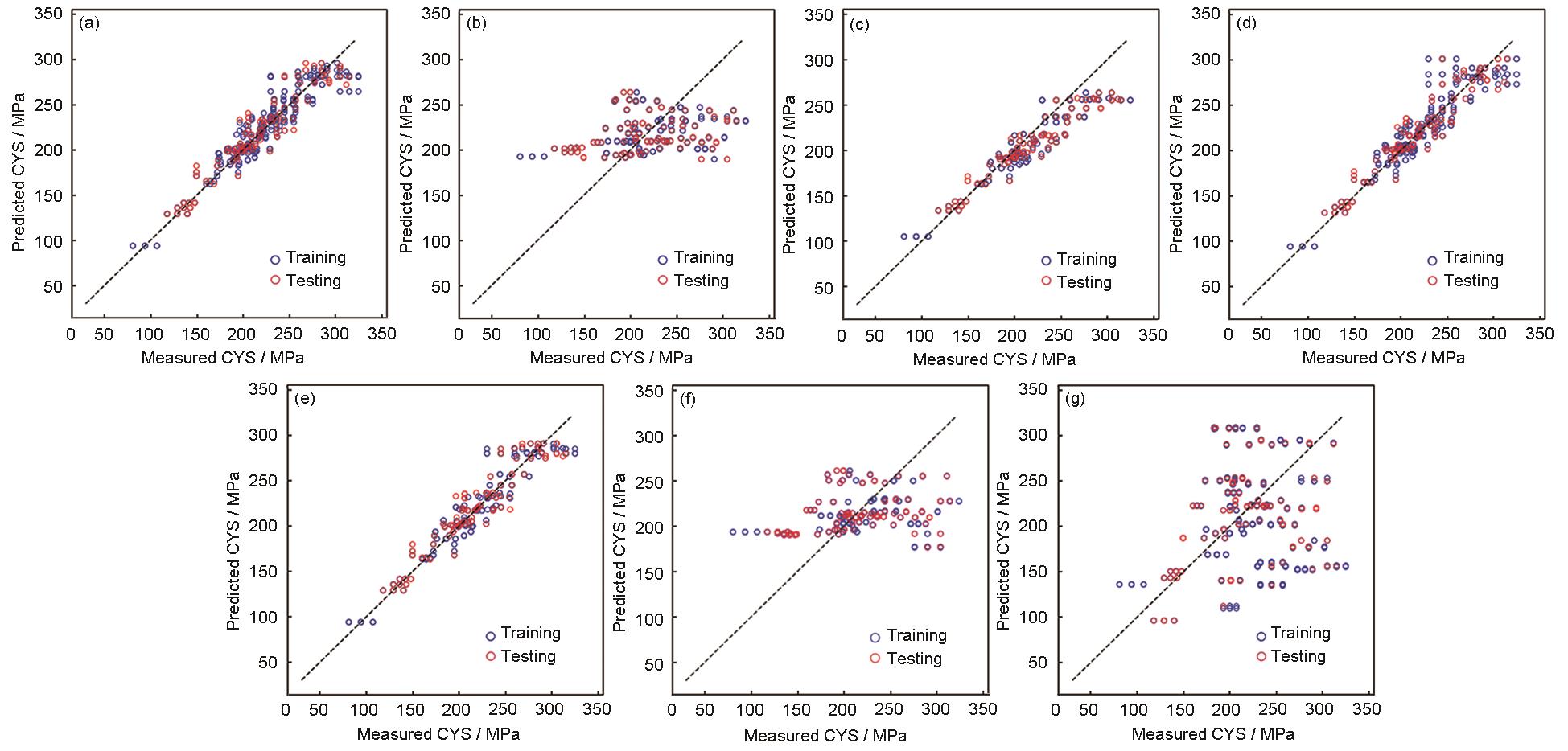
Abstract Recent studies indicate that zinc alloys are preferred in biodegradable metal materials owing to their unique biodegradability and biocompatibility. However, their mechanical properties are relatively insufficient; thus, it is crucial to design zinc alloys that meet the mechanical performance implantation standards required for application in biomedicine. The traditional alloy design method depends on experience and trial and error resulting in low efficiency and high cost. In recent years, the rapid development of artificial intelligence has provided new tools and methods for material science. Machine learning (ML), a subset of artificial intelligence, offers new ideas for material design and prediction. This study obtained the mechanical property data of the Zn-Mg-Mn alloy through experimental investigation and literature review. A performance-oriented ML model was used to predict the compressive yield strength (CYS) and hardness of the Zn-Mg-Mn alloy, considering various element types and contents and different alloy preparation processes. Furthermore, the influence of the element types and contents on the microstructure and macroscopic mechanical properties of the material was explored. Based on the existing dataset, a comparative evaluation of seven machine learning algorithms was conducted, and the k-nearest neighbors (KNN) algorithm exhibited the highest predictive performance. To further validate the accuracy of the model prediction, a random method was used to select data beyond the dataset for comparative analysis with the model results. Simultaneously, the Shapley additive explanation method was applied to quantitatively examine the correlation between the two alloying elements, the preparation process, the CYS, and the hardness in the Zn-Mg-Mn alloy. The Mg element was determined to significantly impact the alloy's CYS and hardness. Finally, the influence of individual elements on the mechanical properties of the materials was analyzed through microstructure characterization. The results showed that the formation of new phases (Mg2Zn11 and MgZn13) due to adding alloy elements significantly affected the mechanical properties. Based on the research results, this study proposed a composition ratio range for the Zn-Mg-Mn alloy to satisfy the mechanical performance standards required for medical implant materials. When Mg content is between 2.25% and 2.50% (mass fraction, the same below) and Mn content is between 2.50% and 3.50%, the CYS and hardness of the alloy comply with the implant standards.
|
|
Received: 27 September 2024
|
|
|
| Fund: National Natural Science Foundation of China(52175408);Natural Science Foundation of Shan-dong Province(ZR2023ME077);Natural Science Foundation of Shan-dong Province(ZR2023MC140) |
Corresponding Authors:
QIAO Yang, associate professor, Tel: 13791051675, E-mail: me_qiaoy@ujn.edu.cn
|
| [1] |
Li G N, Yang H T, Zheng Y F, et al. Challenges in the use of zinc and its alloys as biodegradable metals: Perspective from biomechanical compatibility [J]. Acta Biomater., 2019, 97: 23
doi: S1742-7061(19)30527-6
pmid: 31349057
|
| [2] |
Yang D H, Chen J Q, Chen W P, et al. Fabrication of cellular Zn-Mg alloy foam by gas release reaction via powder metallurgical approach [J]. J. Mater. Sci. Technol., 2017, 33: 1141
doi: 10.1016/j.jmst.2017.03.019
|
| [3] |
Tong X, Shi Z M, Xu L C, et al. Degradation behavior, cytotoxicity, hemolysis, and antibacterial properties of electro-deposited Zn-Cu metal foams as potential biodegradable bone implants [J]. Acta Biomater., 2020, 102: 481
doi: S1742-7061(19)30781-0
pmid: 31740321
|
| [4] |
Sikora-Jasinska M, Mostaed E, Mostaed A, et al. Fabrication, mechanical properties and in vitro degradation behavior of newly developed Zn-Ag alloys for degradable implant applications [J]. Mater. Sci. Eng., 2017, C77: 1170
|
| [5] |
Saris N E L, Mervaala E, Karppanen H, et al. Magnesium: An update on physiological, clinical and analytical aspects [J]. Clin. Chim. Acta, 2000, 294: 1
doi: 10.1016/s0009-8981(99)00258-2
pmid: 10727669
|
| [6] |
Bagha P S, Khaleghpanah S, Sheibani S, et al. Characterization of nanostructured biodegradable Zn-Mn alloy synthesized by mechanical alloying [J]. J. Alloys Compd., 2018, 735: 1319
doi: 10.1016/j.jallcom.2017.11.155
|
| [7] |
Shi Z Z, Li X M, Yao S L, et al. 300 MPa grade biodegradable high-strength ductile low-alloy (BHSDLA) Zn-Mn-Mg alloys: An in vitro study [J]. J. Mater. Sci. Technol., 2023, 138: 233
doi: 10.1016/j.jmst.2022.08.015
|
| [8] |
Cho D H, Lee B W, Park J Y, et al. Effect of Mn addition on corrosion properties of biodegradable Mg-4Zn-0.5Ca-xMn alloys [J]. J. Alloys Compd., 2017, 695: 1166
doi: 10.1016/j.jallcom.2016.10.244
|
| [9] |
Li M, Shi Z Z, Wang Q, et al. Zn-0.8 Mn alloy for degradable structural applications: Hot compression behaviors, four dynamic recrystallization mechanisms, and better elevated-temperature strength [J]. J. Mater. Sci. Technol., 2023, 137: 159
doi: 10.1016/j.jmst.2022.08.002
|
| [10] |
Sun S N, Ren Y P, Wang L Q, et al. Abnormal effect of Mn addition on the mechanical properties of as-extruded Zn alloys [J]. Mater. Sci. Eng., 2017, A701: 129
|
| [11] |
Li M, Xue Z, Shi Z Z, et al. High temperature strengthening mechanism of pure Zn with trace Mn addition [J]. J. Mater. Res. Technol., 2023, 25: 6764
doi: 10.1016/j.jmrt.2023.07.144
|
| [12] |
Chang Y J, Jui C Y, Lee W J, et al. Prediction of the composition and hardness of high-entropy alloys by machine learning [J]. JOM, 2019, 71: 3433
doi: 10.1007/s11837-019-03704-4
|
| [13] |
Suh J S, Suh B C, Bae J H, et al. Machine learning-based design of biodegradable Mg alloys for load-bearing implants [J]. Mater. Des., 2023, 225: 111442
doi: 10.1016/j.matdes.2022.111442
|
| [14] |
Liu Y W, Wang L Y, Zhang H, et al. Accelerated development of high-strength magnesium alloys by machine learning [J]. Metall. Mater. Trans., 2021, 52A: 943
|
| [15] |
Mazhnik E, Oganov A R. Application of machine learning methods for predicting new superhard materials [J]. J. Appl. Phys., 2020, 128: 075102
|
| [16] |
Zhang S G. Pressureless sintered silicon carbide with enhanced mechanical properties obtained by a two-step sintering method [J]. Refract. Lime, 2015, 40(5): 48
|
|
张世国. 由两步烧结法获得的机械性能增强的无压烧结碳化硅 [J]. 耐火与石灰, 2015, 40(5): 48
|
| [17] |
Xu H J, Li J, Shi R X. Preparation of ZrO2(3Y) nanoceramics under two-stage non-pressurized sintering [J]. China Powder Sci. Technol., 2006, 12(4): 11
|
|
徐海军, 李 嘉, 师瑞霞. 两段式无压烧结制备纳米二氧化锆(3Y)材料 [J]. 中国粉体技术, 2006, 12(4): 11
|
| [18] |
Lóh N J, Simão L, Faller C A, et al. A review of two-step sintering for ceramics [J]. Ceram. Int., 2016, 42: 12556
doi: 10.1016/j.ceramint.2016.05.065
|
| [19] |
Liu X W, Sun J K, Zhou F Y, et al. Micro-alloying with Mn in Zn-Mg alloy for future biodegradable metals application [J]. Mater. Des., 2016, 94: 95
doi: 10.1016/j.matdes.2015.12.128
|
| [20] |
Ren T T, Gao X, Xu C, et al. Evaluation of as‐extruded ternary Zn-Mg-Zr alloys for biomedical implantation material: In vitro and in vivo behavior [J]. Mater. Corros., 2019, 70: 1056
|
| [21] |
Liu X W, Sun J K, Qiu K J, et al. Effects of alloying elements (Ca and Sr) on microstructure, mechanical property and in vitro corrosion behavior of biodegradable Zn-1.5 Mg alloy [J]. J. Alloys Compd., 2016, 664: 444
doi: 10.1016/j.jallcom.2015.10.116
|
| [22] |
Yang Y W, Yuan F L, Gao C D, et al. A combined strategy to enhance the properties of Zn by laser rapid solidification and laser alloying [J]. J. Mech. Behav. Biomed. Mater., 2018, 82: 51
doi: S1751-6161(18)30326-6
pmid: 29567530
|
| [23] |
Yang H T, Jia B, Zhang Z C, et al. Alloying design of biodegradable zinc as promising bone implants for load-bearing applications [J]. Nat. Commun., 2020, 11: 401
doi: 10.1038/s41467-019-14153-7
pmid: 31964879
|
| [24] |
Zhang K Q, Yin H Q, Jiang X, et al. A novel approach to predict green density by high-velocity compaction based on the materials informatics method [J]. Int. J. Miner. Metall. Mater., 2019, 26: 194
doi: 10.1007/s12613-019-1724-x
|
| [25] |
Putcha C, Dutta S, Gupta S K. Reliability and Risk Analysis in Engineering and Medicine [M]. Cham: Springer, 2021: 1
|
| [26] |
Jia B, Yang H T, Han Y, et al. In vitro and in vivo studies of Zn-Mn biodegradable metals designed for orthopedic applications [J]. Acta Biomater., 2020, 108: 358
doi: S1742-7061(20)30141-0
pmid: 32165194
|
| [27] |
Shen C, Liu X W, Fan B, et al. Mechanical properties, in vitro degradation behavior, hemocompatibility and cytotoxicity evaluation of Zn-1.2Mg alloy for biodegradable implants [J]. RSC Adv., 2016, 6: 86410
doi: 10.1039/C6RA14300H
|
| [28] |
Huang W J, Yin S C, Wang X J, et al. Grain growth and Hall-Petch relationship in Ti37V15Nb22Hf23W3 refractory high-entropy alloys [J]. J. Mater. Res., 2023, 38: 1719
doi: 10.1557/s43578-023-00924-y
|
| [29] |
Hernández-Escobar D, Champagne S, Yilmazer H, et al. Current status and perspectives of zinc-based absorbable alloys for biomedical applications [J]. Acta Biomater., 2019, 97: 1
doi: S1742-7061(19)30523-9
pmid: 31351253
|
| [30] |
Wan Y J, Zeng Y, Dou Y C, et al. Improved mechanical properties and strengthening mechanism with the altered precipitate orientation in magnesium alloys [J]. J. Magnes. Alloy., 2022, 10: 1256
doi: 10.1016/j.jma.2020.09.028
|
| [31] |
Ren Y P, Lou D F, Zhang M D, et al. Fabrication, microstructures, and mechanical properties of Zn-0.1Mg-1Mn (wt.%) alloy tube [J]. J. Mater. Eng. Perform., 2023, 32: 793
doi: 10.1007/s11665-022-07122-7
|
| [32] |
Wang L Q, Lou D F, Ren Y P, et al. Effect of Mn content on the microstructure and mechanical properties of as-extruded Zn-0.2Mg-Mn (wt%) alloys [J]. Mater. Charact., 2022, 194: 112400
doi: 10.1016/j.matchar.2022.112400
|
| [33] |
Bowen P K, Drelich J, Goldman J. Zinc exhibits ideal physiological corrosion behavior for bioabsorbable stents [J]. Adv. Mater., 2013, 18: 2577
|
| [34] |
Kong L Y, Heydari Z, Lami G H, et al. A comprehensive review of the current research status of biodegradable zinc alloys and composites for biomedical applications [J]. Materials, 2023, 16: 4797
doi: 10.3390/ma16134797
|
| No Suggested Reading articles found! |
|
|
Viewed |
|
|
|
Full text
|
|
|
|
|
Abstract
|
|
|
|
|
Cited |
|
|
|
|
| |
Shared |
|
|
|
|
| |
Discussed |
|
|
|
|