|
|
|
| Effect of Seawater Pressures on Microstructure Quantitative Analysis and Failure Dynamics Mechanism of Copper Alloys for Ship Propellers |
YANG Huimin1, LI Ruixue1, ZHOU Chenxi1, MA Yuxuan1, ZHAO Xuhui1, YONG Xingyue2( ), LIU Jingjun1() ), LIU Jingjun1() |
1 School of Materials Science and Engineering, Beijing University of Chemical Technology, Beijing 100029, China
2 School of Chemical Engineering, Beijing University of Chemical Technology, Beijing 100029, China |
|
Cite this article:
YANG Huimin, LI Ruixue, ZHOU Chenxi, MA Yuxuan, ZHAO Xuhui, YONG Xingyue, LIU Jingjun. Effect of Seawater Pressures on Microstructure Quantitative Analysis and Failure Dynamics Mechanism of Copper Alloys for Ship Propellers. Acta Metall Sin, 2026, 62(9): 1591-1605.
|
|
|
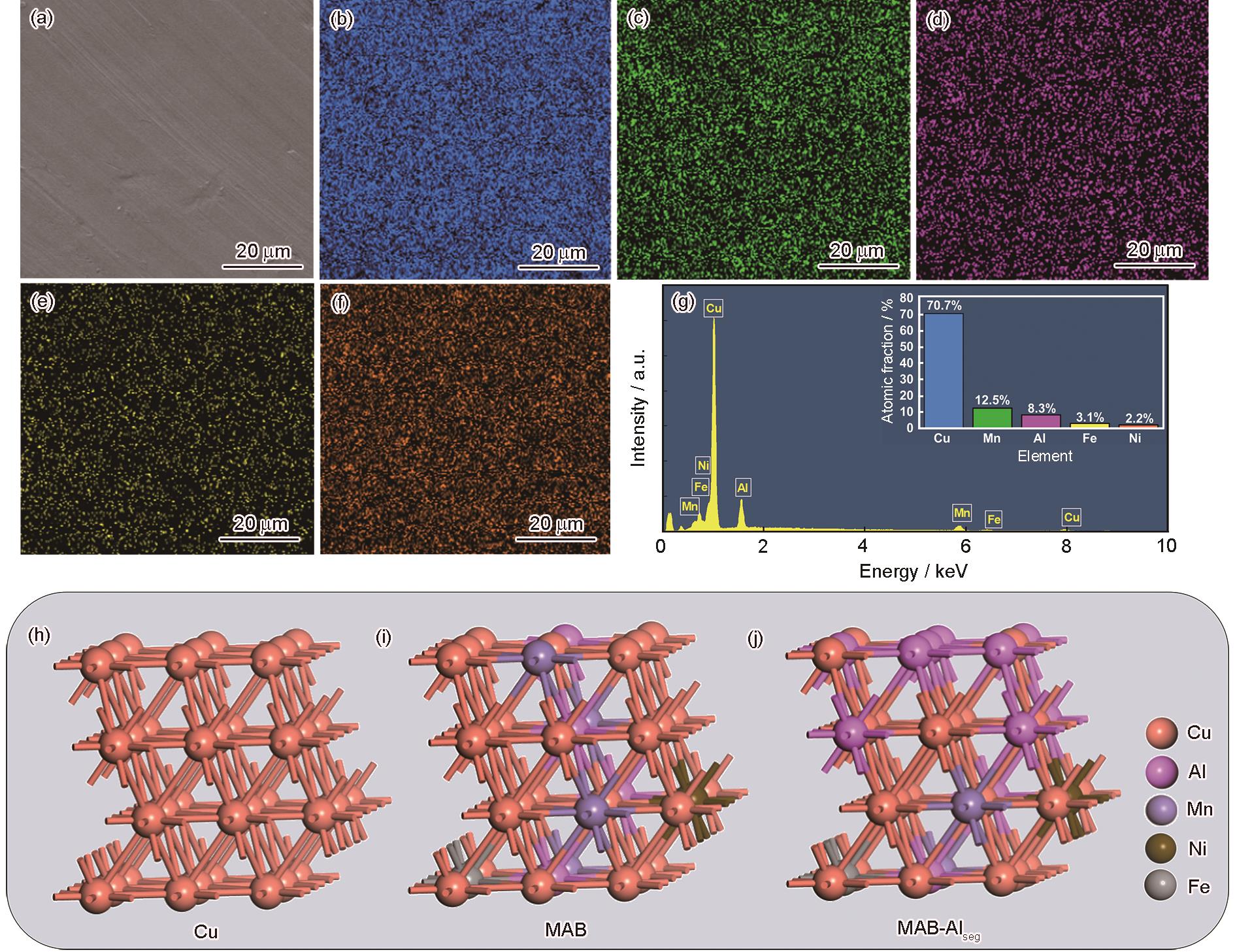
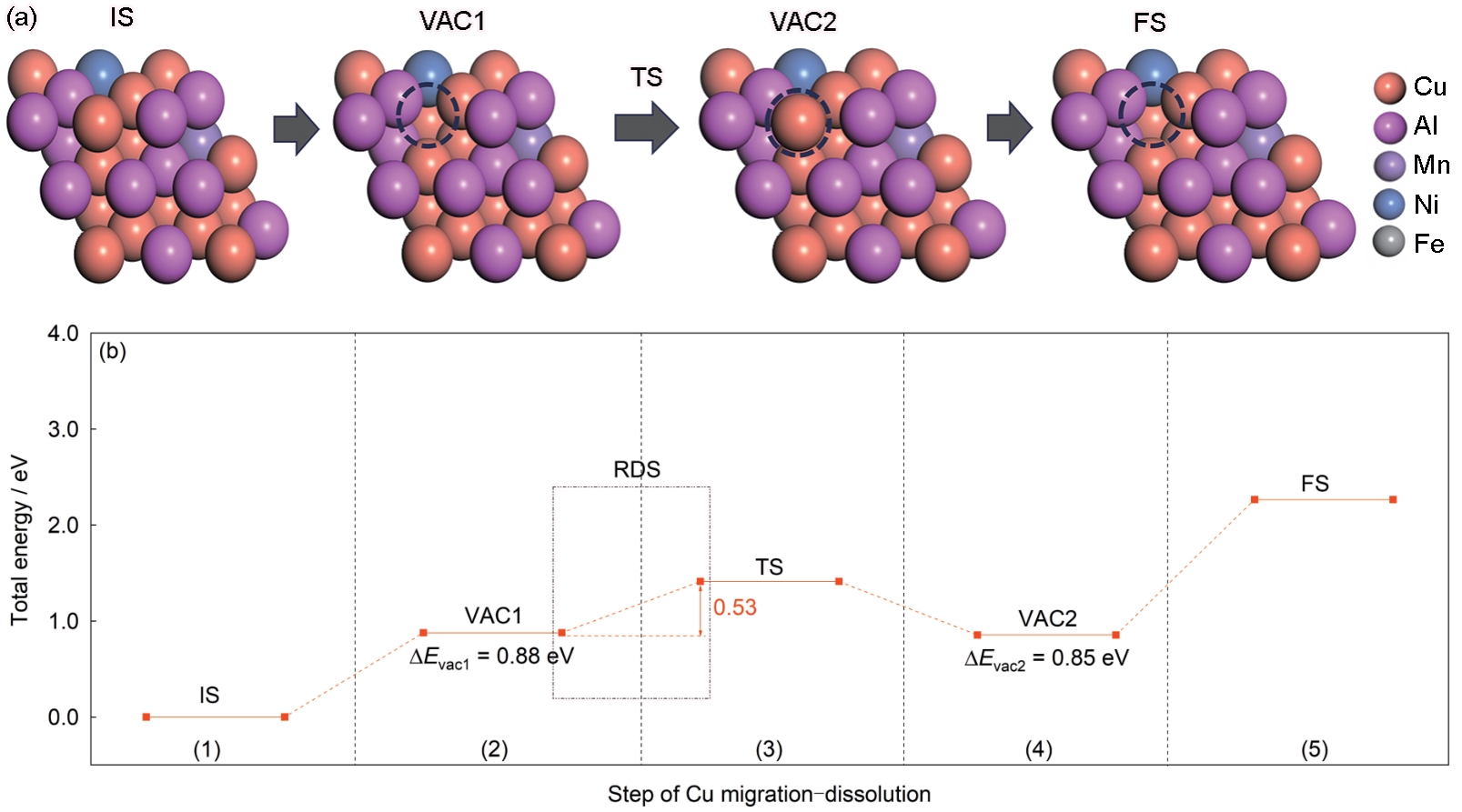
Abstract The microstructure evolution and stress-coupling failure of copper alloys are the primary factors contributing to their accelerated degradation in deep-sea environments, particularly under seawater pressure. In this study, high-manganese aluminum bronze (MAB), a material commonly used in ship propellers, is selected as the research subject. The atomic structure model of MAB alloy with aluminum atomic surface segregation and the strain-coupling model under varying seawater pressures are established through a combination of simulation and experimentation. The failure mechanism under different pressures is further examined, and the corrosion rate is predicted. As seawater pressure increases from 0.1 MPa to 10.0 MPa, the alloy's dislocation density and strain level progressively rise. When the pressure exceeds 6.0 MPa, these increases become more pronounced. The dislocation density of the alloy's (111) crystal surface increases by 6.08 × 10⁻³ nm-2, while the elastic micro-strain level rises by 0.79%. Experimental results indicate that the mass loss rate of copper alloys escalates with increasing pressure. Additionally, the morphology of the corrosion products transitions from a spot-like to a lamellar structure. Density functional theory calculations reveal that seawater pressure significantly affects the stability of the alloy structure. When seawater pressure surpasses the critical threshold of 6.0 MPa, the copper vacancy formation energy and migration-dissolution activation barrier decrease substantially, leading to a notable increase in the dissolution rate. The molecular dynamics method is employed to investigate the adsorption behavior of Cl- on the alloy surface under deep-sea pressure and its influence on corrosion. The results demonstrate that increasing pressure enhances the chemical adsorption of Cl-. However, at 10.0 MPa, the saturated adsorption of Cl- on the surface does not significantly affect the dissolution rate.
|
|
Received: 14 August 2024
|
|
|
| [1] |
Cobo I, Biezma-Moraleda M V, Linhardt P. Corrosion evaluation of welded nickel aluminum bronze and manganese aluminum bronze in synthetic sea water [J]. Mater. Corros., 2022, 73: 1788
|
| [2] |
Linhardt P, Strobl S, Böhm J, et al. Heat treatment effect on the microstructure and the corrosion resistance of manganese-aluminum bronzes [J]. Prakt. Metallogr., 2021, 58: 72
|
| [3] |
Ocejo I C, Moraleda M V B, Linhardt P. Corrosion behavior of heat-treated nickel-aluminum bronze and manganese-aluminum bronze in natural waters [J]. Metals, 2022, 12: 380
doi: 10.3390/met12030380
|
| [4] |
Feng X W, Zheng Z B, Feng B, et al. Microstructure and corrosion properties of nickel aluminum bronze (NAB) [J]. Corros. Prot., 2022, 43(10): 84
|
|
冯晓伟, 郑志斌, 冯 波 等. 镍铝青铜(NAB)的微观组织及腐蚀性能 [J]. 腐蚀与防护, 2022, 43(10): 84
|
| [5] |
Zhang C D, Liu B, Shi Z Y, et al. Research progress in corrosion behavior of nickel aluminum bronze alloys in seawater [J]. J. Chin. Soc. Corros. Prot., 2022, 42: 25
|
|
张赪栋, 刘 斌, 石泽耀 等. 镍铝青铜合金海水腐蚀行为研究进展 [J]. 中国腐蚀与防护学报, 2022, 42: 25
doi: 10.11902/1005.4537.2020.221
|
| [6] |
Sun F L, Li X G, Lu L, et al. Corrosion behavior of copper alloys in deep ocean environment of south China sea [J]. Acta Metall. Sin., 2013, 49: 1211
doi: 10.3724/SP.J.1037.2013.00142
|
|
孙飞龙, 李晓刚, 卢 琳 等. 铜合金在中国南海深海环境下的腐蚀行为研究 [J]. 金属学报, 2013, 49: 1211
doi: 10.3724/SP.J.1037.2013.00142
|
| [7] |
Song Q N, Li H L, Zhang H N, et al. Correlation between microstructure and corrosion and cavitation erosion behaviors of nickel aluminum bronze [J]. Trans. Nonferrous Met. Soc. China, 2022, 32: 2948
doi: 10.1016/S1003-6326(22)65995-8
|
| [8] |
Yi X N. Study on the relationship between microstructure and corrosion behavior of typical marine copper alloys [D]. Shenyang: University of Science and Technology of China, 2022
|
|
衣雪宁. 典型船用铜合金微观组织与腐蚀行为关系研究 [D]. 沈阳: 中国科学技术大学, 2022
|
| [9] |
Tan Y X, Xie H F, Feng X, et al. Effect of Al / Ni ratio on the microstructure and properties of nickel-aluminum bronze alloys [J]. Materials, 2024, 17: 1330
doi: 10.3390/ma17061330
|
| [10] |
Chen K X, Li Z H, Wang Z D, et al. Morphological evolution of Fe-rich precipitates in a Cu-2.0Fe alloy during isothermal treatment [J]. Acta Metall. Sin., 2023, 59: 1665
doi: 10.11900/0412.1961.2021.00568
|
|
陈凯旋, 李宗烜, 王自东 等. Cu-2.0Fe合金等温处理过程中富Fe析出相的形态演变 [J]. 金属学报, 2023, 59: 1665
doi: 10.11900/0412.1961.2021.00568
|
| [11] |
Liu M Z, Zhou L L, Zuo P C, et al. Preparation and corrosion behavior of additive manufactured nickel-aluminum bronze alloys [J]. Copper Eng., 2024, (1): 54
|
|
刘明泽, 周礼龙, 左鹏程 等. 增材制造镍铝青铜合金的制备与腐蚀行为研究进展 [J]. 铜业工程, 2024, (1): 54
|
| [12] |
Liu Y X, Zhu W W, Qi S G. Study on welding and heat treatment technology of nickel-aluminium bronze C63000 [J]. Power Stn. Aux. Equip., 2023, 44(1): 15
|
|
刘玉祥, 朱伟伟, 齐淑改. 镍铝青铜C63000材料的焊接及热处理工艺研究 [J]. 电站辅机, 2023, 44(1): 15
|
| [13] |
Zong L. Effect of hot treatment on microstructure and corrosion resistance of NAB alloy [D]. Ganzhou: Jiangxi University of Science and Technology, 2023
|
|
宗 林. 热处理对镍铝青铜合金组织和耐蚀性的影响研究 [D]. 赣州: 江西理工大学, 2023
|
| [14] |
Tong Y, Song Q N, Li H L, et al. A comparative assessment on cavitation erosion behavior of typical copper alloys used for ship propeller [J]. J. Chin. Soc. Corros. Prot., 2021, 41: 639
|
|
佟 瑶, 宋亓宁, 李慧琳 等. 三种典型船舶螺旋桨用铜合金的空蚀行为对比研究 [J]. 中国腐蚀与防护学报, 2021, 41: 639
|
| [15] |
Wu S X, Gao Z M, Jia H, et al. Effect of hydrostatic pressure on the anodic dissolution process of X80 steel [J]. J. Mater. Res. Technol., 2024, 30: 4786
doi: 10.1016/j.jmrt.2024.04.174
|
| [16] |
Xiong X L, Ban X J, Yan Y, et al. Hydrostatic pressure effect on double layer capacity of iron [J]. J. Electroanal. Chem., 2020, 871: 114306
doi: 10.1016/j.jelechem.2020.114306
|
| [17] |
Liu R, Cui Y, Liu L, et al. Study on the mechanism of hydrostatic pressure promoting electrochemical corrosion of pure iron in 3.5% NaCl solution [J]. Acta Mater., 2021, 203: 116467
doi: 10.1016/j.actamat.2020.11.009
|
| [18] |
Ma R Y, Zhao L, Wang C G, et al. Influence of hydrostatic pressure on the thermodynamics and kinetics of metal corrosion [J]. Acta Metall. Sin., 2019, 55: 281
doi: 10.11900/0412.1961.2018.00215
|
|
马荣耀, 赵 林, 王长罡 等. 静水压力对金属腐蚀热力学及动力学的影响 [J]. 金属学报, 2019, 55: 281
doi: 10.11900/0412.1961.2018.00215
|
| [19] |
Ma H Y, Liu R, Cui Y, et al. The effect law of different hydrostatic pressures on the failure of multilayer Cr/GLC coatings in 3.5 wt% NaCl solution [J]. Corros. Sci., 2023, 217: 111120
doi: 10.1016/j.corsci.2023.111120
|
| [20] |
Song Z Q, Tegus O. The corrosion properties of bronze alloys in NaCl solutions [J]. Materials, 2023, 16: 5144
doi: 10.3390/ma16145144
|
| [21] |
Hu S B, Liu L, Cui Y, et al. Influence of hydrostatic pressure on the corrosion behavior of 90/10 copper-nickel alloy tube under alternating dry and wet condition [J]. Corros. Sci., 2019, 146: 202
doi: 10.1016/j.corsci.2018.10.036
|
| [22] |
Song Y S, Liu R, Cui Y, et al. Stress corrosion behavior of Ni-Cr-Mo-V steel in 3.5%NaCl solution under the interaction of hydrostatic pressure and tensile stress [J]. Acta Metall. Sin., 2025, 61: 309
|
|
宋昱杉, 刘 叡, 崔 宇 等. 静水压力和拉伸应力交互作用下Ni-Cr-Mo-V钢在3.5%NaCl溶液中的应力腐蚀行为 [J]. 金属学报, 2025, 61: 309
doi: 10.11900/0412.1961.2023.00087
|
| [23] |
Hájek J, Kříž A, Chocholaty O, et al. Effect of heat treatment on microstructural changes in aluminium bronze [J]. Arch. Metall. Mater., 2016, 61: 925
|
| [24] |
Ding Y, Zhao R, Qin Z B, et al. Evolution of the corrosion product film on nickel-aluminum bronze and its corrosion behavior in 3.5 wt% NaCl solution [J]. Materials, 2019, 12: 209
doi: 10.3390/ma12020209
|
| [25] |
Punburi P, Tareelap N, Srisukhumbowornchai N, et al. De-alloying corrosion in the heat-affected zone in Mn-Al bronze weld [J]. Mater. Chem. Phys., 2018, 212: 471
doi: 10.1016/j.matchemphys.2018.03.065
|
| [26] |
Song Q N, Wang Y, Jin Z T, et al. Comparison of the corrosion and cavitation erosion behaviors of the cast and surface-modified manganese-aluminum bronzes in sodium chloride solution [J]. J. Mater. Res. Technol., 2024, 30: 4310
doi: 10.1016/j.jmrt.2024.04.140
|
| [27] |
Yi X N, Ma A L, Zheng Y G, et al. Elucidating different selective corrosion behavior of two typical marine aluminum bronze alloys from the perspective of constituent phases [J]. Corros. Sci., 2024, 235: 112167
doi: 10.1016/j.corsci.2024.112167
|
| [28] |
Zak A K, Majid W H A, Abrishami M E, et al. X-ray analysis of ZnO nanoparticles by Williamson-Hall and size-strain plot methods [J]. Solid State Sci., 2011, 13: 251
doi: 10.1016/j.solidstatesciences.2010.11.024
|
| [29] |
Aigbodion V S, Ozor P O, Eke M N, et al. Explicit microstructure, corrosion, and stress analysis of value-added Al-3.7%Cu-1.4%Mg/1.5% rice husk ash nanoparticles for pump impeller application [J]. Chem. Data Collect., 2021, 33: 100675
doi: 10.1016/j.cdc.2021.100675
|
| [30] |
Delley B. An all-electron numerical method for solving the local density functional for polyatomic molecules [J]. J. Chem. Phys., 1990, 92: 508
|
| [31] |
Saavedra-Torres M, Escobar C A, Ocayo F, et al. 1,2,3-Benzotriazole derivatives adsorption on Cu(111) surface: A DFT study [J]. Chem. Phys. Lett., 2017, 689: 128
doi: 10.1016/j.cplett.2017.09.067
|
| [32] |
Straumanis M E, Yu L S. Lattice parameters, densities, expansion coefficients and perfection of structure of Cu and of Cu-In α phase [J]. Acta Cryst., 1969, 25A: 676
|
| [33] |
Chen Z M, Jin C, Ji X Y, et al. Atomistic understanding of Pt-based medium entropy alloys for oxygen reduction electrocatalysis based on first principles [J]. Int. J. Hydrogen Energy, 2023, 48: 160
doi: 10.1016/j.ijhydene.2022.09.247
|
| [34] |
Liu M, Jin Y, Zhang C H, et al. Density-functional theory investigation of Al pitting corrosion in electrolyte containing chloride ions [J]. Appl. Surf. Sci., 2015, 357: 2028
doi: 10.1016/j.apsusc.2015.09.180
|
| [35] |
Wang H B, Hao Y L, Chen S H, et al. DFT study of imidazoles adsorption on the grain boundary of Cu (100) surface [J]. Corros. Sci., 2018, 137: 33
doi: 10.1016/j.corsci.2018.03.009
|
| [36] |
Luo H, Dong C F, Xiao K, et al. Characterization of passive film on 2205 duplex stainless steel in sodium thiosulphate solution [J]. Appl. Surf. Sci., 2011, 258: 631
doi: 10.1016/j.apsusc.2011.06.077
|
| [37] |
Mosleh-Shirazi S, Hua G M, Akhlaghi F, et al. Interfacial valence electron localization and the corrosion resistance of Al-SiC nanocomposite [J]. Sci. Rep., 2015, 5: 18154
doi: 10.1038/srep18154
pmid: 26667968
|
| [38] |
Li Q Y, Lu H, Cui J, et al. Understanding the low corrosion potential and high corrosion resistance of nano-zinc electrodeposit based on electron work function and interfacial potential difference [J]. RSC Adv., 2016, 6: 97606
doi: 10.1039/C6RA19563F
|
| [39] |
Delley B. The conductor-like screening model for polymers and surfaces [J]. Mol. Simul., 2006, 32: 117
doi: 10.1080/08927020600589684
|
| [40] |
Halgren T A, Lipscomb W N. The synchronous-transit method for determining reaction pathways and locating molecular transition states [J]. Chem. Phys. Lett., 1977, 49: 225
doi: 10.1016/0009-2614(77)80574-5
|
| [41] |
Canneaux S, Bohr F, Henon E. KiSThelP: A program to predict thermodynamic properties and rate constants from quantum chemistry results [J]. J. Comput. Chem., 2014, 35: 82
pmid: 24190715
|
| [42] |
Lebègue E. Allen J. Bard, Larry. R. Faulkner, Henry S. White: Electrochemical methods: Fundamentals and applications [J]. Transit. Met. Chem., 2023, 48: 433
doi: 10.1007/s11243-023-00555-6
|
| [43] |
Magnussen O M, Groß A. Toward an atomic-scale understanding of electrochemical interface structure and dynamics [J]. J. Am. Chem. Soc., 2019, 141: 4777
doi: 10.1021/jacs.8b13188
pmid: 30768905
|
| [44] |
Spohr E. Molecular dynamics simulations of water and ion dynamics in the electrochemical double layer [J]. Solid State Ionics, 2002, 150: 1
doi: 10.1016/S0167-2738(02)00275-8
|
| [45] |
Feng L J, Yang H Y, Wang F H. Experimental and theoretical studies for corrosion inhibition of carbon steel by imidazoline derivative in 5% NaCl saturated Ca(OH)2 solution [J]. Electrochim. Acta, 2011, 58: 427
doi: 10.1016/j.electacta.2011.09.063
|
| [46] |
Kornherr A, Nauer G E, Sokol A A, et al. Adsorption of organosilanes at a Zn-terminated ZnO (0001) surface: Molecular dynamics study [J]. Langmuir, 2006, 22: 8036
pmid: 16952238
|
| [47] |
Byrne C, Brady A, Walsh L, et al. Chemical and electrical characterisation of the segregation of Al from a CuAl alloy (90% :10% wt) with thermal anneal [J]. Thin Solid Films, 2016, 599: 59
doi: 10.1016/j.tsf.2015.12.056
|
| [48] |
Dai Y, Ou L H, Liang W, et al. Efficient and superiorly durable Pt-lean electrocatalysts of Pt-W alloys for the oxygen reduction reaction [J]. J. Phys. Chem., 2011, 115C: 2162
|
| [49] |
Yin X H, Li Y K, Zhou R F, et al. Microstructure and properties of QAl10-4-4 alloy fabricated by rheological squeeze casting [J]. J. Mater. Res., 2023, 38: 2453
doi: 10.1557/s43578-023-00975-1
|
| [50] |
Deng J, Wang C, Guan G Z, et al. The deformations of carbon nanotubes under cutting [J]. ACS Nano, 2017, 11: 8464
doi: 10.1021/acsnano.7b04130
pmid: 28767215
|
| [51] |
Bryzgalov V, Kistanov A A, Khafizova E, et al. Experimental study of corrosion rate supplied with an ab-initio elucidation of corrosion mechanism of biodegradable implants based on Ag-doped Zn alloys [J]. Appl. Surf. Sci., 2024, 652: 159300
doi: 10.1016/j.apsusc.2024.159300
|
| [52] |
Ma H, Chen X Q, Li R H, et al. First-principles modeling of anisotropic anodic dissolution of metals and alloys in corrosive environments [J]. Acta Mater., 2017, 130: 137
doi: 10.1016/j.actamat.2017.03.027
|
| [53] |
Fischer S, Karplus M. Conjugate peak refinement: An algorithm for finding reaction paths and accurate transition states in systems with many degrees of freedom [J]. Chem. Phys. Lett., 1992, 194: 252
doi: 10.1016/0009-2614(92)85543-J
|
| [54] |
Sun M, Nelson A E, Adjaye J. Ab initio DFT study of hydrogen dissociation on MoS2, NiMoS, and CoMoS: Mechanism, kinetics, and vibrational frequencies [J]. J. Catal., 2005, 233: 411
doi: 10.1016/j.jcat.2005.05.009
|
| [55] |
Li R X, Zhou C X, Yang H M, et al. Microstructural evolution and dynamic failure mechanism of B10 Cu-Ni alloy under multiple stress coupling in flowing seawater [J]. Acta Metall. Sin., 2026, 62: 1273
doi: 10.11900/0412.1961.2024.00323
|
|
李瑞雪, 周晨曦, 杨慧敏 等. 流动海水中多重应力耦合作用下B10 Cu-Ni合金的微观结构演变与动态失效机制 [J]. 金属学报, 2026, 62: 1273
doi: 10.11900/0412.1961.2024.00323
|
| [56] |
Lück J, Latz A. Modeling of the electrochemical double layer and its impact on intercalation reactions [J]. Phys. Chem. Chem. Phys., 2018, 20: 27804
doi: 10.1039/c8cp05113e
pmid: 30379165
|
| [57] |
Xu K, Wang B J, Sun J. Research progress on the influence of anions in typical corrosive media on corrosion behavior of magnesium alloys [J]. Mater. Prot., 2022, 55(12): 166
|
|
许 凯, 王保杰, 孙 杰. 典型腐蚀介质中阴离子对镁合金腐蚀行为影响的研究进展 [J]. 材料保护, 2022, 55(12): 166
|
| [58] |
Zhang C H, Liu M, Jin Y, et al. The corrosive influence of chloride ions preference adsorption on α-Al2O3 (0 0 0 1) surface [J]. Appl. Surf. Sci., 2015, 347: 386
doi: 10.1016/j.apsusc.2015.04.088
|
| No Suggested Reading articles found! |
|
|
Viewed |
|
|
|
Full text
|
|
|
|
|
Abstract
|
|
|
|
|
Cited |
|
|
|
|
| |
Shared |
|
|
|
|
| |
Discussed |
|
|
|
|