



自20世纪50年代以来,受益于线弹性断裂力学的发展和实验技术的巨大进步,疲劳裂纹扩展的力学模型、疲劳裂纹扩展速率表达式、疲劳寿命的预测模型先后建立。Irwin[4]于1957年提出使用应力强度因子(K)来表征线弹性裂尖力学场,为后续疲劳裂纹扩展模型的发展奠定了理论基础。在此基础上,Paris和Erdogan[5]总结出了描述疲劳裂纹扩展速率的幂指数定律,即Paris公式,为后续预测疲劳裂纹扩展寿命提供了一种新的估算方法。为了更精确地描述疲劳裂纹扩展行为,Forman等[6]考虑了平均应力对裂纹扩展速率(da / dN,其中,a为裂纹扩展长度,N为循环周次)及应力强度因子范围(ΔK)的影响,通过修正Paris公式提出了Forman公式。Forman公式和Paris公式已经被广泛应用于宏观疲劳裂纹扩展之中。然而,实际的疲劳裂纹扩展过程是一个从微观到宏观的多尺度发展过程,Forman公式和Paris公式并不适用于描述短裂纹疲劳扩展规律[7,8]。为此,Deng等[9]提出了一个描述短裂纹疲劳扩展规律的经验公式。Ye等[10]探究了微观组织小裂纹(microstructurally small crack,MSC)、介观物理小裂纹(physically small crack,PSC)和宏观长裂纹(long crack,LC)阶段的疲劳裂纹扩展规律,并提出了一个多尺度疲劳裂纹扩展模型。该模型基于微观结构非相似性原理,认为微观结构非相似性主导了裂纹在MSC阶段的扩展行为,而在PSC和LC阶段,线弹性断裂力学主导了裂纹扩展行为。Ye等[10]还提出了通过局部屈服强度控制不同尺度下裂纹尖端塑性区内的局部应力分布以及材料的塑性变形能力和微观结构等,用转变参数控制不同工况下MSC阶段到PSC/LC阶段的转变速率。
上述研究使用的方法主要基于经验科学、理论科学和计算科学,如今,科学研究已迈入数据驱动科学范式[11,12],以机器学习为主的数据驱动方法正在被广泛应用于各个领域[13,14]。在疲劳裂纹扩展预测领域,Wang等[15]利用径向基函数网络和遗传算法优化反向传播网络(genetic algorithm optimized backpropagation,GABP)对2024-T451铝合金的疲劳裂纹扩展进行了预测,其预测的准确性和有效性均优于经典的双参数模型(K方法)。Younis等[16]和Zafar等[17]基于多种神经网络方法预测了多种铝合金的疲劳裂纹扩展行为,其预测结果与实验数据吻合良好。Mortazavi和Ince[18]开发了一种径向基函数人工神经网络(radial basis function artificial neural network,RBF-ANN)模型,用以预测Ti-6Al-4V钛合金等的疲劳裂纹扩展行为,模型展现出了良好的预测精度。Zhang等[19]提出了一种基于机器学习的新数据驱动方法,使用反向传播神经网络预测了疲劳裂纹扩展速率与有效应力强度因子的关系以及表面裂纹试样的疲劳寿命。结果表明,该方法能够准确且快速地获取材料数据和预测疲劳寿命。Barbosa等[20]基于人工神经网络提出了一种生成金属恒定寿命图(constant life diagram,CLD)的新方法,可以根据平均应力和应力幅度,在拉伸载荷占主导地位的区域中估计高周疲劳状态的安全区域。Gan等[21]提出了两种基于机器学习的模型用以作为半经验模型的替代方案,以提高平均应力效应的预测精度。Yang等[22]提出了一种基于深度学习的方法以预测多轴疲劳寿命,打破了传统模型局限于特定材料和载荷条件的限制。目前,已有较多关于机器学习在疲劳裂纹扩展预测中的研究,但其均未考虑疲劳裂纹的多尺度裂纹扩展。如前文所述,实际的疲劳裂纹扩展过程是一个多尺度发展过程,若仅使用宏观长裂纹的扩展数据进行预测,将无法全面反映整个裂纹扩展过程,甚至可能会得到非保守的预测结果,因此需要在预测中纳入多尺度裂纹的影响。
此外,虽然数据驱动方法正在被广泛应用,但囿于决策的透明度和结果的可解释性,该方法目前难以部署到一些性能要求高的关键领域。最近,部分学者尝试将数据驱动与机理驱动相结合,通过增加边界条件对模型参数进行约束,以增强数据驱动可解释性、提高泛化能力,进而得到符合物理规律的预测结果。Liu等[23]将局部屈曲理论和弹性屈曲理论引入到人工神经网络模型中,显著提升了在轴向压缩圆柱壳屈曲设计中屈曲载荷的预测效果。Zhang等[24]通过物理信息引导的特征扩展,提高了机器学习模型在蠕变疲劳寿命方面的预测精度。Karpatne等[25]论述了利用物理机理提高数据驱动模型在解决复杂科学问题时的准确性和可靠性。为了解决噪声处理、复杂网格生成和高维参数化等成本密集型问题,Kevrekidis等[26]提出了一种物理信息机器学习模型,该模型融合了噪声数据与数学模型,并通过神经网络或基于核的回归网络实现,达到了简化流程和提高准确性的目的。Yang等[27]针对尼龙-6 (polyamide-6,PA6)与速率有关的多轴疲劳寿命问题,在半经验寿命预测模型的基础上加入了临界面方法以及两个物理约束条件来引导神经网络的训练,改进后混合模型的泛化性能得到了显著提高。Jiang等[28]提出了一种基于物理信息的多层嵌套神经网络框架,用于预测316不锈钢在不同温度和应变率下的低周疲劳寿命。该框架将物理约束集成到多层嵌套神经网络中,以引入物理约束来提高机器学习方法的预测精度。结果表明,所有疲劳寿命预测结果的误差均在2倍以内,大部分在1.5倍以内。进一步,针对316不锈钢在高温高压水环境中的疲劳寿命预测难题,Jiang等[29]提出了一种基于条件生成对抗网络(conditional generative adversarial networks,cGAN)的新模型,该模型以应变幅值、应变速率、温度、溶解氧含量和层错能为条件,实现了环境疲劳寿命的预测与概率评估。然而,目前结合机理驱动的方法仍处于探索阶段,且对边界条件的要求较为苛刻,数据机理双驱动下的融合建模和合理解释仍然是学者们面临的一个难题。
鉴于此,本工作选用304奥氏体不锈钢为研究对象,首先对K近邻回归(KNN)、支持向量机回归(SVR)和随机森林回归(RF)三种算法的疲劳裂纹扩展预测能力进行对比,筛选出预测性能最优的算法。随后,选择该算法,分别基于长裂纹、短裂纹和多尺度裂纹三种疲劳裂纹扩展模型添加数据进行数据增强,以提高疲劳裂纹扩展预测的准确性。最后,基于添加数据增强策略的双驱动模型框架,在不同载荷下进行了多尺度疲劳裂纹扩展预测。与现有研究相比,本工作同样基于数据驱动与机理驱动相结合的思想,但采用了数据增强策略,并聚焦于多尺度疲劳裂纹扩展的预测。
1 数据来源、机器学习算法及数据增强
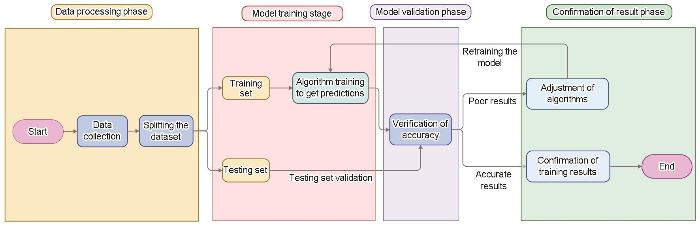
1.1 数据来源及其训练
图1
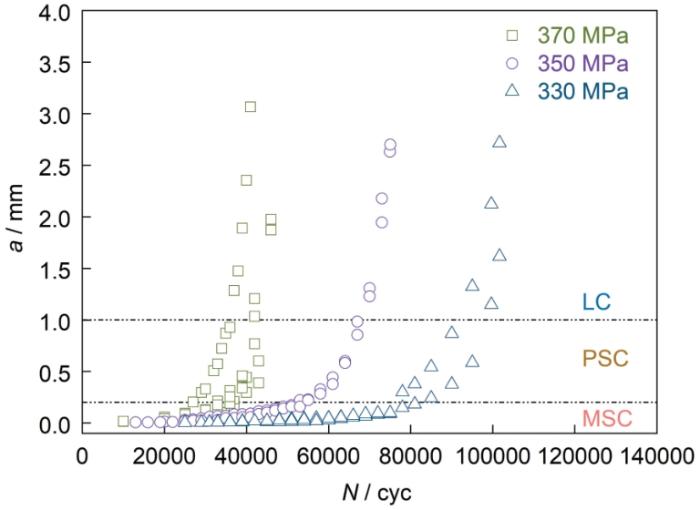
图2
1.2 数据预处理
为了确保模型训练的数值稳定性并促进模型快速收敛,采用Z得分归一化(Z-score normalization)法对输入特征进行标准化处理,以消除特征尺度和分布的差异,如
式中,z为标准化后的特征值,μ为所有数据的均值,σ为所有数据的标准差,x为原始数据点。变化后的数据均值为0,标准差为1,确保所有数据处于统一尺度,便于基于相应算法进行学习和预测。
1.3 机器学习算法
本工作采用KNN、SVR和RF三种机器学习算法。其中,KNN算法是一种监督学习算法,主要用于回归预测[31]。该算法假设新输入数据对应的输出值在各个样本对应的输出值空间中相似,最相似的K个数据点及其各个特征具有相同权重。故输入新数据后,提取样本中与新数据最相似的K个数据,通过取K个数据对应输出值的均值作为新数据的输出值。KNN算法通常采用Euclidean距离对数据点和新数据点进行距离度量,新数据点x0 = [x0, 1, x0, 2, …, x0, j,…, x0, n ]和样本点xi = [xi,1, xi,2, …, xi, j, …, xi, n ]之间的距离(d(x0, xi ))为[31]:
式中, x 为输入的特征向量, ω 为权重向量,b为偏置项。目标是在误差容限内找到最优的 ω 和b,以最小化模型的损失函数[33]:
式中,
式中,RF为预测输出,Si 为第i个样本集,Ck 为第k棵决策树,η(Ck, Si )为Ck 对Si 的决策值,
1.4 模型评价标准
式中,yi 为第i个样本的实测值,
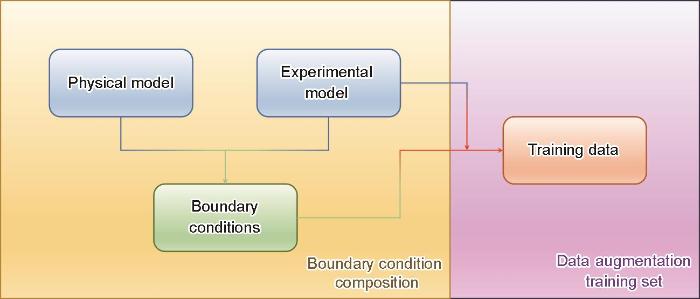
1.5 基于不同裂纹扩展模型的数据增强
图3
式中,C、m为材料参数。
短裂纹扩展模型由Deng等[9]提出,其定义如
式中,A、B为拟合参数。
多尺度裂纹扩展模型由Ye等[10]提出,其表达式如下:
| Model | Parameter | Value |
|---|---|---|
| Long crack | C | 1.615 |
| m | 2.58 | |
| Short crack | A | 1.000 |
| B | 1.19 | |
| Multi-scale crack | C | 3.630 |
| q | 1.37 |
表2 数据集数量
Table 2
Load / MPa | Number of experimental dataset | Number of data augmentation dataset |
|---|---|---|
| 330 | 61 | 18 |
| 350 | 50 | 15 |
| 370 | 45 | 14 |
2 结果与讨论
2.1 不同算法对比
首先选用370 MPa下的数据作为训练集和测试集,基于三种算法的训练集的训练结果和测试集预测结果如图4所示(apre为裂纹长度预测值,aexp为裂纹长度实测值)。由图可见,与SVR和KNN算法相比,RF算法训练结果和测试结果的预测精度均为最佳,这表明与SVR和KNN算法相比,RF算法更适合疲劳裂纹扩展预测。进一步,通过对比三种算法的RMSE和R2 (图5)可知,相较于其他两种算法,RF算法的RMSE更低,R2更高,即RF算法的预测更准确。从训练集训练结果来看,三种算法的精度排序为RF > KNN > SVR;从测试集预测结果来看,三种算法的精度为RF > SVR > KNN。鉴于此,本工作将选用RF算法进行后续研究。
图4
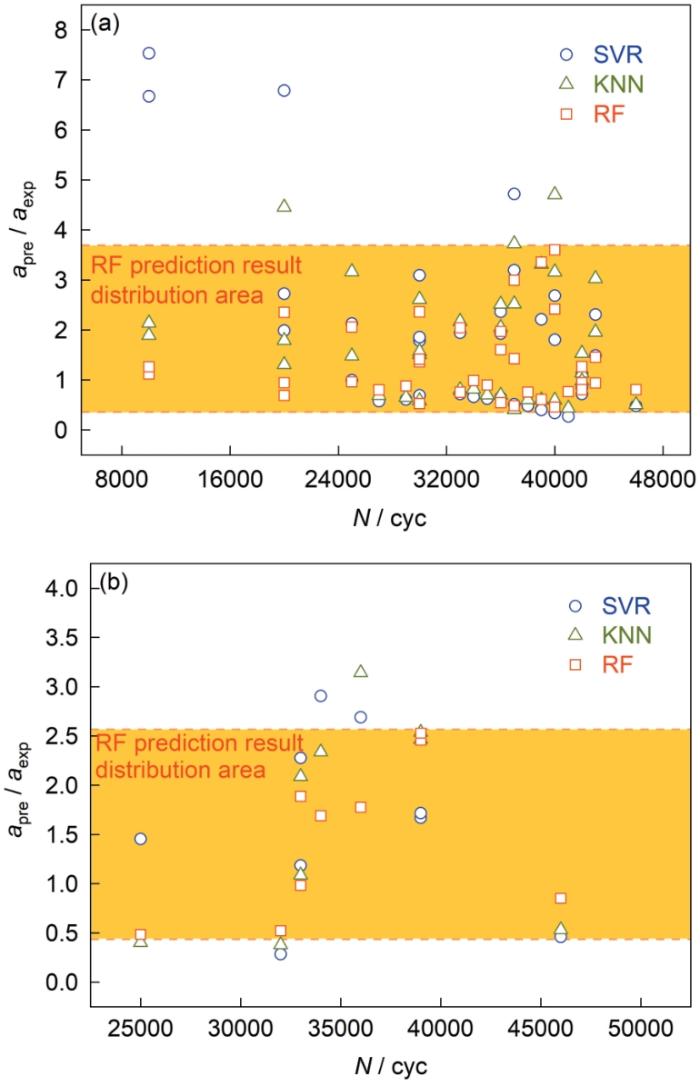
图4
三种算法训练集训练结果和测试集预测结果对比
Fig.4
Comparisons of training results of training sets (a) and prediction results of testing sets (b) for three algorithms (SVR—support vector machine regression, KNN—nearest neighbor regression, RF—random forest regression, apre—predicted crack length, aexp—experimental crack length)
图5
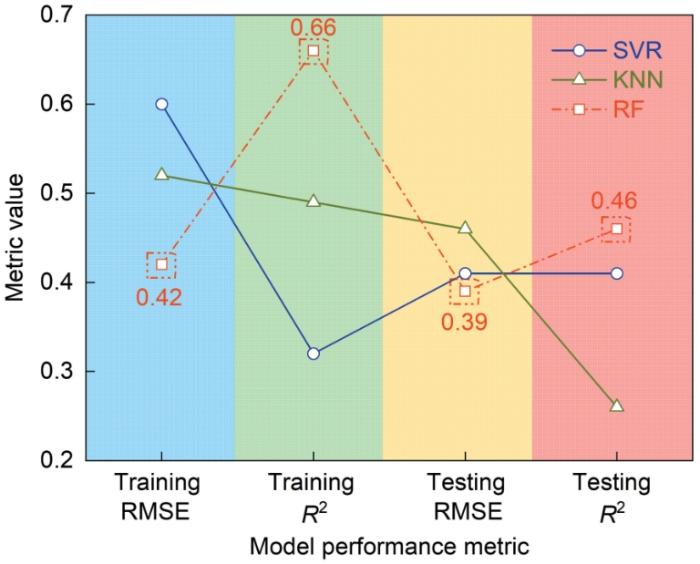
图5
三种算法的均方根误差(RMSE)及决定系数(R2)对比
Fig.5
Comparisons of root mean square errors (RMSE) and coefficient of determinations (R2) among the three algorithms
2.2 不同疲劳裂纹扩展模型数据增强效果对比
图6
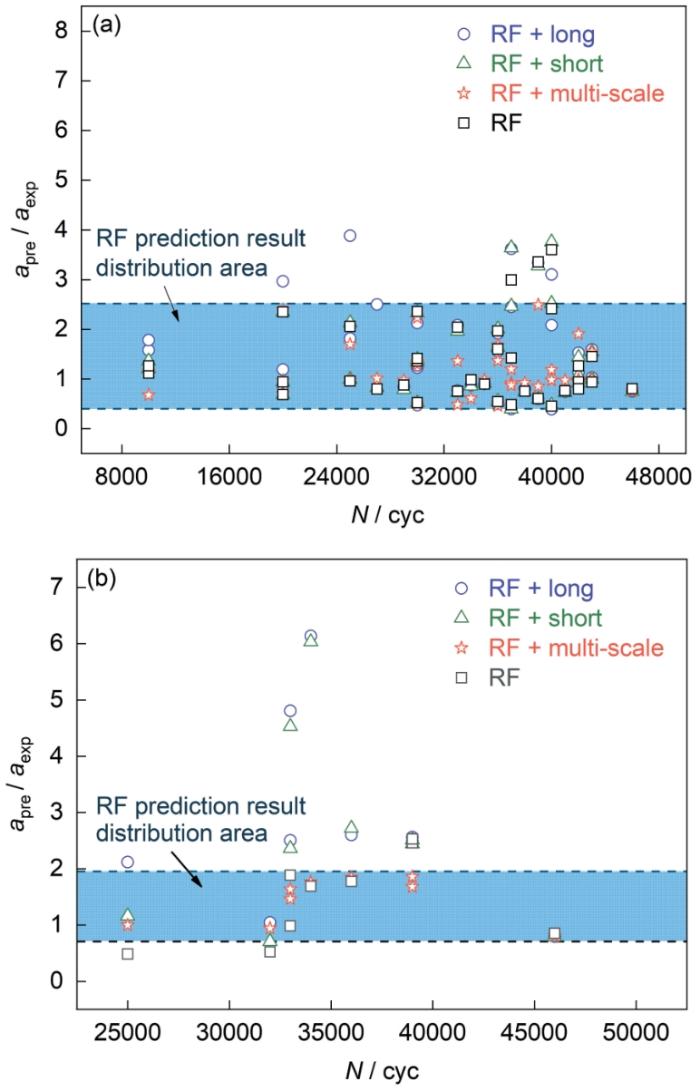
图6
三种疲劳裂纹扩展模型对训练集和测试集的数据增强效果
Fig.6
Data augmentation effects of three fatigue crack propagation models on training results of training sets (a) and prediction results of test sets (b)
基于三种模型数据增强后的RMSE及R2如图7所示。可以看出,经多尺度裂纹扩展模型数据增强后,RMSE明显降低、R2显著提高。这说明多尺度疲劳裂纹扩展模型完整地反映了裂纹扩展的全过程,而长裂纹扩展模型和短裂纹扩展模型仅能准确反映裂纹扩展的部分过程,其预测精度反而较数据增强前有所降低。
图7
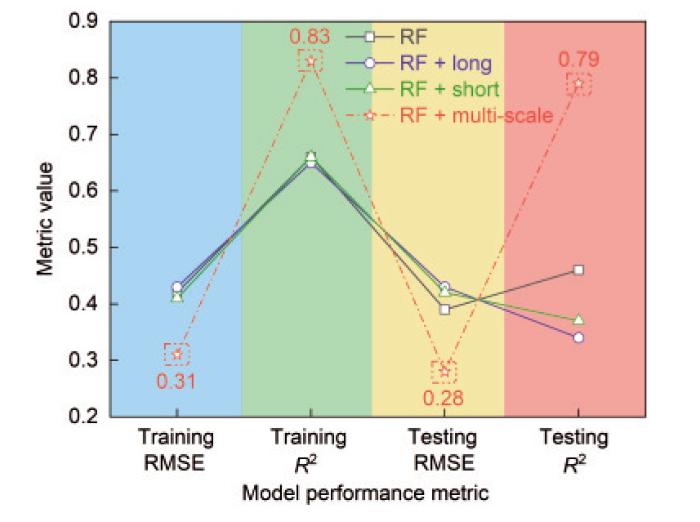
图7
基于三种模型数据增强后RMSE及R2对比
Fig.8
Comparison of RMSE and R2 after data augmentation based on the three models
2.3 不同载荷下多尺度疲劳裂纹扩展预测
图8
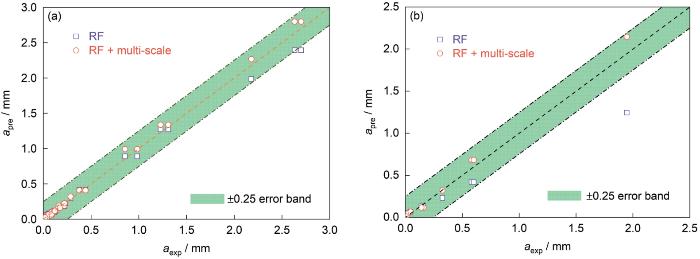
图8
350 MPa下基于双驱动模型和随机森林(RF)算法模型的多尺度疲劳裂纹扩展预测结果
Fig.8
Prediction results of multi-scale fatigue crack propagation at 350 MPa based on dual-drive model and RF model
(a) training results of training sets (b) prediction results of testing sets
图9
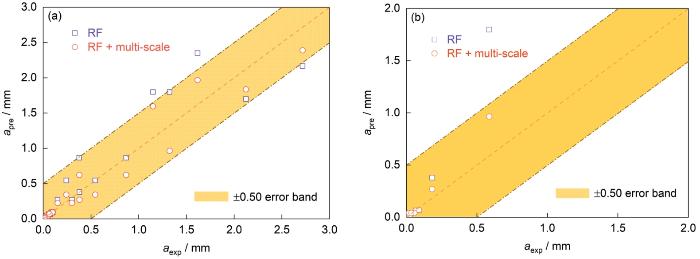
图9
330 MPa下基于双驱动模型和RF算法模型的多尺度疲劳裂纹扩展预测结果
Fig.9
Prediction results of multi-scale fatigue crack propagation at 330 MPa based on dual-drive model and RF model
(a) training results of training sets (b) prediction results of testing sets
350和330 MPa载荷条件下,RMSE与R2如图10所示。可以看出,数据增强后,350 MPa下基于多尺度裂纹扩展模型的训练集与测试集的RMSE分别为0.046与0.111,R2达到了0.995与0.961;330 MPa下训练集与测试集的RMSE分别为0.171与0.081,R2达到了0.911与0.721,均优于纯数据驱动模型。在MSC阶段的预测结果优于PSC阶段与LC阶段。
图10
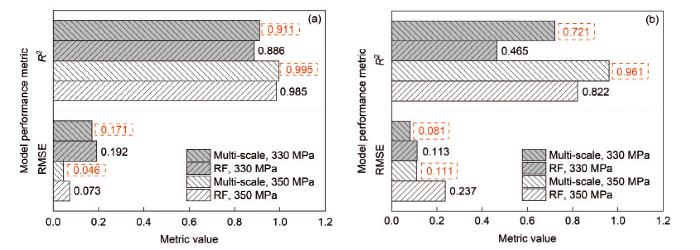
图10
350和330 MPa下基于双驱动模型和RF算法模型的RMSE及R2
Fig.10
RMSE and R2 at 350 and 330 MPa based on dual-drive model and RF model
(a) training results of training sets (b) prediction results of testing sets
在实际工程中,由于各种条件限制,无法得到大量的实验数据,也很难获得不同尺度下的疲劳裂纹扩展结果。本工作通过数据增强方法增加了实验数据数量,并基于多尺度疲劳裂纹扩展模型进行预测,获得了较为准确的不同尺度下的疲劳裂纹扩展数据,有效地解决了这一难题,为实际工程应用提供了便利。需要说明的是,虽然本工作以304奥氏体不锈钢为研究对象,但所提出的方法具备一定的普适性,可适用于其他金属材料。
3 结论
(1) 与SVR和KNN算法相比,RF算法的RMSE更低,R2更高,更适合疲劳裂纹扩展预测。370 MPa载荷条件下,从训练集训练结果来看,三种算法的精度为RF > KNN > SVR;从测试集预测结果来看,三种算法的精度为RF > SVR > KNN。
(2) 多尺度疲劳裂纹扩展模型完整地反映了裂纹扩展全过程,长裂纹和短裂纹扩展模型仅能准确反映裂纹扩展的部分过程,基于多尺度疲劳裂纹扩展模型的数据增强效果明显优于其余两种模型。数据增强后,其训练集训练结果精度提升了25.76%,测试集预测结果精度提升了71.74%。
(3) 基于RF算法与数据增强策略的双驱动模型具有很好的泛化能力,350 MPa下基于多尺度裂纹扩展模型的训练集与测试集的RMSE分别为0.046与0.111,R2分别达到了0.995与0.961;330 MPa下训练集与测试集的RMSE分别为0.171与0.081,R2分别达到了0.911与0.721。此外,与基于RF算法的纯数据驱动模型相比,双驱动模型预测结果明显更加准确。
参考文献
Review: Relations between metastable austenite and fatigue behavior of steels
[J].
With the deepening and improvement of the research on the conventional mechanical properties of metallic materials, the long-term service properties, such as fatigue and creep, showed more and more critical influence on the development of metallic materials. As one of the most important engineering structural materials, in order to clarify the fatigue failure mechanism, the research of steels on the relationship between microstructure and fatigue properties has been a hot and difficult problem for a long time. With the rapid development of smelting technology for steels, the research on the influencing factors of fatigue gradually changes from inclusions to microstructures as metastable austenite, precipitates, etc. Therefore, in order to further analyze the feasible direction of the research on the influence of microstructure on fatigue, this paper summarizes the influence and mechanism of metastable austenite on the fatigue property of advanced steel materials. The influence mechanism of metastable austenite on fatigue property by relevant scholars under different service conditions such as low cycle fatigue and high cycle fatigue was reviewed. Based on the experimental results, the relationship between metastable austenite and fatigue properties was quantitatively evaluated by machine learning. The quantitative relationship between the content/stability of metastable austenite and fatigue life was established, which could provide the basis direction for the further study of the mechanism of fatigue for steels.
综述: 钢中亚稳奥氏体组织与疲劳性能关系
[J].
Investigation of novel type of cylindrical lithium-ion battery heat exchangers based on topology optimization
[J].
Machine learning-based fatigue life prediction of metal materials: Perspectives of physics-informed and data-driven hybrid methods
[J].
Analysis of stresses and strains near the end of a crack traversing a plate
[J].A substantial fraction of the mysteries associated with crack extension might be eliminated if the description of fracture experiments could include some reasonable estimate of the stress conditions near the leading edge of a crack particularly at points of onset of rapid fracture and at points of fracture arrest. It is pointed out that for somewhat brittle tensile fractures in situations such that a generalized plane-stress or a plane-strain analysis is appropriate, the influence of the test configuration, loads, and crack length upon the stresses near an end of the crack may be expressed in terms of two parameters. One of these is an adjustable uniform stress parallel to the direction of a crack extension. It is shown that the other parameter, called the stress-intensity factor, is proportional to the square root of the force tending to cause crack extension. Both factors have a clear interpretation and field of usefulness in investigations of brittle-fracture mechanics.
A critical analysis of crack propagation laws
[J].The practice of attempting validation of crack-propagation laws (i.e., the laws of Head, Frost and Dugdale, McEvily and Illg, Liu, and Paris) with a small amount of data, such as a few single specimen test results, is questioned. It is shown that all the laws, though they are mutually contradictory, can be in agreement with the same small sample of data. It is suggested that agreement with a wide selection of data from many specimens and over many orders of magnitudes of crack-extension rates may be necessary to validate crack-propagation laws. For such a wide comparison of data a new simple empirical law is given which fits the broad trend of the data.
Numerical analysis of crack propagation in cyclic-loaded structures
[J].An improved theory is proposed for the crack-growth analysis of cyclic-loaded structures. The theory assumes that the crack tip stress-intensity-factor range, ΔK, is the controlling variable for analyzing crack-extension rates. The new theory, however, takes into account the load ratio, R, and the instability when the stress-intensity factor approaches the fracture toughness of the material, Kc. Excellent correlation is found between the theory and extensive experimental data. A computer program has been developed using the new theory to analyze the crack propagation and time to failure for cyclic-loaded structures.
Initiation of fatigue cracks in commercial aluminium alloys and the subsequent propagation of very short cracks
[J].
Surface small crack growth behavior in low-cycle fatigue at elevated temperature and application limit of macroscopic crack growth law
[J].
Small fatigue crack growth mechanisms of 304 stainless steel under different stress levels
[J].
Fatigue life prediction of nickel-based GH4169 alloy on the basis of a multi-scale crack propagation approach
[J].
Perspective: Materials informatics and big data: Realization of the “fourth paradigm” of science in materials science
[J].
From DFT to machine learning: Recent approaches to materials science—A review
[J].
Remaining useful life estimation of mechanical systems based on the data-driven method and bayesian theory
[J].A novel remaining useful life(RUL) estimation method is proposed based on the data-driven method and Bayesian theory for the remaining useful life estimation of complex mechanical systems. Firstly, the condition monitoring data of same or similar systems are fused to form the Health Index indicating the degradation degree of systems and the state model by the data-driven method. Then, a Bayesian model of the state model parameters is built on Bayesian theory. With the on-line condition monitoring data of system to be estimated and the Bayesian model, the model parameters are updated by Markov Chain Monte Carlo (MCMC) and the RUL of system is estimated. At last, a turbofan engine case is used to show the effectiveness of the present method.
一种基于数据驱动和贝叶斯理论的机械系统剩余寿命预测方法
[J].针对复杂机械系统剩余寿命预测问题,提出一种基于数据驱动方法和贝叶斯理论的机械系统剩余寿命预测方法。该方法基于数据驱动方法,对相同或相似系统的历史状态监测数据进行融合,并建立表征系统退化程度的健康指示量和预测剩余寿命的状态模型;基于贝叶斯理论,建立状态模型参数的贝叶斯模型;在此基础上,基于待估系统的实时状态监测数据和贝叶斯模型,利用马尔科夫链蒙特卡洛方法来更新模型参数并预测待估系统的剩余寿命;通过一个航空发动机的预测问题,来说明该方法的有效性。
Machine learning in materials genome initiative: A review
[J].Discovering new materials with excellent performance is a hot issue in the materials genome initiative. Traditional experiments and calculations often waste large amounts of time and money and are also limited by various conditions. Therefore, it is imperative to develop a new method to accelerate the discovery and design of new materials. In recent years, material discovery and design methods using machine learning have attracted much attention from material experts and have made some progress. This review first outlines available materials database and material data analytics tools and then elaborates on the machine learning algorithms used in materials science. Next, the field of application of machine learning in materials science is summarized, focusing on the aspects of structure determination, performance prediction, fingerprint prediction, and new material discovery. Finally, the review points out the problems of data and machine learning in materials science and points to future research. Using machine learning algorithms, the authors hope to achieve amazing results in material discovery and design.
A comparison study of machine learning based algorithms for fatigue crack growth calculation
[J].The relationships between the fatigue crack growth rate ( d a / d N ) and stress intensity factor range ( Δ K ) are not always linear even in the Paris region. The stress ratio effects on fatigue crack growth rate are diverse in different materials. However, most existing fatigue crack growth models cannot handle these nonlinearities appropriately. The machine learning method provides a flexible approach to the modeling of fatigue crack growth because of its excellent nonlinear approximation and multivariable learning ability. In this paper, a fatigue crack growth calculation method is proposed based on three different machine learning algorithms (MLAs): extreme learning machine (ELM), radial basis function network (RBFN) and genetic algorithms optimized back propagation network (GABP). The MLA based method is validated using testing data of different materials. The three MLAs are compared with each other as well as the classical two-parameter model ( K * approach). The results show that the predictions of MLAs are superior to those of K * approach in accuracy and effectiveness, and the ELM based algorithms show overall the best agreement with the experimental data out of the three MLAs, for its global optimization and extrapolation ability.
Prediction of fatigue crack growth rate in aircraft aluminum alloys using optimized neural networks
[J].
Training deep neural networks with novel metaheuristic algorithms for fatigue crack growth prediction in aluminum aircraft alloys
[J].Fatigue cracks are a major defect in metal alloys, and specifically, their study poses defect evaluation challenges in aluminum aircraft alloys. Existing inline inspection tools exhibit measurement uncertainties. The physical-based methods for crack growth prediction utilize stress analysis models and the crack growth model governed by Paris’ law. These models, when utilized for long-term crack growth prediction, yield sub-optimum solutions and pose several technical limitations to the prediction problems. The metaheuristic optimization algorithms in this study have been conducted in accordance with neural networks to accurately forecast the crack growth rates in aluminum alloys. Through experimental data, the performance of the hybrid metaheuristic optimization–neural networks has been tested. A dynamic Levy flight function has been incorporated with a chimp optimization algorithm to accurately train the deep neural network. The performance of the proposed predictive model has been tested using 7055 T7511 and 6013 T651 alloys against four competing techniques. Results show the proposed predictive model achieves lower correlation error, least relative error, mean absolute error, and root mean square error values while shortening the run time by 11.28%. It is evident through experimental study and statistical analysis that the crack length and growth rates are predicted with high fidelity and very high resolution.
An artificial neural network modeling approach for short and long fatigue crack propagation
[J].
A machine learning-based approach to predict the fatigue life of three-dimensional cracked specimens
[J].
Fatigue life prediction of metallic materials considering mean stress effects by means of an artificial neural network
[J].
Fatigue life prediction considering mean stress effect based on random forests and kernel extreme learning machine
[J].
A novel method of multiaxial fatigue life prediction based on deep learning
[J].
Application of physics-informed machine learning methods in buckling design of axially compressed cylindrical shells
[J].
A physics-informed neural network for creep-fatigue life prediction of components at elevated temperatures
[J].
Theory-guided data science: A new paradigm for scientific discovery from data
[J].
Physics-informed machine learning
[J].The rapidly developing field of physics-informed learning integrates data and mathematical models seamlessly, enabling accurate inference of realistic and high-dimensional multiphysics problems. This Review discusses the methodology and provides diverse examples and an outlook for further developments.
Rate-dependent multiaxial life prediction for polyamide-6 considering ratchetting: Semi-empirical and physics-informed machine learning models
[J].
Physics-informed machine learning for low-cycle fatigue life prediction of 316 stainless steels
[J].
A cGAN-based fatigue life prediction of 316 austenitic stainless steel in high-temperature and high-pressure water environments
[J].
Statistical pattern recognition: A review
[J].
Nearest neighbor pattern classification
[J].
A tutorial on support vector regression
[J].
Machine Learning for Materials Research and Development
[J].The rapid advancement of big data and artificial intelligence has resulted in new data-driven materials research and development (R&D), which has achieved substantial progress. This fourth paradigm is believed to improve materials design efficiency and industrialized application and stimulate the discovery of new materials. The focus of this work is on the emerging field of machine learning-assisted material R&D, with an emphasis on machine learning predictions and optimization design. Following a brief description of feature construction and selection, recent developments in material predictions on phases/structures, processing-structure-property relationships, microstructure, and material performance are reviewed. This paper also summarizes the research progress on optimization algorithms with machine learning models, which is expected to overcome the bottlenecks such as the small size and high noise level of material data samples and huge space for exploration. The challenges and future opportunities for machine learning applications in materials R&D are discussed and prospected.
机器学习在材料研发中的应用
[J].大数据和人工智能技术的快速发展推动数据驱动的材料研发快速发展成为变革传统试错法的新模式,即所谓的材料研发第四范式。新模式将大幅度提升材料研发效率和工程化应用水平,推动新材料快速发展。本文聚焦机器学习辅助材料研发这一新兴领域,以材料预测和优化设计为主线,在简述材料特征构建与筛选的基础上,综述了机器学习在材料相结构、显微组织、成分-工艺-性能、服役行为预测等方面的研究进展;针对材料数据样本量少、噪音高、质量差,以及新材料探索空间巨大的特点,综述了机器学习模型与优化算法和策略融合,在新材料优化设计中的研究进展和典型应用。最后,讨论了机器学习在材料领域的发展机遇和挑战,展望了发展前景。


