



通过对竹子的微观结构分析发现,其沿轴向形成的纤维结构可以有效地提高材料的综合力学性能,展现出优异的强韧性协同,这成为一种通过调控微结构来设计性能的独特方法[17,18]。基于此,针对非连续增强的TiB/Ti复合材料,本工作综合粉末冶金与热塑性成形技术,设计并制备了一种仿生类竹纤维结构,使纤维区(硬区)与纯Ti基体区(软区)之间产生异质变形诱导(hetero-deformation-induced,HDI)硬化以协调材料的强塑性。同时,从纤维结构的构型设计出发,研究其微观结构演变和力学响应,分析由TiB晶须组成的类纤维结构对微观组织、力学行为和断裂机制的影响,旨在为通过调控增强体空间分布设计和制备强塑化协同的非连续增强钛基复合材料,提供新的设计思路和可行的技术途径。
1 实验方法
1.1 材料制备
图1
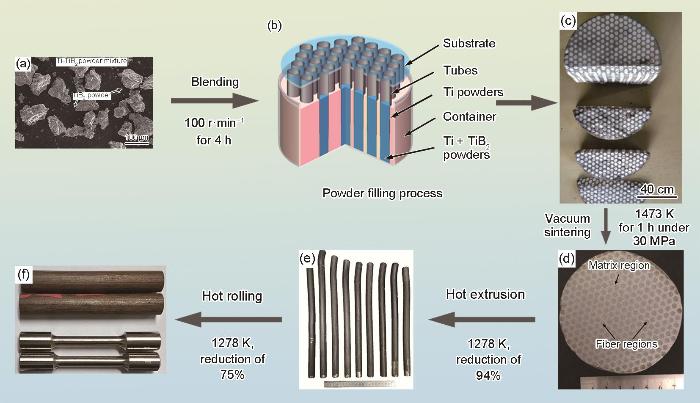
图1
类竹纤维结构钛基复合材料(FLSCR-10%)的制备
Fig.1
Fabrication of the bamboo-fiber-like structural titanium matrix composites (FLSCR-10%)
(a) microstructure of raw materials (b) powder filling process
(c) preform with columnar structure (d) consolidated composites (ϕ80 mm)
(e) extruded composite bar (ϕ20 mm) (f) composites rod (ϕ10 mm)
(1) 设计仿生类竹纤维结构(图1b):设计制作一个由数百个管和衬底组成的模具以控制复合材料粉体分布,壁厚0.1 mm、直径2 mm、长120 mm的不锈钢管固定在塑料衬底上,将复合材料混合粉体填充于阵列管中,将纯Ti粉填充在管壁外空隙中,最终形成复合材料混合粉体的阵列限域分布,呈类竹纤维结构,纤维区总体积分数设计为40%,因此类竹纤维结构TiB/Ti复合材料中TiB的体积分数为4%。
(2) 预制坯体冷压成形(图1c):将已填粉的类纤维结构模具放入钢制冷压模具(内径80 mm、深度100 mm)中,然后竖直向上匀速拔出填粉模具,随后使用YA32-315型四柱液压机对粉末进行冷压成型,压制压力400 MPa,保压时间2 min,冷压后相对密度可达80%,颗粒间接触面积较大,有利于后续的致密化,其粉末冷压块体的尺寸为直径80 mm、厚60 mm。
(3) 真空热压烧结(图1d):采用ZT-20Y-20真空热压烧结炉将预制坯体压制为直径80 mm、厚48 mm的块体,烧结工艺为1473 K、1 h,压力30 MPa,真空度保持在0.01 Pa。
1.2 物相分析与性能测试方法
利用BX51 M光学显微镜(OM)和Mira3-LHM扫描电镜(SEM)观察原料粉末和复合材料的微观组织及断口形貌,利用电子背散射衍射(EBSD)技术分析复合材料晶粒尺寸、微区晶粒取向等信息,并采用HKL Channel5软件分析EBSD采集的数据。采用Talos F200X G2透射电镜(TEM)观察复合材料横截面(垂直于纤维方向)基体及增强体形貌。
在Zwick/Roell Z20万能材料试验机上测试复合材料纤维方向的常温力学性能,采用圆棒试样进行单轴拉伸测试,试样尺寸参照GB/T 228—2010标准(试样标距为30 mm、直径为4 mm),拉伸速率0.6 mm/min。棒状试样取样时尽量保证标距段位于棒材正中心位置,每个试样标距段表面均用2000号砂纸打磨至同一粗糙度。为降低实验误差,同一材料样品进行至少3次实验,取平均值。利用SEM观察片状拉伸试样(试样标距长度为12 mm、宽度为6 mm、厚度为1.5 mm)拉伸后的断口表面形貌。拉伸测试前利用线切割机将试样从金属块体上切出,并依次用180、320、600和1200号砂纸将样品表面及侧面打磨至无明显划痕。
2 实验结果
2.1 微观组织
图2

图2
FLSCR-10%复合材料轧制棒材外观及横/纵截面宏观形貌的OM像
Fig.2
Photo (a) and OM images of the cross section (b) and longitudinal section (c) of the as-rolled FLSCR-10% sample (RD—rolling direction)
图3a和b分别为轧制态HS-4%和FLSCR-10%复合材料纤维组织的OM像。可以看出,在HS-4%复合材料中,TiB分布较为均匀,无明显团聚现象,并与轧向基本保持平行。在FLSCR-10%复合材料中,TiB均匀分布在纤维区域,基体均匀分布于间隙区域,表明其具有所设计的成分分布及内部结构。FLSCR-10%复合材料横截面上的TiB主要呈颗粒状,晶须基本与轧向平行,纤维方向同样平行于轧向,纤维区域直径约为250 μm。纤维区域与基体区域的界面附近不存在TiB体积分数梯度,并且在界面处也未发现孔洞等冶金缺陷,表明FLSCR-10%复合材料具有优良的冶金结合界面。并且,FLSCR-10%复合材料中基体晶粒均为等轴状,未发现变形晶粒,表明基体晶粒发生了完全再结晶。图3c和d分别统计了两种材料中TiB的长径比。HS-4%晶须平均长径比最大为6.00,FLSCR-10%晶须长径比平均值为5.31。可见,在相同轧制工艺下,纤维区域TiB平均长径比与该区域TiB含量有关,即TiB平均长径比随局部区域TiB含量的升高而减小,因为高含量的增强体带来高强化效果,热变形时高TiB体积分数区域具有较高的热变形抗力,而低TiB含量区域热变形抗力较小,变形抗力的大小决定了TiB承受载荷的大小,最终影响了TiB的断裂程度。因此,在类竹纤维结构钛基复合材料中,增强体集中分布于纤维区域,导致局部区域增强体含量相对于均匀结构复合材料有所提高,使得在相同热变形条件下,该区域增强体断裂趋势增加,若仅考虑晶须长径比的影响,则将降低增强体的强化效果[19]。
图3
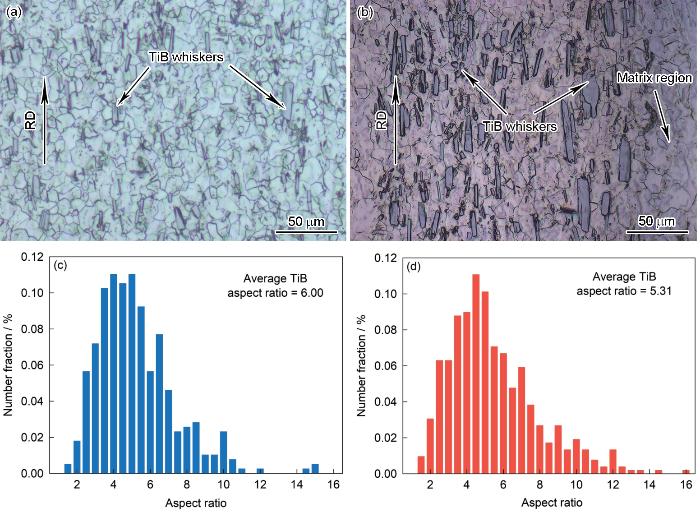
图3
轧制态TiB均匀分布的钛基复合材料(HS-4%)和FLSCR-10%复合材料纵截面微观组织的OM像及晶须长径比
Fig.3
OM images of the longitudinal section (a, b) and TiB aspect ratio distributions (c, d) of the as-rolled HS-4% (a, c) and FLSCR-10% (b, d) samples (HS-4%—homogeneous structure-4%)
图4a、b和d所示分别为轧制态纯Ti、HS-4%和FLSCR-10%材料纵截面显微组织的EBSD反极图。对于纯Ti,可以看到其内部只存在等轴α晶粒,且晶粒尺寸并不均匀,最大晶粒尺寸可达50 μm。在粗大晶粒的三叉晶界或者其他局部区域则存在大量直径约5 μm的细小晶粒,可见,再结晶晶粒主要在晶界处产生,先期形成的晶粒在高温下粗化,而后续产生的晶粒未能迅速长大,仍维持在细小状态保留下来。经统计,其平均晶粒尺寸为9.9 μm (图4a)。对于HS-4%复合材料,由于TiB均匀分布,因此晶粒尺寸也比较均匀,相比于纯Ti,因为TiB具有显著的晶粒细化作用,平均晶粒尺寸更为细小,为4.2 μm (图4b)。而对于FLSCR-10%复合材料,TiB的区域性分布使得FLSCR-10%材料内部晶粒尺寸也呈现类似区域性分布,即细晶主要分布在纤维区域,而粗晶主要分布在基体区。经统计,FLSCR-10%纤维区平均晶粒尺寸为3.7 μm,而基体区平均晶粒尺寸为7.2 μm (图4d)。根据细晶强化效应及增强体承载强化作用,纤维区域具有较高的强度;而基体区由于晶粒尺寸较为粗大,其表现出较低的强度,但塑性更加优良。此外,由于纤维区与基体区之间的TiB是非连续分布的,因此可以看到存在一些较粗的晶粒贯穿纤维区与基体区,即说明纤维与基体区域间并没有明显的界线,证明FLSCR-10%复合材料不同区域的界面存在紧密的冶金结合。然而从平均晶粒尺寸来看,相比于HS-4%,随着TiB含量提高到10%,FLSCR-10%复合材料纤维区的晶粒尺寸仅从4.2 μm减小至3.7 μm,表明TiB的晶粒细化效应是随其含量的提高而递减的。
图4
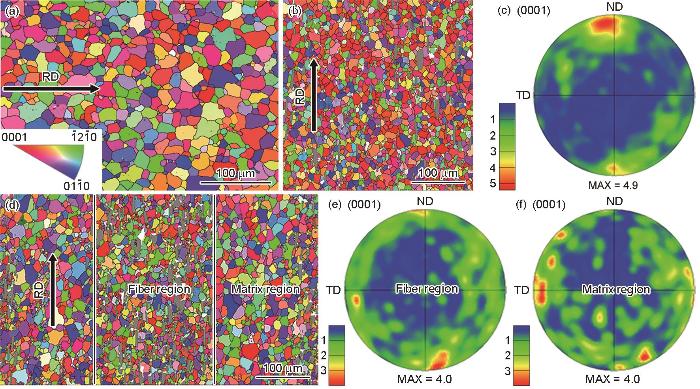
图4
轧制态纯Ti及钛基复合材料纵截面的EBSD反极图和极图
Fig.4
EBSD maps of the longitudinal sections of the as-rolled pure Ti (a), HS-4% (b, c), and FLSCR-10% (d-f) samples (TD—transverse direction, ND—normal direction) (a, b, d) inverse pole figures (IPFs) (c) (0001) pole figure (PF) (e, f) (0001) PFs of fiber region (e) and matrix region (f)
图5为轧制态FLSCR-10%纤维区和基体区横截面的TEM明场像。可见,TiB横截面为六边形,这与其晶体结构有关,TiB内部常见有层错缺陷,层错的出现可能会降低其抗拉强度,从而影响强化效果[20];TiB晶须与基体间界面处干净而无界面反应产物,表明TiB与Ti基体间润湿性较好,结合强度高,良好的界面可以保证载荷能充分从基体传递到增强体而不发生开裂,有利于保持强度。TiB晶须[010]晶向平行于轧向,这是由于TiB晶须具有B27结构,由于晶体结构的不对称性,其沿[010]方向具有最大的生长速率,因此在生长过程中沿[010]方向长成晶须状[21],热加工变形后晶须发生转动并沿轧向排列,使得TiB的[010]//RD;由于基体为纯Ti,未加入其他合金成分,因此在纤维区与基体区中未发现其他第二相析出物。此外,从图中可以看到,TiB周围基体中以及Ti基体中局部区域存在高密度位错,这些位错在热变形时产生,由于轧棒快速冷却,基体来不及回复,缠结的高密度位错保留在FLSCR-10%材料内部,这些残留的高密度位错使基体产生加工硬化,起到一定的强化作用。
图5
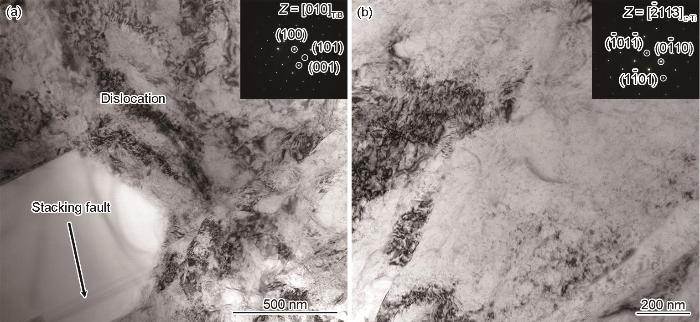
图5
轧制态FLSCR-10%纤维区和基体区横截面的TEM明场像
Fig.5
TEM bright-field images of fiber region (a) and matrix region (b) in as-rolled FLSCR-10% samples (Insets are the corresponding SAED patterns)
2.2 室温力学性能与断裂行为
图6所示为轧制态纯Ti、HS-4%和FLSCR-10%材料的室温拉伸曲线以及加工硬化曲线,以分析TiB类纤维分布模式对力学性能的影响。如图6a所示,FLSCR-10%的抗拉强度相比纯Ti提高了35.8%,但仍保持19.1%的高延伸率。对于具有同等TiB体积分数的HS-4%和FLSCR-10%复合材料,FLSCR-10%复合材料的抗拉强度为778 MPa,略低于HS-4%复合材料(811 MPa),但延伸率相比HS-4%复合材料却提高了31%。这表明TiB分布模式对钛基复合材料的力学性能确有重要影响,相比于均匀分布,当TiB集中分布于纤维区域时,FLSCR-10%复合材料的抗拉强度有所降低,而连续Ti基体区域有助于提升其塑性变形能力,使FLSCR-10%复合材料仍保持良好的塑性,表明纤维区与基体区的有机结合最终实现了钛基复合材料强塑性的良好匹配。从图6b可以看出,均匀分布的TiB降低了HS-4%复合材料的均匀延伸率和塑性变形能力,而FLSCR-10%复合材料的均匀延伸率显著高于HS-4%复合材料,其稳定段(应变大于0.04)应变硬化率明显大于HS-4%复合材料,这说明类竹纤维构型的引入可以抑制纤维区域的颈缩并使钛基复合材料具有极好的均匀变形特性。因此,FLSCR-10%基体区的高体积占比,使其获得了高的应变硬化率,因而与纯Ti的均匀变形能力相当,展现出更为优异的塑性。
图6
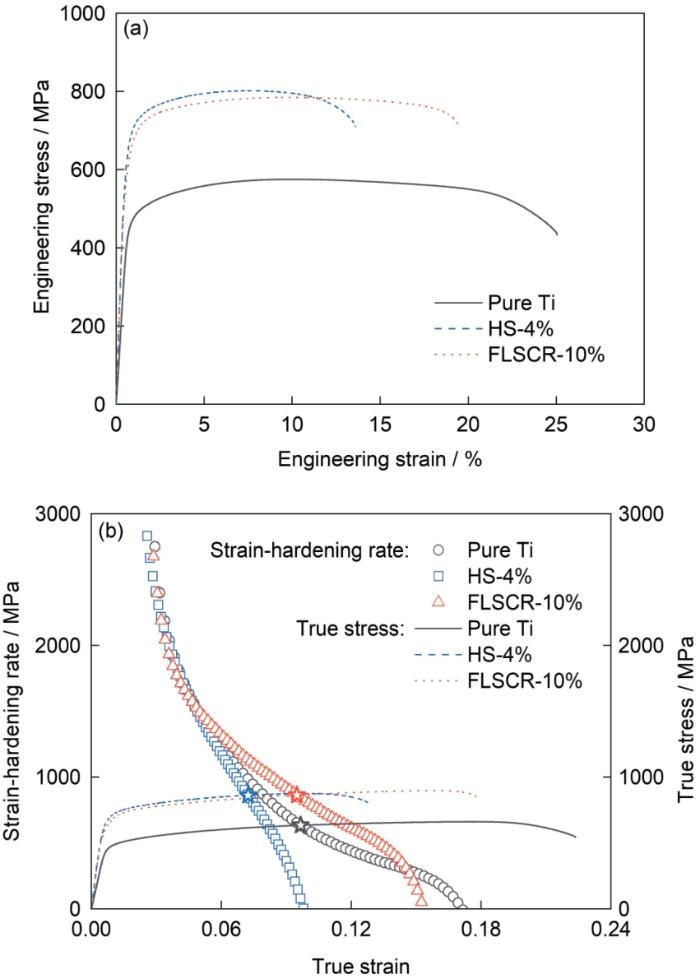
图6
轧制态纯Ti、HS-4%和FLSCR-10%试样的室温拉伸曲线和加工硬化曲线
Fig.6
Room-temperature tensile curves (a) and strain-hardening curves (b) of as-rolled pure Ti, HS-4%, and FLSCR-10% samples
图7a为轧制态FLSCR-10%复合材料拉伸后断口形貌的SEM像。可以看出,Ti基体中存在大量凸起的撕裂棱和韧窝,撕裂棱侧壁宽而曲折,韧窝尺寸不均且深度较深,表明基体为韧窝型断裂。此外,在纤维区观察到较多的深孔,深孔底部存在断裂的TiB,说明TiB断裂早于基体,且基体在TiB断裂后仍进行了较大程度的变形,说明此时基体对TiB断裂形成的裂纹有良好的钝化作用。对于HS-4%复合材料,如图7b所示,其TiB体积分数远低于10%,但整体断裂特征与FLSCR-10%复合材料的纤维区相近,断裂机制同样为韧窝型断裂,但其断口中存在较浅的TiB断口孔洞,表明基体在TiB断裂后不久即发生断裂,这说明HS-4%复合材料中的裂纹扩展速率快于FLSCR-10%复合材料。从插图中的宏观断口形貌来看,HS-4%和FSLCR-10%复合材料断口均为纤维状,但FLSCR-10%复合材料断面更加高低不平,说明其主裂纹在扩展过程中发生了剧烈的偏转偏折行为。根据断口形貌分析认为,FLSCR-10%复合材料塑性要优于HS-4%复合材料。上述分析表明,当FLSCR-10%复合材料中包含较高体积分数基体区时,由于基体区具有良好的变形能力,使得整体断裂过程减慢,纤维区裂纹扩展速率降低,因而基体变形更充分;此外,当增强体类纤维分布时,断裂主裂纹扩展路径更加多变,增加了裂纹扫过的面积,从而提高了FLSCR-10%复合材料断裂所消耗的能量。
图7
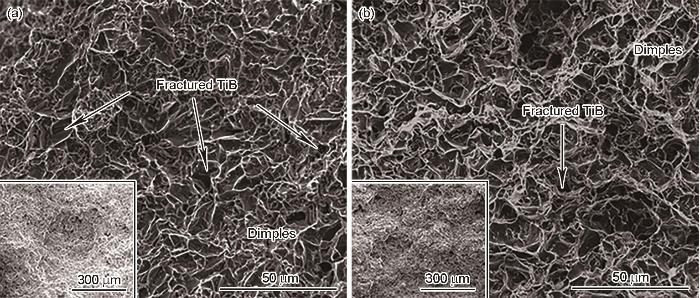
图7
轧制态FLSCR-10%和HS-4%复合材料的断口形貌SEM像
Fig.7
Fracture SEM images of the as-rolled FLSCR-10% (a) and HS-4% (b) tensile samples (Insets show the corresponding low magnification morphologies of the composites)
3 强韧化机制分析
对于均匀分布TiB增强钛基复合材料,晶须增强体强化效果可以用“剪滞”理论进行计算[22]:
式中,Δσreinf为晶须增强体强化对屈服强度的贡献,σm为基体屈服强度,l为晶须长度,d为晶须直径,V为增强体体积分数,C0为几何取向因子。
此外,TiB诱导的晶粒细化也会引起基体强度的提高,细晶强化从微观上可以解释为晶粒尺寸越小,导致晶界数量增多,其对位错运动起到的阻碍作用越强,需要增加外力才能使变形传递到其他晶粒,表现为材料屈服强度的提高。细晶强化对屈服强度的贡献(ΔσHall-Petch)可以用Hall-Petch公式估计[23]:
式中,k为Hall-Petch系数,D为复合材料晶粒尺寸,D0为基体晶粒尺寸。
对于HS-4%复合材料,其强化对屈服强度的贡献(Δσ)为:
代入
式中,σ0为纯Ti的屈服强度,455 MPa;k取18 MPa/mm1/2 [24];D取HS-4%平均晶粒尺寸,4.2 μm;D0取纯Ti平均晶粒尺寸,9.9 μm;晶须长径比l / d = 6.00;V = 4%。计算可得,HS-4%比纯Ti的理论屈服强度提高了163 MPa。
对于FLSCR-10%复合材料,其内部存在纤维区和分布于纤维间隙的基体区,基体区体积分数为60%且不含TiB,因此该区域只考虑细晶强化效果。沿纤维结构方向拉伸时,屈服强度的计算可以根据串联法则,即纤维区和基体区之间的变形符合等应变法则:εFiber region = εMatrix region = ε (其中,εFiber region为纤维区的轴向应变,εMatrix region为基体区的轴向应变,ε为FLSCR-10%复合材料整体的宏观轴向应变),则其强化效果可由下式计算:
式中,ΔσFiber region和ΔσMatrix region分别为纤维区和基体区对屈服强度的贡献,可分别用下式计算:
式中,D1为纤维区平均晶粒尺寸,3.7 μm;l / d = 5.31;V = 10%;D2为基体区平均晶粒尺寸,7.2 μm。计算可得:ΔσFiber region = 107 MPa,ΔσMatrix region = 19 MPa,屈服强度理论增加值为126 MPa。
屈服强度理论增加值列于表1。可以看到,基体区对强化作用的贡献很小,在FLSCR-10%复合材料中,基体区体积分数为60%,其晶粒细化作用对整体强化效果的贡献只有15.2%,因此FLSCR-10%复合材料强度的提高主要取决于纤维区域的体积分数,即当总TiB体积分数相同时,TiB分布区域越大,FLSCR-10%复合材料的屈服强度越高。
表1 HS-4%、FLSCR-10%复合材料的理论强化效果
Table 1
| Material | ΔσFiber region / MPa | ΔσMatrix region / MPa | Δσ / MPa | TYS / MPa | AYS / MPa |
|---|---|---|---|---|---|
| HS-4% | 163 | - | 163 | 617.5 | 629 ± 4 |
| FLSCR-10% | 107 | 19 | 126 | 580.0 | 575 ± 10 |
以上分析表明,上述构型复合材料的强化效果主要取决于TiB的强化作用及其对材料基体产生的晶粒细化效果。当TiB均匀分布时,其内部所有区域晶粒均能得到细化;当TiB分布于纤维区域时,由于纤维区体积占整个材料的40%,则只有40%的基体得到有效细化。因此,均匀构型钛基复合材料的强度优于增强体纤维分布构型钛基复合材料。
除了强度、塑性外,韧性是评价材料性能的另一重要维度。本工作通过静力韧性(static toughness)来说明不同构型结构钛基复合材料的韧性差异,静力韧性通过计算真应力-真应变曲线与应变轴所围成的面积获得,定义为单向拉伸时单位体积材料断裂所吸收的能量。FLSCR-10%复合材料的静力韧性为142.5 MJ/m3,远大于HS-4%复合材料的113.3 MJ/m3;这说明TiB呈纤维分布时,FLSCR-10%复合材料断裂时需要消耗更多能量,即具有较好的韧性。研究[25~27]表明,材料的韧性主要受变形时内部晶粒变形以及微裂纹形核与扩展所造成的能量耗散过程影响。在类竹纤维结构钛基复合材料中,基体区具有良好的塑性,可以进行较大程度的塑性变形,吸收更高的变形能量,从而提高韧性。
为了进一步阐明类竹纤维分布的TiB对FLSCR-10%韧化机制的影响,对应变为9%和14%时FLSCR-10%基体区与纤维区界面处的应变分布进行了EBSD分析,结果如图8所示。从图8a可以看出,变形量为9%时,基体区及纤维区的晶粒变形程度较小;当变形量增加到14% (图8b),基体区及纤维区晶粒发生了变形,且晶粒内部产生了大量小角度晶界,这是由于晶体滑移产生的大量位错缠结导致。图8c为9%应变时的界面区域应变分布图。可见,在基体与纤维区域存在明显的非均匀应变分配,即两个区域之间发生了塑性不相容;并且,纤维区内的基体应变整体大于基体区,这是由于沿拉伸方向基体区与纤维区应变相等,但是纤维区基体体积分数为90%,小于基体区(100%),因此相比于基体区,纤维区承担变形的晶粒数量更少,导致晶粒平均变形程度大于基体区;此外,可以看到基体区中变形程度较大的区域内粗晶粒周围分布着较多细晶,这是由于根据Hall-Petch公式,细晶强度较高,因此,细晶区域相对难以发生形变,其周围粗晶粒需产生较大程度的变形才能使得变形协调,从而使得该区域附近应变集中分布,这说明基体区晶粒存在较好的变形协调作用,纤维区也存在应变集中区域(红色),但是其分布区域较小。当应变为14%时,如图8d所示,纤维区整体应变进一步加大,纤维区应变仍大于基体区,同时纤维区中出现数个大应变区(红色),大应变区分布在TiB间且面积较小,这是由于TiB是刚性增强体,在拉伸变形过程中,TiB与基体的界面处存在较高的局部取向差(KAM)。界面作为位错运动的障碍,因此在局部产生几何必需位错(GND)[28]。纤维区有相当大的GND密度,且随应变的增加而显著增加,从而阻断了基体间的变形协调作用,加剧了应变局域化;并且,在基体区的大变形区面积也明显增大,说明局部应变可以传递至相邻区域,即基体区可以有效地缓解源自纤维区的局部应力集中;随着应变的增大,基体区的界面附近位错逐渐积累并形成应变梯度,导致塑性变形过程中产生HDI硬化[29]。这种独特的应变分配行为导致的HDI硬化还可以显著抑制纤维区中塑性失稳的过早发生[30],从而使FLSCR-10%复合材料在宏观尺度上的塑性变形更为均匀,应变硬化效果更为明显。
图8
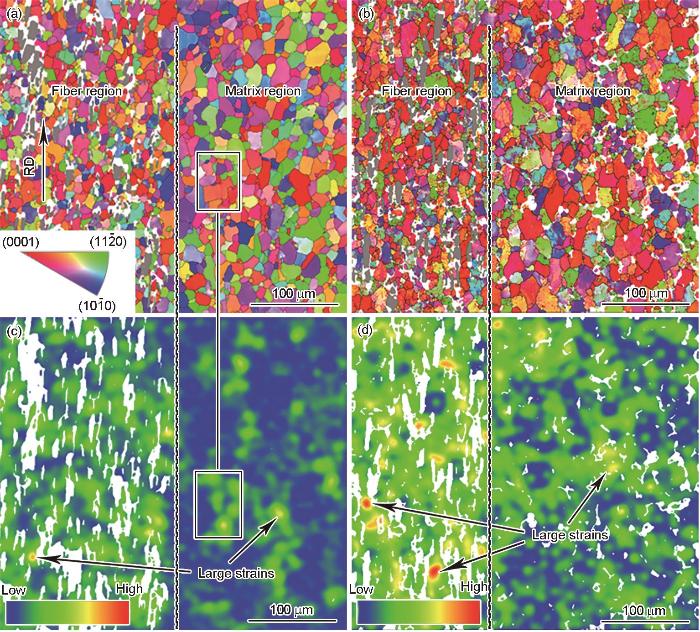
图8
9%和14%应变时FLSCR-10%复合材料界面区域的反极图和应变分布图
Fig.8
IPFs (a, b) and corresponding local strain distributions (c, d) of the interface region in the FLSCR-10% samples with the engineering strains of 9% (a, c) and 14% (b, d)
此外,相比于纯Ti,FLSCR-10%复合材料塑性下降的原因为:加载时,TiB增强体往往先于基体发生断裂,TiB断后裂纹将成为材料内部裂纹源,加快断裂的发生;其次,TiB的加入降低了基体体积分数,相同宏观变形量时,基体晶粒的平均变形程度增大,因此断裂将会提前,表现为宏观塑性的降低;TiB在起到强化基体的同时,也会限制一部分基体的变形,一方面使参与变形的基体进一步减少,另一方面TiB的存在对基体的屏蔽作用降低了基体变形协调能力,使得局部应变无法有效传递到邻近区域,从而加剧应变局域化现象,局部变形较大的基体更易发生开裂失效,加速了材料整体断裂;最后,TiB的加入使基体晶粒得到显著细化,大量细小晶粒(< 2 μm)的出现可能导致纤维区塑性下降。
4 结论
本工作设计并成功制备了具有仿生类竹纤维结构的非连续增强TiB/Ti基复合材料。与具有相同TiB体积分数的均匀结构增强钛基复合材料相比,这种独特的类纤维构型展现出更加优异的强塑性协同效果:其抗拉强度得以保持在较高水平,主要归因于纤维区内定向排布的TiB晶须不仅通过细化晶粒来强化基体,而且还体现出高效的承载能力;更为关键的是,基体区内晶粒的连续性特征显著提高了应变硬化能力,使得塑性变形更加均匀,断裂延伸率大幅提升至19.1%,同时该连续基体结构在变形过程中能够有效钝化和偏转裂纹,显著抑制了裂纹在纤维区的扩展,从而大幅提高了静力韧性,验证了仿生构型设计的有效性。
参考文献
Optimizing the local microstructure and mechanical properties of variable section particulate reinforced titanium matrix composites component based on numerical simulation and isothermal forming
[J].
The impact of matrix texture and whisker orientation on property anisotropy in titanium matrix composites: Experimental and computational evaluation
[J].
Superior superplasticity and multiple accommodation mechanisms in TiB reinforced near-α titanium matrix composites
[J].
Research progress and development tendency of discontinuously nano-reinforced titanium matrix composites
[J].
非连续纳米相增强钛基复合材料研究进展与展望
[J].
A review of fabrication, processing and application of heat-resistant titanium matrix composites
[J].
耐热钛基复合材料制备加工及应用综述
[J].
Understanding the confined TiB fiber-like structure for strength-ductility combination of discontinuous-reinforced titanium matrix composites
[J].
Titanium metal matrix composites: An overview
[J].
Multiscale architecture and superior high-temperature performance of discontinuously reinforced titanium matrix composites
[J].
Heterostructured titanium composites with superior strength-ductility synergy via controllable bimodal grains and <c + a> dislocation activity
[J].
Evading the strength and ductility trade-off dilemma in titanium matrix composites through designing bimodal grains and micro-nano reinforcements
[J].
Microstructurally inhomogeneous composites: Is a homogeneous reinforcement distribution optimal?
[J].
Development of finite element modeling technique for metal matrix composites with tailored architectures
[J].
构型化金属基复合材料有限元建模技术
[J].
Metal matrix composites with microstructural architectures
[J].
金属材料的构型复合化
[J].
The self-stimulation effect for high-performance metal matrix composites
[J].
金属基复合材料的内源性效应
[J].
Preparation of high fracture performance SiCp-6061A1/6061A1 composite
[J].
Using Mg and Mg-nanoAl2O3 concentric alternating macro-ring material design to enhance the properties of magnesium
[J].
Merger of structure and material in nacre and bone—Perspectives on de novo biomimetic materials
[J].
The superior mechanical and physical properties of nanocarbon reinforced bulk composites achieved by architecture design—A review
[J].
In situ preparation of TiB nanowires for high-performance Ti metal matrix nanocomposites
[J].
Strengthening behavior of in situ-synthesized (TiC-TiB)/Ti composites by powder metallurgy and hot extrusion
[J].
Growth mechanism of in situ TiB whiskers in spark plasma sintered TiB/Ti metal matrix composites
[J].
Effects of degree of deformation on the microstructure, mechanical properties and texture of hybrid-reinforced titanium matrix composites
[J].
Simultaneously improving the strength and ductility of the as-sintered (TiB + La2O3)/Ti composites by in-situ planting ultra-fine networks into the composite powder
[J].
Enhanced strength-ductility synergy in fiber-like structural titanium matrix composites by controlling TiB content
[J].
Bioinspired structural materials
[J].
Natural structural materials are built at ambient temperature from a fairly limited selection of components. They usually comprise hard and soft phases arranged in complex hierarchical architectures, with characteristic dimensions spanning from the nanoscale to the macroscale. The resulting materials are lightweight and often display unique combinations of strength and toughness, but have proven difficult to mimic synthetically. Here, we review the common design motifs of a range of natural structural materials, and discuss the difficulties associated with the design and fabrication of synthetic structures that mimic the structural and mechanical characteristics of their natural counterparts.
Toughening of aluminum matrix nanocomposites via spatial arrays of boron carbide spherical nanoparticles
[J].
Bamboo-like dual-phase nanostructured copper composite strengthened by amorphous boron framework
[J].Grain boundary engineering is a versatile tool for strengthening materials by tuning the composition and bonding structure at the interface of neighboring crystallites, and this method holds special significance for materials composed of small nanograins where the ultimate strength is dominated by grain boundary instead of dislocation motion. Here, we report a large strengthening of a nanocolumnar copper film that comprises columnar nanograins embedded in a bamboo-like boron framework synthesized by magnetron sputtering co-deposition, reaching the high nanoindentation hardness of 10.8 GPa among copper alloys. The boron framework surrounding copper nanograins stabilizes and strengthens the nanocolumnar copper film under indentation, benefiting from the high strength of the amorphous boron framework and the constrained deformation of copper nanocolumns confined by the boron grain boundary. These findings open a new avenue for strengthening metals via construction of dual-phase nanocomposites comprising metal nanograins embedded in a strong and confining light-element grain boundary framework.© 2023. Springer Nature Limited.
Loss-free tensile ductility of dual-structure titanium composites via an interdiffusion and self-organization strategy
[J].The deformation-coordination ability between ductile metal and brittle dispersive ceramic particles is poor, which means that an improvement in strength will inevitably sacrifice ductility in dispersion-strengthened metallic materials. Here, we present an inspired strategy for developing dual-structure-based titanium matrix composites (TMCs) that achieve 12.0% elongation comparable to the matrix Ti6Al4V alloys and enhanced strength compared to homostructure composites. The proposed dual-structure comprises a primary structure, namely, a TiB whisker-rich region engendered fine grain Ti6Al4V matrix with a three-dimensional micropellet architecture (3D-MPA), and an overall structure consisting of evenly distributed 3D-MPA “reinforcements” and a TiBw-lean titanium matrix. The dual structure presents a spatially heterogeneous grain distribution with 5.8 μm fine grains and 42.3 μm coarse grains, which exhibits excellent hetero-deformation-induced (HDI) hardening and achieves a 5.8% ductility. Interestingly, the 3D-MPA “reinforcements” show 11.1% isotropic deformability and 66% dislocation storage, which endows the TMCs with good strength and loss-free ductility. Our enlightening method uses an interdiffusion and self-organization strategy based on powder metallurgy to enable metal matrix composites with the heterostructure of the matrix and the configuration of reinforcement to address the strength-ductility trade-off dilemma.
Superior strength-ductility synergy in three-dimensional heterogeneous-nanostructured metals
[J].
A new strategy for fabrication of unique heterostructured titanium laminates and visually tracking their synchronous evolution of strain partitions versus microstructure
[J].Heterostructured (HS) material with extraordinary mechanical properties has been regarded as one of the most promising structural materials. Here, we reported a new strategy for preparing heterostructured pure titanium laminates that possess a good combination of strength and ductility by combining gradient structure (GS) and heterogeneous lamella structure (HLS). The deformation characteristic versus microstructure evolution of GS/HLS titanium laminates, namely the strain partitions between different-sized grains (480-25 μm) was visualized using a scanning electron microscope (SEM) equipped with electron backscattered diffraction (EBSD) mode combined with the digital image correlation (SEM-DIC) with an ultrahigh spatial resolution for the first time. As a result, the hetero-deformation of unique GS/HLS structure by the characteristic of strain partitions could be accurately captured. While the hetero-deformation could result in the hetero-deformation induced (HDI) stress strengthening and HDI hardening, which were regarded as the key reason that the resulting GS/HLS Ti laminates showed a superior combination of strength and ductility. This could promote a more in-depth understanding of the strengthening-toughening mechanism of heterostructured material.


