



激光热过程会引发材料的相变及变体择优生长,其处理速度快,能够实现一次加工成型,因此成为近年来表面处理技术与层状异质结构制备相结合的新方法[3]。科研人员[4,5]在对采用激光粉末床熔融(L-PBF)技术构建出的TC4块体进行多道次激光表面重熔(LSR)时发现,由于冷却速率高,激光造成的局部热应力在细化α马氏体片层的同时会诱导产生大量的
激光表面处理是一个非常复杂的高能瞬态冶金过程,高能激光与试样表面的接触时间极短,并且存在着复杂的物质交换和热量交换过程,对微观结构的形成和演化会产生极大的影响。为了控制商用TC4钛合金的微观结构和力学性能,本工作对基体为全马氏体组织的TC4钛合金进行脉冲LSR处理实验,并对断口附近表面产生的反常
1 实验方法
1.1 实验材料
本实验采用商用TC4钛合金轧制板材,化学成分(质量分数,%)为:Al 5.9,V 3.95,Fe 0.073,C 0.0081,N 0.02,H 0.002,O 0.07,Ti余量。毛坯板沿板材轧向(RD)、横向(TD)和法向(ND)的尺寸分别为90、40和5.5 mm。采用金相法测定该合金的β转变温度为(980 ± 5) ℃。毛坯板首先在KSL-1200X-M马弗炉中经990 ℃固溶处理1 h,随后水淬(WQ),以获得全马氏体组织,该类样品标记为WQ。然后,利用HWLW-600A-C-V5.2.01型YAG脉冲激光器对部分WQ样品的RD-TD表面进行LSR处理,具体工艺参数为:激光功率160 W,峰值功率1600 W,扫描速率8 mm/s,脉冲宽度 5 ms,频率20 Hz,功率密度204 W/mm2,线性能量密度20 J/mm,离焦量0 mm,光束直径1 mm,搭接率50%。为防止氧化,在整个LSR处理过程中,使用连续流动的高纯度Ar气(流量为5 L /min)进行保护,LSR处理后的样品标记为WQ-LSR。
1.2 实验方法
利用DK7720-DK7735B电火花线切割机,从WQ和WQ-LSR试样切割出长15 mm、宽4 mm、厚1.8 mm的哑铃型拉伸试样。拉伸实验在WARTER + BAI LFV 10-HH试验机上进行,沿RD方向的应变速率为10-3 s-1。所有拉伸实验至少重复3次,以保证实验的可重复性。参考前期研究成果[3],WQ样品的抗拉强度为(963 ± 8) MPa,延伸率为(6.8 ± 0.1)%,而LSR处理后的WQ-LSR样品,其抗拉强度提升至(1023 ± 11) MPa,延伸率增加至(8.2 ± 0.1)%。双面激光处理后的TC4样品由于异质结构强化效应,实现了强塑性的同步提升,抗拉强度提高6.23%,延伸率提升20.59%。
1.3 微结构表征
采用Nordlys Max2电子背散射衍射仪(EBSD)和JEM-2100F透射电镜(TEM)观察WQ和WQ-LSR试样变形前后的显微组织特征,同时结合扫描透射电子显微镜-能量色散X射线光谱(STEM-EDS,XFlash 5030T)对LSR处理前后的样品进行微区成分分析及元素分布测定。在EBSD检查前,对TD-ND面切片进行机械研磨和电解抛光。通过电解双喷制备TEM薄膜样品,随后在JEM-2100F TEM上对WQ和WQ-LSR样品开展TEM观察和STEM-EDS分析,工作电压200 kV。利用配有EBSD的Nova 400 FEG扫描电镜(SEM)进行微观结构分析,步长0.2 μm。利用Channel 5系统进行EBSD数据分析。在数据处理过程中,所有Kikuchi图案的标定率均保持在85%以上。
2 结果与讨论
2.1
图1
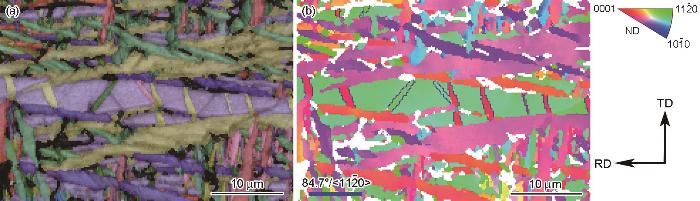
图1
水淬-激光表面重熔(WQ-LSR)试样断口附近重熔层的EBSD表征结果
Fig.1
All-Euler-angle image (a) and inverse pole figure (IPF) (b) of laser remelted layer close to fracture surface of the WQ-LSR sample (RD—rolling direction, TD—transverse direction, ND—normal direction, WQ—water quenching, LSR—laser surface remelting)
一般而言,当hcp晶体的c轴方向受拉或垂直于c轴方向受压缩应力时,会产生孪生变形。当宏观应力轴方向与晶粒c轴平行时,一个晶粒可能会形成6种
图2

图2
WQ-LSR试样断口表面
Fig.2
TEM image of the {
图3
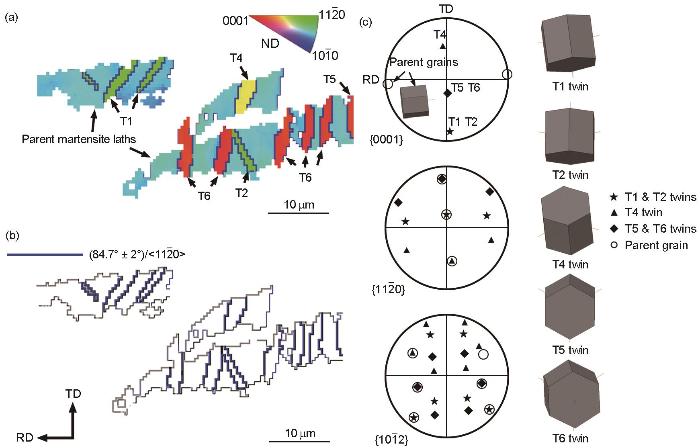
图3
WQ-LSR试样拉伸断口EBSD取向分析
Fig.3
EBSD orientation analyses of tensile fracture surface of WQ-LSR sample
(a) EBSD orientation maps
(b) grain boundary maps corresponding to Fig.3a
(c) crystal orientation maps of twins and the matrix corresponding to Fig.3a
表1 图3a中孪晶变体的分析结果
Table 1
| Matrix orientation in Euler angle / (°) | Twin type | Twin orientation in Euler angle / (°) | Twin variant |
|---|---|---|---|
| (93.7, 91.4, 45.0) | T1 | (9.2, 74.2, 55.8) | ( |
| T2 | (178.6, 105.1, 0.0) | ( | |
| T4 | (9.8, 134.9, 3.4) | ( | |
| T5 | (168.5,164.6, 45.7) | ( | |
| T6 | (32.7, 16.0, 30.6) | ( |
2.2
利用Channel 5软件对WQ-LSR试样断口表面区域的EBSD数据进行SF计算,得到TC4钛合金中常出现的基面<a>滑移和柱面<a>滑移的SF分布,结果如图4所示。根据柱状图可知,大部分马氏体板条的SF在0.3~0.5,而在出现孪晶的CML中,柱面<a>滑移的SF极低,说明开启该种滑移的可能性极低。虽然CML中基面<a>滑移的SF稍高于柱面<a>滑移,但此时拉伸过程中产生的应力远未达到基面<a>滑移启动的CRSS,而此时
图4

图4
WQ-LSR试样柱面滑移和基面滑移的Schmid因子分布图及统计图
Fig.4
Schmid factor (SF) distribution images and corresponding statistical histograms (insets) of prismatic slip (a) and basal slip (b) in WQ-LSR sample
图5给出了WQ试样断口表面的SF分布。可以看出,柱面<a>滑移中SF值呈现蓝色的极少区域(SF较低)同样出现了类孪晶结构,并且产生孪晶的马氏体片层与WQ-LSR样品相比没有显著的尺寸及分布特征。可以认为这些孪晶是在拉应力的作用下偶然产生的孪晶组织,对WQ试样整体的力学性能没有显著影响。
图5
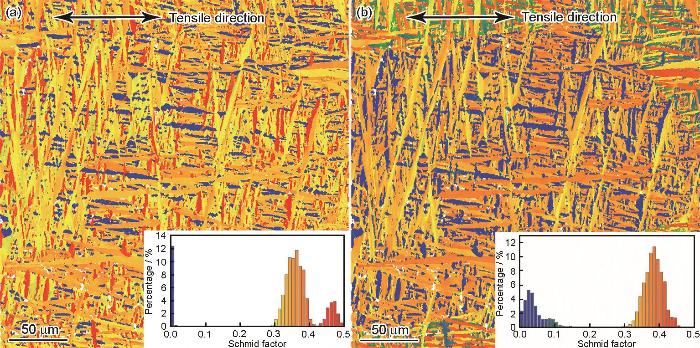
图5
WQ试样柱面滑移和基面滑移的SF分布图及统计图
Fig.5
SF distribution images and statistical histograms (insets) of prismatic slip (a) and basal slip (b) in WQ sample
利用EBSD数据统计可得,WQ-LSR样品中的孪晶面积分数为1.79%,而WQ样品中的孪晶基本可以忽略不计。相应地,孪晶界是强烈的位错障碍,阻止了位错的自由运动,增加了材料的屈服强度和硬化率。另一方面,材料通过孪生协调变形提高了塑性。因此,WQ-LSR样品的抗拉强度从WQ样品的963 MPa 提高到1023 MPa,延伸率从6.8%提升到8.2%,实现了材料强塑性的同步提升[3]。
2.3
已有研究[16~18]表明,Al作为α相稳定元素,会提高hcp晶格的轴比c / a,提升晶格的各向异性,抑制孪晶的激活;随着Al含量的增加,TC4钛合金的c / a升高,增大了α晶格的不对称性,对
表2 WQ和WQ-LSR试样的STEM-EDS元素分析结果 (mass fraction / %)
Table 2
| Sample | Al | Ti | V |
|---|---|---|---|
| WQ | 6.72 | 89.76 | 3.52 |
| WQ-LSR | 5.74 (-14.58%) | 90.63 (+0.96%) | 3.63 (+3.13%) |
2.4 马氏体变体选择规律
本工作中,孪晶的马氏体取向比较统一,推测在激光表面处理的过程中可能存在某一方向的择优取向,因此对这些产生孪晶的马氏体进行EBSD变体分析。
WQ与WQ-LSR试样中的马氏体板条形态有很大不同[3],造成这种差异的原因可能是激光冷却过程中的变体选择行为。根据Burgers规则,bcc-β相在相变时会产生12种hcp-α相变体,如表3[9,23,24]所示(此处的V1~V12与图6中V1~V12是对应关系)。为了明确这种粗大马氏体板条是如何在激光处理的过程中生成的,对两种试样进行原始β晶粒重构:利用母相(β相)与子相(α相)之间的晶体学位向关系,重构出原母相β晶粒的结构,结果如图6所示。同时,统计WQ与LSR-WQ试样中原始β晶粒及其12个α变体的Euler角及面积占比,结果如表4所示。图6a为WQ试样的重构及变体分离结果。可以看到,12种变体分布均匀,不存在某种变体数量显著增加的现象。WQ-LSR试样重构及变体分离结果如图6b所示,尽管同样存在12种马氏体变体,但产生
表3 TC4钛合金中通过Burgers取向关系由β→α相变产生的12种变体[9,23,24]
Table 3
| Variant | Plane parallel | Direction parallel | Rotation angle/axis from V1 |
|---|---|---|---|
| V1 | - | ||
| V2 | |||
| V3 | |||
| V4 | |||
| V5 | |||
| V6 | |||
| V7 | |||
| V8 | |||
| V9 | |||
| V10 | |||
| V11 | |||
| V12 |
图6
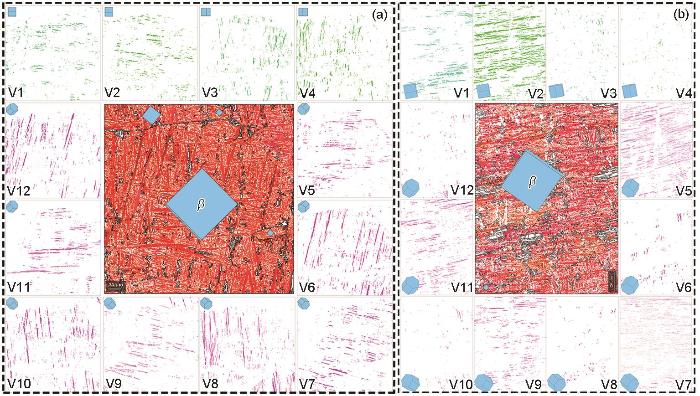
图6
WQ和WQ-LSR试样的初始β晶粒重构及α变体取向
Fig.6
Prior β grains and α variant orientations reconstructed from WQ (a) and WQ-LSR (b) samples
表4 WQ和WQ-LSR试样中原始β晶粒及其12个α变体的Euler角与面积占比
Table 4
| Grain/variant | Euler angle | Area fraction / % | ||
|---|---|---|---|---|
| WQ | WQ-LSR | WQ | WQ-LSR | |
| Prior β grain | (319.7°, 177.7°, 95.1°) | (55.2°, 85.3°, 272.0°) | 100.00 | 100.00 |
| V1 | (269.6°, 88.5°, 176.5°) | (190.2°, 91.9°, 170.0°) | 5.88 | 8.70 |
| V2 | (89.6°, 91.5°, 352.9°) | (10.2°, 88.1°, 359.5°) | 5.90 | 28.50 |
| V3 | (179.6°, 91.8°, 356.2°) | (100.4°, 85.2°, 352.8°) | 8.26 | 1.75 |
| V4 | (359.6°, 88.2°, 173.2°) | (280.4°, 94.8°, 176.7°) | 6.43 | 0.75 |
| V5 | (314.4°, 42.7°, 85.0°) | (237.1°, 49.8°, 82.1°) | 7.10 | 25.49 |
| V6 | (134.4°, 137.3°, 84.4°) | (57.1°, 130.2°, 87.3°) | 11.74 | 2.46 |
| V7 | (227.0°, 135.2°,268.0°) | (140.8°, 132.8°,258.3°) | 7.15 | 12.61 |
| V8 | (47.0°, 44.8°, 261.4°) | (320.8°, 47.2°, 271.2°) | 12.82 | 1.23 |
| V9 | (42.3°, 134.7°, 81.5°) | (330.3°, 136.8°, 91.7°) | 7.52 | 6.32 |
| V10 | (222.3°, 45.3°, 88.0°) | (150.3°, 43.2°, 77.8°) | 8.58 | 1.74 |
| V11 | (134.8°, 47.3°, 264.5°) | (53.0°, 40.3°, 267.8°) | 8.76 | 8.22 |
| V12 | (314.8°, 132.7°, 265.0°) | (233.0°, 139.7°, 261.7°) | 9.86 | 2.23 |
值得注意的是,根据Burgers取向关系重构出的WQ与WQ-LSR试样的原始β相取向一致,这与原始板材的高温轧制工艺密切相关。在高温轧制过程中,材料主要以bcc-β相存在,并形成{001}<110>轧制织构。冷却后,bcc-β相根据Burgers关系转变为12种hcp-α相。在实验前的热处理-激光表面处理过程中,材料经历了快速熔化与凝固,伴随α→β及β→α相变,大部分轧制织构得以继承并保留。
图7为WQ和WQ-LSR试样相对于原始取向的马氏体变体的非相邻变体间的取向差角统计。两种试样的取向差角分布相似,但WQ-LSR试样在63°附近的取向差比较集中,其取向差角占比最高,对应的转轴为
图7
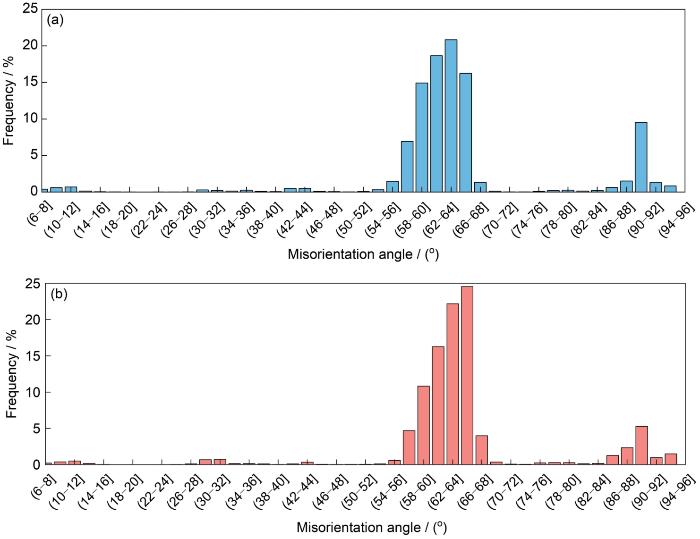
图7
WQ和WQ-LSR试样的取向差角统计
Fig.7
Misorientation histograms of WQ (a) and WQ-LSR (b) samples
表5 WQ和WQ-LSR试样变体α/α晶界长度占比统计
Table 5
| α/α boundary | Rotation angle / (°) | Frequency / % | |
|---|---|---|---|
| WQ | WQ-LSR | ||
| Type 1 | 10.53 | 1.9 | 1.3 |
| Type 2 | 60 | 33.6 | 21.6 |
| Type 3 | 60.83 | 6.8 | 4.6 |
| Type 4 | 63.26 | 47.0 | 65.1 |
| Type 5 | 90 | 10.6 | 7.4 |
Ma等[9]在采用L-PBF技术对TC4钛合金进行增材制造的过程中发现,由于激光表面处理过程中的热循环作用,不同高度方向上马氏体变体的生成具有择优性,根据温度梯度及冷却速率的不同[7,26,27],马氏体变形择优性大致分为3个区:底部、中部及上部,冷却速率为底部>上部>中部。本工作中,由于只有一次线扫描的过程,因此情况与文献[9]中底部区域类似,具有极高的冷却速率(104~105 K/s),显著高于β相向α马氏体转变的临界速率(410 K/s)[28,29],β相在冷却时会形成α'马氏体相,此时
如表4所示,在WQ-LSR试样的12种变体中,变体V2 (Euler角为(10.2°, 88.1°, 359.5°))和V5 (Euler角为(237.1°, 49.8°, 82.1°))占比最高,分别为28.5%和25.49% 。二者的α/α界面符合
3 结论
(1) WQ-LSR试样拉伸断口表面产生的孪晶为
(2) 激光与试样表面作用时,熔池高温导致Al元素蒸发,Al含量降低使TC4钛合金中α相的c / a降低,晶格各向异性减弱,从而降低了
(3) WQ-LSR试样在激光表面处理的过程中会产生特殊取向的马氏体变体,这与激光过程极高的冷却速率有关。高的冷却速率产生了巨大的残余应力,促进了
参考文献
Application and development of aerial titanium alloys
[J].
航空钛合金的应用及发展趋势
[J].
Research development and application of Ti6Al4V alloy
[J].
钛合金TC4的研究开发与应用
[J].
Strength-ductility improvement achieved by introducing heterostructured martensite in a Ti-6Al-4V alloy
[J].
Coarsening of martensite with multiple generations of twins in laser additively manufactured Ti6Al4V
[J].
Influence of substructures on the selective laser melted Ti-6Al-4V alloy as a function of laser re-melting
[J].
Basal slip and twinning in α-titanium single crystals
[J].
Orientation dependence of twinning in commercially pure titanium
[J].
Characterization and correlation of microstructure and hardness of Ti-6Al-4V sheet surface-treated by pulsed laser
[J].
Variant selection within one β grain in laser solid formed Ti-6Al-4V alloys
[J].
Heat treatment of Ti6Al4V produced by Selective Laser Melting: Microstructure and mechanical properties
[J].
Microstructural characterization and hardness variation of pure Ti surface-treated by pulsed laser
[J].
Formation and control of martensite in Ti-6Al-4V alloy produced by selective laser melting
[J].
Slip-twinning interdependent activation across phase boundaries: An in-situ investigation of a Ti-Al-V-Fe (α + β) alloy
[J].
Schmid factor analysis of twinning behavior in Ti-2Al alloy
[J].
Enhancing
Deformation behavior of HCP Ti-Al alloy single crystals
[J].
Deformation twinning in Ti-6Al-4V during low strain rate deformation to moderate strains at room temperature
[J].
Deformation and solid solution strengthening of titanium-aluminum single crystals
[R].
Effect of Al content on microstructure and properties of TC4 fabricated by laser additive manufacturing
[D].
Al含量对激光增材制造TC4组织及性能的影响
[D].
Processing window and evaporation phenomena for Ti-6Al-4V produced by selective electron beam melting
[J].
Generalized stacking fault energies and critical resolved shear stresses of random α-Ti-Al alloys from first-principles calculations
[J].
Experimental evaluation of critical resolved shear stress for the first-order pyramidal c + a slip in commercially pure Ti by micropillar compression method
[J].
Variant selection and intervariant crystallographic planes distribution in martensite in a Ti-6Al-4V alloy
[J].
Crystallographic features of α variants and β phase for Ti-6Al-4V alloy fabricated by selective laser melting
[J].
Effect of self-accommodation on α/α boundary populations in pure titanium
[J].
Architectured heterogeneous alloys with selective laser melting
[J].
On the texture formation of selective laser melted Ti-6Al-4V
[J].
Phase transformations during cooling in α + β titanium alloys
[J].
A metallurgical phase transformation framework applied to SLM additive manufacturing processes
[J].
Effect of scanning strategy on variant selection in additively manufactured Ti-6Al-4V
[J].
Influences of dislocations on nucleation and micro-texture formation of α phase in Ti-6Al-4V alloy
[J].
位错对Ti-6Al-4V合金α相形核及微织构形成的影响
[J].
借助Willis-Steeds-Lothe方法计算了单根长直刃型与螺型位错应力场, 并采用相场动力学方法模拟了含位错Ti-6Al-4V合金中β→α转变过程, 探索长直位错应力场下共格α相的形核及对微织构形成的影响. 研究表明, 刃型位错应力场与择优α变体间相互作用能中, 正应力分量S<sub>33</sub>起主要作用; 螺型位错时切应力分量S<sub>23</sub>作用最大. 刃型位错应力场对α变体选择的作用要强于螺型位错. 刃型位错下择优变体以V1与V7为主, 螺型位错时以变体V7, V10及V12为主, 且V1/V7, V1/V4/V6是刃型位错下主要出现的变体组合类型, 而螺型位错时则以V7/V10/V12组合为主. 含位错体系的微观组织由位错应力场与α变体之间相互作用能, 以及α变体之间弹性相互作用能共同决定. 位错周围的应力场可导致界面能较高的界面类型出现.
Variant selection during α precipitation in Ti-6Al-4V under the influence of local stress—A simulation study
[J].
Variant selection by dislocations during α precipitation in α/β titanium alloys
[J].
A sensitivity study of parameters affecting residual stress predictions in finite element modelling of the inertia friction welding process
[J].
Effect of martensite start and finish temperature on residual stress development in structural steel welds
[J].


