



自修复材料是一种安全性相对较高的智能材料,当其受到损伤或破坏后能够自发地对损伤部位进行修复,从而在一定程度上恢复材料的固有性能。实现损伤自修复可有效提高相关器件的可靠性和安全性,降低维修成本,延长服役寿命。自修复材料最早是20世纪70年代美国为降低航空航天设备损毁概率及维修成本而提出的设想,但直到21世纪初才获得技术上的突破[3]。近年来开发的自修复材料越来越多,其应用领域也不断拓展。然而,目前已开发的自修复材料大多为聚合物或复合材料[4~6],普遍存在强度低、耐高温和抗辐照性能差等问题,严重限制了其在核能领域的应用。金属或陶瓷材料的自修复通常是通过在高温环境下发生氧化、原子扩散或相变来实现的。研究表明,SiC在高温环境下发生氧化,生成SiO2[7],从而实现对裂纹的修复;1400 ℃热处理600 h后,UO2中宽度为60 μm的裂缝可通过原子扩散实现裂纹的愈合[8];1250 ℃热处理20 min后,ZrO2中的裂纹明显消失[9],主要归因于高温条件下ZrO2由四方晶体结构变为单斜晶体结构,发生体积膨胀,从而填补了裂纹。
近年来,随着纳米技术的发展,微纳材料逐渐成为制备可在苛刻环境下服役的高性能微纳器件不可或缺的基本结构单元。材料在微纳尺度通常表现出优于宏观块体材料的物理特性,如单晶Si纳米线的拉伸应变可达16%,接近Si的理论弹性应变极限[10]。另外,研究人员发现,部分纳米材料表现出独特的自修复特性,其在没有外界条件作用下即可实现裂纹或断面的自修复,例如:碳纳米管在高电压作用下发生断裂,当电压降低后,断裂的碳纳米管又可重新连接形成完整的碳纳米管结构[11];WS2纳米管[12]和GaAs纳米线[13]在应力作用下发生扭折和局部断裂,当应力卸载后其微观结构能够恢复到初始状态;Au纳米线[14]在透射电镜(TEM)中相互接触便可焊接在一起;SiC[15]、单质Si[16]和金刚石[17]纳米线完全断裂后,在室温条件下其断面能够通过重新键合而发生自修复,并能承受一定的拉伸应力。
MAX相是指具有Mn + 1AXn 分子式的金属陶瓷材料,其中,n = 1、2、3或4,M为前过渡金属元素,A为主族元素,X为C或N[18]。独特的纳米片层结构(Mn + 1Xn 片与单原子厚的A层交织)和化学键特征(金属键、共价键与离子键共存),赋予了MAX相优异的耐高温、抗辐照、易加工等性能,使其在核领域有着巨大的应用潜力[19]。此外,MAX相也表现出优异的自修复特性,例如:Ti2AlC MAX相能够在1000~1400 ℃环境下通过氧化形成填充氧化物(如TiO2、Al2O3和钛铝酸盐氧化物),从而实现裂纹的愈合[20];Cr2AlC MAX相在压应力作用下产生裂纹,卸载之后裂纹在室温条件下能够自发愈合,但其自修复效率和微观机制尚不明晰[21]。Nb4AlC3MAX相作为MAX相家族中的一员,具有优异的高温力学性能,其韧脆转变温度可达1400~1500 ℃[22],高于Ta4AlC3、Ta2AlC以及Ti3AlC2等MAX相(800~1000 ℃)[22,23],这表明,Nb4AlC3MAX相能够在更宽温度范围内维持较高的强度,但也同时意味着其在更宽温度范围内呈现脆性断裂行为,一旦发生脆性断裂,相关器件或零部件将完全失效。目前,针对Nb4AlC3MAX相力学行为的研究较少,且主要为关于宏观块体多晶材料的实验研究[22,24,25]或基于第一性原理计算的预测[26,27],关于单晶Nb4AlC3MAX相在微纳尺度的力学特性、断裂行为、断面自修复行为及机制还有待进一步探究。
本工作利用基于聚焦离子束(FIB)系统的微纳加工技术,从Nb4AlC3MAX相粉末颗粒中制备[0001]取向的单晶Nb4AlC3MAX相纳米线,在TEM中进行拉伸实验,原位定量探究其力学行为以及断面自修复及相关机制,提出利用电子束辐照增强断面自修复效率的策略并进行实验验证,揭示了其微观物理机制。本工作对设计制备长寿命、高安全性的微纳器件,以及预测相关器件的服役性能具有重要指导意义,能够为开发相应的模拟预测工具提供理论基础和数据支撑,提出的电子束辐照策略有望应用于MAX相复杂微结构的焊接等应用。
1 实验方法
1.1 样品制备
Nb4AlC3MAX相纳米线是以Nb4AlC3MAX相粉末颗粒为原料,通过微纳加工技术制备而成的单晶纳米线。利用D8 Discover多晶X射线衍射仪(XRD)、Helios G4 CX聚焦离子束扫描电子显微镜双束系统(FIB-SEM)和Spectra 300球差校正TEM,对Nb4AlC3MAX相粉末颗粒的结构和形貌进行表征。利用Helios G4 CX FIB-SEM制备单晶Nb4AlC3MAX相纳米线的方法为,首先沿[0001]方向从Nb4AlC3MAX相粉末中提取出长度6 μm、宽度4 μm、厚度1.2 μm的薄片,将薄片两端分别焊接固定在压转拉装置的可移动端(mobile)和固定端(fixed),加工和焊接所用聚焦离子束参数分别为30 kV、2.1 nA和30 kV、40 pA。利用聚焦离子束对薄片进行减薄,并对其形状进行修整,从而加工成纳米线,减薄和形状修整所用的聚焦离子束参数为30 kV、40 pA。
1.2 原位定量表征
利用Talos F200X TEM中的PI-95原位力学测试系统对Nb4AlC3MAX相纳米线进行原位定量拉伸。实验过程中,纳米线一端(下端,即fixed端)固定,利用金刚石平头压针推动压转拉装置可移动部分,使纳米线另一端(上端,即mobile端)发生移动,从而给纳米线施加拉伸应力,加载方式采用位移控制模式,加载速率为3 nm/s。压转拉装置带有对称的弹簧,样品断裂后卸载,样品在弹簧作用下能够回到初始位置。关闭电子束装置1 h,从而使断面发生自修复。对断面修复前后的样品形貌进行表征,并对自修复后的样品再次进行拉伸,定量探究其自修复效率。为增强Nb4AlC3MAX相纳米线的断面修复效率,利用Talos F200X TEM的高能电子束对Nb4AlC3MAX相纳米线进行辐照,加速电压为200 kV,辐照剂量率为6 × 10⁵ e-/(nm2·s),辐照时间为1 h。
2 实验结果
图1a1和a2分别为Nb4AlC3MAX相粉末颗粒和Nb4AlC3MAX相标准粉末的XRD谱。可见,Nb4AlC3MAX相粉末颗粒的XRD峰与标准粉末的衍射图谱吻合,表明Nb4AlC3MAX相粉末颗粒纯度较高[28]。图1b为高纯Nb4AlC3MAX相粉末颗粒的SEM像。可以看出,其形态呈微米级的颗粒状,因此可利用微纳加工技术从单个颗粒中制备单晶Nb4AlC3MAX相纳米线。Nb4AlC3MAX相粉末颗粒的高角环形暗场扫描透射电子显微镜(HAADF-STEM)像如图1c所示。可以看出,Nb4AlC3MAX相具有典型的层状特征。图1d为图1c的局部放大图,图1d中插图为沿[11
图1
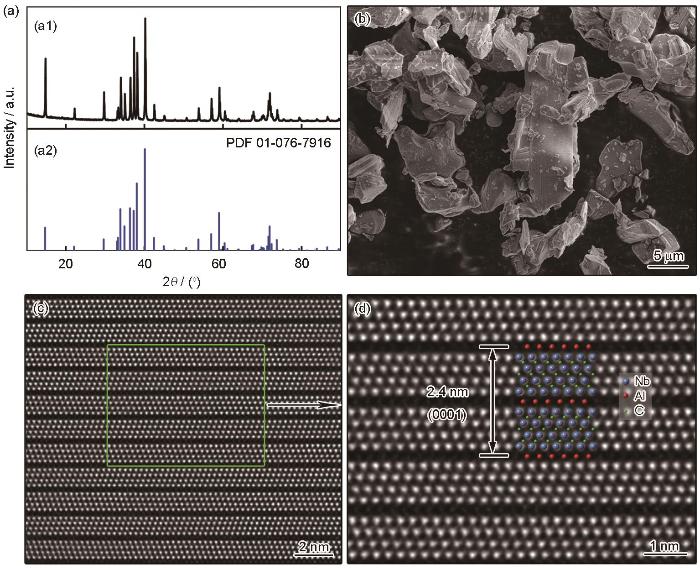
图1
Nb4AlC3MAX相粉末颗粒表征
Fig.1
Characterizations of Nb4AlC3MAX phase powders (a1, a2) XRD patterns of experimental powder (a1) and standard powder (a2) (b, c) SEM (b) and HAADF-STEM (c) images (d) partially enlarged view of Fig.1c (Inset shows the Nb4AlC3MAX phase atomic model viewed along the [11
Nb4AlC3MAX相属于纳米层状结构材料,具有显著的各向异性。在其微米颗粒的生长过程中,基面(即(0001)晶面)往往平行于层状平面,而较大的平坦面通常对应于基面,垂直于基面的方向即[0001]晶向。因此,可在FIB-SEM双束系统中根据颗粒表面形貌确定[0001]晶向(图2a),从而方便制备[0001]取向的单晶纳米线。图2b和c为压转拉装置的SEM像。装置上的弹簧呈对称分布,沿[0001]方向提取的Nb4AlC3MAX相并焊接在压转拉装置上。图2d为纳米线的SEM像。纳米线的厚度(t)为70 nm。图2e为纳米线的低倍TEM像。纳米线的长度为300 nm,宽度(w)为80 nm,直径
图2
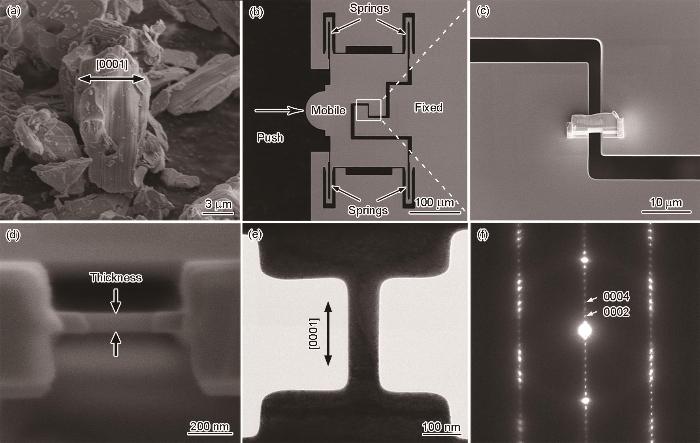
图2
Nb4AlC3MAX相纳米线的加工及表征
Fig.2
Fabrication and characterization of the Nb4AlC3MAX phase nanowire
(a) SEM image of Nb4AlC3MAX phase particles
(b, c) SEM images of the push-to-pull (PTP) device (b) and corresponding enlarged view (c) (Nb4AlC3MAX sheet was fabricated from the particle, and transferred and fixed on PTP device)
(d) SEM image showing the thickness of the fabricated nanowire
(e, f) TEM image (e) and SAED pattern (f) of the fabricated nanowire
Nb4AlC3MAX相纳米线在拉伸应力作用下发生断裂,其断裂和卸载过程的微观结构如图3a所示。卸载后,纳米线断面在压转拉装置弹簧作用下回到初始位置,形成较明显的裂纹,如图3a中绿色圆圈区域所示。关闭电子束静置1 h后,断面在没有外界环境刺激下发生了局部自修复,随后再次对其进行拉伸,其断裂和卸载过程如图3b所示。断裂之后对其进行1 h电子束辐照并再次进行拉伸测试,其断裂和卸载过程如图3c所示。图3d1为纳米线初始拉伸断裂过程的应力-应变曲线。纳米线的最大伸长率为11.5%,断裂强度为6.98 GPa。图3d2中蓝色曲线为关闭电子束自修复后拉伸断裂过程的应力-应变曲线。此条件下,纳米线的断裂强度恢复至2.11 GPa。图3d2中红色曲线为辐照后再次拉伸断裂过程的应力-应变曲线。此条件下,断裂强度恢复至3.93 GPa。
图3
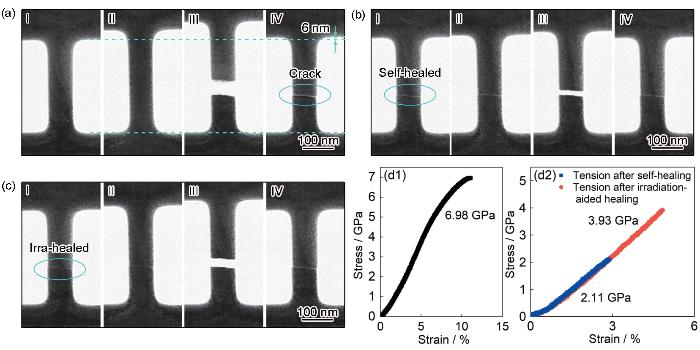
图3
Nb4AlC3MAX相纳米线断裂及自修复行为的原位定量测试
Fig.3
In situ quantitative TEM investigations on the fracture and self-healing behaviour of the Nb4AlC3MAX phase nanowire
(a) TEM images showing fracture (I-III) and unloading (IV) processes of the initial tension
(b) TEM images showing fracture (I-III) and unloading (IV) processes after self-healing for 1 h
(c) TEM images showing fracture (I-III) and unloading (IV) processes after irradiation-aided healing for 1 h
(d1, d2) tensile stress-strain curves during the initial tension (d1) and after self-healing and after irradiation-aided healing (d2)
图4
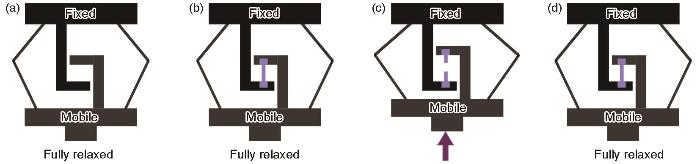
图4
Nb4AlC3MAX相纳米线拉伸断裂及自修复过程示意图
Fig.4
Schematics showing the fracture and self-healing processes of the Nb4AlC3MAX phase nanowire (After unloading, the upper fracture surface returned to its initial position thanks to the springs in the PTP device, and there is no stress applied on the fracture surfaces because the springs are fully relaxed) (a, b) PTP device before (a) and after (b) fixing the sample (c, d) sample fractured under tensile strain (c) and fully unloaded (d)
3 分析与讨论
3.1 Nb4AlC3MAX 相纳米线断裂行为分析
Nb4AlC3MAX相纳米线在拉伸应力作用下完全断裂,断裂前未观察到明显颈缩(图3a)。室温下,MAX相在拉伸过程中通常表现为脆性断裂,这与MAX相的结构有关:MAX相属于六方晶系,具有层状排列结构,其中,M—X之间以较强的共价键与离子键结合,M—A之间以较弱的共价键与金属键结合,M—M之间以金属键结合,MX片层与A原子层之间的结合力较弱[31],并且室温下MAX相中唯一容易开动的滑移系是基面滑移,有限的滑移系和相对较弱的结合面(MX片层与A原子层)导致MAX相在拉伸应力作用下容易发生脆性解理断裂。MAX相在拉伸应力作用下的室温伸长率通常较小(< 2%)[32],而本工作中制备的单晶Nb4AlC3MAX相纳米线表现出超高的伸长率(11.5%),并且断裂强度(6.98 GPa)远高于宏观块体Nb4AlC3MAX相(0.34 GPa)[25],主要原因在于尺寸效应,材料的尺寸越大,包含的缺陷(如空位、孔隙、杂质等)就越多,在拉伸载荷下,微裂纹容易在缺陷处形核并扩展,而本工作制备的单晶MAX相纳米线尺寸较小,内部缺陷少,不易产生应力集中,所以具有超高的伸长率和断裂强度。
值得注意的是,MAX相属于纳米层状材料,其在剪切或压缩应力作用下通常会产生基面滑移或出现扭折现象,从而表现出一定的塑性变形能力[33~35],而Nb4AlC3MAX相纳米线在拉伸断裂过程中表现为脆性断裂,主要原因在于加载方式为单轴拉伸,并且拉伸方向为c轴方向(即[0001]方向)。基面滑移是MAX相的主要塑性变形机制,当作用在基面上的分切应力大于临界切应力时便会产生基面滑移,当压应力或剪切应力使得MAX相无法通过滑移来协调变形时,局部区域便会发生弯曲或扭折[33,34,36]。本工作沿着c轴(垂直于基面)施加拉伸载荷,无论拉伸载荷多大,基面滑移系上都不存在分切应力,并且在拉伸应力作用下难以发生弯曲或扭折,所以基面滑移无法被激活,只能通过基面解理失效,表现为脆性断裂。
3.2 Nb4AlC3MAX 相纳米线断面自修复机制
早在2011年,Wang等[13]发现,GaAs纳米线在压缩过程中发生局部断裂,卸载后裂纹逐渐消失并恢复到初始结构,他们认为极性半导体纳米线断裂表面带有相反电荷,静电力诱导断面相互吸引从而发生自修复。随后,Wang等[37]通过分子动力学模拟计算了GaAs纳米线断面自修复后的力学性能,同时预测其他极性半导体(SiC、ZnO、GaN)纳米线也具有自修复能力,但实验中很难对自修复效率进行定量表征。本课题组[15,16]率先利用上述带有弹簧的压转拉装置对极性半导体SiC和非极性半导体Si纳米线的断面自修复行为进行原位定量研究和原子尺度表征,并结合分子动力学模拟计算,揭示了断面平整度是影响断面自修复效率的重要因素之一,断面越平整,自修复效率越高。
Nb4AlC3MAX相属于典型的层状MAX相材料(图1b和c),独特的化学键特征使其在[0001]方向拉伸应力作用下发生解理断裂,断面较平整,容易发生断面自修复。在Nb4AlC3MAX相中,Nb原子层与C原子层之间化学键较强,Nb原子层与Al原子层之间化学键较弱[38],因此当沿[0001]晶向对其进行拉伸时,在拉伸应力作用下,Nb原子层与Al原子层之间的化学键会优先断裂,而Nb原子层与C原子层之间的化学键不易断裂,导致Nb4AlC3MAX相纳米线在沿[0001]晶向拉伸断裂后断面比较平整。断面原子在相距较近时会因Van der Waals吸引力吸在一起,形成化学键,即断面原子重新键合,这导致系统能量降低[16],因此断面能够在没有外界环境刺激作用下自发进行修复。
图5a和b分别为Nb4AlC3MAX相断面自修复前后的高分辨TEM (HRTEM)像。如图5a所示,Nb4AlC3MAX相断面并不具有原子层级别的平整度,这是因为当样品尺寸较大时,其内部不同区域可能存在不同的缺陷,比如空位(MAX相具有较高的空位容纳能力[39])等,这些缺陷导致样品很难沿同一原子层解离断裂,导致断面凹凸不平。当断面相互靠近时,如果断面凹凸不平,先接触的原子会优先参与成键,而其他断面原子由于相距较远,形成较明显的缝隙,Van der Waals作用力很难使其键合,而自修复效率与键合的原子数量成正比,所以断面越平整,自修复效率就越高。由图5b可看出,自修复1 h后断面裂纹处缝隙变小,表明断面附近原子发生了原子迁移,原子迁移促进了更多原子参与键合,从而使其具有较高的断面自修复效率。此外,如果能提高Nb4AlC3MAX相的断面平整度,当断面回到初始位置时,平整的断面会使更多的断面原子参与成键,从而提高断面自修复效率。
图5
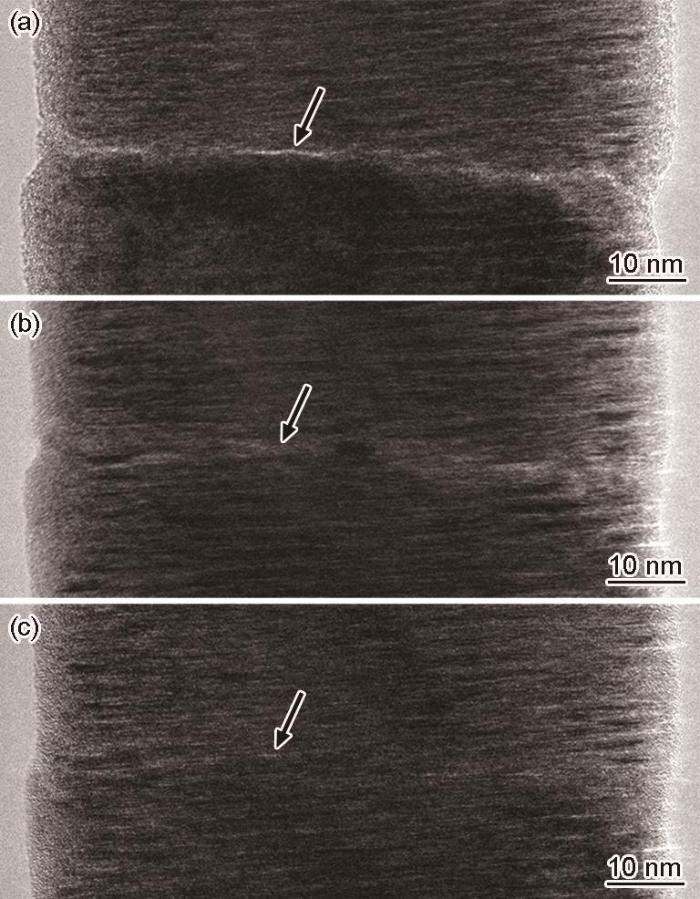
图5
修复前后Nb4AlC3MAX相纳米线断面的高分辨TEM像
Fig.5
HRTEM images of fracture surfaces of the Nb4AlC3MAX phase nanowire before (a) and after (b) the self-healing, and after the irradiation-aided healing (c) (Arrows represent fracture surfaces)
值得注意的是,拉伸断裂并卸载后,试样断面在压转拉装置弹簧的作用下回到初始位置,其断面并非理想的平整断面(图5a);纳米线可能会发生部分塑性变形导致长度伸长,但弹簧的刚度非常小(0.38 μN/nm),因此断面只能轻微接触,并不能完全回到初始位置,卸载之后纳米线顶端距初始位置(也就是弹簧不受应力时的位置)还有6 nm (图3a),表明弹簧变形量也为6 nm,此时纳米线断面之间存在一定的压力(F1),已知弹簧受到的反作用力
3.3 电子束辐照增强Nb4AlC3MAX 相纳米线断面自修复
为进一步增强Nb4AlC3MAX相纳米线断面的修复效率,本工作提出了利用电子束辐照的修复策略,利用TEM中的高能电子束对Nb4AlC3MAX相纳米线进行1 h辐照后断面的HRTEM像如图5c所示。可见,断面原子发生了明显迁移,裂纹基本消失,表明电子束辐照促进了断面原子迁移,断面在电子束辐照作用下修复效果较好。对辐照辅助修复之后的Nb4AlC3MAX相纳米线再次进行原位定量拉伸测试,其断裂强度恢复至3.93 GPa,修复效率为56.3%,远高于未经电子束辐照的自修复效率。
与大多数MAX相辐照行为一致,Nb4AlC3MAX相在辐照作用下沿c轴方向会发生晶格膨胀[40],使Nb4AlC3MAX相纳米线长度变长,但由于纳米线两端固定在压转拉装置上,使纳米线产生压应力,而即使微小的压应力也会促进断面处更多原子参与键合,从而促进断面自修复。此外,高速电子束轰击导致被轰击材料温度升高[41],材料晶格原子在被轰击过程中会发生原子迁移[42],并且温度的升高使得原子更加活跃,即更加容易迁移。原子迁移导致断面更多原子参与成键,从而增强Nb4AlC3MAX相纳米线的断面修复效率。值得注意的是,电子束辐照除了能够增强Nb4AlC3MAX相纳米线的修复效率外,也会产生空位等缺陷,甚至在轰击过程中使材料晶格原子脱离基体造成材料流失,从而降低其力学承受能力[16],所以合理选择电子束辐照参数对增强Nb4AlC3MAX相修复效率至关重要。
4 结论
(1) 利用聚焦离子束微纳加工技术可从Nb4AlC3MAX相粉末颗粒中加工制备[0001]取向的单晶Nb4AlC3MAX相纳米线,其具有超高的断裂强度(6.98 GPa)和伸长率(11.5%),主要归因于单晶Nb4AlC3MAX相纳米线消除了晶界的影响和尺寸效应。
(2) Nb4AlC3MAX相纳米线在拉伸应力作用下发生脆性断裂,在室温时,没有外界刺激作用下断面能够发生自修复,断裂强度恢复至2.11 GPa,自修复效率为30.2%。Nb4AlC3MAX相纳米线在拉伸应力作用下沿着Al原子面解离断裂,平整的断面使较多的断面原子发生键合,断面原子发生迁移促进原子重新键合。
(3) 电子束辐照可增强Nb4AlC3MAX相纳米线的断面修复效率,原位定量测试结果表明,在200 kV加速电压、6 × 10⁵ e-/(nm2·s)辐照剂量率的电子束辐照1 h之后,断裂强度恢复至3.93 GPa,修复效率为56.3%。Nb4AlC3在电子束辐照作用下MAX相纳米线晶格沿c轴发生膨胀,使断面产生压应力,压应力和电子束辐照引起的原子迁移使断面处更多原子参与成键,提高了其断面修复效率。
参考文献
Ion irradiation damage behavior in titanium carbide with different stoichiometry
[J].
不同化学计量碳化钛的离子辐照损伤行为研究
[J].
Phase field and crystal plasticity simulation of irradiation-induced He bubbles evolution and mechanical behavior in 316H steel and weld metal
[J].
316H steel is an important structural material candidate for Generation-IV advanced nuclear reactors. During service, the material operates under conditions of high temperature, irradiation, and complex stress for extended durations, and the working environment is extremely harsh. In particular, He bubbles, generated through nuclear transmutation under irradiation, can cause severe irradiation embrittlement and accelerate the failure of the material. To clarify the role of He bubbles in the degradation of 316H steel and weld metal, this study proposes a coupled computational framework that integrates the phase field model and crystal plasticity. Within this framework, the nucleation, growth, and coalescence of He bubbles in 316H steel and weld metal were simulated, and their mechanical responses were systematically analyzed. The research shows that He bubbles nucleate and grow by absorbing supersaturated vacancies and He atoms. In the later stage, they grow through coalescence and Ostwald ripening processes. As the He bubble size increases, the internal pressure gradually decreases until reaching an equilibrium state. The high density of dislocations in the weld metal, which preferentially absorb interstitial atoms, results in an increased vacancy concentration. Meanwhile, dislocations act as rapid diffusion channels. These two factors together contribute to the rapid growth of He bubbles. An increase in diffusion capacity does not change the final proportion of He bubbles; instead, it accelerates the nucleation and growth processes, thereby promoting the kinetic evolution of He bubbles in the weld metal. At small strains, the stress-strain response is governed by the effects of external strain and the internal pressure of He bubbles, with the macroscopic stress value being negative. As the external strain increases, the stress-strain response becomes influenced by the external strain. During tensile deformation, significant stress concentration arises at the He bubble-matrix interface, leading to considerable plastic deformation in these regions. At 4% applied strain, distinct plastic deformation bands form in both 316H steel and the weld metal. However, due to strain localization in the weld metal, the degree of plastic deformation is greater than that observed in 316H steel.
316H钢及其焊缝金属辐照He泡演化与力学行为的相场-晶体塑性耦合模拟
[J].
Self-healing materials: A review
[J].The ability of materials to self-heal from mechanical and thermally induced damage is explored in this paper and has significance in the field of fracture and fatigue. The history and evolution of several self-repair systems is examined including nano-beam healing elements, passive self-healing, autonomic self-healing and ballistic self-repair. Self-healing mechanisms utilized in the design of these unusual materials draw much information from the related field of polymer-polymer interfaces and crack healing. The relationship of material damage to material healing is examined in a manner to provide an understanding of the kinetics and damage reversal processes necessary to impart self-healing characteristics. In self-healing systems, there are transitions from hard-to-soft matter in ballistic impact and solvent bonding and conversely, soft-to-hard matter transitions in high rate yielding materials and shear-thickening fluids. These transitions are examined in terms of a new theory of the glass transition and yielding, viz., the twinkling fractal theory of the hard-to-soft matter transition. Success in the design of self-healing materials has important consequences for material safety, product performance and enhanced fatigue lifetime.
Room-temperature self-healing polymers based on dynamic-covalent boronic esters
[J].
Recent advancements in self-healing materials: Mechanicals, performances and features
[J].
Crack healing in silicon carbide
[J].
Modification of indentation cracks in TZP ceramics by thermal treatment
[J].
Approaching the ideal elastic strain limit in silicon nanowires
[J].Single-crystalline silicon nanowires can be reversibly stretched above 10% elastic strain at room temperature.
In situ transmission electron microscope studies on one-dimensional nanomaterials: Manipulation, properties and applications
[J].
Self-healing of bended WS2 nanotubes and its effect on the nanotube's properties
[J].
Self-healing of fractured GaAs nanowires
[J].In-situ deformation experiments were carried out in a transmission electron microscope to investigate the structural response of single crystal GaAs nanowires (NWs) under compression. A repeatable self-healing process was discovered in which a partially fractured GaAs NW restored its original single crystal structure immediately after an external compressive force was removed. Possible mechanisms of the self-healing process are discussed.
Cold welding of ultrathin gold nanowires
[J].The welding of metals at the nanoscale is likely to have an important role in the bottom-up fabrication of electrical and mechanical nanodevices. Existing welding techniques use local heating, requiring precise control of the heating mechanism and introducing the possibility of damage. The welding of metals without heating (or cold welding) has been demonstrated, but only at macroscopic length scales and under large applied pressures. Here, we demonstrate that single-crystalline gold nanowires with diameters between 3 and 10 nm can be cold-welded together within seconds by mechanical contact alone, and under relatively low applied pressures. High-resolution transmission electron microscopy and in situ measurements reveal that the welds are nearly perfect, with the same crystal orientation, strength and electrical conductivity as the rest of the nanowire. The high quality of the welds is attributed to the nanoscale sample dimensions, oriented-attachment mechanisms and mechanically assisted fast surface-atom diffusion. Welds are also demonstrated between gold and silver, and silver and silver, indicating that the technique may be generally applicable.
In situ TEM observation of rebonding on fractured silicon carbide
[J].
Atomic insights of self-healing in silicon nanowires
[J].
Self-healing of fractured diamond
[J].
Chemical scissor-mediated structural editing of layered transition metal carbides
[J].Intercalated layered materials offer distinctive properties and serve as precursors for important two-dimensional (2D) materials. However, intercalation of non-van der Waals structures, which can expand the family of 2D materials, is difficult. We report a structural editing protocol for layered carbides (MAX phases) and their 2D derivatives (MXenes). Gap-opening and species-intercalating stages were respectively mediated by chemical scissors and intercalants, which created a large family of MAX phases with unconventional elements and structures, as well as MXenes with versatile terminals. The removal of terminals in MXenes with metal scissors and then the stitching of 2D carbide nanosheets with atom intercalation leads to the reconstruction of MAX phases and a family of metal-intercalated 2D carbides, both of which may drive advances in fields ranging from energy to printed electronics.
Progress in structural tailoring and properties of ternary layered ceramics
[J].
三元层状材料结构调控及性能研究进展
[J].
Effect of temperature on the healing capacity and mechanical properties of Ti2AlC MAX phase ceramics
[J].
Room temperature crack-healing in an atomically layered ternary carbide
[J].Kinking induced local deformation and rotation can lead to autonomous crack-healing in atomically layered ceramic materials.
In situ reaction synthesis, electrical and thermal, and mechanical properties of Nb4AlC3
[J].
Compressive properties of Ti3AlC2 ceramics prepared by SHS/PHIP
[J].
自蔓延准热等静压技术制备Ti3AlC2可加工陶瓷的压缩性能
[J].
Mechanical and thermal properties and microstructural evolution of Ta-doped Nb4AlC3
[J].
Mechanical properties and oxidation behavior of Ti-doped Nb4AlC3
[J].
The role of group III, IV elements in Nb4AC3 MAX phases (A = Al, Si, Ga, Ge) and the unusual anisotropic behavior of the electronic and optical properties
[J].
Oxidation mechanism and mechanical properties of substitutional transition metal modified Nb4AlC3: A first-principles density functional theory study
[J].
Nb4AlC3: A new compound belonging to the MAX phases
[J].
Highly efficient self-healing of fractured Ti3AlC2 MAX phase nanowires
[J].
Disorder in Mn + 1 AXn phases at the atomic scale
[J].\n Atomic disordering in materials alters their physical and chemical properties and can subsequently affect their performance. In complex ceramic materials, it is a challenge to understand the nature of structural disordering, due to the difficulty of direct, atomic-scale experimental observations. Here we report the direct imaging of ion irradiation-induced antisite defects in M\n n+1\n AX\n n\n phases using double C\n S\n -corrected scanning transmission electron microscopy and provide compelling evidence of order-to-disorder phase transformations, overturning the conventional view that irradiation causes phase decomposition to binary fcc-structured M\n n+1\n X\n n\n. With the formation of uniformly distributed cation antisite defects and the rearrangement of X anions, disordered solid solution γ-(M\n n+1\n A)X\n n\n phases are formed at low ion fluences, followed by gradual transitions to solid solution fcc-structured (M\n n+1\n A)X\n n\n phases. This study provides a comprehensive understanding of the order-to-disorder transformations in M\n n+1\n AX\n n\n phases and proposes a method for the synthesis of new solid solution (M\n n+1\n A)X\n n\n phases by tailoring the disorder.\n
Preparation, structural featrures, properties and prospective of MAX phases
[J].
MAX相陶瓷的制备、结构、性能及发展趋势
[J].
Tensile properties of Ti3SiC2 in the 25-1300 oC temperature range
[J].
Non-classical crystallographic slip in a ternary carbide-Ti2AlC
[J].
Nanoindentation-induced deformation twinning in MAX phase Ti2AlN
[J].
Single crystal pillar microcompression tests of the MAX phases Ti2InC and Ti4AlN3
[J].
Mechanical properties and microstructure evolution of Ti2AlC under compression in 25-1100 oC temperature range
[J].This study investigates the effects of the initial grain size and temperature (ranging from room temperature to 1100 degrees C) on the mechanical properties and microstructure evolution of Ti2AlC MAX phase. A Hall-Petch like relationship is observed between compressive strength and the grain size below brittle-to-plastic transition temperature (BPTT). However, the compressive strength of fine-grained MAX phase decreases more rapidly with increasing temperature resulting in inverse Hall-Petch effect above BPTT. Results from postmortem EBSD analysis reveal complex microstructural evolution in both fine- and coarse-grained microstructures during loading at different temperatures. The pronounced drop in compressive strength for fine-grained microstructures at temperatures close to BPTT is attributed to creep induced grain boundary sliding resulting in texture development with more grains oriented for easy slip. In coarse-grained microstructures, no significant texture development is observed even though grain refinement occurs at all temperatures. A mathematical model has also been formulated to predict the experimentally observed grain size and temperature dependent variation in the compressive strength of Ti2AlC over a wide range of grain sizes and test temperatures. The mathematical model accounts for the competing effects of Hall-Petch strengthening and high temperature creep induced softening mechanisms. (C) 2020 Acta Materialia Inc. Published by Elsevier Ltd.
Self-healing in fractured GaAs nanowires
[J].
Phase stability, electronic structure and mechanical properties of ternary-layered carbide Nb4AlC3: An ab initio study
[J].
On the formation mechanisms and properties of MAX phases: A review
[J].MAX phases are a family of ternary carbide or nitride ceramics possessing a layered crystal structure and, due to their chemical bonds having a mixed covalent-ionic-metallic nature, have unique properties combining those of metals and ceramics. In this review, the formation mechanisms of MAX phases from elemental and compound powders are reviewed in detail, as the formation mechanisms are closely related to the unique properties of wellsynthesized MAX phases. The stability of MAX phases in some harsh external environments is significantly influenced by the defect population, allowing the mechanisms of defect formation and migration to strongly influence their self-healing performance and radiation tolerance. The properties of MAX phases can be tailored by creating solid solutions, which have lattice distortions, and texturing which results in the preferential orientation of plate-like grains.
The stability of irradiation-induced defects in Zr3AlC2, Nb4AlC3 and (Zr0.5, Ti0.5)3AlC2 MAX phase-based ceramics
[J].This work is a first assessment of the radiation tolerance of the nanolayered ternary carbides (MAX phases), Zr3AlC2, Nb4AlC3 and (Zr-0.5,Ti-0.5)(3)AlC2, using proton irradiation followed by post-irradiation examination based primarily on x-ray diffraction analysis. These specific MAX phase compounds are being evaluated as candidate coating materials for fuel cladding applications in advanced nuclear reactor systems. The aim of using a MAX phase coating is to protect the substrate fuel cladding material from corrosion damage during its exposure to the primary coolant. Proton irradiation was used in this study as a surrogate for neutron irradiation in order to introduce radiation damage into these ceramics at reactor-relevant temperatures. The post-irradiation examination of these materials revealed that the Zr-based 312-MAX phases, Zr3AlC2 and (Zr-0.5,Ti-0.5)(3)AlC2 have a superior ability for defect-recovery above 400 degrees C, whilst the Nb4AlC3 does not demonstrate any appreciable defect recovery below 600 degrees C. Density functional theory calculations have demonstrated that the structural differences between the 312 and 413-MAX phase structures govern the variation of the irradiation tolerance of these materials. (C) 2019 Acta Materialia Inc. Published by Elsevier Ltd.
Fatigue characteristics of copper-steel electron beam welding materials
[J].The fatigue performance of dissimilar metal welded components has an important influence on the service reliability of spacecraft. The fatigue life and fatigue fracture mechanism of dissimilar metal welded joints of QCr0.8 copper alloy and 1Cr21Ni5Ti stainless steel were investigated. The copper-steel composite plate was properly prepared by electron beam welding. The microstructure and composition of welding seam were characterized and analyzed by metallographic microscope. Mechanical properties of welded joints were tested using electronic tensile testing machine and fatigue testing machines. Scanning electron microscopy was used to observe the fatigue fracture in different cycles. The results show that the overall metallurgical bonding of the two metals is good, however, the local fusion zone on the steel side has a large area and extends into the weld from the steel base. The tensile specimens of the copper-steel electron beam welding all fracture at the minimum section of the weld, and the average fatigue limit of the fatigue specimens is 48.04 MPa and they all fracture at the minimum section of the weld. In the high cycle fatigue sample, a single crack source is observed at the endpoint of the weld top surface, while in the low cycle fatigue sample, more crack sources are observed on the top and bottom surface and inside of the weld. The final fracture zone of both samples is located in the copper alloy matrix.It can be seen in the process of fatigue fracture,the number of crack sources is different between high and low cycle fracture,but in both cases,the cracks are easy to initiate at the minimum section of the weld and spread to the copper alloy matrix.
铜-钢电子束焊接材料的疲劳特性
[J].


