金属学报, 2026, 62(5): 822-834 DOI: 10.11900/0412.1961.2025.00302

综述

金属材料在高温高压水、液态Pb-Bi和海洋环境中的腐蚀疲劳行为研究进展

吴欣强,, 谭季波, 张兹瑜, 薛宝权, 柯伟

中国科学院金属研究所 中国科学院核用材料与安全评价重点实验室 沈阳 110016

Research Advance on Corrosion Fatigue Behavior of Metallic Materials in High-Temperature Pressurized Water, Liquid Pb-Bi, and Marine Environments

WU Xinqiang,, TAN Jibo, ZHANG Ziyu, XUE Baoquan, KE Wei

CAS Key Laboratory of Nuclear Materials and Safety Assessment, Institute of Metal Research, Chinese Academy of Sciences, Shenyang 110016, China

通讯作者: 吴欣强,xqwu@imr.ac.cn,主要从事核用材料环境损伤行为研究

责任编辑: 肖素红

收稿日期: 2025-09-30   修回日期: 2026-02-07  

基金资助: 中国科学院战略性先导科技专项项目(XDA0410000)
国家重点研发计划项目(2021YFB3702201)
国家重点研发计划项目(2021YFB-3702202)
国家自然科学基金项目(U23B2074)

Corresponding authors: WU Xinqiang, professor, Tel:(024)23915898, E-mail:xqwu@imr.ac.cn

Received: 2025-09-30   Revised: 2026-02-07  

Fund supported: Strategic Priority Research Program of Chinese Academy of Sciences(XDA0410000)
National Key Research and Development Program of China(2021YFB3702201)
National Key Research and Development Program of China(2021YFB-3702202)
National Natural Science Foundation of China(U23B2074)

作者简介 About authors

吴欣强,男,1972年生,研究员,博士

摘要

腐蚀疲劳是金属材料在交变载荷与腐蚀环境协同作用下的一种典型失效形式,广泛存在于核电、海洋工程、航空航天、能源装备等关键领域,直接影响工程构件的服役安全和寿命评估。随着先进能源系统在深空、深海、深地等极端环境探索的推进,材料所面临的环境-力学耦合损伤日趋严苛。其中高温高压水、液态Pb-Bi和海洋环境为典型的腐蚀环境,理解并预测金属材料在上述环境中的腐蚀疲劳行为具有重要意义。本文综述了金属材料在上述三类典型腐蚀环境中的腐蚀疲劳实验技术、损伤机理和预测模型等的研究进展。在实验技术方面,重点介绍了模拟服役环境疲劳测试装置及样品应变/位移、裂纹长度原位监测方法的发展现状;在损伤机理方面,阐述了腐蚀坑应力集中、保护膜破裂和滑移溶解、表面渗氢和氢致损伤、表面能降低等多种机制的竞争和协同作用;在预测模型方面,梳理了从传统经验模型(Basquin和Coffin-Manson模型)到数据驱动的机器学习方法的发展脉络,并指出了当前模型在工程适用性和机理融合方面的不足。本文还讨论了该领域目前存在的主要挑战,如极端新环境实验技术的缺失、多机制耦合损伤理论的不足以及小样本条件下高精度寿命预测模型的缺乏等,并对未来研究方向进行了展望,包括发展跨尺度原位表征技术、融合物理机理与机器学习方法以及推动耐腐蚀疲劳新材料的设计和评价体系建设等。

关键词: 金属材料; 腐蚀疲劳; 损伤机理; 预测模型; 腐蚀环境

Abstract

Corrosion fatigue is a typical failure mode of metallic materials subjected to the combined effects of cyclic loading and corrosive environments. It is widely observed in critical fields such as nuclear power, marine engineering, aerospace, and energy equipment, and directly affects the service safety and life assessment of engineering components. With the advancement of advanced energy systems operating in extreme environments such as deep space, deep sea, and deep earth, materials increasingly experience severe environmental-mechanical coupling damage. Among these environments, high-temperature pressurized water, liquid lead-bismuth, and marine conditions represent typical corrosive systems. Therefore, understanding and predicting the corrosion fatigue behavior of metallic materials under these conditions is of considerable importance. This paper reviews recent research progress on corrosion fatigue experimental techniques, damage mechanisms, and prediction models for metallic materials in the three representative corrosive environments mentioned above. Regarding experimental techniques, particular attention is given to the development of fatigue testing devices capable of simulating service environments, as well as in situ monitoring methods for specimen strain/displacement and crack length. In terms of damage mechanisms, the competition and synergistic interactions among several mechanisms are discussed, including stress concentration at corrosion pits, rupture of protective films and slip dissolution, hydrogen ingress and hydrogen-induced damage, and reductions in surface energy. For prediction models, the evolution from traditional empirical models, such as the Basquin and Coffin-Manson models, to data-driven machine learning approaches is summarized. The limitations of current models in terms of engineering applicability and integration of physical mechanisms are also highlighted. Furthermore, this paper discusses major challenges in the field, including the lack of experimental techniques for emerging extreme environments, insufficient understanding of multimechanism coupled damage theories, and the absence of high-precision life prediction models under small-sample conditions. Future research directions are proposed, including the development of cross-scale in situ characterization techniques, the integration of physical mechanisms with machine learning methods, and the advancement of design and evaluation systems for materials resistant to corrosion fatigue.

Keywords: metallic material; corrosion fatigue; damage mechanism; prediction model; corrosive environment

PDF (1788KB) 元数据 多维度评价 相关文章 导出 EndNote| Ris| Bibtex  收藏本文

本文引用格式

吴欣强, 谭季波, 张兹瑜, 薛宝权, 柯伟. 金属材料在高温高压水、液态Pb-Bi和海洋环境中的腐蚀疲劳行为研究进展[J]. 金属学报, 2026, 62(5): 822-834 DOI:10.11900/0412.1961.2025.00302

WU Xinqiang, TAN Jibo, ZHANG Ziyu, XUE Baoquan, KE Wei. Research Advance on Corrosion Fatigue Behavior of Metallic Materials in High-Temperature Pressurized Water, Liquid Pb-Bi, and Marine Environments[J]. Acta Metallurgica Sinica, 2026, 62(5): 822-834 DOI:10.11900/0412.1961.2025.00302

腐蚀疲劳是材料在交变载荷与腐蚀环境交互作用下的一种损伤形式,普遍存在于桥梁、车辆、航空航天、能源等工业界,严重威胁关键装备的服役安全和经济性,是工程构件寿命设计必须关注的因素。在腐蚀疲劳过程中,材料表面或裂纹尖端通常与环境介质发生化学反应、电化学反应、物理溶解等腐蚀损伤,导致其抗疲劳性能降低。例如,压水堆核电站压力边界设备(压力容器、主管道、蒸汽发生器等)材料服役于高温高压(325 ℃、15.5 MPa)硼锂水中,在滑移溶解和/或氢致开裂的作用下,疲劳寿命可能下降10%~90%[1~17];类似地,铅冷快堆关键结构材料处于高温液态Pb-Bi环境中,会遭受液态金属腐蚀与脆化的共同作用,导致疲劳寿命下降可达80%[18~23]。因此,研究金属结构材料的腐蚀疲劳行为至关重要。

随着风能、太阳能、氢能、核能等先进能源的快速发展,以及人类向“深空、深海、深地”领域探索的战略驱动下,关键装备的服役条件越来越苛刻,逐渐向高温、高压、强腐蚀、强辐照/辐射等环境转化(图1)。研究关键装备材料在上述苛刻环境中的腐蚀疲劳行为,必须发展模拟服役环境中的载荷、应变/位移、裂纹长度、环境参数等的原位监测技术,研发模拟服役条件下的腐蚀疲劳实验技术和装置,揭示材料在模拟服役环境中的腐蚀疲劳损伤机理,建立其多因素耦合环境疲劳寿命预测模型,为关键构件的疲劳寿命分析和设计提供支撑。

图1

图1   金属材料在苛刻服役环境中的腐蚀疲劳

Fig.1   Corrosion fatigue of metal materials in harsh environments


本文综述了模拟高温高压水、高温液态Pb-Bi和海洋环境中腐蚀疲劳实验技术的发展现状,讨论了金属结构材料在这些环境中的腐蚀疲劳损伤机理,总结了当前的腐蚀疲劳寿命预测模型,并展望了未来可能的研究方向。

1 模拟服役环境中的腐蚀疲劳实验技术

疲劳测试方法通常有高周疲劳(载荷控制)、低周疲劳(应变控制)、蠕变疲劳(载荷/应变控制)、疲劳裂纹扩展(载荷控制)等[24~27]。研究材料的腐蚀疲劳行为,需在常规疲劳实验装置上附加模拟环境箱。图2a为典型的腐蚀疲劳实验装置,通常采用标准棒状试样或片状试样;图2b为典型的腐蚀疲劳裂纹扩展实验装置,通常采用紧凑拉伸(CT)试样。模拟环境箱能够提供近服役环境的腐蚀介质、化学参数及可控的温度/压力等。光滑试样高周/低周腐蚀疲劳实验的关键技术为原位监测/控制试样在模拟服役环境中的载荷和应变/位移;CT试样腐蚀疲劳裂纹扩展实验的关键技术为原位测量试样在模拟服役环境中的裂纹长度。

图2

图2   光滑试样腐蚀疲劳实验装置和腐蚀疲劳裂纹扩展实验装置

Fig.2   Testing devices of corrosion fatigue for smooth specimens (a) and corrosion fatigue crack growth (b) (LVDT—linear variable differential transformer, DCPD—direct current potential drop, CT—compact tension)


在空气环境中,通常采用应变片、引伸计、数字图像相关法等测量光滑疲劳试样的应变,采用柔度法测量CT试样的裂纹长度。但常规的引伸计不能用于苛刻腐蚀环境。目前,通常采用线性可变差动变压位移传感器(LVDT)测量试样在腐蚀环境中的应变(图2a)或裂纹口张开位移(图2b) ,采用直流电位降(DCPD)测量CT试样在腐蚀环境(不导电或弱导电介质)中的裂纹长度(图2b),也有利用声发射技术原位监测腐蚀疲劳过程的研究报道[28]。在苛刻环境的腐蚀疲劳实验中,LVDT凭借其坚固的密封结构、卓越的抗腐蚀能力、非接触测量的可靠性以及长期的稳定性,成为测量位移(如裂纹张开位移)的首选方案。它有效克服了应变片易受环境影响、寿命有限的问题,避免了引伸计可能滑脱和损伤表面的缺点,同时也解决了数字图像技术对环境光路要求苛刻、难以在密闭腐蚀环境中应用的难题。

基于近服役环境模拟技术和相应的原位监测技术,中国科学院金属研究所(IMR)研发了系列腐蚀疲劳实验技术和装置,包括:模拟海洋环境腐蚀疲劳实验装置,可开展模拟潮差区、流动海水区和海洋飞溅区等的疲劳实验;湿H2S环境中的腐蚀疲劳实验装置,可实现不同浓度的H2S及其混合气体循环溶液(≤ 75 ℃)密闭环境中的疲劳实验;模拟压水堆核电一回路环境腐蚀疲劳实验装置,可开展高温高压循环水(350 ℃、20 MPa,溶解氧浓度和溶解氢浓度可精确调控)环境中的疲劳实验;模拟铅冷快堆冷却剂环境腐蚀疲劳实验装置,可开展精确控氧高温液态Pb-Bi环境中的疲劳实验[29]。其核心技术在于实现力学载荷(疲劳、慢拉伸、恒载荷)与腐蚀环境的耦合作用,并集成多种原位实时监测手段,包括电化学测量、光学和光谱分析、声发射技术等,以实时监测材料的腐蚀行为、表面状态及裂纹扩展过程,为揭示材料在真实服役条件下的损伤机制提供关键数据支撑。这些装置主要依托三大技术原理:首先,通过高温高压循环水系统及可靠的密封设计(如卡套密封),在高压釜或管路中精确复现目标服役环境的温度、压力和水化学条件;其次,借助力学加载系统在模拟环境中对试样施加疲劳、慢应变速率拉伸等多种载荷,从而达到腐蚀环境与应力状态的协同耦合作用;最关键的是,这些装置集成了耐高温高压的原位测试探头和传感器,实现了电化学信号、光学观测和声发射事件等关键参数的实时采集,有效避免了传统离线分析引入的误差,为揭示材料损伤机制提供了数据支撑。

尽管金属材料在模拟苛刻服役环境中的腐蚀疲劳实验技术取得了一定进展,但随着氢能、先进核能、万米深潜、万米深地、宇宙深空等新领域的迅速发展,当前依然缺乏成熟可靠的模拟高压氢、高温熔盐、超高压海水、高压深地、模拟深空(空间辐射、原子氧、等离子体等)环境中的疲劳实验技术,需重点发展。

2 金属材料腐蚀疲劳损伤机理

金属材料的腐蚀疲劳行为受环境、力学和材料多因素协同效应的影响,在不同环境-材料体系下损伤机制存在差异。目前广泛认可的腐蚀疲劳损伤机理为腐蚀坑应力集中模型、保护膜破裂模型、滑移溶解模型、氢致损伤及表面能降低模型等。实际工程构件在发生腐蚀疲劳失效时,多种机理在不同阶段的协同和竞争进一步加剧了腐蚀疲劳行为的复杂性。尤其在高温高压水、液态金属、深海等极端服役条件下,用传统机理解释观测到的腐蚀疲劳现象已显现局限性。因此,近服役苛刻环境中的腐蚀疲劳损伤机制仍亟待深入研究。

2.1 腐蚀坑应力集中模型

腐蚀坑应力集中模型是解释金属材料腐蚀疲劳裂纹萌生的经典理论之一,已广泛应用于工业领域[30~32]。该模型通过电化学局部腐蚀损伤与力学应力集中效应的协同作用,阐明了疲劳裂纹萌生的加速机制[33~35]。腐蚀坑的几何特征(尤其是深宽比)直接影响应力集中程度,坑体越深、越尖锐,应力集中程度越高,裂纹越易萌生[36]。与惰性环境中材料需经历较长时间形成挤出/侵入等应力集中源不同,腐蚀环境可通过快速形成腐蚀坑而预先引入应力集中源,从而显著缩短疲劳裂纹萌生寿命[37,38]

在核电高温高压水环境中,尽管介质为纯H2O或硼锂水,但奥氏体不锈钢和镍基合金表面的氧化膜仍可能发生局部破裂,或因制造残留的划痕、异物沉积等诱发点蚀,在系统压力波动、机械振动和热疲劳载荷的共同作用下,这些缺陷部位可能成为疲劳裂纹萌生源[11,13,16,17]

在海洋和近海工程环境中,高浓度Cl⁻易侵蚀不锈钢和铝合金表面的钝化膜,引发点蚀[39~41]。叠加波浪、海流等带来的循环载荷,例如海上风电结构的焊接接头和热影响区、船舶和潜艇的螺旋桨轴(高强度不锈钢)以及海洋平台导管架的飞溅区等薄弱部位,因腐蚀坑与循环应力的协同作用而成为裂纹萌生的高风险区域[40,41]

2.2 保护膜破裂和滑移溶解模型

保护膜破裂和滑移溶解模型是解释不锈钢、镍基合金、铝合金和钛合金等金属材料在腐蚀环境中发生疲劳裂纹萌生和扩展的核心理论之一[29]。保护膜本身的电化学/力学不稳定性使其成为裂纹萌生点,它的破裂和修复过程引入了局部应力集中和缺陷,从而促进了裂纹的萌生。该模型的关键在于“膜破裂-金属溶解/再钝化-产生应力集中/缺陷”这一循环过程的持续重复。每一次应力循环均可能引起保护膜的局部损伤和微量金属溶解,长期累积后最终形成尖锐的裂纹源。循环载荷引起的局部塑性变形与电化学阳极溶解过程之间反复、协同的动态交互作用,共同驱动裂纹尖端向前扩展。该模型合理解释了腐蚀疲劳裂纹扩展行为对载荷频率和环境化学参数的强烈依赖性:频率越低,每一循环内裂纹尖端新鲜金属暴露于腐蚀介质的时间越长,溶解量越大,导致每循环扩展量升高;环境条件越苛刻(如Cl⁻浓度高、温度高、再钝化能力差等),溶解速率越快,疲劳裂纹扩展速率(da / dN,其中,a为裂纹长度,N为循环次数)也相应增大[29]。二者的核心区别可以概括为:滑移溶解模型关注的是“机械损伤如何引发和促进电化学溶解”,而保护膜模型关注的是“电化学过程如何引发和促进机械损伤”。实际上,在大多数腐蚀疲劳过程中,这两种机制往往是共同作用、相互促进的,很难完全分开。滑移溶解过程会造成保护膜破裂和溶解,溶解和再钝化过程又会改变表面的力学状态,产生新的应力集中点,促进更多的塑性变形。因此,保护膜破裂和滑移溶解模型分别描述了腐蚀疲劳损伤过程中不同环节的主导机制。

核电领域是滑移溶解模型应用和研究最为成熟的典型场景,奥氏体不锈钢(如304/316L)和镍基合金(如600/690合金)长期暴露于含微量溶解氧和溶解氢的高温高压水(320 ℃、12.5 MPa)环境中[2,9~11,13~17,42~44],材料表面通常形成以Ni/Fe-Cr尖晶石为主的保护性氧化膜[11~13,45]。但在裂纹尖端应力和塑性应变集中区域,循环载荷导致位错滑移反复破坏该氧化膜,暴露出的新鲜金属发生阳极溶解,随后重新形成氧化膜[15,17,44]。上述过程受水温、溶解氢浓度、Li浓度及pH值等水化学参数的控制,从而影响疲劳裂纹的萌生和扩展行为[9,46,47]。这种“滑移-膜破裂-溶解-再钝化”循环持续驱动腐蚀疲劳裂纹稳定扩展,如图3[11]所示。

图3

图3   奥氏体不锈钢在高温高压水环境中保护膜破裂和滑移溶解模型的原理示意图[11]

Fig.3   Schematics of protective film rupture and slip dissolution model of austenitic stainless steel in a high-temperature, pressurized water environment[11] (DO—dissolved oxygen, PWR—pressurized water reactor, BWR—boiling water reactor, PSBs—persistence slip bands)


在深海高压、低温及低频疲劳载荷作用下,载人潜水器耐压壳体和管道材料常采用钛合金或高强钢,主要依靠稳定钝化膜抵抗腐蚀[48~63]。深海装备承受高静水压力和循环波浪载荷,在焊缝及几何不连续等应力集中区域,钝化膜可能发生反复破裂[50,51]。经历数万次循环载荷后,最终可能导致微裂纹萌生。此外,深海低温条件会延缓再钝化动力学,增大每次循环溶解量,进一步加速疲劳裂纹萌生。循环应力使裂纹尖端发生位错滑移,反复撕裂表面钝化膜[56,59,60]。尽管钛合金再钝化能力较强,但高静水压力会改变其再钝化动力学和离子迁移行为[56,60]。每次循环伴随微区溶解-再钝化,长期累积会促使裂纹扩展。

在航空领域,常采用高强度不锈钢或钛合金制造飞机发动机压气机叶片,特别是在舰载机或沿海地区飞行的飞机,处于海洋大气盐雾和压缩升温的严苛腐蚀疲劳环境[52~54]。盐分沉积破坏表面钝化膜并形成电解液薄膜,在高周疲劳载荷作用下,裂纹尖端的保护膜因应力循环反复破裂,暴露出的新鲜金属在含Cl⁻介质中发生阳极溶解,且Cl⁻会显著阻碍再钝化过程[52~54]。“压缩升温”指的是航空部件(如发动机压气机叶片、涡轮叶片、机翼蒙皮等)在承受交变载荷时,由于空气动力学压缩和摩擦,导致部件表面局部温度显著升高的现象[52,53]。当这种效应与富含Cl⁻的海洋大气结合时,会极大地加速滑移溶解过程。

2.3 表面渗氢和氢致损伤模型

表面渗氢模型是描述H原子从外部环境产生、吸附并渗透进入金属表面,从而为后续一系列氢致损伤(如氢脆、氢致开裂)奠定基础的物理化学过程模型[64]。氢致损伤是指H原子侵入金属内部后,通过多种微观机制导致材料塑性、韧性等力学性能显著下降的现象,涵盖从局部塑性丧失至宏观脆性断裂(氢脆)的全过程[65]。其主要机制为氢增强局部塑性(HELP)、氢致脱键(HEDE)及氢化物形成。HELP机制中H原子通过促进位错运动并诱导塑性变形局域化,引发微裂纹形核[66];HEDE机制中H通过在裂纹尖端偏聚,降低原子间结合能,导致解理开裂;在钛、锆等金属中,H更可形成脆性氢化物相,直接成为裂纹源。

在压水堆环境中,早期采用的镍基合金(如600合金)蒸汽发生器传热管在高温高压水(约300 ℃、15 MPa)环境中面临严峻挑战[67,68]。一回路为抑氧而添加的H2以及H2O与合金的化学反应共同提供了氢源,H原子在残余应力与工作应力的共同驱动下向晶界偏聚,通过HELP等机制引发沿晶应力腐蚀裂纹的缓慢扩展,最终可能导致传热管破裂及放射性冷却剂泄漏事故。该问题是促成抗氢致开裂性能更优的690合金被广泛采纳并用于改进设计的关键原因之一[11,13]

在深海环境中,氢致损伤与疲劳的交互作用是导致材料失效的核心机制,其危险性远高于常规环境[57,58,60,64,69~74]。在巨大静水压力、海水腐蚀以及长期静载与低频疲劳载荷的协同作用下,H2分子在高压下分解为原子并侵入金属,并在晶界和应力集中区富集,诱导裂纹的萌生和扩展,可能导致关键承力构件在服役载荷低于设计预期时发生突发性断裂,安全风险极高[65,70,75,76]

2.4 表面能降低模型

表面能降低模型从热力学角度阐释了环境介质对金属材料裂纹扩展的促进作用[77]。表面能降低的机理基于Rebinder效应与Griffith断裂理论的结合[77]。Rebinder效应是指,当液态金属或特定离子等介质吸附于裂纹尖端表面时,材料原子间的键合强度将被削弱,从而降低裂纹扩展所需的能量[77]。Griffith理论是指在纯弹性固体中考虑能量守恒,即断裂过程中释放的弹性应变能完全转化为由于解理形成的新表面所需的表面能,如下式所示[77]

σa=2Eγπa'

式中,σa为外加应力,E为固体的Young's模量,γ为界面处的比表面能,a'为内部已存在裂纹的半长。根据Griffith理论,表面能的下降使得材料在较低应力水平下即可发生断裂[77]。因此,表面能降低模型常被用于解释由液态金属等介质引起的特异性吸附所导致的脆性开裂行为。

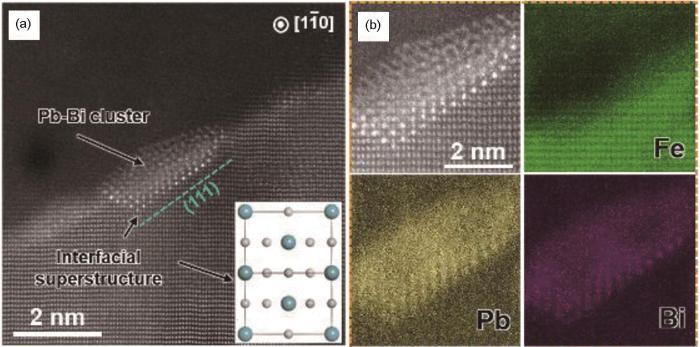
在第四代核电液态金属冷却快堆中,奥氏体不锈钢及铁素体/马氏体钢与液态钠或Pb-Bi共晶(LBE)冷却剂接触时,液态金属原子会吸附于裂纹尖端区域,显著降低局部表面能[78]。在循环载荷作用下,每次加载均使新生金属表面暴露于液态金属环境中,引发快速吸附行为,从而显著提高da / dN,这已成为制约先进核电技术发展的关键问题之一[19,20,22,78]。IMR利用自主研发的液态金属环境腐蚀疲劳试验系统及CT试样裂纹长度原位监测技术,系统研究了T91铁素体/马氏体钢和316LN奥氏体不锈钢在液态Pb-Bi环境中的疲劳裂纹扩展行为[18,21,23]。结果表明,裂纹先以延性模式扩展,然后转变为准解理开裂模式,最后转变为解理开裂模式,如图4[18]所示。穿晶脆性裂纹优先沿裂纹尖端附近由于塑性变形形成的高密度位错带等微观界面扩展。Pb、Bi原子易于在这些界面发生偏聚,削弱界面原子结合力,诱发脆性断裂[18,21]。原子尺度表征进一步揭示了Pb/Bi原子在微观界面形成有序吸附超结构,如图5[21]所示。上述原子尺度上液态金属原子在裂纹尖端微观界面偏聚吸附并诱导界面解理的实验现象,为表面能降低模型提供了直接证据。

图4

图4   液态Pb-Bi辅助316LN奥氏体不锈钢疲劳裂纹扩展过程的示意图[18]

Fig.4   Schematics of fatigue crack growth process of 316LN austenitic stainless steel assisted by liquid Pb-Bi (LBE)[18] (σ—loading stress, LME—liquid metal embrittlement, TBs—twin boundaries, GBs—grain boundaries)

(a) ductile cracking

(b) ductile crackingquasi-cleavage cracking

(c) ductile crackingquasi-cleavage crackingcleavage cracking


图5

图5   Pb、Bi原子在裂纹尖端附近微观组织界面上的吸附状态[21]

Fig.5   Adsorption states of lead and bismuth atoms on the microstructure interface near the crack tip[21]

(a) Pb-Bi clusters and superstructures (Inset illustrates the adsorption configurations of Pb/Bi atoms, with green spheres representing Pb/Bi atoms and gray spheres representing the Fe atoms of the substrate)

(b) atomic-level energy spectrum of the segregation state of Pb/Bi atoms


然而,在突发性脆性断裂过程中,仅依靠热力学扩散,Pb/Bi原子在极短时间内难以快速迁移至裂纹前端。研究[18,21]表明,塑性变形是液态Pb-Bi环境中诱发穿晶解理开裂的必要条件,其可能通过促进Pb/Bi原子向裂纹尖端区域的输运,从动力学角度为脆性开裂提供驱动力。此外,Pb/Bi原子可能与塑性变形引入的微观缺陷发生相互作用,但目前尚缺乏能够系统解释此类现象的机理模型。传统理论模型已难以全面涵盖观察到的实验现象。因此,未来研究应结合原位表征技术,进一步揭示苛刻液态金属环境下的脆化机制。

3 金属材料腐蚀疲劳寿命预测模型

疲劳设计模型是工程关键构件安全设计及运行的重要保障,通常分为疲劳寿命模型和裂纹扩展速率模型,分别对应疲劳设计中的基于S-N/ε-N (其中,S为应力,ε为应变)曲线的总寿命法和基于da / dNK (其中,ΔK为应力强度因子范围)关系的损伤容限法。总寿命法基于控制应力或者应变幅获得的光滑试样产生疲劳失效(断裂或者峰值拉应力下降到特定值)对应的寿命。损伤容限法基于应力控制下获得的含裂纹试样的da / dN及其与ΔK的关系。

应力/应变-寿命模型中应用最广泛的模型为Basquin模型[79] (针对高周疲劳)和Coffin-Manson模型[80,81] (针对低周疲劳)。由于在实际服役过程中工程构件所承受的载荷/变形处于动态变化过程中,可以采用Palmgren-Miner累积损伤模型[82]计算变幅疲劳产生的损伤。为满足工程设计的需求,Langer[83]在Coffin-Manson模型的基础上进行了简化,得到了目前美国机械工程师学会(ASME)锅炉和压力容器设计规范中采用的方程。

Basquin模型[79]的表达式为:

Δσ / 2=σf'(2Nf)b

式中,Δσ为应力变幅,即最大应力与最小应力之差;Δσ / 2为应力幅,即应力变幅的一半;σf'为疲劳强度系数;Nf为疲劳寿命;b为疲劳强度指数。

Coffin-Manson模型[80,81]的表达式为:

Δεp / 2=εf'(2Nf)c
Δε / 2=σf'(2Nf)b / E+εf'(2Nf)c

式中,Δεp为塑性应变幅,εf'为疲劳延性系数,c为疲劳延性指数,Δε为总应变幅。

Palmgren-Miner累积损伤模型[82]的表达式为:

imniNfi

式中,ni 为含有m个载荷块的加载序列中在恒应力幅为σai 时第i个载荷块的循环数,Nfi 为在σa下的破坏循环数。

Langer方程简化模型[83]的表达式为:

εa=AN25-B+C

式中,εa为应变幅;A为方程的系数;BC为与材料成分和结构有关的常数,与载荷和环境无关;N25为峰值拉应力下降25%时对应的循环周次。

正如前文所述,特定的环境和力学参数下结构材料的疲劳寿命会明显降低,表现出明显的环境效应[2,5,22,84]。但前述模型均为空气环境中的数据拟合模型,未包含环境因素的影响。考虑环境因素对低周疲劳寿命影响的主要方法有三种。(1) 根据材料、载荷(应变速率、波形等)和环境(温度、溶解氧浓度等)分别建立不同条件下的疲劳寿命模型。这种方法所需的数据量巨大,需要针对所有材料,在所有力学参数及环境参数下进行不同应变幅/应力幅条件下的疲劳实验,获得疲劳数据后进行拟合得到考虑环境因素的疲劳模型,因此不适用于工程应用。(2) 基于空气环境中疲劳寿命模型植入环境疲劳影响因子(Fen)。该方法是目前核电压力容器设计领域通常采用的方法,定义Fen = NAir / NWater,其中NAir为空气环境中的疲劳寿命,NWater为水环境中的疲劳寿命。NAir由Langer方程简化模型确定(见 式(6))。考虑环境中对疲劳寿命有明显影响的因素(应变速率、温度、溶解氧浓度等),通过拟合Fen与不同影响因素之间的关系并结合Fen的阈值,得到Fen模型。目前核电领域考虑环境因素的Fen模型主要包括ANL (Argonne National Laboratory)模型(美国)[85]、JNES (Japan Nuclear Energy Safety Organization)模型(日本)[86]及IMR模型(中国)[9]。(3) 结合腐蚀过程的具体损伤形式建立腐蚀特征参数与疲劳寿命之间的模型。该方法通常结合腐蚀缺陷形态(主要为点蚀),构建其与疲劳寿命之间的关系。Gabb等[32]建立了腐蚀坑尺寸与剩余疲劳寿命之间的关系(Nf = a''Dn,其中,a''n为常数,D为腐蚀坑尺寸(宽度、深度和面积),Godard[87]建立了腐蚀坑深度与时间的关系(h = Kt1/3,其中,h为腐蚀坑深度,t为时间,K为常数),两个关系式均为幂函数的形式。在此基础上部分研究者将力学参数或腐蚀过程中的电化学参数引入到模型中,进一步完善了模型。Harlow和Wei[88]提出了基于Faraday定律的蚀坑生长时间与蚀坑半径之间的关系;Sriraman和Pidaparti[89]考虑了外加载荷的影响,建立了蚀坑生长时间与临界蚀坑半径的关系(tci=2πn΄Fρ3MIP0(aci3-a03)expΔHRT,其中,tci为蚀坑生长时间,n'为化合价,F为Faraday常数,ρ为材料密度,M为相对原子质量,IP0为点蚀电流密度,aci为临界蚀坑半径,a0为初始蚀坑半径,ΔH为活化能,T为热力学温度,R为气体常数)。Li和Akid [90]将点蚀坑等效为缺口,采用权函数修正的临界距离法得到有效应变范围,对空气环境中的疲劳寿命模型进行了修正(Npit=apcA'1 / B109.19exp(0.036σa),其中,Npit为腐蚀坑扩展寿命,apc为坑向裂纹过渡的临界坑尺寸,A'为系数)。但上述模型仅适用于材料发生点蚀的条件,不适用于其他腐蚀形态下的寿命预测。

大多数工程合金的疲劳裂纹扩展规律(da / dNK关系)存在三个明显的区间。当ΔK小于门槛值时,裂纹不扩展或da / dN太小无法检测;当ΔK大于门槛值时,da / dN随ΔK增大快速增加,随后,da / dN随ΔK变化符合线性关系,即目前研究数据最多的Paris区;随ΔK继续增大,da / dN快速增大,直至发生断裂。目前关于疲劳裂纹扩展速率的模型多集中在Paris区,空气环境中该区域的疲劳裂纹扩展模型为:da / dN = C'K) n',其中,C'n'为系数[91]。目前考虑环境因素的疲劳裂纹扩展模型主要有三种。(1) 基于Paris模型植入环境因子进行修正。首先选取环境参数中明显影响da / dN的因子,基于数据拟合获得环境因子的表达式。由于该方法便于工程应用,ASME标准的Code Case中也给出了推荐模型表达式,目前核电领域主要的模型包括ASME Code Case N809 (dadN=9.10×10⁶exp(-2516T)(1+exp(8.02(R'-0.748)))tR0.3(K)2.25,其中,tR为加载上升时间,R'为应力比)[92]及JSME模型(dadN=1.61×10⁻¹⁰TK0.63tR0.333ΔK3 /(1-R΄)1.56,其中,TK为温度,单位为℃)[43]。上述两种模型的表达式形式均为:da / dN = C'f1(T)f2(tR)f3(R')(ΔK) n',但不同参数对应的函数表达式存在差异。(2) 将环境中da / dN分解为疲劳分量和环境分量。由于腐蚀是依赖时间的过程,因此部分研究[44,93]采用da / dt来表征疲劳裂纹扩展速率,采用线性叠加的方式考虑环境影响,da / dt可以转化为da / dN进行统一。关于环境分量,部分研究采用空气环境中da / dNn次方的形式,也有研究采用ΔK幂函数的形式。(3) 基于腐蚀疲劳表面反应过程的疲劳裂纹扩展模型。根据腐蚀疲劳表面反应涉及的主要过程的差异提出的疲劳裂纹扩展模型主要包括表面渗氢模型[94,95]和阳极溶解模型[96]等。裂纹尖端电流密度模型[94,95]的表达式为:

I(t) / B΄=0tft-τCTODττdτ

式中,I(t)为裂尖总电流,B'为样品厚度,CTODττ为裂纹口张开位移,τ为虚拟变量。

阳极溶解模型[96]的表达式为:

dadN=M'n'FρIbt0+Ift1+(Ib-If)1-exp (-βt1)β

式中,M'为平均原子质量,t0为一个周期中新表面的产生时间,t1为一个周期中裂纹口张开但未产生新表面的时间,Ib为新生面电流密度,If为定常面电流密度,β为膜形成速率常数。

由于传统的基于数据拟合获得的经验模型需要大量实验数据,腐蚀疲劳环境模拟也较为复杂,通常需要投入较大的人力和物力,且应变速率(频率)或应变(应力)幅较低条件下的实验周期往往需要几个月或更长时间。同时,经验模型依赖于材料和实验条件,普适性不高,机理越明确的模型其表达式往往越复杂,不便于工程应用。因此,亟需基于小样本数据获得具有较高精度的预测模型,从而降低实验成本。数据驱动的机器学习方法通过从有限的实验数据中学习复杂规律,为腐蚀疲劳寿命预测提供了可行途径,适用于小样本条件下建立预测模型。其基本过程是通过整合和提炼疲劳寿命及裂纹扩展速率数据信息,经过训练和拟合形成预测模型。数据驱动的疲劳预测模型主要包括统计学模型和机器学习模型两种。统计学模型通过概率寿命预测方法将不确定性建模和量化手段引入疲劳寿命的评估,通过结构件寿命的概率分布或置信区间为疲劳设计及寿命管理等提供了依据[88,97]。在腐蚀疲劳寿命问题研究中,统计学模型一方面通过对腐蚀疲劳失效数据进行非线性参数拟合,基于概率密度曲线定性分析腐蚀环境对疲劳寿命的影响规律,同时评估腐蚀疲劳寿命;另一方面通过概率方法降低物理模型参数的不确定性,进而提高预测结果的可靠度[98]。利用统计学方法预测疲劳寿命目前已在航空领域得到了较为广泛的应用。但实验室统计方法样本数据有限,预测结果的准确性与分布函数及其参数的选取有关。机器学习模型通过聚类技术、降维技术、分类技术及回归技术对数据进行处理,可以从数据中自动学习并得出规律,具有更强大的数据处理能力和泛化能力,能够针对腐蚀疲劳寿命预测问题给出比较准确的结果[98~101]。但机器学习方法的可解释性低,无法解释数据中蕴含的基本力学或化学原理[102]。将物理约束引入机器学习的数据驱动-物理融合方法可以实现物理信息融合,提高机器学习方法的可解释性,但上述方法在腐蚀疲劳寿命预测中的应用有待进一步研究[99,103,104]

Yang等[105]回顾了海洋结构腐蚀疲劳的研究进展,指出一些新开发的基于数据驱动机器学习和海上监测的腐蚀疲劳理论和实验方法已得到初步应用。这些方法能够同时考虑材料性能、环境参数和载荷条件等多种因素,建立与腐蚀疲劳寿命的复杂映射关系。机器学习模型可以整合实验数据、现场监测数据和物理模型输出,形成更全面的预测框架。例如,通过将腐蚀电位、pH值、Cl-浓度等环境参数与应力水平、频率等力学参数共同作为输入特征,使机器学习模型能够捕捉这些因素之间的复杂交互作用。Feng等[106]采用符号回归辅助的机器学习方法,对第四代先进核电站所用的T91钢和316L不锈钢进行了腐蚀疲劳寿命预测。结果表明,引入符号回归提取的特征能有效提升各类机器学习模型的性能。其中,人工神经网络(ANN)模型改进最为显著,其均方根误差(RMSE)较未使用符号回归特征的模型降低了22%。此外,还将训练完备的ANN模型迁移应用于316L不锈钢的预测,在训练样本减少50%的情况下仍保持良好的性能,体现出该方法在提升模型训练和部署效率方面的潜力。

4 总结与展望

(1) 模拟服役环境的腐蚀疲劳实验技术已取得显著进步,基于LVDT、DCPD等原位监测方法,已发展出适用于海洋、核电高温高压水、液态金属等复杂环境的疲劳测试装置,为揭示材料在真实工况下的损伤行为提供了关键平台。然而,面对氢能、深空、深地等新兴领域带来的高压氢、高温熔盐、超高压深海、空间辐射等极端环境,现有实验技术仍存在空白。上述环境下环境箱的适应性设计及动密封的实现是未来关注的重点,其中采用波纹管实现苛刻环境下的动密封是可供选择的方法之一。模块化设计可以提高模拟服役环境测试装置的通用性及制造效率,是模拟测试技术标准化发展的重要方向。结合新一代装备的材料可靠性评价的迫切需求,高精度、长周期、多参数协同监测的标准化和模块化实验平台是实验技术领域的重点发展方向。

(2) 腐蚀疲劳损伤涉及腐蚀坑应力集中、保护膜破裂和滑移溶解、表面渗氢和氢致损伤及表面能降低等多种机理,这些机制在不同材料-环境-力学条件下呈现复杂的协同或竞争作用,表现出跨时间和空间尺度的动态演化特征。传统理论在解释极端环境新现象时已显不足,例如液态金属环境中脆性断裂的动力学机制、高压氢环境下氢扩散和疲劳损伤的耦合行为等。未来需借助高时空分辨的原位表征技术(如原位电化学、同步辐射、透射电镜等),从原子尺度到宏观尺度系统揭示腐蚀疲劳损伤的动态过程,发展能够定量描述多机制交互作用的理论模型,并以此指导新一代耐腐蚀疲劳材料的设计和表面防护技术的开发。

(3) 工程上的疲劳设计模型主要围绕总寿命法(S-N/ε-N曲线)和损伤容限法(da / dNK)展开,其核心难点在于如何有效量化环境因素的影响。当前工程中普遍采用引入环境因子(如Fen)的经验模型进行修正,但其普适性受限,且严重依赖大量实验数据。尽管基于物理机理的模型具有更好的理论普适性,但其形式复杂、参数难以获取,制约了工程应用。未来研究需突破传统经验模型对大量实验数据的依赖,大力发展基于小样本的数据驱动和机器学习方法,并通过融合物理约束(如腐蚀动力学方程、断裂力学准则)提升模型的可解释性和外推能力。最终目标是构建能够描述从腐蚀萌生、裂纹扩展到最终断裂的全过程,且适用于多场耦合环境的统一预测模型,为关键装备的寿命设计和安全运维提供坚实支撑。此外,随着材料基因组、数字孪生等新兴技术的发展,建立腐蚀疲劳数据库、开发多尺度仿真平台、推动材料-环境-力学一体化智能设计,将成为该领域的重要发展趋势,为实现材料在极端环境下长寿命、高可靠服役奠定理论与技术基础。

参考文献

Ma Y J, Zhang Z Y, Tan J B, et al.

Microstructurally and mechanically small fatigue crack growth behaviors of 316LN stainless steel in high-temperature pressurized water

[J]. Corros. Sci., 2024, 227: 111735

DOI      URL     [本文引用: 1]

Ma Y J, Zhang Z Y, Zhang X, et al.

Effects of strain rate on low-cycle fatigue crack growth behavior of 316LN weld metal in high-temperature pressurized water

[J]. Corros. Sci., 2022, 199: 110169

DOI      URL     [本文引用: 2]

Ma Y J, Zhang Z Y, Tan J B, et al.

Effect of surface roughness on low-cycle fatigue behaviors of 316LN stainless steel in borated and lithiated high-temperature pressurized water

[J]. Corros. Sci., 2022, 209: 110792

DOI      URL    

Gao J, Zhang Z Y, Tan J B, et al.

Differences of corrosion fatigue behaviors among 316LN base metal, 316LN heat-affected zone and 308L weld metal in a safe-end weld joint in borated and lithiated high-temperature water

[J]. Int. J. Fatigue, 2021, 148: 106223

DOI      URL    

Gao J, Tan J B, Zhang Z Y, et al.

Effects of welding columnar grain orientation and strain rate on corrosion fatigue behavior of alloy 52/52M weld metal in high-temperature water

[J]. Corros. Sci., 2021, 180: 109196

DOI      URL     [本文引用: 1]

Gao J, Zhang Z Y, Tan J B, et al.

Environmentally assisted fatigue behavior of 308L weld metal in borated and lithiated high-temperature water

[J]. J. Nucl. Mater., 2020, 539: 152365

DOI      URL    

Gao J, Tan J B, Wu X Q, et al.

Effect of grain boundary engineering on corrosion fatigue behavior of 316LN stainless steel in borated and lithiated high-temperature water

[J]. Corros. Sci., 2019, 152: 190

DOI      URL    

Gao J, Tan J B, Jiao M, et al.

Role of welding residual strain and ductility dip cracking on corrosion fatigue behavior of alloy 52/52M dissimilar metal weld in borated and lithiated high-temperature water

[J]. J. Mater. Sci. Technol., 2020, 42: 163

DOI     

Corrosion fatigue behavior of Alloy 52/52M dissimilar metal weld (DMW) was investigated in borated and lithiated high-temperature water. The fatigue life of Alloy 52/52M DMW in high-temperature water decreased in comparison with that in air. The fatigue cracks initiated at Alloy 52M butt weld or at the interface of Alloy 52 buttering and Alloy 52M butt weld. The welding residual strain and ductility dip cracking in Alloy 52M butt weld promoted the initiation and propagation of fatigue cracks. The environmentally assisted fatigue damage in high-temperature water is discussed by taking account of microstructure defects.

Tan J B, Zhang Z Y, Zheng H, et al.

Corrosion fatigue model of austenitic stainless steels used in pressurized water reactor nuclear power plants

[J]. J. Nucl. Mater., 2020, 541: 152407

DOI      URL     [本文引用: 3]

Tan J B, Wu X Q, Han E H, et al.

Strain-rate dependent fatigue behavior of 316LN stainless steel in high-temperature water

[J]. J. Nucl. Mater., 2017, 489: 33

DOI      URL    

Tan J B, Wu X Q, Han E H, et al.

The effect of dissolved oxygen on fatigue behavior of alloy 690 steam generator tubes in borated and lithiated high temperature water

[J]. Corros. Sci., 2016, 102: 394

DOI      URL     [本文引用: 7]

Tan J B, Wu X Q, Han E H, et al.

Role of TiN inclusion on corrosion fatigue behavior of alloy 690 steam generator tubes in borated and lithiated high temperature water

[J]. Corros. Sci., 2014, 88: 349

DOI      URL    

Tan J B, Wu X Q, Han E H, et al.

Corrosion fatigue behavior of alloy 690 steam generator tube in borated and lithiated high temperature water

[J]. Corros. Sci., 2014, 89: 203

DOI      URL     [本文引用: 4]

Zhang Z Y, Tan J B, Wu X Q, et al.

Corrosion fatigue crack growth behavior of 316LN stainless steel in high-temperature pressurized water

[J]. Nucl. Eng. Technol., 2021, 53: 2977

DOI      URL    

Zhang Z Y, Tan J B, Wu X Q, et al.

Corrosion fatigue behavior and crack-tip characteristic of 316LN stainless steel in high-temperature pressurized water

[J]. J. Nucl. Mater., 2019, 518: 21

DOI      [本文引用: 1]

The corrosion fatigue (CF) behavior and crack tip characteristic of 316LN stainless steel in 325 degrees C water at different strain rates were investigated under a strain amplitude of 0.6%. With decreasing the strain rate from 0.4% s(-1) to 0.0004% s(-1), the CF life decreased linearly in log-log plot. More obvious reduction of CF life at low strain rate was due to the environmental damage. The morphology of cracks and the dislocation density near the crack-tip front exhibit a significant different under different strain rate conditions. The hydrogen enhanced localized plasticity mechanism is discussed to explain the micro-damage process at different strain rates in high-temperature water. (C) 2019 Elsevier B.V.

Zhang Z Y, Tan J B, Wu X Q, et al.

Effects of temperature on corrosion fatigue behavior of 316LN stainless steel in high-temperature pressurized water

[J]. Corros. Sci., 2019, 146: 80

DOI      [本文引用: 1]

Influence of temperature on corrosion fatigue (CF) behavior of 316LN stainless steel in high-temperature pressurized water was investigated from 373 K to 598 K at a strain rate of 0.04%s(-1). It is found that the CF life of 316LN stainless steel decreases with increasing temperature in water environment. The relationship between the reciprocal of temperature and the logarithm of fatigue life was found to be linear. Mechanisms involving temperature effects on CF crack initiation are discussed and a linear CF model to account for the above temperature effects of CF life is proposed.

Zhang Z Y, Tan J B, Wu X Q, et al.

Synergistic effect of mechanical and environmental damages of 316LN stainless steel under different fatigue strain amplitudes in high-temperature pressurized water

[J]. Mater. Sci. Eng., 2019, A743: 243

[本文引用: 4]

Xue B Q, Tan J B, Wu X Q, et al.

Unveiling liquid Pb-Bi embrittlement of 316LN stainless steel under fatigue crack propagation tests through multiscale advanced characterization

[J]. Corros. Sci., 2025, 246: 112752

DOI      URL     [本文引用: 7]

Xue B Q, Wang W, Tan J B, et al.

Insights into the fatigue damage mechanism of T91 steel in liquid lead-bismuth eutectic at 150-550 oC

[J]. Corros. Sci., 2024, 232: 112007

DOI      URL     [本文引用: 1]

Xue B Q, Tan J B, Wu X Q, et al.

Strain-rate dependent fatigue behavior of T91 steel at 550 °C of liquid lead-bismuth eutectic

[J]. Corros. Sci., 2024, 240: 112433

DOI      URL     [本文引用: 1]

Xue B Q, Tan J B, Wu X Q, et al.

Insights into fatigue crack propagation mechanism of T91 steel in liquid lead-bismuth eutectic at 150-450 oC

[J]. Corros. Sci., 2024, 236: 112264

DOI      URL     [本文引用: 6]

Xue B Q, Tan J B, Zhang Z Y, et al.

Effect of temperature on low cycle fatigue behavior of T91 steel in liquid lead-bismuth eutectic environment at 150-550 oC

[J]. Int. J. Fatigue, 2023, 167: 107344

DOI      URL     [本文引用: 2]

Xue B Q, Tan J B, Wu X Q, et al.

A novel monitoring system for fatigue crack length of compact tensile specimen in liquid lead-bismuth eutectic

[J]. Nucl. Eng. Technol., 2024, 56: 1887

DOI      URL     [本文引用: 2]

ASTM. ASTM E466-21 Standard practice for conducting force controlled constant amplitude axial fatigue tests of metallic materials [S]. West Conshohocken: ASTM, 2021

[本文引用: 1]

ASTM. ASTM E606/E606M-21 Standard test method for strain-controlled fatigue testing[S]. West Conshohocken: ASTM, 2021

ASTM. ASTM E2714-13 Standard test method for creep-fatigue testing [S]. West Conshohocken: ASTM, 2020

ASTM. ASTM E647-08 Standard test method for measurement of fatigue crack growth rates [S]. West Conshohocken: ASTM, 2008

[本文引用: 1]

Riccioli F, Alkhateeb S, Mol A, et al.

Feasibility assessment of non-contact acoustic emission monitoring of corrosion-fatigue damage in submerged steel structures

[J]. Ocean Eng., 2024, 312: 119296

DOI      URL     [本文引用: 1]

Tan J B, Zhang Q, Wang X, et al.

Fatigue test device in high-temperature liquid lead bismuth environment

[P]. Chin Pat, 202120775649.6, 2021

[本文引用: 3]

谭季波, 张 强, 王 翔 .

一种高温液态铅铋环境中的疲劳试验装置

[P]. 中国专利, 202120775649.6, 2021

[本文引用: 3]

Evans C, Leiva-Garcia R, Akid R.

Strain evolution around corrosion pits under fatigue loading

[J]. Theor. Appl. Fract. Mech., 2018, 95: 253

DOI      URL     [本文引用: 1]

Okenyi V, Afazov S, Mansfield N, et al.

Corrosion surface morphology-based methodology for fatigue assessment of offshore welded structures

[J]. Fatigue Fract. Eng. Mater. Struct., 2023, 46: 4663

DOI      URL    

Gabb T P, Telesman J, Hazel B, et al.

The effects of hot corrosion pits on the fatigue resistance of a disk superalloy

[J]. J. Mater. Eng. Perform., 2010, 19: 77

DOI      URL     [本文引用: 2]

Li Y, Guan L, Wang G, et al.

Influence of mechanical stresses on pitting corrosion of stainless steel

[J]. J. Chin. Soc. Corros. Prot., 2019, 39: 215

[本文引用: 1]

李 雨, 关 蕾, 王 冠 .

机械应力对不锈钢点蚀行为的影响

[J]. 中国腐蚀与防护学报, 2019, 39: 215

[本文引用: 1]

Rimkevicius S, Kaliatka A, Valincius M, et al.

Development of approach for reliability assessment of pipeline network systems

[J]. Appl. Energy, 2012, 94: 22

DOI      URL    

Ebara R.

Corrosion fatigue crack initiation behavior of stainless steels

[J]. Procedia Eng., 2010, 2: 1297

DOI      URL     [本文引用: 1]

Frankel G S.

Pitting corrosion of metals: A review of the critical factors

[J]. J. Electrochem. Soc., 1998, 145: 2186

DOI      [本文引用: 1]

Adedipe O, Brennan F, Mehmanparast A, et al.

Corrosion fatigue crack growth mechanisms in offshore monopile steel weldments

[J]. Fatigue Fract. Eng. Mater. Struct., 2017, 40: 1868

DOI      URL     [本文引用: 1]

Laleh M, Huo Y, Kannan M B, et al.

Probing and monitoring multiple forms of localised corrosion occurring concurrently on pipeline steels in marine environments

[J]. Corros. Sci., 2024, 240: 112453

DOI      URL     [本文引用: 1]

Choudhary S, Kelly R G, Birbilis N.

On the origin of passive film breakdown and metastable pitting for stainless steel 316L

[J]. Corros. Sci., 2024, 230: 111911

DOI      URL     [本文引用: 1]

Chen S, Sun L, Cao W K, et al.

Research on the pitting behavior of high nitrogen austenitic stainless steel 316LN in sodium chloride solution by using modified potentiostatic pulse test

[J]. J. Electroanal. Chem., 2022, 922: 116739

DOI      URL     [本文引用: 1]

Duan Z W, Man C, Dong C F, et al.

Pitting behavior of SLM 316L stainless steel exposed to chloride environments with different aggressiveness: Pitting mechanism induced by gas pores

[J]. Corros. Sci., 2020, 167: 108520

DOI      URL     [本文引用: 2]

Ehrnstén U, Andresen P L, Que Z Q.

A review of stress corrosion cracking of austenitic stainless steels in PWR primary water

[J]. J. Nucl. Mater., 2024, 588: 154815

DOI      URL     [本文引用: 1]

Hong S, Min K D, Jeon S H, et al.

Environmental fatigue crack growth rate of type 347 austenitic stainless steel in simulated PWR water conditions

[J]. Int. J. Press. Vessels Pip., 2018, 167: 11

DOI      URL     [本文引用: 1]

Seifert H P, Ritter S, Leber H J.

Corrosion fatigue crack growth behaviour of austenitic stainless steels under light water reactor conditions

[J]. Corros. Sci., 2012, 55: 61

DOI      URL     [本文引用: 3]

Ruther W E, Soppett W K, Kassner T F.

Corrosion fatigue of alloys 600 and 690 in simulated LWR environments

[R]. Washington: U.S. Nuclear Regulatory Commission, 1996

[本文引用: 1]

Li S P, Dang Y, Hong X F, et al.

Effect of water chemistry on corrosion behavior of nickel-based alloy 690 in high temperature high pressure water

[J]. J. Chin. Soc. Corros. Prot., 2025, 45: 1035

[本文引用: 1]

李顺平, 党 莹, 洪晓峰 .

水化学对690镍基合金高温高压水腐蚀行为的影响

[J]. 中国腐蚀与防护学报, 2025, 45: 1035

DOI      [本文引用: 1]

压水堆核电站蒸汽发生器传热管作为连接一回路和二回路的关键设备,其腐蚀行为受不同水化学参数的影响。本工作以传热管材料690镍基合金为研究对象,研究了溶解氧(DO)和溶解氢(DH)对690合金高温高压水腐蚀性能的影响。与在含1 μg/L DO的高温水中相比,690合金在含3 mg/L DO的高温水中,氧化膜中的富Cr氧化物不稳定,易溶于水,从而形成疏松多孔、不具有保护性的NiO层,导致氧化膜增厚;在含3 mg/L DH的高温水中,DH导致氧化膜中的Cr(OH)<sub>3</sub>增多,Cr<sub>2</sub>O<sub>3</sub>减少,进而导致氧化膜保护性降低,氧化膜增厚。

Fruzzetti K, Ahluwalia K, Hickling J.

Materials reliability program: Effects of hydrogen, pH, lithium and boron on primary water stress corrosion crack initiation in alloy 600 for temperatures in the range 320-330 oC (MRP-147)

[R]. Palo Alto: Electric Power Research Institute, 2005

[本文引用: 1]

Liu R, Liu L, Wang F H.

The role of hydrostatic pressure on the metal corrosion in simulated deep-sea environments—A review

[J]. J. Mater. Sci. Technol., 2022, 112: 230

DOI      URL     [本文引用: 1]

Duan T G, Peng W S, Ding K K, et al.

Long-term field exposure corrosion behavior investigation of 316L stainless steel in the deep sea environment

[J]. Ocean Eng., 2019, 189: 106405

DOI      URL    

Li Y, Zhao Y Y, Deng C Y, et al.

Analysis of fatigue crack growth rate of welded joint after immersion corrosion

[J]. Trans. China Weld. Inst., 2024, 45(9): 14

[本文引用: 1]

李 岳, 赵洋洋, 邓彩艳 .

全浸腐蚀后焊接接头疲劳裂纹扩展速率分析

[J]. 焊接学报, 2024, 45(9): 14

[本文引用: 1]

Liu H C, Fan L, Zhang H B, et al.

Research progress of stress corrosion cracking of Ti-alloy in deep sea environments

[J]. J. Chin. Soc. Corros. Prot., 2022, 42: 175

[本文引用: 1]

柳皓晨, 范 林, 张海兵 .

钛合金深海应力腐蚀研究进展

[J]. 中国腐蚀与防护学报, 2022, 42: 175

DOI      [本文引用: 1]

基于对钛合金应用及研究报道的梳理,综述了钛合金深海应力腐蚀产生原因及机理,探讨了静水压力、溶解氧含量、pH值和温度等深海环境因素对应力腐蚀开裂的影响,以期为今后钛合金深海应力腐蚀开裂等局部腐蚀行为及机制的深入研究提供参考,为优化钛合金组织性能,建立深海先进钛合金材料体系提供支撑。

Alqahtani I, Starr A, Khan M.

Fracture behaviour of aluminium alloys under coastal environmental conditions: A review

[J]. Metals, 2024, 14: 336

DOI      URL     [本文引用: 3]

Aluminium alloys have been integral to numerous engineering applications due to their favourable strength, weight, and corrosion resistance combination. However, the performance of these alloys in coastal environments is a critical concern, as the interplay between fracture toughness and fatigue crack growth rate under such conditions remains relatively unexplored. This comprehensive review addresses this research gap by analysing the intricate relationship between fatigue crack propagation, fracture toughness, and challenging coastal environmental conditions. In view of the increasing utilisation of aluminium alloys in coastal infrastructure and maritime industries, understanding their behaviour under the joint influences of cyclic loading and corrosive coastal atmospheres is imperative. The primary objective of this review is to synthesise the existing knowledge on the subject, identify research gaps, and propose directions for future investigations. The methodology involves an in-depth examination of peer-reviewed literature and experimental studies. The mechanisms driving fatigue crack initiation and propagation in aluminium alloys exposed to saltwater, humidity, and temperature variations are elucidated. Additionally, this review critically evaluates the impact of coastal conditions on fracture toughness, shedding light on the vulnerability of aluminium alloys to sudden fractures in such environments. The variability of fatigue crack growth rates and fracture toughness values across different aluminium alloy compositions and environmental exposures was discussed. Corrosion–fatigue interactions emerge as a key contributor to accelerated crack propagation, underscoring the need for comprehensive mitigation strategies. This review paper highlights the pressing need to understand the behaviour of aluminium alloys under coastal conditions comprehensively. By revealing the existing research gaps and presenting an integrated overview of the intricate mechanisms at play, this study aims to guide further research and engineering efforts towards enhancing the durability and safety of aluminium alloy components in coastal environments.

Cao A G, Zong H, Liu X X, et al.

Application of 15-5PH stainless steel fasteners in high seawater salt fog environment

[J]. Corros. Prot., 2024, 45(7): 84

[本文引用: 1]

曹安港, 宗 浩, 刘欣欣 .

15-5PH不锈钢紧固件在高海水盐雾环境中的应用

[J]. 腐蚀与防护, 2024, 45(7): 84

[本文引用: 1]

Zhou X F, Lv X Y, Wu S J, et al.

Corrosion fatigue properties of hot continuous rolling Ti-Al-Nb-Zr-Mo alloy seamless tube by electron beam welding in 3.5% NaCl solution

[J]. J. Mater. Eng. Perform., 2025, 34: 5063

DOI      [本文引用: 2]

Fan Y, Su H Z, Chen K, et al.

Corrosion fatigue crack growth behavior of austenitic stainless steels in seawater environment

[J]. Corros. Prot., 2020, 41(7): 67

范 镒, 苏豪展, 陈 凯 .

奥氏体不锈钢在海水环境中的腐蚀疲劳裂纹扩展行为

[J]. 腐蚀与防护, 2020, 41(7): 67

Zhao Y X, Yu P S, Wu L S, et al.

Corrosion-induced deceleration-to-acceleration of fatigue crack growth for deep-sea Ti6Al4V ELI titanium alloy

[J]. Eng. Fract. Mech., 2023, 281: 109160

DOI      URL     [本文引用: 2]

Yu C L, Guo Q B, Gong X B, et al.

Fatigue life assessment of pressure hull of deep-sea submergence vehicle

[J]. Ocean Eng., 2022, 245: 110528

DOI      URL     [本文引用: 1]

Wang L, Ye C, Sun C Q, et al.

Experimental investigation on compressive dwell fatigue behavior of titanium alloy pressure hull for deep-sea manned submersibles

[J]. Ocean Eng., 2024, 303: 117646

DOI      URL     [本文引用: 1]

Sun C Q, Li Y Q, Xu K L, et al.

Effects of intermittent loading time and stress ratio on dwell fatigue behavior of titanium alloy Ti-6Al-4V ELI used in deep-sea submersibles

[J]. J. Mater. Sci. Technol., 2021, 77: 223

DOI      [本文引用: 1]

Different components of deep-sea submersibles, such as the pressure hull, are usually subjected to intermittent loading, dwell loading, and unloading during service. Therefore, for the design and reliability assessment of structural parts under dwell fatigue loading, understanding the effects of intermittent loading time on dwell fatigue behavior of the alloys is essential. In this study, the effects of the intermittent loading time and stress ratio on dwell fatigue behavior of the titanium alloy Ti-6Al-4V ELI were investigated. Results suggest that the dwell fatigue failure modes of Ti-6Al-4V ELI can be classified into three types, i.e., fatigue failure mode, ductile failure mode, and mixed failure mode. The intermittent loading time does not affect the dwell fatigue behavior, whereas the stress ratio significantly affects the dwell fatigue life and dwell fatigue mechanism. The dwell fatigue life increases with an increase in the stress ratio for the same maximum stress, and specimens with a negative stress ratio tend to undergo ductile failure. The mechanism of dwell fatigue of titanium alloys is attribute to an increase in the plastic strain caused by the part of the dwell loading, thereby resulting in an increase in the actual stress of the specimens during the subsequent loading cycles and aiding the growth of the formed crack or damage, along with the local plastic strain or damage induced by the part of the fatigue load promoting the cumulative plastic strain during the dwell fatigue process. The interaction between dwell loading and fatigue loading accelerates specimen failure, in contrast to the case for individual creep or fatigue loading alone. The dwell fatigue life and cumulative maximum strain during the first loading cycle could be correlated by a linear relationship on the log-log scale. This relationship can be used to evaluate the dwell fatigue life of Ti alloys with the maximum stress dwell.

Jin Y, Liu R, Cui Y, et al.

Study on corrosion fatigue of Ti-6Al-4V alloy under hydrostatic pressure environment in 3.5 % NaCl solution

[J]. Corros. Sci., 2025, 252: 112950

DOI      URL     [本文引用: 3]

Wu Y M, Zhao W J, Wang L P.

State of the art and current trends on the metal corrosion and protection strategies in deep sea

[J]. J. Mater. Sci. Technol., 2025, 215: 192

DOI     

Deep sea, with rich oil, gas, and mineral resources, plays an increasingly crucial role in scientific and industrial realms. However, the highly corrosive feature of deep sea hinders further exploration and development, which requires metal materials with robust corrosion resistance. This review covers an in-depth and all-around overview of the up-to-date advances in corrosion and protection of metals in deep-sea environment. Firstly, the unique characteristics of deep-sea environment are summarized in detail. Subsequently, the corrosion performances of metals in both <em>in situ</em> and simulated deep-sea environments are illustrated systematically. Furthermore, corrosion prevent strategies of metals, including sacrificial anode protection, organic coatings, as well as coatings achieved by physical vapor deposition (PVD coatings), are highlighted. Finally, we outline current challenges and development trends of corrosion and protection of metals in deep-sea environment in the future. The purpose of this review is not only to summarize the recent progress on metal corrosion and protection in deep sea, but also to aid us in understanding them more comprehensively and deeply in a short time, so as to boost their fast development.

Ren P W, Meng H M, Xia Q J, et al.

Tribocorrosion of 316L stainless steel by in-situ electrochemical methods under deep-sea high hydrostatic pressure environment

[J]. Corros. Sci., 2022, 202: 110315

DOI      URL    

Traverso P, Canepa E.

A review of studies on corrosion of metals and alloys in deep-sea environment

[J]. Ocean Eng., 2014, 87: 10

DOI      URL     [本文引用: 1]

Liu J G, Guo Y G, Xing X, et al.

A comprehensive review on hydrogen permeation barrier in the hydrogen transportation pipeline: Mechanism, application, preparation, and recent advances

[J]. Int. J. Hydrogen Energy, 2025, 101: 504

DOI      URL     [本文引用: 2]

Barrera O, Bombac D, Chen Y, et al.

Understanding and mitigating hydrogen embrittlement of steels: A review of experimental, modelling and design progress from atomistic to continuum

[J]. J. Mater. Sci., 2018, 53: 6251

DOI      PMID      [本文引用: 2]

Hydrogen embrittlement is a complex phenomenon, involving several length- and timescales, that affects a large class of metals. It can significantly reduce the ductility and load-bearing capacity and cause cracking and catastrophic brittle failures at stresses below the yield stress of susceptible materials. Despite a large research effort in attempting to understand the mechanisms of failure and in developing potential mitigating solutions, hydrogen embrittlement mechanisms are still not completely understood. There are controversial opinions in the literature regarding the underlying mechanisms and related experimental evidence supporting each of these theories. The aim of this paper is to provide a detailed review up to the current state of the art on the effect of hydrogen on the degradation of metals, with a particular focus on steels. Here, we describe the effect of hydrogen in steels from the atomistic to the continuum scale by reporting theoretical evidence supported by quantum calculation and modern experimental characterisation methods, macroscopic effects that influence the mechanical properties of steels and established damaging mechanisms for the embrittlement of steels. Furthermore, we give an insight into current approaches and new mitigation strategies used to design new steels resistant to hydrogen embrittlement.

Birnbaum H K, Sofronis P.

Hydrogen-enhanced localized plasticity—A mechanism for hydrogen-related fracture

[J]. Mater. Sci. Eng., 1994, A176: 191

[本文引用: 1]

Hoang P H, Gangadharan A, Ramalingam S C.

Primary water stress corrosion cracking inspection ranking scheme for alloy 600 components

[J]. Nucl. Eng. Des., 1998, 181: 209

DOI      URL     [本文引用: 1]

Rebak R B, Szklarska-smialowska Z.

The mechanism of stress corrosion cracking of alloy 600 in high temperature water

[J]. Corros. Sci., 1996, 38: 971

DOI      URL     [本文引用: 1]

Li Y, Liu Z Y, Fan E D, et al.

The effect of crack tip environment on crack growth behaviour of a low alloy steel at cathodic potentials in artificial seawater

[J]. J. Mater. Sci. Technol., 2020, 54: 119

DOI      [本文引用: 1]

The environment at crack tip and its effect on the crack growth behaviour of low alloy steel- E690 steel were studied at cathodic potentials in artificial seawater. The results showed that the micro environment at crack tip and crack growth behaviour were related to the electrochemical reactions at crack tip, which were affected by the stress state and applied potentials. The crack tip environment was acidified under cyclic loading, resulting from the crack tip anodic dissolution reaction and corresponding hydrolysis reaction. Because of the hydrogen evolution and the inhibited anodic dissolution inside the crack, the crack tip pH increases as the cathodic potential decreases. The effect of cathodic potentials on the electrochemical reactions caused the variation of the hydrogen content, which influenced the crack growth rate because the crack growth behaviour was controlled by hydrogen embrittlement mechanism. This resulted in a fact that with the negative decrease of potential, the crack growth rate first decreased and then increased, with the minimum rate at -0.75 V. And the crack growth path exhibited transgranular fracture.

Li Z, Fan L, Ma L, et al.

Perspective review on factors that influence the stress corrosion of Ti alloys for deep-sea applications

[J]. J. Mater. Sci. Technol., 2025, 222: 228

DOI      [本文引用: 1]

This paper reviews the current state of knowledge and advances on the stress-corrosion cracking (SCC) of Ti alloys subject to harsh corrosive environments in the deep sea, and presents the knowledge gaps and future directions. A comprehensive review of classifications and applications of Ti alloys for deep-sea engineering indicates that the near-<em>α</em> and <em>α</em> + <em>β</em> Ti alloys with high strength and great weldability are the primary selection for deep-sea equipment. The role of residual stress, microstructure types, alloying elements and corrosive environmental factors on SCC performance of Ti alloys are also summarised. It is revealed that the Ti alloys with Widmanstatten structure show the lowest SCC susceptibility, and alloying of Nb, Mo and Al elements plays a positive role in the boost corrosion resistance of passive film. Synergistic effects of environmental deep-sea factors include high hydrostatic pressure, low dissolved oxygen content, low temperature and decreasing pH levels intensify the SCC of Ti alloys by inducing local dissolution of the passive film and facilitating hydrogen-induced cracking at crack tip. The study also highlights future research requirements in SCC of Ti alloys in deep sea: including the set-up of unified and suitable methods of <em>in-situ</em> and simulated experiments, modeling and predicting of SCC behaviour in real situations, and exploring practical protective strategies specifically. These findings provide a reference for further SCC mechanisms research and promote the microstructure optimisation and performance improvement of the advanced Ti alloy-based material systems for deep-sea engineering.

Komoda R, Kubota M, Staykov A, et al.

Effect of water temperature in the deep sea on the mitigation of hydrogen embrittlement by O2 impurity

[J]. Eng. Fail. Anal., 2025, 180: 109885

DOI      URL    

Li Y, Zhou X K, Dou Y N, et al.

Numerical analysis of dynamic and fatigue characteristics of deep-sea mining riser considering irregular waves and currents

[J]. Ocean Eng., 2024, 311: 118910

DOI      URL    

Guo Y H, Wang S C, Liu G.

Creep-fatigue life prediction of a titanium alloy deep-sea submersible using a continuum damage mechanics-informed BP neural network model

[J]. Ocean Eng., 2024, 311: 118826

DOI      URL    

Guo Y H, Liu G, Xu J C, et al.

Numerical analysis on the creep-fatigue damage of titanium alloy deep-sea pressure hull at room temperature

[J]. Mar. Struct., 2024, 96: 103639

DOI      URL     [本文引用: 1]

Zhang T M, Zhao W M, Li T T, et al.

Comparison of hydrogen embrittlement susceptibility of three cathodic protected subsea pipeline steels from a point of view of hydrogen permeation

[J]. Corros. Sci., 2018, 131: 104

DOI      URL     [本文引用: 1]

Wan H X, Du C W, Liu Z Y, et al.

The effect of hydrogen on stress corrosion behavior of X65 steel welded joint in simulated deep sea environment

[J]. Ocean Eng., 2016, 114: 216

DOI      URL     [本文引用: 1]

Rostoker W, McCaughey J M, Markus H. Embrittlement by Liquid Metals [M]. New York: Reinhold Publishing Corporation, 1960: 1

[本文引用: 5]

Gong X, Short M P, Auger T, et al.

Environmental degradation of structural materials in liquid lead- and lead-bismuth eutectic-cooled reactors

[J]. Prog. Mater. Sci., 2022, 126: 100920

DOI      URL     [本文引用: 2]

Basquin O H.

The exponential law of endurance tests

[A]. Proceedings of the 10th Annual Meeting [C]. Atlantic City: ASTM, 1910: 625

[本文引用: 2]

Coffin L F.

A study of the effects of cyclic thermal stresses on a ductile metal

[J]. J. Fluids Eng., 1954, 76: 931

[本文引用: 2]

Manson S S.

Behavior of materials under conditions of thermal stress

[R]. Washington: National Advisory Committee for Aeronautics, 1953

[本文引用: 2]

Miner M A.

Cumulative damage in fatigue

[J]. J. Appl. Mech., 1945, 12: A159

DOI      URL     [本文引用: 2]

The phenomenon of cumulative damage under repeated loads was assumed to be related to the net work absorbed by a specimen. The number of loading cycles applied expressed as a percentage of the number to failure at a given stress level would be the proportion of useful life expended. When the total damage, as defined by this concept, reached 100 per cent, the fatigue specimen should fail. Experimental verification of this concept for an aluminum alloy, using different types of specimens, various stress ratios, and various combinations of loading cycles is presented. These data are also analyzed to provide information on different stress ratios when an S-N curve for any one ratio is known. Results of a sample analysis based on experiments are given. It is concluded that a simple and conservative analysis is possible using the concept of cumulative fatigue damage.

Langer B F.

Design of pressure vessels for low-cycle fatigue

[J]. J. Basic Eng., 1962, 84: 389

DOI      URL     [本文引用: 2]

Methods are described for constructing a fatigue curve based on strain-fatigue data for use in pressure vessel design. When this curve is used, the same fatigue strength-reduction factor should be used for low-cycle as for high-cycle conditions. When evaluating the effects of combined mean and alternating stress, the fatigue strength-reduction factor should be applied to both the mean and the alternating component, but then account must be taken of the reduction in mean stress which can be produced by yielding. The complete fatigue evaluation of a pressure vessel can be a major task for the designer, but it can be omitted, or at least drastically reduced, if certain requirements can be met regarding design details, inspection, and magnitude of transients. Although the emphasis in this paper is on pressure vessel design, the same principles could be applied to any structure made of ductile metal and subjected to limited numbers of load cycles.

Wu X Q, Rong L J, Tan J B, et al.

Research advance on liquid lead-bismuth eutectic corrosion resistant Si enhanced ferritic/martensitic and austenitic stainless steels

[J]. Acta Metall. Sin., 2023, 59: 502

DOI      [本文引用: 1]

Structural materials are one of the major factors that restrict the lead-cooled fast reactor construction due to metallic elements that can dissolve in the liquid lead-bismuth eutectic (LBE), which may affect the structure's safety. T91 steel and 316 stainless steel are the leading structural materials for critical equipment such as fuel cladding, reactor vessels, and reactor core internals. The environmental compatibility of those steels with the liquid LBE needs to be systematically evaluated. However, T91 steel and 316 stainless steel suffer from rapid oxidation corrosion in oxygen-saturated LBE at 550oC. T91 steel's corrosion resistance in liquid LBE can be improved by decreasing the oxygen concentration (1.26 × 10⁻⁶%, mass fraction), but dissolved corrosion occurred at dissolved oxygen concentration below 1 × 10⁻⁶% for T91 steel and 316 stainless steel. T91 steel is sensitive to liquid metal embrittlement, significantly reducing its corrosion fatigue life in the liquid LBE. Compared to the standard (9%-12%)Cr ferritic/martensitic steel and 316 stainless steel, the microalloyed Si enhanced (9%-12%)Cr ferritic/martensitic steel (9Cr-Si and 12Cr-Si) and 316 stainless steel (ASS-Si) have good microstructural stability and comprehensive mechanical properties. The Si-rich oxide formation in liquid LBE improves the oxide film compactness and corrosion resistance. The dissolution corrosion was inhibited in static oxygen-saturation and oxygen-controlled (10-6%-10-7%) flowing liquid LBE (0.3 m/s) at 550oC for 9Cr-Si, 12Cr-Si, and ASS-Si. These alloys are expected to meet the design requirements for a lead-cooled fast reactor.

吴欣强, 戎利建, 谭季波 .

耐Pb-Bi腐蚀Si增强型铁素体/马氏体钢和奥氏体不锈钢的研究进展

[J]. 金属学报, 2023, 59: 502

DOI      [本文引用: 1]

结构材料是制约铅冷快堆建设的关键因素之一,原因是其组成元素在液态Pb-Bi共晶(LBE)中会发生不同程度的溶解,影响结构安全。候选结构材料铁素体/马氏体钢T91与不锈钢316在550℃饱和氧LBE环境中发生快速氧化腐蚀;溶解氧浓度降至1.26 × 10<sup>-6</sup>% (质量分数)可减轻T91的液态LBE腐蚀,但低于1 × 10<sup>-6</sup>%时,T91与316钢发生溶解腐蚀;T91液态LBE脆化敏感性高,导致其在350℃液态LBE中腐蚀疲劳寿命显著降低。与商用的(9%~12%)Cr铁素体/马氏体钢和316型奥氏体不锈钢相比,经微合金化的Si增强型铁素体/马氏体钢(9Cr-Si和12Cr-Si)和奥氏体不锈钢(ASS-Si),具有较好的组织稳定性和综合力学性能,且在液态LBE中形成的富Si氧化物提高了氧化膜的致密性,改善了其耐腐蚀性能,在550℃下静态饱和氧和动态控氧LBE环境中的溶解腐蚀受到抑制,有望满足铅冷快堆的设计需求。

Chopra O K, Stevens G L.

Effect of LWR coolant environments on the fatigue life of reactor materials

[R]. Washington: U.S. Nuclear Regulatory Commission, 2018

[本文引用: 1]

Japan Nuclear Energy Safety Organization.

Environmental fatigue evaluation method for nuclear power plants

[R]. Tokyo: Japan Nuclear Energy Safety, 2011

[本文引用: 1]

Godard H P.

The corrosion behavior of aluminum in natural waters

[J]. Can. J. Chem. Eng., 1960, 38: 167

DOI      URL     [本文引用: 1]

Harlow D G, Wei R P.

Probability approach for prediction of corrosion and corrosion fatigue life

[J]. AIAA J., 1994, 32: 2073

DOI      URL     [本文引用: 2]

Sriraman M R, Pidaparti R M.

Life prediction of aircraft aluminum subjected to pitting corrosion under fatigue conditions

[J]. J. Aircr., 2009, 46: 1253

DOI      URL     [本文引用: 1]

Li S X, Akid R.

Corrosion fatigue life prediction of a steel shaft material in seawater

[J]. Eng. Fail. Anal., 2013, 34: 324

DOI      URL     [本文引用: 1]

Paris P, Erdogan F.

A critical analysis of crack propagation laws

[J]. J. Fluids Eng., 1963, 85: 528

[本文引用: 1]

ASME. N-809 Reference fatigue crack growth rate curves for austenitic stainless steels in pressurized reactor water environments [S]. New York: ASME, 2015

[本文引用: 1]

Chan K S, Enright M P, Moody J, et al.

A microstructure-based time-dependent crack growth model for life and reliability prediction of turbopropulsion systems

[J]. Metall. Mater. Trans., 2014, 45A: 287

[本文引用: 1]

Pressouyre G M, Bernstein I M.

A quantitative analysis of hydrogen trapping

[J]. Metall. Trans., 1978, 9A: 1571

[本文引用: 2]

Turnbull A, de Maria M S S.

Predicting the kinetics of hydrogen generation at the tips of corrosion fatigue cracks

[J]. Metall. Trans., 1988, 19A: 1795

[本文引用: 2]

Masuda H, Nishijima S.

Application of scratching electrode method for corrosion fatigue

[J]. Corros. Eng., 1985, 34: 30

DOI      URL     [本文引用: 2]

Zhao Y X, Wang J N, Gao Q.

A unified classical maximum likelihood approach for estimating P-S-N curves of three commonly used fatigue stress-life relations

[J]. Chin. J. Appl. Mech., 2001, 18(1): 83

[本文引用: 1]

赵永翔, 王金诺, 高 庆.

估计三种常用疲劳应力-寿命模型P-S-N曲线的统一经典极大似然法

[J]. 应用力学学报, 2001, 18(1): 83

[本文引用: 1]

Xu H H, Ao N, Wu S C, et al.

Research progress on corrosion fatigue life prediction models of metal structural materials

[J]. Chin. J. Solid Mech., 2023, 44: 1

[本文引用: 2]

徐会会, 奥 妮, 吴圣川 .

金属结构材料腐蚀疲劳寿命预测模型的研究进展

[J]. 固体力学学报, 2023, 44: 1

[本文引用: 2]

Zhang T Y. An Introduction to Materials Informatics (I): The Elements of Machine Learning [M]. Beijing: Science Press, 2022: 1

[本文引用: 1]

张统一. 材料信息学导论(上): 机器学习基础 [M]. 北京: 科学出版社, 2022: 1

[本文引用: 1]

Bao H Y X, Wu S C, Wu Z K, et al.

A machine-learning fatigue life prediction approach of additively manufactured metals

[J]. Eng. Fract. Mech., 2021, 242: 107508

DOI      URL    

Zhan Z X, Li H.

Machine learning based fatigue life prediction with effects of additive manufacturing process parameters for printed SS 316L

[J]. Int. J. Fatigue, 2021, 142: 105941

DOI      URL     [本文引用: 1]

Haque M E, Sudhakar K V.

Prediction of corrosion-fatigue behavior of DP steel through artificial neural network

[J]. Int. J. Fatigue, 2001, 23: 1

[本文引用: 1]

Zhang X C, Gong J G, Xuan F Z.

A physics-informed neural network for creep-fatigue life prediction of components at elevated temperatures

[J]. Eng. Fract. Mech., 2021, 258: 108130

DOI      URL     [本文引用: 1]

Neerukatti R K, Liu K C, Kovvali N, et al.

Fatigue life prediction using hybrid prognosis for structural health monitoring

[J]. J. Aerosp. Inf. Syst., 2014, 11: 211

[本文引用: 1]

Yang Y F, Chen C H, Zhuang Y F, et al.

Reviewing the progress of corrosion fatigue research on marine structures

[J]. Front. Mater., 2024, 11: 1399292

DOI      URL     [本文引用: 1]

This paper reviews the state-of-the-art progress of research into corrosion fatigue on marine structures, both theoretical and experimental. This includes corrosion fatigue life prediction models/methods, load–environment interaction/coupling test methods, accelerated corrosion methods in corrosion fatigue testing, fatigue crack measurement, and corrosion fatigue life assessment in the whole life period. To date, some theoretical models and methods for predicting the corrosion fatigue life of metallic materials or structures have been proposed and applied. Meanwhile, load–environment interaction/coupling testing on metallic material specimens has been maturely developed and widely applied. Some newly developed corrosion fatigue theoretical and experimental methods, based on data-driven machine learning and at-sea monitoring, have received preliminary application. This review of accelerated corrosion methods, fatigue crack measurement methods, and corrosion fatigue life assessment for marine structures in the whole-life period has been undertaken by extensive reference to relevant studies conducted worldwide. Challenges and recommendations for further developing and improving corrosion fatigue assessment methods and test techniques are also reported and discussed.

Feng S W, Sun X Y, Chen G, et al.

LBE corrosion fatigue life prediction of T91 steel and 316 SS using machine learning method assisted by symbol regression

[J]. Int. J. Fatigue, 2023, 177: 107962

DOI      URL     [本文引用: 1]

/