Polysynthetic Twinned High-Performance TiAl Alloy with Ordered Structures of Functional Units
CHEN Guang,1,2,3, CHEN Fengrui,1,2,3, ZHU Demin1,2,3, LI Guizhong1,2,3, LI Luo1,2,3, SONG Weidong1,2,3, WANG Zite1,2,3, XIANG Henggao1,2,3, CHEN Yang1,2,3, QI Zhixiang1,2,3
1.State Key Laboratory of Light Superalloys, Nanjing Research Base, Nanjing University of Science and Technology, Nanjing 210094, China
2.State Key Laboratory of Advanced Casting Technologies, Nanjing University of Science and Technology, Nanjing 210094, China
3.Nanjing Belight Laboratory, Nanjing 210094, China
国家自然科学基金项目(92463301) 国家自然科学基金项目(92163215) 国家自然科学基金项目(52595663) 国家自然科学基金项目(52571145) 国家自然科学基金项目(52433016) 国家重点研发计划项目 National Key Research and Development Program of China(2024YFB3713503) 重点新材料研发及应用国家科技重大专项项目(2025ZD0608600) 中国博士后科学基金面上项目(2025M784312) 高温轻合金及应用技术全国重点实验室开放基金项目(sysjj2025101) 高温轻合金及应用技术全国重点实验室开放基金项目(sysjj2025102) 高温轻合金及应用技术全国重点实验室开放基金项目(sysjj2025201) 高温轻合金及应用技术全国重点实验室开放基金项目(sysjj2025202) 高温轻合金及应用技术全国重点实验室开放基金项目(sysjj2025203) 江苏省卓越博士后计划项目 Jiangsu Funding Program for Excellent Postdoctoral Talent
Corresponding authors:CHEN Guang, professor, Tel:(025)84315159, E-mail:gchen@njust.edu.cn;CHEN Fengrui, Tel:(025)84315159, E-mail:cfr@njust.edu.cnQI Zhixiang, professor, Tel:(025)84315159, E-mail:zxqi@njust.edu.cn
Received:2026-02-09Revised:2026-03-07
Fund supported:
National Natural Science Foundation of China(92463301) National Natural Science Foundation of China(92163215) National Natural Science Foundation of China(52595663) National Natural Science Foundation of China(52571145) National Natural Science Foundation of China(52433016)(2024YFB3713503) Advanced Materials-National Science and Technology Major Project(2025ZD0608600) China Postdoctoral Science Foundation(2025M784312) State Key Laboratory of Light Superalloys(sysjj2025101) State Key Laboratory of Light Superalloys(sysjj2025102) State Key Laboratory of Light Superalloys(sysjj2025201) State Key Laboratory of Light Superalloys(sysjj2025202) State Key Laboratory of Light Superalloys(sysjj2025203)
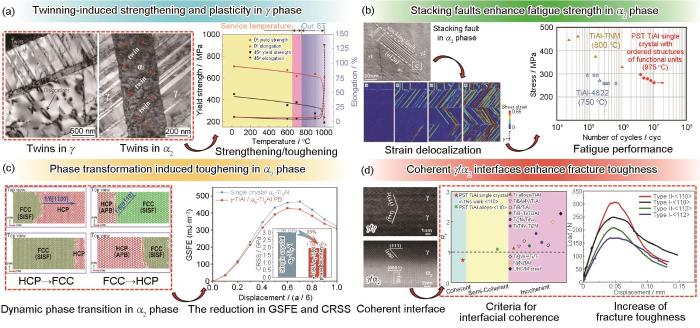
Transformative TiAl alloys are in high demand for hot-end components such as aeroengine blades and for lightweighting advanced aerospace equipment. However, traditional TiAl alloys are brittle at room temperature and exhibit low long-term capability at high temperatures. To overcome these limitations, our team has proposed a new material-design paradigm based on “ordered structures of functional units.” By precisely regulating the intrinsic characteristics and ordered structures of the soft γ-TiAl phase, the hard α2-Ti3Al phase, and nano-twins, we considerably enhance the strength, plasticity, and high-temperature capability of polysynthetic twinned TiAl alloys. We also demonstrate the decisive roles of ordered-structure parameters, such as interface type, lamellar orientation, lamellar thickness, and phase proportion, on the mechanical properties of the alloy. The physical strengthening and toughening mechanisms include twinning-induced strengthening and plasticity in the γ phase, fatigue-strength-enhancing stacking faults in the α2 phase, toughening via transformation of the α2 phase, and γ/α2 coherent interfaces, which improve fracture toughness. These insights illuminate promising directions for the development of TiAl alloys with ordered functional unit structures.
Keywords:polysynthetic twinned TiAl alloy;
functional unit;
ordered structure;
strengthening and toughening;
mechanical property
CHEN Guang, CHEN Fengrui, ZHU Demin, LI Guizhong, LI Luo, SONG Weidong, WANG Zite, XIANG Henggao, CHEN Yang, QI Zhixiang. Polysynthetic Twinned High-Performance TiAl Alloy with Ordered Structures of Functional Units[J]. Acta Metallurgica Sinica, 2026, 62(4): 541-549 DOI:10.11900/0412.1961.2026.00048
航空航天高端装备轻量化是国家重大战略急需,是世界科技前沿。叶片材料制造技术是航空发动机“卡脖子”关键技术。TiAl金属间化合物的理论密度只有3.9 g/cm3,不到镍基高温合金的1/2,熔点更高,是600 ℃以上热端部件国际发展方向[1~4]。2012年,美国率先使用TiAl-4822合金制造波音787飞机GEnx-1BTM发动机最末两级低压涡轮叶片,单台发动机减重约90 kg,实现节油20%、降噪50%、减少NO x 排放80%等综合性效益[5]。此外,TiAl合金也广泛应用于高超声速飞行器蒙皮、导弹热防护系统等[6,7]。但TiAl合金还存在室温脆性大(延伸率< 2%)和长时承温能力低(TiAl-4822合金在700 ℃、3000 h条件下片层组织发生分解)两大世界难题,严重限制了其更广泛的应用[8~10]。
为解决金属材料强度与韧/塑性难以兼顾的矛盾,“功能基元序构”(ordered structures with functional units,OSFU)已成为一种极具发展潜力的新材料探索范式[11,12]。功能基元是指在原子/分子尺度和宏观尺度之间引入具有特定功能的中间结构单元;序构是指功能基元通过人工设计制造而成的特定空间堆垛、排列方式。基于序构设计,材料性能可超越基元自身[13]。功能基元序构的高性能材料可以突破元素种类的限制,为设计和发展具有突破性和变革性的关键新材料拓展更大的空间。
Fig.1
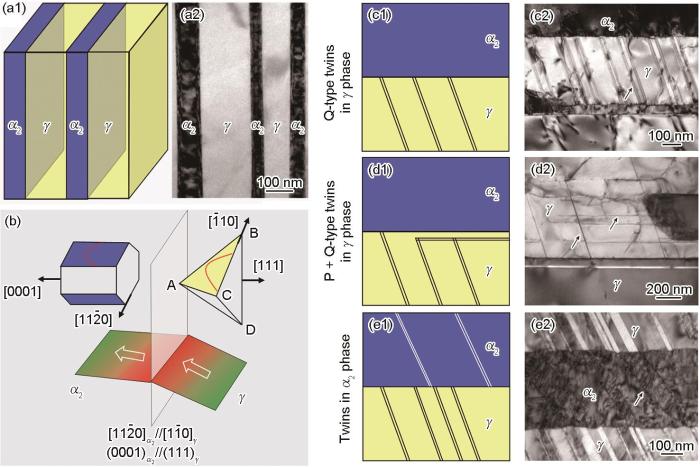
Types of functional units in polysynthetic twinned TiAl alloys (a1, a2) schematic[15] (a1) and TEM image[1] (a2) of α2 phase and γ phase (b) schematic of slip continuity between geometrically favored slip systems in the γ lamella (tetragon) and α2 lamellae (hexagonal prisms) (The white arrows denote the strain energy release routes either across or along the γ/α2 interface)[21] (c1, c2) schematic (c1) and TEM image[1] (c2) of Q-type twins within the γ phase (Arrow shows twins. The same in Figs.1d2 and e2) (d1, d2) schematic (d1) and TEM image (d2) of P + Q-type twins within the γ phase (e1, e2) schematic (e1) and TEM image[27] (e2) of twins within the α2 phase
Fig.2
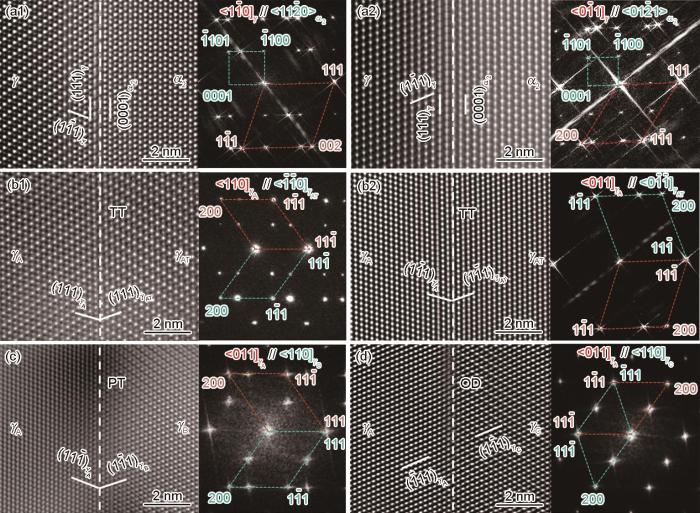
Types of interface of polysynthetic twinned TiAl alloy with ordered structures of functional units (a1, a2) γ/α2 phase interfaces from <10] γ[29] (a1) and <01] γ (a2) directions (b1, b2) 180° γ/γ true twin (TT) interfaces from <110][29] (b1) and <011] (b2) directions (Where γA is the matrix, γAT is the 180° TT) (c) 60° γ/γ pseudo twin (PT) interface[29] (Where γB is the 60° PT) (d) 120° γ/γ ordered domain (OD) interface[29] (Where γC is the 120° OD)
Fig.3
Influences of ordered structure parameters on mechanical properties (a1-a4) intrinsic plastic deformation properties (a1) and microstructures related to the lamellar internal orientations of 0° (a2), 45° (a3), and 90° (a4)[21] (UTS—ultimate tensile strength) (b1-b4) mechanical properties (b1) and microstructures[33] (b2-b4) of nanoscale α2 + O phase modulated by 625 oC and 5 h heat treatment and then air cooling (AC) (HIP—hot isostatic pressing; red arrow in Fig.3b3 shows nanoscale preci-pitated O phase; T1 and T2 in Fig.3b4 show twin 1 and twin 2, respectively) (c1-c4) mechanical properties (c1) and EBSD images[34] (c2-c4) after cyclic regulation of the two-phase ratios (c2) initial state (c3) annealed at 1373 K for 6 h (c4) annealed at 1613 K for 6 h
... [1,15,21,27]Types of functional units in polysynthetic twinned TiAl alloys (a1, a2) schematic<sup>[<xref ref-type="bibr" rid="R15">15</xref>]</sup> (a1) and TEM image<sup>[<xref ref-type="bibr" rid="R1">1</xref>]</sup> (a2) of <i>α</i><sub>2</sub> phase and <i>γ</i> phase (b) schematic of slip continuity between geometrically favored slip systems in the <i>γ</i> lamella (tetragon) and <i>α</i><sub>2</sub> lamellae (hexagonal prisms) (The white arrows denote the strain energy release routes either across or along the <i>γ</i>/<i>α</i><sub>2</sub> interface)<sup>[<xref ref-type="bibr" rid="R21">21</xref>]</sup> (c1, c2) schematic (c1) and TEM image<sup>[<xref ref-type="bibr" rid="R1">1</xref>]</sup> (c2) of Q-type twins within the <i>γ</i> phase (Arrow shows twins. The same in Figs.1d2 and e2) (d1, d2) schematic (d1) and TEM image (d2) of P + Q-type twins within the <i>γ</i> phase (e1, e2) schematic (e1) and TEM image<sup>[<xref ref-type="bibr" rid="R27">27</xref>]</sup> (e2) of twins within the <i>α</i><sub>2</sub> phaseFig.1
... [1] (a2) of α2 phase and γ phase (b) schematic of slip continuity between geometrically favored slip systems in the γ lamella (tetragon) and α2 lamellae (hexagonal prisms) (The white arrows denote the strain energy release routes either across or along the γ/α2 interface)[21] (c1, c2) schematic (c1) and TEM image[1] (c2) of Q-type twins within the γ phase (Arrow shows twins. The same in Figs.1d2 and e2) (d1, d2) schematic (d1) and TEM image (d2) of P + Q-type twins within the γ phase (e1, e2) schematic (e1) and TEM image[27] (e2) of twins within the α2 phaseFig.1
... [1] (c2) of Q-type twins within the γ phase (Arrow shows twins. The same in Figs.1d2 and e2) (d1, d2) schematic (d1) and TEM image (d2) of P + Q-type twins within the γ phase (e1, e2) schematic (e1) and TEM image[27] (e2) of twins within the α2 phaseFig.1
... ,15,21,27]Types of functional units in polysynthetic twinned TiAl alloys (a1, a2) schematic<sup>[<xref ref-type="bibr" rid="R15">15</xref>]</sup> (a1) and TEM image<sup>[<xref ref-type="bibr" rid="R1">1</xref>]</sup> (a2) of <i>α</i><sub>2</sub> phase and <i>γ</i> phase (b) schematic of slip continuity between geometrically favored slip systems in the <i>γ</i> lamella (tetragon) and <i>α</i><sub>2</sub> lamellae (hexagonal prisms) (The white arrows denote the strain energy release routes either across or along the <i>γ</i>/<i>α</i><sub>2</sub> interface)<sup>[<xref ref-type="bibr" rid="R21">21</xref>]</sup> (c1, c2) schematic (c1) and TEM image<sup>[<xref ref-type="bibr" rid="R1">1</xref>]</sup> (c2) of Q-type twins within the <i>γ</i> phase (Arrow shows twins. The same in Figs.1d2 and e2) (d1, d2) schematic (d1) and TEM image (d2) of P + Q-type twins within the <i>γ</i> phase (e1, e2) schematic (e1) and TEM image<sup>[<xref ref-type="bibr" rid="R27">27</xref>]</sup> (e2) of twins within the <i>α</i><sub>2</sub> phaseFig.1
... [15] (a1) and TEM image[1] (a2) of α2 phase and γ phase (b) schematic of slip continuity between geometrically favored slip systems in the γ lamella (tetragon) and α2 lamellae (hexagonal prisms) (The white arrows denote the strain energy release routes either across or along the γ/α2 interface)[21] (c1, c2) schematic (c1) and TEM image[1] (c2) of Q-type twins within the γ phase (Arrow shows twins. The same in Figs.1d2 and e2) (d1, d2) schematic (d1) and TEM image (d2) of P + Q-type twins within the γ phase (e1, e2) schematic (e1) and TEM image[27] (e2) of twins within the α2 phaseFig.1
Types of functional units in polysynthetic twinned TiAl alloys (a1, a2) schematic<sup>[<xref ref-type="bibr" rid="R15">15</xref>]</sup> (a1) and TEM image<sup>[<xref ref-type="bibr" rid="R1">1</xref>]</sup> (a2) of <i>α</i><sub>2</sub> phase and <i>γ</i> phase (b) schematic of slip continuity between geometrically favored slip systems in the <i>γ</i> lamella (tetragon) and <i>α</i><sub>2</sub> lamellae (hexagonal prisms) (The white arrows denote the strain energy release routes either across or along the <i>γ</i>/<i>α</i><sub>2</sub> interface)<sup>[<xref ref-type="bibr" rid="R21">21</xref>]</sup> (c1, c2) schematic (c1) and TEM image<sup>[<xref ref-type="bibr" rid="R1">1</xref>]</sup> (c2) of Q-type twins within the <i>γ</i> phase (Arrow shows twins. The same in Figs.1d2 and e2) (d1, d2) schematic (d1) and TEM image (d2) of P + Q-type twins within the <i>γ</i> phase (e1, e2) schematic (e1) and TEM image<sup>[<xref ref-type="bibr" rid="R27">27</xref>]</sup> (e2) of twins within the <i>α</i><sub>2</sub> phaseFig.1
... [21] (c1, c2) schematic (c1) and TEM image[1] (c2) of Q-type twins within the γ phase (Arrow shows twins. The same in Figs.1d2 and e2) (d1, d2) schematic (d1) and TEM image (d2) of P + Q-type twins within the γ phase (e1, e2) schematic (e1) and TEM image[27] (e2) of twins within the α2 phaseFig.1
... [21,33,34]Influences of ordered structure parameters on mechanical properties (a1-a4) intrinsic plastic deformation properties (a1) and microstructures related to the lamellar internal orientations of 0° (a2), 45° (a3), and 90° (a4)<sup>[<xref ref-type="bibr" rid="R21">21</xref>]</sup> (UTS—ultimate tensile strength) (b1-b4) mechanical properties (b1) and microstructures<sup>[<xref ref-type="bibr" rid="R33">33</xref>]</sup> (b2-b4) of nanoscale <i>α</i><sub>2</sub> + O phase modulated by 625 <sup>o</sup>C and 5 h heat treatment and then air cooling (AC) (HIP—hot isostatic pressing; red arrow in Fig.3b3 shows nanoscale preci-pitated O phase; T1 and T2 in Fig.3b4 show twin 1 and twin 2, respectively) (c1-c4) mechanical properties (c1) and EBSD images<sup>[<xref ref-type="bibr" rid="R34">34</xref>]</sup> (c2-c4) after cyclic regulation of the two-phase ratios (c2) initial state (c3) annealed at 1373 K for 6 h (c4) annealed at 1613 K for 6 hFig.3
... [21] (UTS—ultimate tensile strength) (b1-b4) mechanical properties (b1) and microstructures[33] (b2-b4) of nanoscale α2 + O phase modulated by 625 oC and 5 h heat treatment and then air cooling (AC) (HIP—hot isostatic pressing; red arrow in Fig.3b3 shows nanoscale preci-pitated O phase; T1 and T2 in Fig.3b4 show twin 1 and twin 2, respectively) (c1-c4) mechanical properties (c1) and EBSD images[34] (c2-c4) after cyclic regulation of the two-phase ratios (c2) initial state (c3) annealed at 1373 K for 6 h (c4) annealed at 1613 K for 6 hFig.3
Types of functional units in polysynthetic twinned TiAl alloys (a1, a2) schematic<sup>[<xref ref-type="bibr" rid="R15">15</xref>]</sup> (a1) and TEM image<sup>[<xref ref-type="bibr" rid="R1">1</xref>]</sup> (a2) of <i>α</i><sub>2</sub> phase and <i>γ</i> phase (b) schematic of slip continuity between geometrically favored slip systems in the <i>γ</i> lamella (tetragon) and <i>α</i><sub>2</sub> lamellae (hexagonal prisms) (The white arrows denote the strain energy release routes either across or along the <i>γ</i>/<i>α</i><sub>2</sub> interface)<sup>[<xref ref-type="bibr" rid="R21">21</xref>]</sup> (c1, c2) schematic (c1) and TEM image<sup>[<xref ref-type="bibr" rid="R1">1</xref>]</sup> (c2) of Q-type twins within the <i>γ</i> phase (Arrow shows twins. The same in Figs.1d2 and e2) (d1, d2) schematic (d1) and TEM image (d2) of P + Q-type twins within the <i>γ</i> phase (e1, e2) schematic (e1) and TEM image<sup>[<xref ref-type="bibr" rid="R27">27</xref>]</sup> (e2) of twins within the <i>α</i><sub>2</sub> phaseFig.1
... [29] (b1) and <011] (b2) directions (Where γA is the matrix, γAT is the 180° TT) (c) 60° γ/γ pseudo twin (PT) interface[29] (Where γB is the 60° PT) (d) 120° γ/γ ordered domain (OD) interface[29] (Where γC is the 120° OD)Fig.2
Influences of ordered structure parameters on mechanical properties (a1-a4) intrinsic plastic deformation properties (a1) and microstructures related to the lamellar internal orientations of 0° (a2), 45° (a3), and 90° (a4)<sup>[<xref ref-type="bibr" rid="R21">21</xref>]</sup> (UTS—ultimate tensile strength) (b1-b4) mechanical properties (b1) and microstructures<sup>[<xref ref-type="bibr" rid="R33">33</xref>]</sup> (b2-b4) of nanoscale <i>α</i><sub>2</sub> + O phase modulated by 625 <sup>o</sup>C and 5 h heat treatment and then air cooling (AC) (HIP—hot isostatic pressing; red arrow in Fig.3b3 shows nanoscale preci-pitated O phase; T1 and T2 in Fig.3b4 show twin 1 and twin 2, respectively) (c1-c4) mechanical properties (c1) and EBSD images<sup>[<xref ref-type="bibr" rid="R34">34</xref>]</sup> (c2-c4) after cyclic regulation of the two-phase ratios (c2) initial state (c3) annealed at 1373 K for 6 h (c4) annealed at 1613 K for 6 hFig.3
... [33] (b2-b4) of nanoscale α2 + O phase modulated by 625 oC and 5 h heat treatment and then air cooling (AC) (HIP—hot isostatic pressing; red arrow in Fig.3b3 shows nanoscale preci-pitated O phase; T1 and T2 in Fig.3b4 show twin 1 and twin 2, respectively) (c1-c4) mechanical properties (c1) and EBSD images[34] (c2-c4) after cyclic regulation of the two-phase ratios (c2) initial state (c3) annealed at 1373 K for 6 h (c4) annealed at 1613 K for 6 hFig.3
Influences of ordered structure parameters on mechanical properties (a1-a4) intrinsic plastic deformation properties (a1) and microstructures related to the lamellar internal orientations of 0° (a2), 45° (a3), and 90° (a4)<sup>[<xref ref-type="bibr" rid="R21">21</xref>]</sup> (UTS—ultimate tensile strength) (b1-b4) mechanical properties (b1) and microstructures<sup>[<xref ref-type="bibr" rid="R33">33</xref>]</sup> (b2-b4) of nanoscale <i>α</i><sub>2</sub> + O phase modulated by 625 <sup>o</sup>C and 5 h heat treatment and then air cooling (AC) (HIP—hot isostatic pressing; red arrow in Fig.3b3 shows nanoscale preci-pitated O phase; T1 and T2 in Fig.3b4 show twin 1 and twin 2, respectively) (c1-c4) mechanical properties (c1) and EBSD images<sup>[<xref ref-type="bibr" rid="R34">34</xref>]</sup> (c2-c4) after cyclic regulation of the two-phase ratios (c2) initial state (c3) annealed at 1373 K for 6 h (c4) annealed at 1613 K for 6 hFig.3
... [34] (c2-c4) after cyclic regulation of the two-phase ratios (c2) initial state (c3) annealed at 1373 K for 6 h (c4) annealed at 1613 K for 6 hFig.3