金属学报, 2026, 62(3): 523-531 DOI: 10.11900/0412.1961.2024.00138

研究论文

晶界沟槽形成过程的相场模拟

申文龙1, 廖宇轩1, 吴学志2, 姜彦博1, 柳文波,1,3

1.西安交通大学 核科学与技术学院 西安 710049

2.中国原子能科学研究院 反应堆工程技术研究所 北京 102413

3.西安交通大学 陕西省先进核能技术重点实验室 西安 710049

Phase-Field Simulation of Grain Boundary Groove Formation

SHEN Wenlong1, LIAO Yuxuan1, WU Xuezhi2, JIANG Yanbo1, LIU Wenbo,1,3

1.School of Nuclear Science and Technology, Xi'an Jiaotong University, Xi'an 710049, China

2.Institute of Reactor Engineering and Technology, China Institute of Atomic Energy, Beijing 102413, China

3.Shaanxi Key Laboratory of Advanced Nuclear Energy and Technology, Xi'an Jiaotong University, Xi'an 710049, China

通讯作者: 柳文波,liuwenbo@xjtu.edu.cn,主要从事核材料与核燃料的多尺度模拟方面的研究

责任编辑: 李海兰

收稿日期: 2024-05-07   修回日期: 2024-06-26  

基金资助: 国家自然科学基金面上项目(12375258)
中国博士后科学基金项目(2019M663738)
清华大学新型陶瓷与精细工艺国家重点实验室项目(KF201713)
中国核工业集团有限公司领创科研项目

Corresponding authors: LIU Wenbo, professor, Tel:(029)82668648, E-mail:liuwenbo@xjtu.edu.cn

Received: 2024-05-07   Revised: 2024-06-26  

Fund supported: National Natural Science Foundation of China(12375258)
China Postdoctoral Science Foundation(2019M663738)
State Key Laboratory of New Ceramic and Fine Processing Tsinghua University(KF201713)
Innovative Scientific Program of China National Nuclear Corporation

作者简介 About authors

申文龙,男,2000年生,硕士生

摘要

材料表面形成的晶界沟槽会影响表面物质的传输机制,引起晶界迁移的驱动力发生改变,从而影响晶粒长大动力学规律。本工作构建了耦合晶界沟槽演化和晶粒长大的相场模型,对晶界沟槽的形成过程进行了模拟。构建了多晶体系的自由能方程,总自由能的减少为体系的演化提供了驱动力;对迁移率系数进行了修正,使得晶界沟槽形成和晶粒生长遵循不同的动力学过程。然后,对UO2陶瓷燃料晶界沟槽演化行为进行了模拟,结果表明,单个晶界的沟槽演化过程受表面扩散机制控制,且与Mullins经典理论解吻合较好。进一步研究表明,晶界沟槽的轮廓随着晶界的移动变得不再对称,而处于晶界移动方向前方的晶粒内出现更大的物质堆积。三维多晶薄膜结构的演化结果显示,所有晶粒朝着柱状晶结构演化,晶界与表面相交的位置逐渐产生了沟槽。此时,同一晶粒不同侧晶界所产生的沟槽会在晶粒表面发生重叠,晶界沟槽的轮廓形状也会发生改变。沟槽深度增加会使晶界移动速率减缓,晶粒长大过程变慢。

关键词: 相场模拟; 晶界沟槽; 表面; 晶粒生长; 扩散

Abstract

The grain boundary grooves formed on material surface significantly affect the mechanisms of mass transport, altering the driving force for grain boundary migration, and consequently influencing the kinetics of grain growth. Herein, a phase-field model is developed to simulate the coupled evolution of grain boundary grooving and grain growth in UO2 ceramic fuels. The process of developing the model begins by constructing a free energy equation for a polycrystalline system, where the reduction in total free energy drives system evolution. The mobility coefficients are then adjusted to ensure that the formation of grain boundary grooves and grain growth follow different kinetic processes. Results show that groove evolution at individual grain boundary is controlled by surface diffusion, aligning closely with Mullins' classical theoretical solution. Moreover, with the movement of grain boundaries, the groove contours become decreasingly symmetric, with increased material accumulation occurring in the grain in front of the moving direction of the grain boundary. The evolution results of a 3D polycrystalline thin film structure show that all grains evolve toward a columnar crystal structure, with grooves gradually forming at the intersections of grain boundaries and the surface. Moreover, grooves generated by different grain boundaries within the same grain tend to overlap on the grain surface, altering the groove contours. With increasing groove depth, grain boundary movement becomes increasingly slow, ultimately reducing the rate of grain growth.

Keywords: phase-field simulation; grain boundary groove; surface; grain growth; diffusion

PDF (2594KB) 元数据 多维度评价 相关文章 导出 EndNote| Ris| Bibtex  收藏本文

本文引用格式

申文龙, 廖宇轩, 吴学志, 姜彦博, 柳文波. 晶界沟槽形成过程的相场模拟[J]. 金属学报, 2026, 62(3): 523-531 DOI:10.11900/0412.1961.2024.00138

SHEN Wenlong, LIAO Yuxuan, WU Xuezhi, JIANG Yanbo, LIU Wenbo. Phase-Field Simulation of Grain Boundary Groove Formation[J]. Acta Metallurgica Sinica, 2026, 62(3): 523-531 DOI:10.11900/0412.1961.2024.00138

多晶材料的晶粒尺寸和分布对其性能有着重要影响,而表面会严重影响其晶粒形态[1]。由于材料表面原子与内部晶体原子所处的环境截然不同,在材料表面与晶界相交的位置上经常会形成沟槽,晶界沟槽对多晶材料表面附近晶界的迁移影响尤为明显。由晶界沟槽所引发的脆性裂纹扩展,也会影响多晶氧化物陶瓷的强度[2]。因此,揭示材料表面晶界沟槽的形成机理对其制备工艺优化及服役性能的提高至关重要。

通常认为,材料表面晶界沟槽的形成机制主要有3种:表面扩散、体扩散、蒸发-冷凝[1]。不同的机制涉及不同的动力学过程,从而形成不同的剖面形状,因此实验上可通过材料静止晶界上沟槽的形状参数来确定扩散系数、晶界能与表面能之比等参数[3]。可以认为,晶界沟槽是材料中处于表面的晶界与气相接触才出现的凹槽,因此材料晶界沟槽的形成过程中必然伴随着晶粒生长行为,即晶界并不会处于静止状态。材料表面附近的晶界的移动不仅受到材料内部缺陷所施加的阻力[4~6],还会受表面处晶界沟槽的影响,此时晶界沟槽的剖面形状和动力学过程也必然会发生改变。因此,对比研究材料表面附近的静止晶界和移动晶界上沟槽的演化过程具有重要意义。

目前,国内外针对晶界沟槽演化过程的理论及模拟研究已经开展了一些工作[7~9]。Mullins[7]对晶界沟槽形成的热力学过程进行了分析,在建模过程中假设材料参数各向同性,晶界垂直于表面,沟槽根部斜率较小。结果表明,当表面扩散为主要控制机制时,晶界沟槽的剖面形状与时间无关,而深度随时间的四次方根线性增加。Mullins[8]还分析了沟槽形成对晶界移动造成的影响,发现对于圆柱形晶粒,当晶界形成“悬链面”时具有零曲率,晶粒停止收缩。Robertson[9]不再局限于小斜率的假设,求解了沟槽根部斜率更大时由表面扩散所控制形成的剖面轮廓。虽然上述模型基于材料热力学和表面扩散理论对单个晶界沟槽的热力学和动力学行为进行了理论计算,然而仍然无法再现复杂多晶结构材料表面的晶界沟槽演化过程,特别是无法揭示多晶材料的晶界沟槽演化机制。

基于Ginzburg-Landau理论的相场理论在模拟材料微观组织演变时,克服了经典理论中明锐界面的局限性,将界面看作相场变量连续变化过渡的区域,因而在处理多晶结构形貌演变方面具有巨大优势[10~12]。近年来,相场模型已被用于描述不同晶粒结构的晶界沟槽形成过程[13~17]。Verma等[13~15]利用相场方法研究了恒定驱动力下晶界移动对沟槽形貌的影响,并拓展到多晶结构,研究了晶界沟槽对多晶薄膜晶粒长大过程的影响规律。结果表明,薄膜厚度越小,晶界沟槽对晶界移动的阻碍作用越显著。Mukherjee和Abinandanan[16]研究了表面能各向异性以及小晶粒尺寸下的沟槽演化行为,并通过三维的四晶粒结构研究了晶界沟槽对材料点蚀过程的影响。Chakraborty等[17]研究了电流和温度梯度对晶界沟槽形成和迁移的影响。然而,对于多晶材料晶界沟槽形貌演变的三维相场模拟,目前均假设晶粒为柱状晶,这与材料实际微观结构有很大差异,而且难以揭示晶粒长大和三维弯曲晶界对材料表面晶界沟槽的影响机制。

本工作基于相场理论,构建了耦合晶界沟槽演化和晶粒长大的介观尺度模型,对UO2陶瓷燃料晶界沟槽演化行为进行了模拟。该模型对迁移率系数进行修正,使得晶界沟槽形成和晶粒长大遵循不同的动力学过程,研究了静止晶界和以固定速率移动的晶界上的沟槽演化行为。利用上述模型,对等轴多晶材料的晶界沟槽形成和晶粒长大过程进行了模拟研究。

1 相场模型

1.1 相场自由能方程

相场方法中,由一系列相场变量描述微观组织结构及其演化[10,11]。本模型所用的相场变量如图1所示,采用保守浓度场变量(ρ)区分UO2固相与气相;采用一组非保守的取向场变量(η1, η2,…, ηp )区分固相UO2内各个晶粒,其中p为晶粒取向总数。所有相场变量都是随时间和空间连续变化的。在任意时刻,任一晶粒内部,浓度场变量的值都为1,且只有与其对应的取向场变量的值为1,其余取向场变量全为0。气相内,浓度场变量和所有取向场变量的值都为0。在界面处,所对应的相场变量(相界对应ρηi,晶界对应ηiηj )在0和1之间分别连续变化。

图1

图1   相场变量示意图

Fig.1   Schematic of phase field variables (ρ—concentration field variable, η1—order parameter of grain 1, η2—order parameter of grain 2)


相场模型中,非均匀系统的总自由能(F)由相场变量的体自由能密度函数及与其梯度项有关的扩散界面自由能密度函数组成。本工作相场模型中F的定义如下:

F=V[f(ρ, η1, η2,..., ηp)+gh(η1)+
κρρ2+i=1pκηηi2]dV

式中,第一项f为局部自由能密度函数,其只与局部的相组成有关;第二项g·h(η1)为驱动力项,g为决定晶界移动速率的系数;κρκη 为能量梯度项系数,与第一项共同决定了界面处自由能的大小[18]V为模拟体系的总体积。在本工作中,假设界面性质都具有各向同性,故梯度项系数都设置为常数。

本工作的相场模型采用的局部自由能密度函数定义如下[19]

f(ρ, ηi)=Aρ2(1-ρ)2+Bρ2ξ(ηi)+Z(1-ρ)2ηi2

式中,ABZ都为正常数。第一项为双势阱函数,A决定了浓度场变量的势垒高度;后2项耦合了浓度场变量与取向场变量。第二项内的函数ξ(ηi )的形式如下:

ξ(ηi)=i=1pηi44-ηi22+2ηi2ηj2+0.25

函数ξ(ηi )常用于模拟晶粒长大的相场模型。在晶粒内部,即当(ρ, η1, η2,…, ηp ) = ((1, 1, 0,…, 0), (1, 0, 1,…, 0),…, (1, 0, 0,…, 1))时,函数ξ(ηi )和f(ρ, ηi )都取得极小值0;在气相内,即当(ρ, η1, η2,…, ηp ) = (0, 0, 0,…, 0)时,f(ρ, ηi )同样取得极小值0。通过改变参数ABZ和2个能量梯度项系数,可以获取所需要的界面性质。

按照Cahn和Hilliard方法[10],界面能的计算需要获取初始平直界面的平衡解。现考虑一个平直晶界,界面左右两侧的相场变量值分别为(ρ, η1, η2) = (1, 1, 0)、(1, 0, 1)。由 式(1)可得晶界能(γGB)为:

γGB=-+fρ=1, η1, η2+i=12κηdηidx2dx

式中,x为垂直于晶界的位置坐标。根据变分法原理,并仿照文献[20,21]的处理过程,可得:

fρ=1, η1, η2=κηdη1dx2+dη2dx2

式(5)进行变形,可得:

dη1dx=-fρ=1, η1, η2κη1+dη2dη12

式(5)和(6)代入 式(4)积分,可得:

γGB=2κηB01ξ(η1, η2)1+dη2dη12dη1

按照上述推导过程,也可以得到表面能(γS)的积分形式为:

γS=201f(ρ, η)κρ+κηdηdρ2dρ

式(7)和(8)可以看出,等号右边的积分通常并不具有解析的形式,但通过数值计算方法可以求解。因此,如果确定了γGBγS,就可以通过数值方法求解 式(7)和(8)得到相场模型参数[22]。本工作所选取的UO2晶界能和表面能分别为0.3和0.6 J/m2 [23]

1.2 相场方程演化

ρ的时间演变受Cahn-Hilliard方程控制[24]

ρt=MδFδρ

式中,t为时间,M为与扩散系数相关的迁移率。通常情况下,位于表面原子的扩散系数比晶界原子和晶粒内部原子大几个数量级。此处将M看作ρηi 的函数,形式如下:

M(ρ, ηi)=MB+16MSρ2(1-ρ)2+
16MGBi=1pj>ip(ηi2ηj2)

式中,MBMSMGB分别表示与体扩散、表面扩散、晶界扩散相关的迁移率参数。一般情况下,MS具有较大的数量级,MGB次之,MB最小。可以看出,采用此形式的迁移率系数,可以使得在晶界和表面位置处的原子具有更强的扩散系数。M与扩散系数(D)的关系为:M = Dvm / (RT),其中,vm为摩尔体积,R为理想气体常数,T为热力学温度。对于UO2,表面扩散系数DS = 50 × exp(-450000 / (RT))[25]

ηi 的时间演变受Allen-Cahn方程控制:

ηit=-LδFδηi

式中,L为序参量的弛豫系数。为了获得更加真实的表面扩散与晶界移动性质,本工作中将L设置为一个与局部组成相关的函数:

L=LGB+16LSρ21-ρ2

式中,LGB与晶界迁移率相关;LS为表面处的弛豫系数,其值比LGB大,这是因为表面的变化同时受到Allen-Cahn方程和Cahn-Hilliard方程的控制,此形式的L能够使得表面处的物质迁移完全受表面扩散的控制,而晶界移动又能表现出正常的晶粒长大动力学过程[26]

由一个Cahn-Hilliard方程和若干个Allen-Cahn方程所构成的偏微分方程组构成了本工作中所使用的相场模型。由于所求解的Allen-Cahn方程的数量取决于ηi 的个数(即晶粒个数),为了提高计算效率,在多晶模拟程序内采用了APT (active parameter tracking)算法[27,28]。在某一格点处只有少数序参量的计算对于体系结构的演化是有效的,APT算法只对这些参与结构界面演化的序参量储存和计算,从而显著提升计算效率。并且,模拟所需的内存大小、运行时间与体系大小相关,而与晶粒数量无关。本工作采用有限差分法求解偏微分方程组,其中,时间微分采用前向Euler法,Laplace算子采用五点差分法进行离散。为了表征模拟结果,本工作中所选取的可视化变量(φ)为[29]

φ=iηi2

2 无量纲化处理

在求解相场方程之前,要对其进行无量纲化处理,即选择完备且又彼此独立的数个物理量作为参考量,将真实物理量除以参考量得到的无量纲数值代替原真实物理量以消除量纲。本模拟中所选择的参考量如下:

l*=κρA12
ε*=A
t*=l*2MSε*

式中,l* 为参考空间长度,ε* 为参考能量密度,t* 为参考时间。根据建模部分UO2的热力学和动力学参数,本工作模拟中所使用的无量纲参数如表1所示。

表1   模拟中所使用的无量纲参数

Table 1  Non-dimensional parameters used in the present simulation

ParameterSymbolValue
Bulk free energy coefficientsA1.0
B0.33
Z3
Gradient energy coefficient of ρκρ1.0
Gradient energy coefficient of ηiκη0.33
Surface mobility parameterMS1.0
Grain boundary mobility parameterMGB10-4
Bulk mobility parameterMB10-4

Grain boundary relaxation coefficient

Surface relaxation coefficient

LGB

LS

1.0

10LGB

新窗口打开| 下载CSV


3 结果与讨论

3.1 静止晶界处的沟槽

图2为双矩形晶粒结构中静止晶界处表面沟槽随时间演化的相场模拟结果及局部放大图。其中,蓝色区域为气相,黄色区域为晶粒,模拟区域中心为一条晶界。模拟区域网格尺寸为2048 × 256,采用周期性边界条件,横向设置2个等大的矩形晶粒,厚度均为128个格点,上、下各被厚度为64个格点的气相所包围。模拟时,晶粒尺寸在水平方向设置得足够大是为了确保由两侧晶界产生的沟槽在模拟时间内不会发生重叠。图2中晶界沟槽附近区域的局部放大图取自模拟区域中心晶界的上侧沟槽。可以看出,晶界处的初始平坦表面逐渐出现一个对称的V形槽,且随着演化的进行其深度不断加深。

图2

图2   静止晶界处沟槽随时间的演化

Fig.2   Microstructure evolution (a1-d1) and corresponding local magnifications (a2-d2) of a groove of a stationary grain boundary (The blue and yellow parts represent the vapour phase and the grains, respectively)

(a1, a2) initial microstructure (b1, b2) 25 × 105 steps

(c1, c2) 50 × 105 steps (d1, d2) 100 × 105 steps


根据Mullins经典理论[7],由单一机制所控制的晶界沟槽的形状不随时间变化,而尺寸的变化则与扩散系数相关。由表面扩散所控制的晶界沟槽深度(d)的增长规律为[7]

d=0.973mβt14

式中,m = tanθθ为沟槽轮廓根部与初始表面之间的夹角;β = (DSγSΩ2v) / (kT),Ω为原子体积,v为每单位表面积的原子数,k为Boltzmann常数。由表面扩散所控制的晶界沟槽形状的近似解为[7]

yx, t=mβt14n=0anun

式中,y代表表面的高度;u = x / (βt)1/4an 的取值为a0=-1 / (2Γ(5/4))a1=1a2 = -1 / (22Γ(3/4))a3=0an+4=an(n-1) / (4(n+1)(n+2)(n+3)(n+4)),其中Γ( )为Gamma函数,n为级数项序号。

图3为相场模拟结果中沟槽深度随时间的变化及拟合结果。本工作所采用的表面能与晶界能之比γS / γGB = 2,由Herring关系[30]可知,沟槽根部的斜率较小,且模型中的界面性质均与取向无关,因此满足了Mullins在其经典理论推导过程中所采用的近似情况[7]。从图3可以看出,本工作相场模拟中的沟槽深度与t0.251成正比,与Mullins理论符合很好。

图3

图3   沟槽深度随时间的变化及其拟合结果

Fig.3   Temporal evolution of the groove depth and the fitting result (t—time)


图4为相场模拟中不同时刻的沟槽轮廓形状与Mullins经典理论[7]所预测的沟槽轮廓的对比,在两个方向上分别除以(βt)1/4以直接对比形状。可以看出,沟槽的剖面轮廓不断接近理论预测形状,当达到一定步数之后,其基本不再发生变化。本工作的模拟结果与理论预测形状基本一致:随着时间的增加,受表面扩散作用,所形成的晶界沟槽尺寸发生变化,但其剖面的形状基本不随时间发生变化。

图4

图4   相场模拟中不同时刻的沟槽轮廓与Mullins理论预测[7]的对比

Fig.4   Comparison of the normalized groove profile and Mullins' theory[7]


3.2 移动晶界处的沟槽

在UO2燃料的制备过程中,晶界通常会发生移动,其表面处的晶粒发生生长时,晶界沟槽也会随之发生移动。当晶界以固定速率移动时,晶界沟槽不再呈现对称的剖面形状,而是在晶界移动方向上沉积更多物质,其形状表达式为[8]

y-=-M'3αexp(αε)                                                   (ε0)y+=-2M'3αexp-(α / 2)εcos32αε+π3  (ε>0)

式中,y+y-分别为移动晶界前方和后方的表面高度;ε为该点与槽根在x方向上的距离;M'为晶界能与表面能之比;α = (V0/ β)1/3V0为槽根移动速率。相场模拟中晶界的移动通过在自由能中加入驱动力项[31]来实现:

hη1=-η1310-15η1+6η12

需要注意的是,此项引入后(g ≠ 0),偏微分方程(11)中泛函导数的计算过程会发生改变:

δFδηi=fηi+ghηi-2κη2ηi

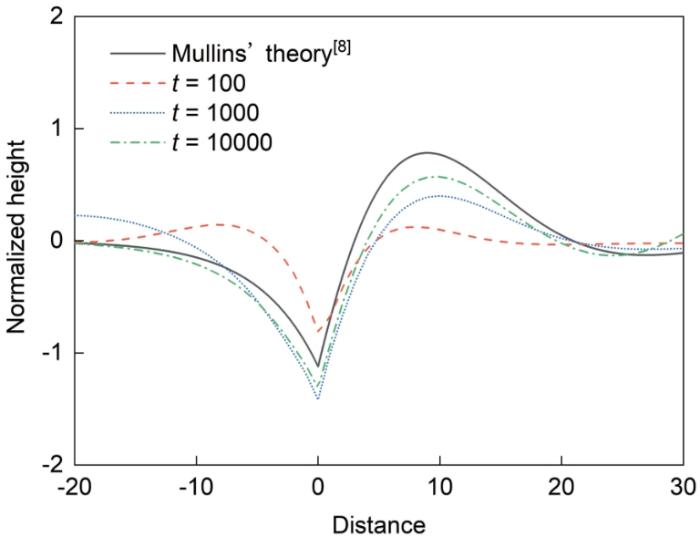
图5为不同时刻下移动晶界沟槽轮廓与理论预测的对比,横轴表示与沟槽根部的相对距离,晶界以固定速率从左向右移动。可以看出,沟槽在早期(t = 100)呈现出一种近乎对称的剖面轮廓,这是由于本工作在初始化时晶界垂直于两晶粒表面,晶界附近的晶粒表面处于完全对称的状态。但随着时间的增加,沟槽轮廓的不对称程度不断加大,右侧晶粒表面明显高于左侧。经过一段时间后,沟槽剖面又会达到稳态,其形状保持不变。与静止晶界不同的是,移动晶界上的沟槽并未表现出对称的形状,在移动方向一侧有更高的物质堆积。这是由于在静止晶界处,由沟槽根部向左右两侧发出的表面原子通量大小相等,两侧的物质堆积表现出对称的形状。而在移动晶界处,相对于槽根,移动方向上的表面原子通量会减少,相反方向上的表面原子通量增加,移动的距离也较大。因此在晶界移动方向上,物质堆积比相反方向更为明显。此外,最终移动晶界上的沟槽剖面形状也能达到稳态,但与静止晶界不同的是,其形状和尺寸都基本不再发生变化。

图5

图5   相场模拟中不同时刻的移动沟槽轮廓与Mullins理论预测[8]的对比

Fig.5   Comparison of the groove profile of a migrating grain boundary and Mullins' theory[8]


3.3 多晶薄膜的形貌演化

本节工作中所使用的模拟区域网格尺寸为256 × 256 × 64,采用周期性边界条件,在模拟区域内随机设置了128个等轴晶粒,初始晶粒尺寸分布可以用对数正态分布很好地描述。模拟结果如图6所示,图中,灰色区域为晶粒,蓝色区域为表面和晶界。可以看出,当模拟时间足够长时,等轴晶最终都转变为柱状晶,即体系内的晶界与表面之间的夹角逐渐接近90°,这是由于当晶粒尺寸接近薄膜厚度时,晶界会贯穿材料的上下表面,而与表面垂直的晶界具有最小的面积。体系朝着降低其总自由能的方向演变,晶界总面积随之减少,从而导致晶界与表面法向的夹角逐渐减小。随着演化的进行,多边形晶粒的交点基本都为三叉晶界,其夹角逐渐接近120°,这与文献[32,33]中形成的稳定三叉晶界相似。在正常的晶粒生长过程中,晶粒尺寸分布可以拟合为对数正态分布函数。当三维体系的晶粒生长至平均晶粒尺寸与薄膜的厚度相当时,会发生厚度效应[34],即晶粒生长过程受到强烈抑制。结合图6的晶粒尺寸分布直方图,可以明显地观察到其在t = 400时已经偏离了对数正态分布,而且具有最大频率的晶粒尺寸都位于18~21之间,其继续增大的趋势明显降低,这是晶界沟槽对晶界迁移起抑制作用的结果。当柱状晶的晶界与上下表面垂直相交,相比于等轴晶,其晶界迁移的驱动力减小,且在表面处形成的互相连通的沟槽网络又会对晶界迁移产生抑制作用,导致晶粒长大过程减缓。当晶粒尺寸超过临界尺寸时,晶界迁移的驱动力与晶界沟槽所施加的钉扎力相互抵消,阻碍了晶粒的进一步生长。

图6

图6   三维多晶薄膜结构随时间的演化

Fig.6   Microstructures (a1-c1) and grain size distributions (a2-c2) of three-dimensional polycrystalline structure for t = 0 (a1, a2), t = 400 (b1, b2), and t = 1000 (c1, c2) (The blue parts represent the surface and the grain boundaries, and the gray parts represent the grains, the same in Fig.7)


沿着如图7a所示的AB线段,提取局部表面轮廓,图7b为两个不同尺寸晶粒的表面轮廓和晶粒之间的晶界沟槽随时间的演化过程。可以看出,对于任一晶粒,其两侧晶界都会产生晶界沟槽,而且沟槽深度和宽度都会随着时间逐渐增加。t = 200时,两侧沟槽的尾部在晶粒表面的中心处发生重叠,形成曲率为负的区域(定义基体的凹表面曲率为负),如图7b所示的2个晶粒都在其表面中心处形成了负曲率区域。t = 600时,小尺寸晶粒的表面曲率全部变为正值,而在大尺寸晶粒表面中心处,曲率为负的区域依然存在。这是由于曲率为负的区域具有相对较低的化学势,在化学势差异的驱动下越来越多的原子堆积在晶粒表面中心,使晶粒表面中心不断升高,负曲率区域慢慢消失,最终会形成曲率处处相等的表面[35]。晶粒表面的面积越大,负曲率区域所需要填充的物质越多,其消失的速度也更慢。

图7

图7   薄膜局部表面随时间的演化

Fig.7   Temporal evolution of the film surface profile

(a) selected surface location (b) surface profile of the selected area


4 结论

(1) 构建了耦合晶界沟槽演化和晶粒长大的介观尺度模型,对UO2陶瓷燃料晶界沟槽演化行为进行了模拟。简单双晶结构晶界处的沟槽轮廓演化结果显示,晶界沟槽的深度随着t0.251成正比,其归一化形状也与理论预测符合非常好。

(2) 在自由能方程中引入晶界移动的驱动力,使得双晶体系中的两条晶界同时向某一晶粒移动。晶界移动使得晶界沟槽的两侧轮廓不再对称,在晶界移动方向前方的晶粒内出现了明显的物质堆积。当晶界的移动速率固定时,其沟槽的轮廓最终达到稳态结构。

(3) 三维多晶材料的演化结果表明,所有晶粒朝着柱状晶结构发展,晶界与表面相交的位置逐渐产生了沟槽。同一晶粒不同晶界所产生的沟槽在晶粒表面发生重叠,且晶界的移动也会使晶界沟槽的轮廓不再对称。沟槽深度增加使得晶界移动速率减缓,晶粒长大过程变慢。

参考文献

Akyildiz O, Ogurtani T O.

Thermal grooving by surface diffusion: A review of classical thermo-kinetics approach

[J]. Hittite J. Sci. Eng., 2017, 4: 7

DOI      URL     [本文引用: 2]

Coble R L.

Thermal grooving in polycrystalline ceramics and initiation of brittle fracture

[J]. J. Am. Ceram. Soc., 1971, 54: 59

DOI      URL     [本文引用: 1]

Haremski P, Epple L, Wieler M, et al.

Grain boundary grooving by surface diffusion in nickel bicrystals

[J]. Acta Mater., 2022, 241: 118334

DOI      URL     [本文引用: 1]

Sun Z Y, Yang C, Liu W B.

Phase field simulations of the sintering process of UO2

[J]. Acta Metall. Sin., 2020, 56: 1295

[本文引用: 1]

孙正阳, 杨 超, 柳文波.

UO2烧结过程的相场模拟

[J]. 金属学报, 2020, 56: 1295

DOI      [本文引用: 1]

利用相场模型对UO<sub>2</sub>陶瓷粉末的烧结过程进行了模拟。在修正的相场模型中,不仅考虑了表面扩散、晶界扩散和晶格扩散3种各向异性的扩散机制对烧结组织形貌和烧结动力学的影响,而且考虑了不同陶瓷颗粒之间的界面能对烧结形貌的影响。基于实验条件和热力学物性参数,对UO<sub>2</sub>陶瓷粉末在2000 K的烧结过程进行了模拟。模拟结果显示:初始形貌为圆形的陶瓷粉末有利于烧结过程的进行;烧结过程中存在大晶粒吞噬小晶粒的现象;晶界扩散机制是UO<sub>2</sub>烧结过程中的主导机制;晶界能的改变导致晶界与相界之间的平衡二面角发生改变。在此基础上,模拟了多晶UO<sub>2</sub>陶瓷粉末的烧结过程,模拟结果与实验结果吻合较好。

Sun Z Y, Wang Y T, Liu W B.

Phase-field simulation of the interaction between pore and grain boundary

[J]. Acta Metall. Sin., 2020, 56: 1643

DOI     

The grain boundary (GB) and average grain size considerably affect the properties of materials, such as the fracture strength, dielectric constant, and thermal conductivity. For instance, when subjected to irradiation at 1750 ℃, the swelling of the UO2 pellets and the release of fission gas from them decrease significantly with the increasing average grain size. However, several second-phase particles, such as pores, are inevitably introduced into a material during the solid-phase sintering or neutron radiation processes. Therefore, studying the interaction between the pores and GBs is considerably important. In this study, a phase-field model of the interaction between the pores and GBs is developed. Subsequently, the free-energy density function was modified, where the diffusion coefficient was incorporated in the tensor form. In addition, the selection of the phenomenological parameters, such as the coefficient in the free-energy density function of the phase-field model, was analyzed, and the influencing factors of interface energy and interface width were discussed. The phase-field model simulation results of the interaction between the pores and GBs show that the curvature of GB was the major driving force associated with the movement of GB and that pores resisted the movement of GB. Accordingly, the pores moved together with the GBs when the maximum pinning force exerted by the pores was larger than the driving force produced by the curvature of GB; however, the pores and GBs separated in the opposite case, during which the GB moved much faster than pores. The results of the phase-field simulation of the grain growth of the pore-containing UO2 show that the grain growth speed decreases with the increasing porosity. The average grain size of UO2 is a power function of time, the exponent of which increases with the increasing porosity.

孙正阳, 王昱天, 柳文波.

气孔与晶界相互作用的相场模拟

[J]. 金属学报, 2020, 56: 1643

DOI     

对现有的气孔与晶界相互作用的相场模型进行改进,提出了新形式的自由能密度函数,并采用了张量形式的扩散系数。分析了相场模型中唯象参数的选择依据,并讨论了模型中界面能和界面宽度等物理参数的影响因素。气孔和晶界相互作用的相场模拟结果表明:晶界的曲率是晶界移动的动力,而气孔是晶界移动的阻力;当气孔施加的最大阻力大于等于晶界移动的动力时,气孔会随晶界一起运动;而当气孔施加的最大阻力小于晶界移动的动力时,气孔与晶界分离。若气孔与晶界未发生分离,体系的演化将由晶界主导转变为气孔主导,演化速率显著下降。含气孔UO<sub>2</sub>多晶体系的晶粒生长的相场模拟结果表明:气孔率越大,晶粒生长速率越慢;UO<sub>2</sub>平均晶粒直径与时间成幂函数关系,幂指数随气孔率的增大而增大。

Jiang Y B, Liu W B, Sun Z P, et al.

Phase-field simulation of void evolution in UO2 under applied stress

[J]. Acta Phys. Sin., 2022, 71: 026103

[本文引用: 1]

姜彦博, 柳文波, 孙志鹏 .

外加应力作用下UO2中空洞演化过程的相场模拟

[J]. 物理学报, 2022, 71: 026103

[本文引用: 1]

Mullins W W.

Theory of thermal grooving

[J]. J. Appl. Phys., 1957, 28: 333

DOI      URL     [本文引用: 9]

A theory is presented which describes the development of surface grooves at the grain boundaries of a heated polycrystal. The mechanisms of evaporation-condensation and surface diffusion are discussed with the use of the Gibbs-Thompson formula and the assumption that the properties of an interface do not depend on its orientation. For the idealized case in which only one of the mechanisms is operative, the groove profile is shown to have a time-independent shape whose linear dimensions are proportional to t½ for evaporation-condensation, and to t½ for surface diffusion. The proportionality constants are evaluated, and criteria are developed which permit one to estimate which process predominates in practice. Order of magnitude agreement is obtained with estimates of actual grooving speeds and profiles.

Mullins W W.

The effect of thermal grooving on grain boundary motion

[J]. Acta Metall., 1958, 6: 414

DOI      URL     [本文引用: 4]

Robertson W M.

Grain-boundary grooving by surface diffusion for finite surface slopes

[J]. J. Appl. Phys., 1971, 42: 463

DOI      URL     [本文引用: 2]

The nonlinear fourth-order differential equation which determines the shape of a grain-boundary groove forming by surface diffusion is solved numerically for groove root slopes ranging from 0 to 4. The groove width is within five percent of the small-slope groove width for all groove root slopes calculated. The groove depth departs by more than ten percent from the small-slope depth for groove root slopes greater than about 0.7.

Cahn J W, Hilliard J E.

Free energy of a nonuniform system. I. Interfacial free energy

[J]. J. Chem. Phys., 1958, 28: 258

DOI      URL     [本文引用: 3]

Chen L Q, Zhao Y H.

From classical thermodynamics to phase-field method

[J]. Prog. Mater Sci., 2022, 124: 100868

DOI      URL     [本文引用: 1]

Guo S Y, Liu W B, Yang Q C, et al.

Phase-field simulation of viscous sintering

[J]. Acta Metall. Sin., 2024, 60: 1691

[本文引用: 1]

郭松源, 柳文波, 杨庆成 .

黏性烧结过程的相场模拟

[J]. 金属学报, 2024, 60: 1691

DOI      [本文引用: 1]

为研究黏性烧结过程的组织形貌和物理性能的变化规律,本工作建立了黏性烧结过程的相场模型,分析了烧结颗粒的形貌、轴向速度场和压强场的演化结果。模拟结果表明:在表面张力驱动下,2个等大颗粒逐渐合并为1个圆形颗粒,演变过程中质量守恒;速度场在颗粒内部分为接触应变区域与刚体运动区域;颗粒内外压强差与颗粒曲率成正比关系。进一步分析发现,2个圆形颗粒的颈球比与收缩率在演化的开始阶段变化很大,符合黏弹性接触的规律;而在演化后期的变化较慢,此时2个圆形颗粒的颈球比与收缩率接近平衡状态的值;随着迁移率的增大,演化速率加快,但对稳定状态的形貌影响不大。多颗粒的模拟结果表明,黏性烧结过程中气孔会发生球化,随后缓慢消失,出现致密化;相同模拟条件下,尺寸较小的气孔演化速率更快。

Verma M, Sugathan S, Bhattacharyya S, et al.

Effect of concurrent thermal grooving and grain growth on morphological and topological evolution of a polycrystalline thin film: Insights from a 3D phase-field study

[J]. Acta Mater., 2023, 261: 119393

DOI      URL     [本文引用: 2]

Verma M, Sugathan S, Bhattacharya S, et al.

A computational analysis of universal behavior of thermal groove in a moving grain boundary

[J]. Scr. Mater., 2022, 209: 114383

DOI      URL    

Verma M, Mukherjee R.

Grain growth stagnation in solid state thin films: A phase-field study

[J]. J. Appl. Phys., 2021, 130: 025305

[本文引用: 1]

Mukherjee R, Abinandanan T A.

Grain boundary grooving in a polycrystalline thin film: A phase-field study

[J]. Comput. Mater. Sci., 2022, 203: 111076

DOI      URL     [本文引用: 1]

Chakraborty S, Kumar P, Choudhury A.

Phase-field modeling of grain-boundary grooving and migration under electric current and thermal gradient

[J]. Acta Mater., 2018, 153: 377

DOI      URL     [本文引用: 2]

Zhao Y H.

Understanding and design of metallic alloys guided by phase-field simulations

[J]. npj Comput. Mater., 2023, 9: 94

DOI      [本文引用: 1]

Phase-field method (PFM) has become a mainstream computational method for predicting the evolution of nano and mesoscopic microstructures and properties during materials processes. The paper briefly reviews latest progresses in applying PFM to understanding the thermodynamic driving forces and mechanisms underlying microstructure evolution in metallic materials and related processes, including casting, aging, deformation, additive manufacturing, and defects, etc. Focus on designing alloys by integrating PFM with constitutive relations and machine learning. Several examples are presented to demonstrate the potential of integrated PFM in discovering new multi-scale phenomena and high-performance alloys. The article ends with prospects for promising research directions.

Mukherjee R, Chakrabarti T, Anumol E A, et al.

Thermal stability of spherical nanoporous aggregates and formation of hollow structures by sintering—A phase-field study

[J]. ACS Nano, 2011, 5: 2700

DOI      PMID      [本文引用: 1]

Nanoporous structures are widely used for many applications and hence it is important to investigate their thermal stability. We study the stability of spherical nanoporous aggregates using phase-field simulations that explore systematically the effect of grain boundary diffusion, surface diffusion, and grain boundary mobility on the pathways for microstructural evolution. Our simulations for different combinations of surface and GB diffusivity and GB mobility show four distinct microstructural pathways en route to 100% density: multiple closed pores, hollow shells, hollow shells with a core, and multiple interconnected pores. The microstructures from our simulations are consistent with experimental observations in several different systems. Our results have important implications for rational synthesis of hollow nanostructures or aggregates with open pores, and for controlling the stability of nanoporous aggregates that are widely used for many applications.

Ahmed K, Yablinsky C A, Schulte A, et al.

Phase field modeling of the effect of porosity on grain growth kinetics in polycrystalline ceramics

[J]. Modell. Simul. Mater. Sci. Eng., 2013, 21: 065005

[本文引用: 1]

Yang Q C, Gao Y X, Kirshtein A, et al.

A free-energy-based and interfacially consistent phase-field model for solid-state sintering without artificial void generation

[J]. Comput. Mater. Sci., 2023, 229: 112387

DOI      URL     [本文引用: 1]

Moelans N, Blanpain B, Wollants P.

Quantitative analysis of grain boundary properties in a generalized phase field model for grain growth in anisotropic systems

[J]. Phys. Rev., 2008, 78B: 024113

[本文引用: 1]

Ahmed K, Pakarinen J, Allen T, et al.

Phase field simulation of grain growth in porous uranium dioxide

[J]. J. Nucl. Mater., 2014, 446: 90

DOI      URL     [本文引用: 1]

Cahn J W.

On spinodal decomposition

[J]. Acta Metall., 1961, 9: 795

DOI      URL     [本文引用: 1]

Bourgeois L, Dehaudt P, Lemaignan C, et al.

Pore migration in UO2 and grain growth kinetics

[J]. J. Nucl. Mater., 2001, 295: 73

DOI      URL     [本文引用: 1]

Joshi C, Abinandanan T A, Mukherjee R, et al.

Destabilisation of nanoporous membranes through GB grooving and grain growth

[J]. Comput. Mater. Sci., 2017, 139: 75

DOI      URL     [本文引用: 1]

Vedantam S, Patnaik B S V.

Efficient numerical algorithm for multiphase field simulations

[J]. Phys. Rev., 2006, 73E: 016703

[本文引用: 1]

Gruber J, Ma N, Wang Y, et al.

Sparse data structure and algorithm for the phase field method

[J]. Modell. Simul. Mater. Sci. Eng., 2006, 14: 1189

DOI      URL     [本文引用: 1]

Fan D, Chen L Q.

Computer simulation of grain growth using a continuum field model

[J]. Acta Mater., 1997, 45: 611

DOI      URL     [本文引用: 1]

Herring C.

Effect of change of scale on sintering phenomena

[J]. J. Appl. Phys., 1950, 21: 301

DOI      URL     [本文引用: 1]

It is shown that when certain plausible assumptions are fulfilled simple scaling laws govern the times required to produce, by sintering at a given temperature, geometrically similar changes in two or more systems of solid particles which are identical geometrically except for a difference of scale. It is suggested that experimental studies of the effect of such a change of scale may prove valuable in identifying the predominant mechanism responsible for sintering under any particular set of conditions, and may also help to decide certain fundamental questions in fields such as creep and crystal growth.

Wang N, Wen Y H, Chen L Q.

Pinning force from multiple second-phase particles in grain growth

[J]. Comput. Mater. Sci., 2014, 93: 81

DOI      URL     [本文引用: 1]

Qi X Y, Liu W B, He Z B, et al.

Phase-field simulation of the densification process during sintering of UN nuclear fuel

[J]. Acta Metall. Sin., 2023, 59: 1513

DOI      [本文引用: 1]

UN is a candidate fuel for light water reactors and fast reactors due to its high density, high thermal conductivity, and high melting point. The highly densified UN particles are desirable to strengthen the fuel structure and delay the release of fission gas. However, the mechanism of densification during sintering is still unclear from the view point of existing experimental results. Therefore, it is essential to simulate the densification process during sintering using the phase-field (PF) method. In the present work, the rigid body action of translation and rotation was introduced in the PF model. This work analyzed the effects of the advection flux of rigid body motion on the formation of the sintered neck, the equilibrium dihedral angle, and the densification during sintering. The simulation results showed that the introduction of advection flux of rigid body motion accelerated the formation of the sintering neck in the early stage of sintering, while such an effect was not obvious in the later stage. The equilibrium dihedral angle of the model with advection flux was consistent with that of the model, which only contained surface diffusion. The densification stomatal shrinkage was divided into three stages: surface diffusion dominated stage, advection flux dominated stage, and final densification progress. The increase in translational mobility accelerated the densification speed and increased the final density after densification, although this effect reached saturation after a certain threshold. Stable trigeminal grain boundaries (GBs) with 120° were formed when densification was completed. The characteristics of the sintered morphology of polycrystalline UN, such as trigeminal GBs, pore shrinkage, and densification, were consistent with the experimental results.

戚晓勇, 柳文波, 何宗倍 .

UN核燃料烧结致密化过程的相场模拟

[J]. 金属学报, 2023, 59: 1513

DOI      [本文引用: 1]

引入了平移和旋转等作用过程,建立了烧结致密化过程的相场模型,分析了平流通量刚体运动对烧结颈的形成、平衡二面角和烧结致密化过程的影响。模拟结果表明,引入平流通量刚体运动在烧结初期加快了烧结颈的形成,而在烧结后期作用不明显;烧结相场模型中是否引入平流通量不影响晶界平衡二面角的取值;致密化过程的气孔收缩分为3个阶段,分别是烧结初期的表面扩散主导阶段、平流通量取代表面扩散的阶段和致密化完成阶段;增大平移迁移率能加快致密化过程、增加致密化程度,但超过一定阈值后其作用达到饱和;颗粒完成致密化收缩后会形成稳定的三叉晶界(夹角120°),多晶UN烧结模拟形貌演化中三叉晶界的形成和气孔收缩致密化的行为与实验结果一致。

Guo Q W, Hou H, Wang K L, et al.

Coalescence of Al0.3CoCrFeNi polycrystalline high-entropy alloy in hot-pressed sintering: A molecular dynamics and phase-field study

[J]. npj Comput. Mater., 2023, 9: 185

DOI      [本文引用: 1]

Existing hot sintering models based on molecular dynamics focus on single-crystal alloys. This work proposes a new multiparticle model based on molecular dynamics to investigate coalescence kinetics during the hot-pressed sintering of a polycrystalline Al0.3CoCrFeNi high-entropy alloy. The accuracy and effectiveness of the multiparticle model are verified by a phase-field model. Using this model, it is found that when the particle contact zones undergo pressure-induced evolution into exponential power creep zones, the occurrences of phenomena, such as necking, pore formation/filling, dislocation accumulation/decomposition, and particle rotation/rearrangement are accelerated. Based on tensile test results, Young’s modulus of the as-sintered Al0.3CoCrFeNi high-entropy alloy is calculated to be 214.11 ± 1.03 GPa, which deviates only 0.82% from the experimental value, thus further validating the feasibility and accuracy of the multiparticle model.

Vandermeer R A, Hu H.

On the grain growth exponent of pure iron

[J]. Acta Metall. Mater., 1994, 42: 3071

DOI      URL     [本文引用: 1]

Hackney S A, Ojard G C.

Grain boundary grooving at finite grain size

[J]. Scr. Metall., 1988, 22: 1731

DOI      URL     [本文引用: 1]

/