



微合金化是一种有效改善板材缺陷、提高材料强塑性的手段[8]。研究[9]表明,向Al-Mg-Si铸轧板中添加Mn元素可以细化组织中的富Fe相,促进粒子刺激形核(PSN)效应,提高合金强度,但会削弱板材的塑性。向合金中添加适量Zr元素有助于调节晶界结构,提高材料的塑韧性[10]。Zhang等[11]研究表明,添加0.06% (质量分数,下同)的Zr元素可显著减少铝合金的二次枝晶间距,细化组织晶粒,抑制宏观偏析。Pan等[12]研究表明,向3003铝合金中添加Zr元素可以促进峰值时效状态下AlFeMnSi和L12结构Al3Zr相细化,提高合金的热稳定性。Zhang等[13]研究表明,向Al-Mg-Si铸轧板中添加微量Zr可以显著促进β′′相的析出,提高合金的力学性能。此外,大量研究[14~16]表明,向铝合金中添加微量的Zr元素可以细化晶粒,大幅提高材料的综合力学性能。由此可见,采用Zr微合金化方式改善铝合金铸轧板的显微组织及力学性能具有高度的可行性。然而,上述研究主要聚焦于Zr微合金化对晶粒的细化作用及其促进强化相析出等角度,关于从PSN角度探索Zr含量对Al-Mg-Si铸轧板再结晶行为影响的研究鲜有报道。
PSN效应主要是指合金中再结晶晶粒优先在尺寸为1~10 μm的粒子处形核,进而促进PSN晶粒生成的一种机制,该机制已逐步成为铝合金再结晶领域的研究热点[9]。Fang等[17]研究表明,微米级Al18Mg3Cr2金属间化合物的形成可以促进α-Al形核,激发PSN效应,加速再结晶过程。但添加适量Cr元素可以促进含Cr纳米级Al3(Yb, Zr)相的弥散析出,通过钉扎效应阻碍晶界滑移,从而抑制再结晶行为。Xia等[18]研究表明,微米级的金属间化合物和Al3(Sc1 - x, Zr x )稳定初生相可以激发PSN效应,共同调控合金的再结晶行为。Liu等[19]研究表明,添加Mn元素可以促进AlFeMnSi相形成,诱发PSN效应,从而加速组织再结晶行为。Zr元素则倾向于在晶内形成细小的L12结构Al3Zr相,由于其与基体的强共格性,可以通过钉扎效应抑制再结晶过程。Moghanaki等[20]研究表明,在380 ℃非等温退火过程中,细小的S′/S粒子可以通过Zener钉扎效应抑制再结晶。然而,当退火温度提高至450 ℃时,S′/S粒子溶解,Zener钉扎效应消除,产生PSN效应,组织发生显著的再结晶现象。Ghayoumabadi等[21]研究表明,在AA6013合金超塑性变形过程中,均匀分布的微米级第二相可以通过PSN效应促进晶粒细化。但在热处理过程中,L12结构相会通过Zener钉扎效应抑制超塑性变形过程中的再结晶和动态晶粒长大。综上所述,PSN效应对铝合金的再结晶行为具有复杂的影响,可以通过控制析出相的尺寸和分布,合理利用PSN诱导再结晶现象,促进晶粒细化,进而有效地降低位错密度和内应力,调控合金的微观结构和综合力学性能[17~21]。由此可见,深入理解PSN诱导再结晶机制并加以合理利用,对于开发具有特定应用需求的高性能铝合金材料具有重要意义。
向铸轧板中添加Zr元素可形成含Zr弥散相,这些含Zr弥散相与其他元素相互作用,可显著调节合金的PSN再结晶行为,实现对合金力学性能的优化。鉴于此,本工作以6061铝合金为研究对象,制备了6种不同Zr含量(0~0.6%,质量分数,下同)的Al-Mg-Si铸轧薄板,分析了不同Zr含量Al-Mg-Si合金铸轧薄板的组织演变行为以及微米级、纳米级析出相的析出行为,旨在从PSN角度揭示Zr含量对Al-Mg-Si铸轧薄板再结晶行为的影响机制,阐明Zr微合金化对铸轧板力学性能的影响规律和强化机理。
1 实验方法
采用Al-10Zr中间合金和6061铝合金作为原料,将其置于SG-XQL1700箱式熔炼加热炉中,随炉升温至750 ℃,保温45 min。随后采用双辊水平铸轧机(直径为16 cm)进行铸轧实验,铸轧速率为20 m/min、浇注温度为680 ℃、辊缝为1.5 mm,制备出6种不同Zr含量(0~0.6%)的Al-Mg-Si铸轧板,板材厚度为1.5 mm,采用SpectrometerLAB直读光谱仪测量铸轧板成分,结果如表1所示。
表1 不同Zr含量Al-Mg-Si铸轧板的化学成分 (mass fraction / %)
Table 1
| Alloy | Mg | Si | Fe | Cu | Cr | Ti | Zn | Mn | Zr | Al |
|---|---|---|---|---|---|---|---|---|---|---|
| 0Zr | 1.02 | 0.74 | 0.21 | 0.32 | 0.14 | 0.05 | 0.04 | 0.38 ± 0.03 | 0 | Bal. |
| 0.1Zr | 1.03 | 0.72 | 0.20 | 0.33 | 0.15 | 0.04 | 0.03 | 0.42 ± 0.05 | 0.11 ± 0.03 | Bal. |
| 0.2Zr | 1.03 | 0.72 | 0.23 | 0.29 | 0.16 | 0.04 | 0.05 | 0.45 ± 0.04 | 0.22 ± 0.02 | Bal. |
| 0.3Zr | 1.01 | 0.74 | 0.22 | 0.30 | 0.14 | 0.04 | 0.05 | 0.41 ± 0.02 | 0.30 ± 0.04 | Bal. |
| 0.4Zr | 1.02 | 0.73 | 0.21 | 0.31 | 0.13 | 0.05 | 0.04 | 0.39 ± 0.02 | 0.45 ± 0.05 | Bal. |
| 0.6Zr | 1.01 | 0.73 | 0.22 | 0.33 | 0.15 | 0.04 | 0.03 | 0.43 ± 0.05 | 0.62 ± 0.04 | Bal. |
采用线切割切取尺寸为12 mm × 10 mm × 1.5 mm的矩形试样,对其进行镶嵌、研磨、抛光,并采用Barker试剂(50 mL H2O + 200 mL HBF4)腐蚀。采用X'Pert Powder X射线衍射仪(XRD)测定试样中的相种类。采用Axio Vert.A1光学显微镜(OM)观察铸轧板显微组织,观测面为RD-ND面(其中,RD为轧制方向,ND为法向)。使用配有X射线能谱仪(EDS)的Sigma 300扫描电子显微镜(SEM)观察铸轧板中相的形貌、尺寸、成分及分布,并使用Image-Pro Plus软件统计相的体积分数。将试样打磨至60 μm厚后进行离子减薄制备出TEM试样,采用Talos F200i扫描透射电镜(TEM)表征纳米级第二相粒子的析出情况。采用EVO MA 10 SEM对铸轧板进行电子背散射衍射(EBSD)分析,并使用AZtecCrystal软件处理数据。沿板材轧制方向切取拉伸试样,采用UTM5305电子万能试验机对试样进行室温拉伸性能检测,拉伸速率为1 mm/min,每组实验设置3个平行试样并取平均值。采用Sigma 300 SEM观察断口形貌。采用Pandat软件计算合金中参与固溶强化的Mg、Si、Cu元素的质量分数。
2 实验结果
图1为不同Zr含量Al-Mg-Si铸轧板显微组织的OM像,其中图1a1~f1、a2~f2为偏光图。可以看出,随着Zr含量的增加,铸轧板组织晶粒尺寸呈先增大后减小再增大的趋势。当Zr含量从0增加到0.1%时,晶粒尺寸从33.5 μm增大到69.2 μm,尺寸增大了106.6%;当Zr含量从0.1%进一步增加到0.4%时,晶粒尺寸减小至34.3 μm,减小了50.4%;当Zr含量达到0.6%时,晶粒尺寸增大,平均尺寸约为35.2 μm。另外,随着Zr含量的增加,晶粒形貌出现显著变化。不添加Zr时,晶粒呈等轴状。随着Zr含量增加至0.2%,晶粒形貌逐步转为近等轴状。当Zr含量从0.3%进一步增加到0.4%时,晶粒呈现出明显的纤维化特征;继续添加Zr至0.6%后,晶粒纤维化特征消失,晶粒恢复为等轴状。进一步观察图1可知,不添加Zr时,铸轧板发生了完全再结晶,平均再结晶晶粒尺寸约为33.5 μm;随着Zr含量增加到0.2%,组织内基本观察不到再结晶晶粒,这表明铸轧板的再结晶行为被完全抑制;进一步添加Zr至0.4%时,组织中发生了部分再结晶,再结晶晶粒尺寸较小,平均再结晶晶粒尺寸约为18.7 μm;当Zr含量增加到0.6%时,组织基本完全再结晶,平均再结晶晶粒尺寸增加至35.2 μm。由上述结果可知,Zr含量可以显著影响Al-Mg-Si铸轧板的再结晶行为。
图1

图1
不同Zr含量Al-Mg-Si铸轧板显微组织的OM像
Fig.1
Low (a1-f1) and high (a2-f2, a3-f3) magnified OM images of Al-Mg-Si cast-rolled sheets with different Zr contents (ND—normal direction, RD—rolling direction. Figs.1a1-f1 and a2-f2 are polarization images, Figs.1a2-f2 and a3-f3 are locally enlarged images of rectangular zones in Figs.1a1-f1, respectively) (a1-a3) 0Zr (b1-b3) 0.1Zr (c1-c3) 0.2Zr (d1-d3) 0.3Zr (e1-e3) 0.4Zr (f1-f3) 0.6Zr
图2为不同Zr含量Al-Mg-Si铸轧板的XRD谱。可以看出,各试样中的Fe均会与Al、Si、Mn等元素结合形成Al0.3Fe3Si0.7和Al17Fe3.2Mn0.8Si2相。而Mn与Al结合形成Al6Mn相。同时,各铸轧板中均形成了Mg2Si强化相。添加Zr后,含Zr铸轧板中开始出现Al3Zr相。
图2
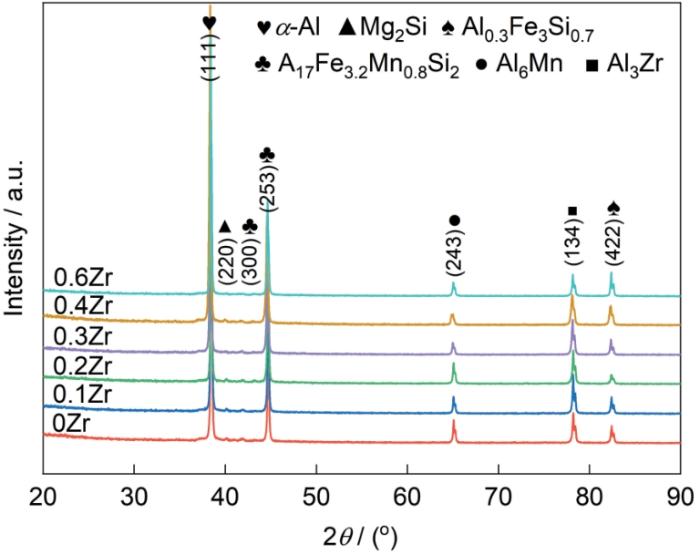
图2
不同Zr含量Al-Mg-Si铸轧板的XRD谱
Fig.2
XRD patterns of Al-Mg-Si cast-rolled sheets with different Zr contents
图3为不同Zr含量Al-Mg-Si铸轧板显微组织的SEM像。结合XRD谱结果(图2)可知,各铸轧板中的富Fe相均主要为Al0.3Fe3Si0.7相(图3中黑色箭头所示)和Al17Fe3.2Mn0.8Si2相(图3中红色箭头所示)。随着Zr含量增加,富Fe相尺寸呈现先增大后减小再增大的趋势,长径比则先减小后增大再减小,体积分数呈先增大后减小再增大的变化趋势。当Zr含量从0增加到0.1%时,富Fe相体积分数由0.81%增加到2.76%;此时其尺寸最大,平均尺寸由1.20 μm增加到2.50 μm。当Zr含量从0.1%增加到0.4%时,富Fe相体积分数由2.76%减小到1.80%,其尺寸不断减小,平均尺寸由2.50 μm减小到0.24 μm。当Zr含量从0.4%进一步增加到0.6%时,富Fe相体积分数由1.80%增加到3.28%,其平均尺寸由0.24 μm增加到2.35 μm,并且在铸轧板中发现了Al3Zr初生相,这些粗大的Al3Zr初生相通常在凝固初期形成,具有D023结构[22],如图1f3所示。此外,在铸轧板微观组织中观察到明显呈黑色短棒状的Mg2Si相(图3中白色箭头所示),Al17Fe3.2Mn0.8Si2相主要呈白色圆点状。上述结果表明,Zr含量可以直接影响Al-Mg-Si铸轧板微观组织中富Fe相的尺寸和数量。
图3

图3
不同Zr含量Al-Mg-Si铸轧板显微组织的SEM像
Fig.3
SEM images of Al-Mg-Si cast-rolled sheets with different Zr contents (Black arrows represent Al0.3Fe3Si0.7 phases, white arrows represent Mg2Si phases, red arrows represent Al17Fe3.2Mn0.8Si2 phases. Insets in Figs.3a, c, and e represent EDS results of the areas marked by the white rectangles, inset in Fig.3d is the corresponding enlarged view)
(a) 0Zr (b) 0.1Zr (c) 0.2Zr (d) 0.3Zr (e) 0.4Zr (f) 0.6Zr
图4a~c为不同Zr含量Al-Mg-Si铸轧板的EBSD图,图中红色区域代表变形组织,黄色区域代表回复组织,蓝色区域代表再结晶组织。可见,不添加Zr元素时,铸轧板以变形组织和再结晶组织为主,再结晶组织占比为31.9%;添加0.3%Zr元素后,铸轧板变形组织比例减小,再结晶组织占比减小至26.7%。这表明,Zr元素可以有效抑制Al-Mg-Si铸轧板的再结晶行为,促进变形组织向回复组织转变,与图1结果一致。图4c和e为添加0.3%Zr铸轧板的TEM像,图中白色相组织为Al17Fe3.2Mn0.8Si2相和Al0.3Fe3Si0.7相,黑色点状相组织为Mg2Si相,黄色虚线表示晶界。Al17Fe3.2Mn0.8Si2、Al0.3Fe3Si0.7和Mg2Si相交错分布于晶界处,这些尺寸为1~10 μm的析出相在半固态成型过程中可以作为形核位点,促进晶粒发生PSN现象。图4d~f为不同Zr含量铸轧板的TEM像和选区电子衍射(SAED)花样,图中黄色方框区域为SAED取点位置。可见,未添加Zr元素时,组织中存在大量的白色条状β″相和少量黑色短棒状β″相;当添加0.3%Zr时,组织中出现大量β″相和白色细小弥散的L12结构Al3Zr相;Zr含量进一步增至0.6%时,Al3Zr相的尺寸增大,但仍呈弥散分布,β″相数量明显减少。结合SEM表征结果(图3)可知,这是由于富Fe相的过分偏聚和长大所致。
图4

图4
不同Zr含量Al-Mg-Si铸轧板显微组织的EBSD和TEM分析
Fig.4
EBSD images (a, b) and TEM images (c-f) of Al-Mg-Si cast-rolled sheets with different Zr contents (Red areas, blue areas, and yellow areas in Figs.4a and b represent deformation grain, recrystallization grain, and recovery grain, respectively. Insets in Figs.4d-f are the corresponding SAED patterns of the area marked by yellow rectangles) (a, d) 0Zr (b, c, e) 0.3Zr (f) 0.6Zr
未添加Zr时,参与析出强化的长条状β″相的平均长度为68.5 nm,数量密度为79 μm-2;短棒状β″相的平均尺寸为7.6 nm,数量密度为70 μm-2。当Zr含量增加到0.3%时,条状β″相的平均长度为84.2 nm,数量密度为140 μm-2;短棒状β″相的平均尺寸为7.5 nm,数量密度为144 μm-2;Al3Zr相的平均尺寸为3.2 nm,数量密度为5.7 × 103 μm-2。Zr含量进一步增至0.6%时,条状β″相的平均长度为139.1 nm,数量密度为22 μm-2;短棒状β″相的平均尺寸为7.8 nm,数量密度为41 μm-2;Al3Zr相的平均尺寸为3.8 nm,数量密度为5.2 × 103 μm-2。由此可见,随着Zr含量的增加,显微组织中条状β″相的长度不断增大,而短棒状β″相的平均尺寸基本不变,数量密度均呈先增大后减小趋势;此外,Al3Zr相的平均尺寸增大,数量密度减小。这表明,添加适宜的Zr可以显著优化Al-Mg-Si铸轧板微观组织中纳米级第二相的析出行为,改善条状β″相和Al3Zr-L12相的形貌和尺寸,大幅提高析出相的数量密度。
图5为不同Zr含量Al-Mg-Si铸轧板的常温拉伸性能和综合力学性能评估图。再加工指数主要指对铝合金材料或制品进行再加工(如冷轧、退火、热处理等)后,衡量其质量、性能等方面的指标。由于富Fe相显著影响合金的力学性能,且在后续的热处理及加工过程中难以去除,因此采用富Fe相体积分数的倒数作为粗略评估再加工性能的指标[9]。断裂指数是衡量材料在裂纹存在时抵抗脆性断裂能力的指标。依据拉伸断口的断裂方式(脆性断口、半韧性断口和韧性断口),将断裂指数设定为1、2、3等级进行评估。由图5可知,添加0.3%Zr后铸轧板的屈服强度、抗拉强度和延伸率均有明显提高。当Zr含量为0.1%时,合金的屈服强度和抗拉强度分别为100.32和204.39 MPa,相较于未添加Zr的铸轧板,屈服强度和抗拉强度分别提高了13.2%和8.9%。Zr含量由0.1%增至0.3%时,板材的屈服强度和抗拉强度继续增加,延伸率基本不变。与未添加Zr时相比,屈服强度、抗拉强度和延伸率分别提高了22.8%、20.8%和52.3%;当Zr含量增加到0.4%时,合金屈服强度进一步增加到178.46 MPa,抗拉强度下降到210.92 MPa,延伸率大幅下降。当Zr含量进一步增至0.6%时,板材强度大幅下降,此时延伸率也较低,与0.3%Zr的铸轧板相比,分别下降了56%和52%。综合上述微观组织观察、再加工指数及断裂指数可知,Zr含量为0.3%时铸轧板的综合力学性能最佳。
图5

图5
Al-Mg-Si铸轧板的室温拉伸性能和综合力学性能评估图
Fig.5
Room temperature tensile properties (a) and statistical results of comprehensive mechanical properties (b) of Al-Mg-Si cast-rolled sheets with different Zr contents (Inset in Fig.5a is the schematic of tensile sample, unit: mm)
图6为不同Zr含量Al-Mg-Si铸轧板的拉伸断口形貌。由图可知,随着Zr含量增加,拉伸断口呈脆性断裂到韧性断裂再到脆性断裂的转变。未添加Zr时,拉伸断口由少量韧窝、河流花样和解理裂纹组成,呈现脆性断裂特征(图6a);添加0.1%Zr时,断口由大量细小且深度较浅的韧窝和少量解理台阶组成,呈现韧性断裂特征(图6b);添加0.2%Zr时,拉伸断口出现众多大尺寸且深度较深的韧窝,为典型的韧性断裂特征(图6c);Zr含量增加到0.3%时,断口中存在尺寸较大的韧窝,但整体韧窝尺寸有所减小,深度变化不大,依然表现出韧性断裂特征(图6d);添加0.4%Zr时,断口处的韧窝数量急剧减少,出现明显的冰糖状延晶脆性断裂特征(图6e);Zr含量增至0.6%时,冰糖状的脆性延晶断裂特征加剧(图6f)。结合图5b可知,Zr含量可以直接影响Al-Mg-Si铸轧板的断裂特征,为了保障铸轧板具有良好的断裂性能,Zr添加量应控制在0.2%~0.3%之间。
图6

图6
不同合金Zr含量Al-Mg-Si铸轧板断口形貌的SEM像
Fig.6
SEM images showing the fracture morphologies of Al-Mg-Si cast-rolled sheets with different Zr contents
(a) 0Zr (b) 0.1Zr (c) 0.2Zr (d) 0.3Zr (e) 0.4Zr (f) 0.6Zr
3 分析与讨论
Zr微合金化是影响Al-Mg-Si铸轧板再结晶行为的重要因素。为了厘清Zr含量对铸轧板材组织演变的作用机制,首先需要明晰铸轧板中大尺寸第二相的PSN行为。再结晶的驱动力受温度、形变诱导储存能量和大尺寸第二相分布的影响[22~24]。在铸轧成型过程中,第二相颗粒通过增加位错密度和改变大尺寸第二相颗粒附近位错运动路径的方式,在相应区域内积累大量形变能量,为再结晶晶粒形核提供了高取向差梯度和高应力场,从而促进了再结晶晶粒的形核。在合金中适量添加微量元素可以增加组织中微米级析出相的数量,影响第二相的尺寸及数量密度,从而直接影响PSN效应[22,25]。未添加Zr的铸轧板中Al0.3Fe3Si0.7和Al17Fe3.2Mn0.8Si2相的尺寸均在1~10 μm之间,弥散分布于基体中。再结晶晶粒在这些弥散分布的富Fe相周围形核,促使铸轧板发生完全再结晶(图1a)。Zr含量由0.1%增加到0.2%时,由于Zr含量较低,部分Zr元素会固溶于基体中,这些固溶于基体中的Zr元素在铸轧板凝固成型过程中影响基体中Si元素的分布[12],争夺富Fe相生长所需的Si元素,促使富Fe相尺寸减小(图3)。由于尺寸介于1~10 μm之间的富Fe相数量的大量减少,PSN效应被明显抑制,因此铸轧板再结晶比例下降(图1b和c)。继续提高Zr添加量后,由于Zr元素可以提高铸轧板的凝固速率[22],提高了轧制过程的固相分数[26],致使板材的位错密度和畸变能升高,使铸轧板进入到不稳定的高自由能状态。凝固速率的提高会加大铸轧成型过程中的轧制力,铸轧板可在更高的固相分数下轧制成型,因此板材中出现了纤维状的组织特征(图1e1~e3)。此时,尺寸较大的富Fe相(大于10 μm)在较大的铸轧力下破碎,重新促进了PSN效应的产生,致使铸轧板发生部分再结晶(图1d1~d3和e1~e3)。但由于此时铸轧板中Zr含量较高,组织中开始析出L12结构的Al3Zr相(图4e),这些纳米级的亚稳相可以钉扎晶界,抑制再结晶晶粒的长大,因此此时铸轧板的再结晶晶粒尺寸较小。继续增加Zr含量至0.6%时,合金中已经开始形成大量D023结构Al3Zr初生相(图3f),这些微米级的初生相不仅促进PSN效应,还降低了L12结构纳米级Al3Zr相的析出数量,从而大幅度弱化了Zr对PSN效应的抑制作用,铸轧板发生完全再结晶,原本的纤维状特征完全被消除,晶粒具有等轴状晶粒特征,再结晶晶粒明显长大(图1e1~e3)。
式中,σ0为纯Al的晶格摩擦应力(取值为35 MPa),σGB为晶界强化贡献的强度,σD为变形过程位错强化贡献的强度,σSS为固溶强化贡献的强度。σGB可通过Hall-Petch公式描述[29]:
式中,ky为Hall-Petch常数,在铝合金中取值为0.068 MPa·m1/2;d为平均晶粒尺寸。
σD主要与储存位错(SSD)和几何必需位错(GND)相关,即与加工硬化和析出强化相关,可由Taylor方程表示[29]:
式中,σSSD为SSD贡献的强度,σGND为GND贡献的强度,fNRX为未再结晶体积分数,M为Taylor因子(取值为3.06),α为常数(取值为0.2),G为剪切模量(取值为27 GPa),b为Burgers矢量模(取值为0.286 nm),ρSSD为SSD密度。
σGND可用下述公式表示[29]:
式中,ρGND为GND密度;λG为常数,反映析出相的形状(其中,立方体颗粒约为8,球状颗粒约为6);dp为析出相尺寸;fv为析出相体积分数;ε为应变。结合
σSS可表示为[5]:
式中,ki 为元素i的固溶强化系数,Ci 为元素i实际参与固溶强化的质量分数。其中,Mg、Si、Cu的固溶强化系数分别为kMg = 29 MPa/%2/3、kSi = 66.3 MPa/%2/3、kCu = 46.4 MPa/%2/3[5]。
由图1计算得到
表2 不同Zr含量Al-Mg-Si铸轧板的理论屈服强度 (MPa)
Table 2
| Alloy | σGB | σSSD | σGND | σSS | σ |
|---|---|---|---|---|---|
| 0Zr | 11.7 | 35.0 | 5.3 | 24.8 | 111.8 |
| 0.3Zr | 11.1 | 40.8 | 24.7 | 24.8 | 136.4 |
| 0.6Zr | 11.5 | 45.3 | 37.7 | 24.8 | 154.3 |
综上分析可知,Zr元素主要通过改变铸轧板中富Fe相的尺寸、数量和分布情况影响PSN效应。同时,配合Zr元素对铸轧成型过程中凝固速率的影响以及纳米级的L12结构Al3Zr亚稳相对再结晶晶粒长大的抑制作用,最终实现调控Al-Mg-Si铸轧板的再结晶行为。
4 结论
(1) 未添加Zr的Al-Mg-Si铸轧板中尺寸介于1~10 μm间的Al0.3Fe3Si0.7和Al17Fe3.2Mn0.8Si2富Fe相促进PSN效应,促使铸轧板发生完全再结晶。Zr微合金化作用可以改变铸轧板中富Fe相的尺寸、数量和分布情况,直接影响PSN效应,调控铸轧板的再结晶行为。
(2) Zr含量可以显著影响Al-Mg-Si铸轧板的力学性能。在影响铸轧板力学性能的各种强化机制中,析出强化占主导地位。添加0.3%Zr的铸轧板综合力学性能最佳,其屈服强度为104.81 MPa,抗拉强度为226.91 MPa,延伸率为15.05%,与未添加Zr的铸轧板相比,其屈服强度、抗拉强度和延伸率分别提高了22.8%、20.8%和52.3%。
参考文献
Analysis of second phase particles in metals using deep learning: Segmentation of nanoscale dispersoids in 6xxx series aluminum alloys (Al-Mg-Si)
[J].
Precipitation behavior during re-aging of Al-Mg-Si-Cu alloy
[J].
Influence of asymmetric rolling on the microstructure, texture evolution and mechanical properties of Al-Mg-Si alloy
[J].
Effect of Cu content on central-segregation composition and mechanical properties of Al-Mg-Si alloys produced by twin-roll casting
[J].
Towards relieving center segregation in twin-roll cast Al-Mg-Si-Cu strips by controlling the thermal-mechanical process
[J].
Serious center segregation greatly limits the application of twin-roll casting (TRC) technology for producing 6xxx alloy strips. Herein, Al-0.9Mg-0.6Si-0.2Cu-0.1Fe (wt.%, 6061) strips with different thicknesses were fabricated by TRC, and we found that the center segregation was well relieved with the thickness increased from 3 mm to 4 mm. To reveal the mechanisms of mitigation of center segregation in the 4 mm strip, various techniques including solidification simulation, crystallographic calculation, electron backscatter diffraction (EBSD), and electron probe micro-analyzer (EPMA) were utilized. The results disclosed that the Fe-containing phase in the 3 mm strip was π-AlFeMgSi, while the counterpart in the 4 mm strip was α-AlFeSi. The α-AlFeSi could serve as nucleation substrates for Mg<sub>2</sub>Si and Q-AlCuMgSi phases, thus promoting the uniform distribution of elements and preventing the accumulation of phases in the center region. Three matching planes between the α-AlFeSi and Q/Mg<sub>2</sub>Si were examined as: (11$\bar{2}$0)<sub>α-AlFeSi</sub> // (0001)<sub>Q,</sub> (0001)<sub>α-AlFeSi</sub> // (110)<sub>Mg2Si,</sub> and (11$\bar{2}$0)<sub>α-AlFeSi</sub> // (1$\bar{1}$0)<sub>Mg2Si</sub>. Meanwhile, the smaller roll separating force during the TRC process in the 4 mm strip could weaken the force-induced liquid flow behavior in the semi-solid region, which is the other reason for the alleviation of center segregation. Owing to the elimination of the center segregation, a more excellent fracture elongation was achieved in the as-homogenized 4 mm strip (∼29%) compared with the counterpart of the 3 mm strip (∼20%). This work may provide a strategy to eliminate the center segregation, thus further promoting the application of TRC process and producing high-performance Al alloy strips efficiently.
Impact of thermal exposure on the microstructure and mechanical properties of a twin-roll cast Al-Mn-Fe-Si strip
[J].Al-Mn-Fe-Si strips were fabricated via both the twin-roll casting (TRC) and the more conventional route, direct-chill casting (DC). The two types of strips prepared were subjected to thermal exposure at a series of temperatures. Uniaxial tensile tests after the thermal exposure showed that while the DC strip presented a -74% decrease in the yield strength and -35% decrease in the ultimate tensile strength (UTS) after being exposed to 350 °C for 12 h, the TRC strip, in contrast, maintained its strength at temperatures up to -460 °C for the same duration. Systematic microstructure characterization revealed that the different thermal stability in the strength of the two types of strips arised from their distinct evolution in grain morphology and second phase particles during the thermal exposure. The calculation based on Cahn-Lücke-Stüwe (CLS) model suggested that due to the highly supersaturated solute atoms, at the beginning of the thermal exposure, the TRC strip experienced a strong solute drag which reduced the grain boundary migrating velocity to a value that is orders of magnitude smaller than that in the DC strip. With the progress of the thermal exposure, the solute atoms precipitated out, forming densely distributed second phase particles. For one thing, these particles stabilized the grain structure by inducing Zener pinning pressure which could be ten times higher than that in the DC strip, depending on the temperature. For another, they acted as dislocation obstacles and compensated for the strength loss owing to decreasing solution hardening. Both effects contributed to the TRC strip's fairly stable strength regarding thermal exposure below 460 °C. The present work could guide the direct application of the TRC strips in the industry. The results should also be helpful for the development of a fundamental framework for designing advanced TRC Al strips with improved mechanical properties at elevated temperatures.
Effectively mitigated macro-segregation and improved tensile properties of twin-roll casting Al-Cu strips via the addition of TiC nanoparticles
[J].
Sustainability through alloy design: Challenges and opportunities
[J].
Microstructure evolution and recrystallization behavior of hot rolled AA6061 twin-roll casting plate with different manganese contents
[J].
Research progress on effects of Sc and Zr microalloying on microstructure and properties of Al-Zn-Mg-(Cu) alloys
[J].
Sc和Zr微合金化对Al-Zn-Mg-(Cu)合金微观组织和性能影响的研究进展
[J].
Microstructure characteristics and mechanical properties improvement of gravity cast Al-7Si-0.4Mg alloys with Zr additions
[J].
Synergistic strengthening by nano-sized α-Al(Mn, Fe)Si and Al3Zr dispersoids in a heat-resistant Al-Mn-Fe-Si-Zr alloy
[J].
Enhanced aging precipitation behavior and mechanical properties of 6022 Al-Mg-Si alloy with Zr addition
[J].
A novel Al-Cr-Sc-Zr alloy additively manufactured via laser directed energy deposition: Microstructure, phase analysis and mechanical properties
[J].
Microstructure evolution and high-temperature performances of AA6111 alloy strengthened by Sc, Zr co-microalloying
[J].
Microstructure and strengthening mechanisms of Zr-modified Al-Cu-Mg alloy processed by selective laser melting
[J].
Effect of intermetallic phases and recrystallization on the corrosion and fracture behavior of an Al-Zn-Mg-Cu-Zr-Yb-Cr alloy
[J].
Effect of Sc and Zr additions on recrystallization behavior and intergranular corrosion resistance of Al-Zn-Mg-Cu alloys
[J].The recrystallization and intergranular corrosion behaviors impacted by the additions of Sc and Zr in Al-Zn-Mg-Cu alloys are investigated. The stronger effect of coherent Al3(Sc1−xZrx) phases on pinning dislocation resulted in a lower degree of recrystallization in Al-Zn-Mg-Cu-Sc-Zr alloy, while the subgrain boundaries can escape from the pinning of Al3Zr phases and merge with each other, bringing about a higher degree of recrystallization in Al-Zn-Mg-Cu-Zr alloy. A low degree of recrystallization promotes the precipitation of grain boundary precipitates (GBPs) with a discontinuous distribution, contributing to the high corrosion resistance of Al-Zn-Mg-Cu-Sc-Zr alloy in the central layer. The primary Al3(Sc1−xZrx) phase promotes recrystallization due to particle-stimulated nucleation (PSN), and acts as the cathode to stimulate an accelerated electrochemical process between the primary Al3(Sc1−xZrx) particles and GBPs, resulting in a sharp decrease of the corrosion resistance in the surface layer of Al-Zn-Mg-Cu-Sc-Zr alloy.
Effects of combined additions of Mn and Zr on dispersoid formation and recrystallization behavior in Al-Zn-Mg alloys
[J].
Heating rate effect on particle stimulated nucleation and grains structure during non-isothermal annealing of multi-directionally forged solution treated AA2024
[J].
The influence of minor additions of Y, Sc, and Zr on the microstructural evolution, superplastic behavior, and mechanical properties of AA6013 alloy
[J].
Precipitation behavior and dispersion-strengthening mechanism of nano-sized dispersoids in zirconium-containing aluminium alloys
[D].
纳米弥散相在含锆铝合金中的析出行为与强化机制
[D].
Micro-alloying effect of Er and Zr on microstructural evolution and yield strength of Al-3Cu (wt.%) binary alloys
[J].
New insight into precipitation of Al3Zr and correlative effect on recrystallization behavior in a rapidly-solidified Al-Zn-Mg-Cu-Zr alloy
[J].
Effect of floating grains on the deformed microstructure of Mn- and Cr-containing Al-Mg-Si-Cu alloys
[J].
Effects of important parameters in the production of Al-A356 alloy by semi-solid forming process
[J].
Effects of cryorolling on properties and precipitation behavior of a high-strength and high-conductivity Cu-1Cr-0.2Zr-0.25Nb alloy
[J].
低温轧制对高强高导Cu-1Cr-0.2Zr-0.25Nb合金性能及析出行为的影响
[J].随着现代工业中交通、电气、航空航天、电子等领域的快速发展,对铜合金的性能要求越来越高。强度和导电率是相互矛盾的性质,实现铜合金兼具高强度和高导电率是现代铜工业发展的重要课题。采用真空熔炼、低温轧制、时效处理等工艺制备了Cu-1Cr-0.2Zr-0.25Nb (质量分数,%)合金,研究了低温轧制对Cu-1Cr-0.2Zr-0.25Nb合金显微组织、力学性能和导电性能的影响,分析了时效工艺对析出相种类、形貌和分布的影响。结果表明,Cu-1Cr-0.2Zr-0.25Nb合金主要由Cr相、富Zr相、Cr<sub>2</sub>Nb相及Cu基体相组成。450℃短时(30 min)时效后Cu-1Cr-0.2Zr-0.25Nb合金即可析出纳米级fcc结构的Cr析出相,在长时间(300 min)时效后,会形成bcc结构的Cr析出相。Cu-1Cr-0.2Zr-0.25Nb合金经过低温轧制和时效处理后,在Cu基体中形成了纳米析出相、纳米变形孪晶和位错等混合组织并获得了优异的综合性能。低温轧制Cu-1Cr-0.2Zr-0.25Nb合金450℃时效30 min后,抗拉强度为700 MPa,导电率为73.29%IACS;450℃时效300 min后,导电率可达79.81%IACS,此时,抗拉强度、屈服强度和硬度分别为646 MPa、606 MPa和212 HV。结合实验结果和对强度贡献计算表明,位错强化和析出强化是Cu-1Cr-0.2Zr-0.25Nb合金的主要强化机制。
Simultaneous enhancement in mechanical and corrosion properties of Al-Mg-Si alloys using machine learning
[J].Al-Mg-Si alloys with high strength and good corrosion resistance are regarded as desirable materials for all-aluminum vehicles. However, the traditional trial-and-error experimental methods are insufficient to address the trade-off between strength and corrosion resistance. In this work, a non-dominated sorting genetic machine-learning algorithm (NSGA-II) was employed to optimize the chemical composition, so as to simultaneously improve the strength and corrosion resistance. Three high-performance Al-Mg-Si alloys with low Mg, Si, and Cu contents were successfully developed, where the yield strength (YS), ultimate tensile strength (UTS), and the elongation (<em>δ</em>) reached 375-380 MPa, 410-416 MPa, and 13.7%-15.2%, respectively. Compared with higher-Cu-content 6013 alloy, the YS and UTS of the present alloys increase by about 60 MPa, and the intergranular corrosion resistance is also significantly improved. Microstructure characterization demonstrated that β'' and QP phases introduced a significant synergistic precipitation strengthening effect; the dispersoids formed by trace Mn, Cr, Fe, Zr, and Ti contributed dispersion strengthening effect; and the good pitting corrosion resistance is attributed to lower Mg and Si contents.
Ultrastrong lightweight compositionally complex steels via dual-nanoprecipitation
[J].Novel dual-nanoprecipitation enables ultrahigh specific strength of new ductile, lightweight compositionally complex steels.


