



鉴于自然时效对Al-Zn-Mg-Cu合金时效强化机制的重要作用,研究者围绕析出相演化和性能调控两方面进行了深入的研究,揭示了自然时效的相关作用机制。在析出相演变方面,研究表明,固溶处理后随着自然时效时间的延长,合金中的析出相经历由过饱和固溶体(SSSS)→GPI区→GPII区→亚稳η′相的演变[7~11],其中GPII区与亚稳η′相需长达数月的时间孕育[7,9]。采用自然时效+人工时效处理方式时,研究[6,12]表明,自然时效后的析出相存在某一临界尺寸,当形成的GPI区尺寸小于临界尺寸时,这些细小的析出相会在人工时效早期回溶于Al基体,而大于临界尺寸时,则会成为后续形成GPII区和亚稳η′相的前驱体。同时,自然时效也具有降低晶界无析出区(PFZ)宽度[13]和提高析出相分布均匀性[14]等作用。
然而仍有一个悬而未决的问题,即自然时效对后续人工时效后合金峰值强度的影响尚不明晰。相关研究认为,自然时效有利于提升合金的峰值强度[6,13,15],这是由于在自然时效期间溶质原子聚集,提供了局部过饱和度并增加了人工时效期间η′相的有利成核位点的数量,导致η′相的密度更大、尺寸更小[6]。而有些研究[22,23]给出了相反的结果,认为在自然时效阶段形成的稳定GPI区会与人工时效阶段形成的主要强化相争夺溶质原子,从而降低合金强度。部分研究[21,24]也发现自然时效对人工时效后合金的峰值强度无显著影响。较为明确的是,合金体系和人工时效处理参数会显著影响峰值时效强度,但在自然时效条件下,即不同的自然时效处理时间,对合金峰值强度的影响仍不明确,尤其对于高合金化的Al-Zn-Mg-Cu合金(合金化元素含量> 12%,质量分数)。
1 实验方法
1.1 试样制备
将纯度均为99.95%的Al、Zn、Mg纯金属和Al-50Cu、Al-10Cr、Al-10Zr中间合金作为原料,使用ZG-25中频真空感应炉熔炼新型超高强铝合金铸锭,实测成分为Al-9.8Zn-2.23Mg-1.38Cu-0.11Cr-0.1Zr-0.05Fe-0.02Si (下文简称新型铝合金)。铸锭在SGM-M30/12A电阻炉中进行400 ℃、24 h + 470 ℃、24 h的均匀化处理后进行轧制,轧制温度为400~420 ℃,热轧变形量为85%。热轧试样经450 ℃、1 h + 470 ℃、1 h + 480 ℃、0.5 h的固溶处理(水淬)后,分别在室温条件下(20 ℃)停放0、1、7和30 d后进行120 ℃人工时效处理,对应的试样分别命名为NA0、NA1、NA7和NA30。
采用VMHT30M显微硬度仪对120 ℃人工时效处理不同时间的试样进行硬度测试,载荷为100 g,取5个测试结果的平均值为最终结果。根据硬度实验得出的峰值时效时间,进行峰值时效状态下试样的拉伸性能测试。在室温下采用CMT6000试验机测试试样的抗拉强度和断后伸长率,拉伸应变率为0.5 mm/min,试样形状为狗骨型,标距20 mm,横截面尺寸为5 mm × 2 mm,取2个试样的平均值作为力学性能的最终结果。透射电镜(TEM)试样采用双喷电解抛光,电解液为HNO3∶CH3OH = 1∶3 (体积比)的混合溶液,抛光温度控制在-30~-25 ℃之间,电压约为15 V。为进一步获得高质量的高分辨率图像,对双喷后的样品进行低温离子减薄(约-196 ℃)作为最终清洁和减薄步骤。APT试样在电解抛光仪上采用两步电解抛光法制备出曲率半径小于100 nm的针尖尖端。第一步采用25%HClO4 + 75%CH3COOH (体积分数)的混合溶液作为电解液进行粗抛,电压为10~15 V;第二步采用2%HClO4 + 98%C6H14O2 (体积分数)的混合溶液进行精抛,电压为5~10 V。整个电解抛光过程均在室温环境(约20 ℃)进行,并通过在电解槽外壁使用循环冷却水浴确保溶液温度稳定,防止局部过热。
1.2 微观组织分析
采用基于CuKα 密封管X射线源的Anton Paar SAXS ess mc2装置进行小角X射线散射(SAXS)实验,X射线波长为0.154 nm,试样与检测器之间的距离为306.8 mm,曝光时间为300 s。采用配备HAADF探测器和X射线能谱仪(EDS)系统的Tecnai G2 F30型TEM,在300 kV下进行HAADF成像和成分分析,观察纳米级第二相的分布和形貌。采用CAMECA LEAP 5000XR装置进行3D-APT成像实验,试样测试温度为50 K,电脉冲分数为20%,电脉冲频率为250 kHz,目标检测率为1%。使用集成可视化和分析软件IVAS进行APT重建和分析。
2 实验结果
2.1 自然时效时间对新型铝合金组织的影响
首先采用高分辨HADDF-STEM对自然时效处理后的试样进行观察,结果如图1所示。随着自然时效时间的延长,图像的明暗对比衬度逐渐增加,考虑到Zn、Cu原子比Al原子更为明亮[28],这反映了析出相的形核和长大。结合图1a~c中矩形框区域的快速Fourier变换(FFT)结果(图1d~f)和高分辨形貌像(图1g~i)可发现,细小的球状相与Al基体为共格关系且在FFT中仅发现Al基体的衍射斑,证明这些细小的球状相为GPI区。随着自然时效时间的延长,在自然时效处理30 d的试样中出现了短棒状析出相,并且在FFT中发现其他微弱的衍射斑(图1f中箭头所示),根据Chung等[28]的研究,该类相被判定为GPII区。统计观察结果表明,在自然时效处理30 d的试样中CPII区所占析出相的比例不足0.5%。因此,三种试样中GPI区均为主要析出相。
图1
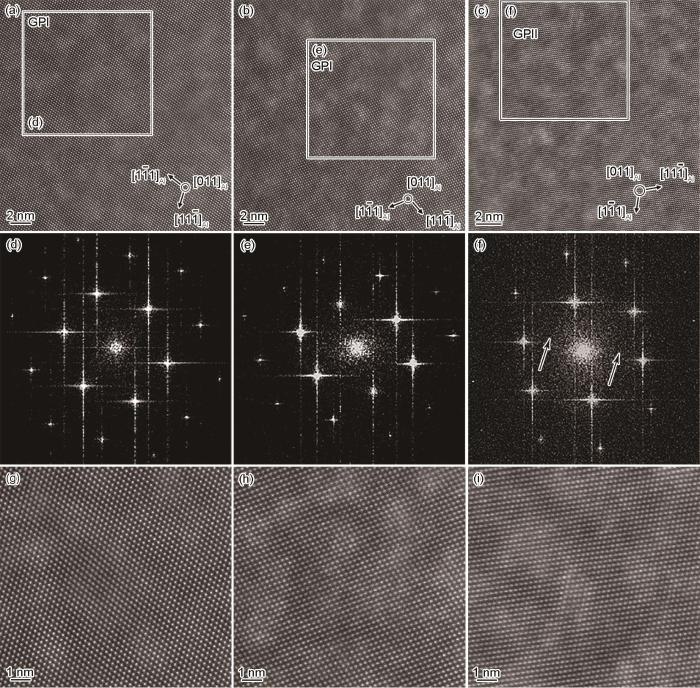
图1
不同自然时效时间处理后新型铝合金晶内析出相的高角度环形暗场(HADDF)-STEM分析
Fig.1
HADDF-STEM analyses of the precipitates of the new aluminum alloy after different natural aging time
(a-c) high-angle annular dark field (HADDF)-STEM images of the precipitates after natural aging for 1 d (a), 7 d (b), and 30 d (c) (d-f) fast Fourier transform (FFT) after natural aging for 1 d (d), 7 d (e), and 30 d (f) corresponding to the rectangle areas in Figs.1a-c (Arrows in Fig.1f indicate weak diffraction spots) (g-i) atomic-level morphologies of the precipitates after natural aging for 1 d (g), 7 d (h), and 30 d (i)
图2

图2
利用小角X射线散射(SAXS)所得不同自然时效时间后新型铝合金的散射矢量模量(q)与散射强度关系图
Fig.2
Scattering vector modulus (q) versus scattering intensity relationship diagrams of the new aluminum alloy after different natural aging time obtained by small angle X-ray scattering (SAXS)
由
2.2 自然时效时间对人工时效下合金力学性能的影响
经不同自然时效时间的NA0、NA1、NA7和NA30试样在120 ℃人工时效不同时间的硬度如图3a所示。随自然时效时间延长,4种试样的硬度均呈现先增大后减小的趋势,且峰值时效时间逐渐提前,NA0、NA1、NA7和NA30试样的峰值时效时间分别为24、22、20和16 h,这表明自然时效加速了峰值时效的响应速度。但对于峰值硬度,随自然时效时间延长,测试结果出现了先降低后增大的现象,NA0、NA1、NA7和NA30试样的峰值硬度分别为(202.6 ± 1.9)、(193.3 ± 3.9)、(204.0 ± 2.6)和(206.0 ± 2.5) HV。为进一步明确该现象,对新型铝合金的峰值时效试样进行拉伸实验,工程应力-应变曲线如图3b所示。可见,NA0、NA1、NA7和NA30试样的抗拉强度(UTS)分别为(708 ± 4)、(685 ± 3)、(712 ± 1)和(722 ± 1) MPa,抗拉强度也表现出了与峰值硬度相同的变化规律。NA0、NA1、NA7和NA30试样的断后伸长率(EL)分别为(9.8 ± 0.1)%、(9.6 ± 0.2)%、(10.9 ± 0.2)%和(9.1 ± 0.2)%,NA7试样具有最高的断后伸长率。
图3

图3
经不同时间自然时效及120 ℃人工时效不同时间后新型铝合金的硬度和人工峰值时效试样的工程应力-应变曲线
Fig.3
Hardnesses of the new aluminum alloy after different natural aging time followed by artificial aging at 120 oC for different time (a) and engineering stress-strain curves under artificial peak aging (b) (The samples with natural aging of 0, 1, 7, and 30 d following with artificial aging are named NA0, NA1, NA7, and NA30, respectively)
2.3 自然时效时间对人工峰值时效状态下合金组织的影响
式中,Smajor为析出相长轴尺寸,Sminor为析出相短轴尺寸。统计结果表明,NA0、NA1、NA7和NA30试样的晶界析出相等效尺寸分别为(10.4 ± 2.2)、(11.5 ± 1.8)、(6.0 ± 1.2)和(14.2 ± 1.6) nm。NA0试样的晶界析出相尺寸分布最为不均匀,NA7试样的晶界析出相最为细小且均匀,NA30试样的晶界析出相尺寸最大。上述现象是由于自然时效改变了空位和溶质的分布状态:短时自然时效(1 d)促进溶质向晶界偏聚,使晶界析出相变粗;随时效时间延长(7 d),晶内析出相优先生长并消耗溶质,抑制晶界析出相粗化;时效时间过长(30 d)后,晶内析出相趋于稳定,溶质重新在晶界富集,从而使晶界析出相尺寸和偏析范围呈现“先增大-后减小-再增大”的变化规律。同时由图4a~d可知,NA0和NA1试样中存在PFZ,而NA7和NA30试样中基本观察不到PFZ,这与前期报道的自然时效可降低PFZ宽度的结果[13]相一致。
图4
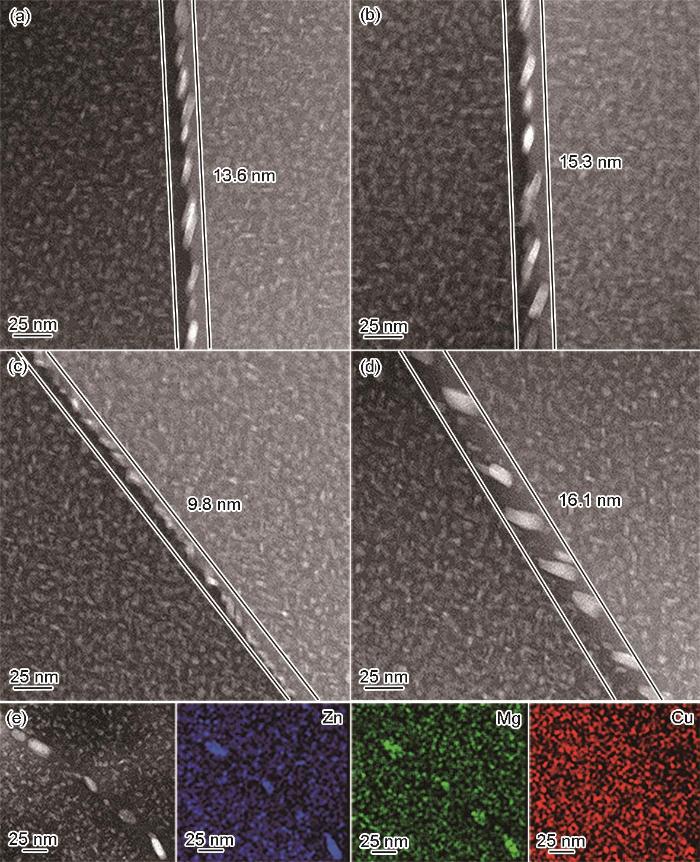
图4
经不同自然时效时间后在人工峰值时效状态下新型铝合金中小角晶界形貌的HADDF-STEM像和NA30试样晶界形貌的EDS分析
Fig.4
HADDF-STEM images of the small-angle grain boundaries of the new aluminum alloy after different natural aging time under artificial peak aging in samples NA0 (a), NA1 (b), NA7 (c), and NA30 (d); and HADDF-STEM image of grain boundary and corresponding EDS elemental mappings in NA30 sample (e)
图5
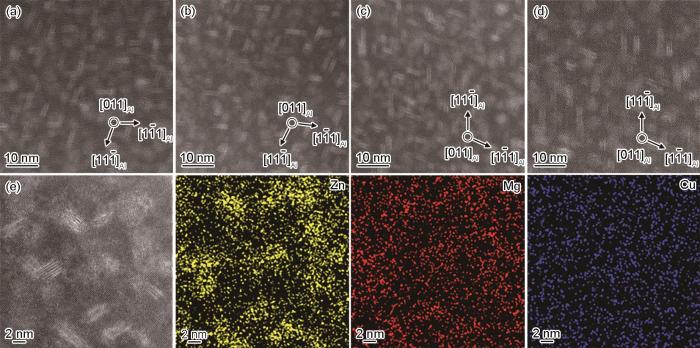
图5
经不同自然时效时间后在人工峰值时效状态下新型铝合金晶内析出相形貌的TEM像和NA30试样晶内析出相形貌的EDS分析
Fig.5
TEM images of the intragranular precipitates of the new aluminum alloy after different natural aging time under artificial peak aging in samples NA0 (a), NA1 (b), NA7 (c), and NA30 (d); and TEM image of intragranular precipitates and corresponding EDS elemental mappings in NA30 sample (e)
采用ImageJ软件,分别对NA0、NA1、NA7和NA30试样晶内析出相的长轴尺寸和短轴尺寸进行统计,每种状态试样均统计200个析出相,统计结果如图6所示。NA0、NA1、NA7和NA30试样的平均长轴尺寸分别为5.5、5.8、5.4和5.1 nm,平均短轴尺寸分别为2.4、2.4、2.5和2.6 nm。随自然时效时间延长,析出相长轴尺寸呈现先增大后减小的现象,而析出相短轴尺寸变化不明显。
图6
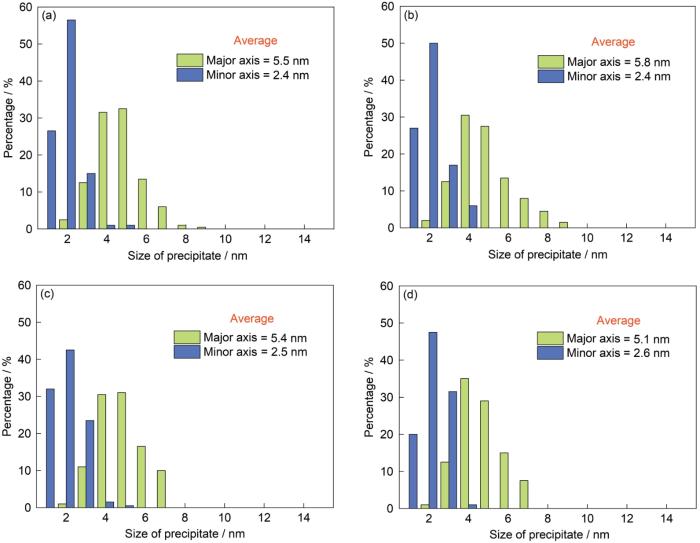
图6
经不同自然时效时间后在人工峰值时效状态下新型铝合金晶内析出相尺寸统计
Fig.6
Intragranular precipitate size statistics of the new aluminum alloy after different natural aging time under artificial peak aging in samples NA0 (a), NA1 (b), NA7 (c), and NA30 (d)
考虑到Zn、Mg和Cu元素会形成不同种类的晶内析出相(图5e),如GPI区、GPII区或η′相等[13]。根据图7a~d中晶内析出相的HADDF-STEM像和对应矩形框图中析出相的FFT结果(图7e~h),进一步按照如下规则统计GPI区、GPII区、η′相以及η相所占的数量分数,其中,尺寸小于5 nm的近球形共格析出相为GPI区、尺寸小于5 nm的棒状或椭球状共格析出相为GPII区、尺寸大于5 nm的棒状或椭球状共格析出相为η′相、尺寸大于5 nm且与Al基体半共格或非共格的析出相为η相,共统计200个析出相。NA0、NA1、NA7和NA30试样中GPI区、GPII区、η′相与η相所占的数量分数如图8所示。可见,在NA0、NA1、NA7和NA30试样中,GPII区均为最主要的析出相,所占数量分数分别为46%、44%、46%和52%,随自然时效时间延长,GPII区的比例先降低后增加,NA30试样具有最高的比例。与之相反,η′相所占数量分数分别为26%、30%、24%和22%,随自然时效时间延长,呈现先增加后降低的趋势。同时在NA7和NA30试样中发现了少量的η相,并且随着自然时效时间的延长,η相出现的概率增大。
图7

图7
经不同自然时效时间后在人工峰值时效状态下新型铝合金晶内析出相形貌的HADDF-STEM像和FFT分析
Fig.7
HADDF-STEM images of the intragranular precipitates of the new aluminum alloy after different natural aging time under artificial peak aging in samples NA0 (a), NA1 (b), NA7 (c), and NA30 (d); and corresponding FFT of rectangle areas in Figs.7a-d for GPII zone (e), η′ phase (f), GPI zone (g), and η phase (h), respectively (Arrows in Figs.7e, f, and h indicate weak diffraction spots)
图8

图8
经不同自然时效时间后在人工峰值时效状态下新型铝合金晶内析出相的种类统计
Fig.8
Precipitate type statistics of the new aluminum alloy after different natural aging time under artificial peak aging in samples NA0 (a), NA1 (b), NA7 (c), and NA30 (d)
进一步,对NA1和NA30试样中的析出相进行3D-APT分析,主要溶质元素为Zn、Mg和Cu。以10%Zn (原子分数)为界面[5],对析出相进行三维重构,分析析出相的数密度和元素分布差异,结果如图9所示。经统计,NA1和NA30试样中晶内析出相的数密度分别为1.42 × 1024和1.69 × 1024 m-3,NA30试样的晶内析出相数密度比NA1试样增加约20%。根据图6~8中GP区和η′相的尺寸分布情况,分别选择对应尺寸的析出相进行GP区和η′相成分的定量分析。为了提升结果的可靠性,每种类型析出相分别选取10个尺寸近似的粒子进行平均成分计算,析出相的成分变化情况如图10所示。GP区和η′相中Zn、Mg和Cu元素的最大含量(原子分数,下同)如表1所示。可以明显看出,在析出相尺寸基本相同的情况下(图10中橙色阴影的长度范围),相比于NA1试样,NA30试样中析出相的成分变化梯度减弱,Zn、Mg、Cu元素最大含量均显著降低,GP区中Zn、Mg和Cu元素最大含量分别由NA1试样的(24.7 ± 1.5)%、(22.8 ± 2.6)%和(1.4 ± 0.5)%分别下降至NA30试样的(20.5 ± 2.6)%、(13.7 ± 1.9)%和(1.0 ± 0.5)%;η′相中Zn、Mg、Cu最大含量分别由NA1试样的(31.4 ± 7.4)%、(23.8 ± 3.5)%和(2.0 ± 0.9)%下降至NA30试样的(22.9 ± 2.5)%、(16.7 ± 2.1)%和(1.3 ± 0.3)%。考虑到NA1和NA30两种试样的成分相同、析出相尺寸相同,较小的成分梯度和较低的Zn、Mg、Cu元素最大含量有利于形成更多的析出相。
图9

图9
经不同自然时效时间后在人工峰值时效状态下NA1和NA30试样中的析出相和Zn、Mg、Cu溶质分布的3D-APT分析
Fig.9
3D-APT analyses of the distributions of precipitates and solutes such as Zn, Mg, and Cu after different natural aging time under artificial peak aging in samples NA1 (a) and NA30 (b)
图10

图10
经不同自然时效时间后在人工峰值时效状态下NA1和NA30试样中典型析出相的邻近浓度分布分析
Fig.10
Proxigram analyses of typical precipitates after different natural aging time under artificial peak aging in samples NA1 and NA30
(a) typical GP zone in sample NA1 (b) typical GP zone in sample NA30
(c) typical η′ phase in sample NA1 (d) typical η′ phase in sample NA30
表1 经不同自然时效时间后在人工峰值时效状态下NA1和NA30试样中GP区和η′相中Zn、Mg和Cu元素的最大含量 (atomic fraction / %)
Table 1
| Element | GP zone | η′ phase | |||
|---|---|---|---|---|---|
| NA1 | NA30 | NA1 | NA30 | ||
| Zn | 24.7 ± 1.5 | 20.5 ± 2.6 | 31.4 ± 7.4 | 22.9 ± 2.5 | |
| Mg | 22.8 ± 2.6 | 13.7 ± 1.9 | 23.8 ± 3.5 | 16.7 ± 2.1 | |
| Cu | 1.4 ± 0.5 | 1.0 ± 0.5 | 2.0 ± 0.9 | 1.3 ± 0.3 | |
3 分析与讨论
3.1 自然时效时间对析出相的影响机制
自然时效促使过饱和固溶体中的溶质原子(Zn、Mg和Cu)通过扩散形成细小、弥散的GP区,并且随着自然时效的延长,GP区逐渐长大[9],热力学稳定性增加。在人工时效初期,细小的析出相因热力学不稳定性会重新溶解到Al基体中,无法为后续相变提供有效形核位点;稳定的GP区将作为前驱体,促进主要强化相(如GPII区、亚稳η′相)的形成。
在自然时效过程中,采用经典形核理论计算形核率(N)[30]:
考虑析出相的尺寸效应与其稳定性的关系。由于析出相的溶解和长大行为与原子在析出相的界面扩散相关,通过下式计算析出相界面浓度(Ci)[31]:
式中,Ceq为基体平衡溶质浓度,γ为析出相与基体间的界面能,Vm为析出相摩尔体积,r为析出相半径,R为气体常数。随着自然时效时间延长,Ci的数值逐渐趋于稳定,形成低温下的准平衡态。而随着时效温度升高,为维持平衡体系,析出相的平均半径倾向于增大,表现为人工时效后试样的析出相尺寸显著高于自然时效的试样。
进一步,基于TCAL6铝合金数据库,采用Thermo-Calc软件计算析出相的临界形核尺寸[32]。对于球状析出相,在过饱和固溶体中析出半径为r的第二相,其Gibbs自由能(ΔG*)如下式所示:
式中,Δg为在基体中析出单位体积第二相所需要的驱动力。在新型铝合金成分和120 ℃温度条件下,根据热力学计算得出,γ = 3.63 × 10⁻⁶ J/m2,Δg = -9829.2 J/m3。由此得到ΔG*随r的变化,如图11所示。对
图11

图11
析出相自由能(ΔG*)随析出相半径(r)的变化
Fig.11
Variations of precipitate free energy (ΔG*) with precipitate radius (r) (r*—critical nucleation size)
图12

图12
自然时效和峰值人工时效状态下析出相的种类和形貌变化示意图
Fig.12
Schematics of the variations in the types and morphologies of precipitates under natural aging (a-d) and peak artificial aging (e-h) conditions
(a, e) NA0 (b, f) NA1 (c, g) NA7 (d, h) NA30
对比NA0与NA1试样,由于自然时效1 d形成的GPI区尺寸小于临界形核尺寸,会在人工时效早期部分溶解,并为未溶解的析出相提供粗化的溶质元素,由此导致η′相的比例较高,而GPI区和GPII区的比例较小(图8a和b)。随着自然时效时间的延长(对比NA1和NA7试样),GPI区尺寸逐渐增大,在人工时效早期部分溶解的析出相数量分数逐渐降低,后续稳定生长的析出相数密度增加,并抑制析出相的粗化和转变,表现为GPI区和GPII区的数密度增大,η′相的数密度降低(图8b和c)。进一步延长自然时效时间(对比NA7和NA30试样),在人工时效早期部分溶解的析出相数密度进一步降低,后续稳定生长的析出相数密度进一步增加,使得η′相的数密度进一步降低,同时由于GPII区相比GPI区的热力学稳定性更高[35],使得GPII区的数密度进一步增加(图8c和d)。
3.2 自然时效处理对新型铝合金强塑性的作用机制
时效析出相阻碍位错运动产生的析出强化效果受Orowan位错绕过机制或位错切过机制中贡献较小一方的控制。当析出强化效果由绕过机制主导时,合金强度增量(Δσorowan)可由下式进行计算[38]:
式中,f为析出相体积分数。由于四种试样中的析出相体积分数差异较小,因此不对其进行准确区分,通过对图5a~d中颜色明亮的表层析出相进行统计,统一认定为8%,重点分析析出相尺寸的影响。
当析出强化效果由切过机制主导时,合金强度增量与相干强化对强度的贡献(Δσcs)、模量失配强化对强度的贡献(Δσms)和有序强化对强度的贡献(Δσos)相关,可通过式(
根据前期的研究结果[5],当析出相尺寸小于4 nm时,位错运动以切过机制中的Δσcs + Δσms作为主导;当析出相尺寸大于4 nm时,位错运动以绕过机制作为主导。以图6中析出相尺寸的百分比分布作为权重,对各尺寸下对应的析出强化强度增量进行加权平均,计算最终的析出强化效果,结果如表2所示。随着自然时效时间延长,析出相长轴方向提供的强度增量先增加后减小,析出相短轴方向提供的强度增量逐渐增大。综合考虑析出相长短轴的贡献(长短轴强度增量的均值),NA0、NA1、NA7和NA30试样中的析出强化贡献分别为633、626、635和647 MPa,随自然时效时间的延长,呈现先减小后增大的规律,与新型铝合金强度的实验变化规律相符。NA1试样与其他三种试样强度计算结果之间的差值小于真实结果之间的差值,可能与其析出相体积分数略低于其他三种状态有关。
表2 不同自然时效处理后新型铝合金的析出强化效果计算 (MPa)
Table 2
| Specimen | Δσl | Δσs | Δσmean |
|---|---|---|---|
| NA0 | 707 | 558 | 633 |
| NA1 | 692 | 560 | 626 |
| NA7 | 708 | 562 | 635 |
| NA30 | 714 | 579 | 647 |
对于合金的塑性,重点分析形貌差异显著的晶界析出相。一般认为晶界PFZ更为柔软[40],在位错塞积时,易产生微孔并长大,降低合金的塑性。不同自然时效处理后,人工峰值时效状态下的晶界析出相尺寸和晶界偏析的影响范围均呈现随自然时效时间延长先增大后减小再增大的趋势,这与合金断后伸长率的变化相一致。
4 结论
(1) 自然时效会加速后续人工时效峰值强度的响应速度。自然时效0、1、7和30 d后所对应的人工峰值时效强度分别为(708 ± 4)、(685 ± 3)、(712 ± 1)和(722 ± 1) MPa,随自然时效时间延长,呈现先降低后增加的趋势;对应的断后伸长率分别为(9.8 ± 0.1)%、(9.6 ± 0.2)%、(10.9 ± 0.2)%和(9.1 ± 0.2)%,自然时效7 d的试样具有最高的断后伸长率。断后伸长率的变化规律与晶界偏析影响范围的变化成负相关。
(2) 短时自然时效(1 d)形成的GPI区(尺寸范围1.1~1.7 nm),会在人工时效处理阶段部分溶解,降低后续GPI区、GPII区和η′相的数密度并促进相长大。自然时效时间的延长会使尺寸大于临界形核尺寸(人工时效温度下)的GPI区比例增大,有助于在后续峰值时效时获得更为细小、弥散的析出相,也使得峰值时效下的GPII区比例逐渐增大、η′相比例逐渐降低。
(3) 相比于自然时效1 d后的峰值时效试样,自然时效30 d后的试样中析出相数密度增加约20%,尺寸近似的析出相,其成分变化梯度减弱,Zn、Mg和Cu元素最大含量均显著降低。
参考文献
Superior light metals by texture engineering: Optimized aluminum and magnesium alloys for automotive applications
[J].
Corrosion behavior and mechanism of Al-Zn-Mg-Cu alloy based on the characterization of the secondary phases
[J].
Recent developments in advanced aircraft aluminium alloys
[J].
Precipitation strengthening of aluminium alloys by room-temperature cyclic plasticity
[J].
\n High-strength aluminum alloys are important for producing lightweight cars, trains, and airplanes. The traditional strategy for doing this is through hours of high-temperature cycling to form precipitates in the alloy. Sun\n et al.\n developed a processing method that relies on mechanical cycling by pushing and pulling on the alloys at room temperature. This quickly creates many very fine precipitates that have the same strengthening effect as those characteristic of traditional thermal methods. This method should also work for other alloy systems.\n
A rapid and effective method for alloy materials design via sample data transfer machine learning
[J].One of the challenges in material design is to rapidly develop new materials or improve the performance of materials by utilizing the data and knowledge of existing materials. Here, a rapid and effective method of alloy material design via data transfer learning is proposed to efficiently design new alloys using existing data. A new type of aluminum alloy (E2 alloy) with ultra strength and high toughness previously developed by the authors is used as an example. An optimal three-stage solution-aging treatment process (T66R) was efficiently designed transferring 1053 pieces of process-property relationship data of existing AA7xxx commercial aluminum alloys. It realizes the substantial improvement of strength and plasticity of E2 alloy simultaneously, which is of great significance for lightweight of high-end equipment. Meanwhile, the microstructure analysis clarifies the mechanism of alloy performance improvement. This study shows that transferring the existing alloy data is an effective method to design new alloys.
The influence of natural aging on the precipitation behavior of the low-alloy content Al-Zn-Mg aluminum alloys during subsequent artificial aging and related mechanisms
[J].
Precipitation strengthening in naturally aged Al-Zn-Mg-Cu alloy
[J].
Solute cluster evolution during deformation and high strain hardening capability in naturally aged Al-Zn-Mg alloy
[J].
Formation of solute nanostructures in an Al-Zn-Mg alloy during long-term natural aging
[J].
Microalloying for the controllable delay of precipitate formation in metal alloys
[J].
Natural and artificial ageing in aluminium alloys—The role of excess vacancies
[J].
The natural ageing effect on pre-ageing kinetics of Al-Zn-Mg alloy
[J].
Natural-ageing-enhanced precipitation near grain boundaries in high-strength aluminum alloy
[J].Artificial ageing above 165 °C directly after quenching induces the formation of ~50 nm wide precipitate-free zone (PFZ) and ~100 nm wide precipitate-sparse zone (PSZ) consisting of coarse precipitates with a gradient in size and density toward the grain center in a commercial Al-Zn-Mg-Cu alloy. With the grain size decreasing, the fraction of PFZ and PSZ in a grain becomes larger and could even occupy the entire volume of the grain. This undesirable microstructure near the grain boundary is mitigated substantially by natural pre-ageing, leading to an exceptional enhancement of the age hardening potential at elevated temperatures. Natural ageing could fundamentally alter the precipitation near grain boundary, and is a promising method to optimize the precipitation hardening in high strength aluminum alloys with unconventionally small grains.
Effect of natural aging on quench-induced inhomogeneity of microstructure and hardness in high strength 7055 aluminum alloy
[J].
Effects of Sn addition on precipitation of a pre-naturally aged Al-Zn-Mg alloy during artificial aging
[J].
Effect of quenching rate on strengthening behavior of an Al-Zn-Mg-Cu alloy during natural ageing
[J].
The effect of combination of pre-ageing and regression heat treatment on the natural aging behavior in Al-Zn-Mg-Cu alloys correlated with precipitate dissolving ratio
[J].
Effects of natural aging on the formation and strengthening effect of G.P. zones in a retrogression and re-aged Al-Zn-Mg-Cu alloy
[J].
Synchronous improvement of mechanical properties and stress corrosion resistance by stress-aging coupled with natural aging pre-treatment in an Al-Zn-Mg alloy with high recrystallization fraction
[J].Enhancing the strength of Al-Zn-Mg alloys is critical to the weight-lightening of structural components in the application of high-speed trains and aerospace industries, while high stress corrosion cracking (SCC) susceptibility of Al-Zn-Mg alloys (especially the alloy with high recrystallization fraction) with high strength makes it difficult. In this study, the influence of tensile stress-aging coupled with natural aging pre-treatment on the mechanical properties and SCC resistance of Al-Zn-Mg alloy with high recrystallization fraction has been investigated. The results show that tensile stress-aging at 160 ℃ can inhibit the dissolution of clusters/Guinier-Preston (GP) zones formed during long-term natural aging pre-treatment, which increases the number density of matrix precipitates (MPts), narrow the width of precipitate free zone (PFZ), and dramatically improve the mechanical properties of the experimental Al-Zn-Mg alloy. Meanwhile, the precipitation of the high density of MPts within the matrix will assume a large number of solute atoms during artificial aging, which will reduce the supplement of solute atoms to grain boundaries. As a result, the volume of anodic active grain boundary precipitates (GBPs) and the content of free solute atoms at grain boundaries are reduced, which reduces the possibility of initial nucleation and propagation of SCC crack. The coupled treatment method proposed in this study proves efficient in resolving the contradiction between the strength and SCC resistance in Al-Zn-Mg alloy.
Effect of predeformation and preaging at room temperature in Al-Zn-Mg-(Cu,Zr) alloys
[J].
Synergetic effect of natural ageing and pre-stretching on the ageing behavior in Tʹ/ηʹ phase-strengthened Al-Zn-Mg-Cu alloys
[J].
Stabilization of 7xxx aluminium alloys
[J].
Natural-aging-induced reversal of the precipitation pathways in an Al-Mg-Si alloy
[J].
Effect of natural ageing on subsequent artificial ageing of AA7075 aluminum alloy
[J].The effects of natural ageing treatment prior to artificial ageing treatment on the microstructures and mechanical properties of AA7075 Al-5.7Zn-2.6Mg-1.5Cu-0.18Cr-0.08Mn-0.05Si-0.17Fe (wt.%) aluminum alloy have been investigated. The hardness of solution-treated samples (91.0 HV) profoundly increased to 146.8 HV after 7 days of natural ageing. The purpose of the present work was to examine the kinetic hardening evolution in subsequent artificial ageing treatments of samples naturally aged for 7 days and their counterparts without natural ageing. The former were labelled as NA-7d samples, and the latter, NA-0d samples. After artificial ageing at 120 °C for 2 h, the hardness of NA-0d samples increased rapidly to 148.2 HV, which was approximately the same as that of the specimens with natural ageing for 7 days, compensating for the prior state of lower hardness without natural ageing. After being treated at 120 °C for 16 h, the ultimate tensile strength (UTS) and yield strength (YS) of NA-7d reached the highest value, respectively, 601 MPa and 539 MPa, followed by a slight decrement of UTS when aged to 24 h. On the other hand, NA-0d specimens aged at 120 °C for 16 and 24 h showed nearly the same UTS (598 MPa); the former possessed YS of 538 MPa, and the latter, 545 MPa. The results presumably reveal that the peak ageing condition for NA-0d samples can be achieved under 24 h ageing at 120 °C. Under the same treatment at 120 °C for 24 h, the size of η’ phase in NA-7d sample (with a length of 4.96 nm) coarsened and grew larger than that in NA-0d sample (with a length of 3.46 nm). In addition, some η’ phase in the NA-7d sample was found to be transformed into the η2 phase. The results indicated that the naturally aged specimens (NA-7d) reached the peak ageing condition earlier, but did not significantly enhance the UTS in AA7075 aluminum alloy, as compared to the samples without prior natural ageing (NA-0d).
Discovery of aluminum alloys with ultra-strength and high-toughness via a property-oriented design strategy
[J].Aluminum alloys with ultra-strength and high-toughness are fundamental structural materials applied in the aerospace industry. Due to the intrinsic restriction between strength and toughness, optimizing a desirable combination of these conflicting properties is always challenging in material development. In this study, 171 sets of data were curated based on the characteristics of high-strength and high-toughness aluminum alloys in the literature. Then, a machine learning design system (MLDS) with a property-oriented design strategy was established to rapidly discover novel aluminum alloys with ductility and toughness indexes (with elongation δ=8%-10% and fracture toughness KIC=33-35 MPa·m 1/2) comparable to those of current state-of-the-art AA7136 aluminum alloys when the ultimate tensile strength (UTS) exceeded approximately 100 MPa, with values reaching 700-750 MPa. With the MLDS for experimental verification, three typical candidate alloys show satisfactory performance with UTS of 707-736 MPa, δ of 7.8%-9.5%, and KIC of 32.2-33.9 MPa·m 1/2. The high contents of Mg and Zn alloying elements in the novel alloys form abundant η′ phases, which produce a significant hardening effect, while the reasonable matching of Cr, Mn, Ti and Zr dispersoids refines the grain size. The decreased Cu content compared with that in the AA7136 alloy inhibits the formation of the σ phase and S phase, so that the alloys show high toughness.
Discovery of ultra-high strength aluminum alloys with high damage tolerance via interpretable chain-based machine learning
[J].
Synchronously enhancing the strength, toughness, and stress corrosion resistance of high-end aluminum alloys via interpretable machine learning
[J].
Transmission electron microscopy investigation of separated nucleation and in-situ nucleation in AA7050 aluminium alloy
[J].
Evolution of precipitate microstructures during the retrogression and re-ageing heat treatment of an Al-Zn-Mg-Cu alloy
[J].
Implementation of classical nucleation and growth theories for precipitation
[J].
Microstructural modelling in metals processing
[J].
CALPHAD-assisted composition and processing design of high-strength and high-conductivity copper alloy
[J].
Modelling the spatial evolution of excess vacancies and its influence on age hardening behaviors in multicomponent aluminium alloys
[J].
Segregation assisted grain boundary precipitation in a model Al-Zn-Mg-Cu alloy
[J].
Early-stage precipitation in Al-Zn-Mg-Cu alloy (7050)
[J].
Enhanced mechanical and electrical properties of a Cu-Ni-Si alloy by thermo-mechanical processing
[J].
Investigation of secondary phases evolution and mechanical properties of ultra-high strength aluminum alloy driven by Cu element
[J].
Mechanical behavior and strengthening mechanisms in ultrafine grain precipitation-strengthened aluminum alloy
[J].
Precipitation strengthening at ambient and elevated temperatures of heat-treatable Al(Sc) alloys
[J].


