



Mg及其合金由于低密度、高比强度、高比模量以及优良散热性能等优点,受到了越来越多的关注,在航空航天、汽车运输以及机械设备等领域具有良好的应用前景。在连接应用中,钎焊连接方法成形稳定且不改变母材组织和性能,是金属及合金常用的连接方式,但Mg化学活性强,具有低熔点、高热导率、高电导率和易氧化等特点[1,2],在钎焊过程中对钎料的设计提出了考验。Mg-Zn基钎料的熔点相对较低,更适用于低熔点母材的钎焊连接。Wu等[3]通过实验分别对比了Mg-68.5%Al、Mg-37.5%Al和Mg-28.7%Al (质量分数,下同) 3种钎料钎焊AZ31B镁合金的焊接可行性、焊接效果和失效机理,发现随着Mg含量提高,钎料的液相线温度分别为467、451和460 ℃,钎料的微观结构由α-Al + β-Al3Mg2转变为α-Mg +共熔合金,接头处的微观结构由γ-Mg17Al12 +共熔合金转变为α-Mg + γ-Mg17Al12,剪切强度由17 MPa提高至75 MPa,高Mg含量钎料能够有效提高搭接界面强度,且与具有相同主要元素的母材物理化学属性相似,具有良好的研究前景。Li等[4]设计了成分为47%Mg-(49~50)%Zn-3%Al-(0~1)%RE (RE指稀土元素)的镁基低温钎料,其中Mg和Zn的原子比约为7∶3,钎焊温度为370~380 ℃,采用超声辅助消除钎剂残留。结果表明,焊缝组织主要由α-Mg固溶体和Mg-Zn共晶相组成,超声辅助能够有效提高固/液界面扩散状态,在超声持续时间为3 s时,钎焊界面达到最大剪切强度85 MPa。
采用实验方法熔铸合金钎料,并结合金相表征和性能测试,可直观评估不同组分和工艺下钎料的焊接效果,但钎料熔铸研磨制备工艺流程复杂、耗时长、成本高,且无法直观表征钎焊过程中钎料与母材固/液界面的扩散状态,因而无法从微观机理层面优化组分比例。分子动力学(MD)方法从原子尺度出发,通过数值模拟分析合金成形状态及失效行为,是进行合金设计的低成本且高效的方法,近年来在多种合金体系中被广泛采用,如NiTi[5]、FeNi[6]、AlCu[7]、FeCr[8]等二元合金以及CoCrFeMnNi[9]、CoCrCuFeNi[10]等高熵合金。Dai等[11]采用第一性原理MD方法研究了MgZn体系中的晶态到非晶态的转变,发现25%Zn和31%Mg (原子分数)是二元合金从晶态转变为非晶态的临界值,可以根据MgZn合金这一性质设计适用于镁基母材的焊接钎料。
液相钎料金属在母材表面的扩散行为是评价钎焊效果的重要标准,MD作为一种纳米尺度模拟方法,被广泛用于研究界面润湿行为。Yang等[12]采用MD方法模拟熔融Ag-Cu-Au合金在Cu基体上的润湿行为,建立了3种晶向单晶Cu的Cassie润湿模型,发现Ag-Cu-Au合金在Cu(100)模型中的铺展程度最大,平衡态接触角达到19.7°;同时对润湿后模型平均力势进行分析,发现润湿状态由Cassie状态转变为Wenzel状态,钎料与母材的润湿性更强,使两者界面间的黏接效果大幅提高。通过MD方法模拟钎料/母材界面润湿行为是研究固/液界面元素扩散过程的有效手段,可应用于研究液相Li[13]、Sn[14]、Pb[15]、Sn-Pb[16]、Zn[17]及Ag[18,19]等在Cu基体表面的润湿行为,液相Cu-Ag[20]、Au-Ni[21]在Ni基体表面的润湿行为,以及液相Al在NiAl基体[22,23]和SiC基体[24,25]上的润湿行为等,但关于Mg及镁基合金体系中固/液界面元素扩散的MD模拟研究还鲜有报道。
基于上述背景,本工作采用MD方法在微观层面系统研究了镁基非晶钎料与Mg基体的连接效果及力学性能。通过引入超声辅助方法研究了应力波作用对固/液界面扩散过程的强化机制及效果,得到了温度及超声参数对界面结合厚度和体系扩散系数的影响规律;对钎焊连接界面进行拉伸测试模拟,以期为镁基钎料及钎焊工艺设计提供理论指导和借鉴。
1 实验方法
1.1 计算模型及方法
为了研究镁基钎料的钎焊机制并对钎焊工艺进行优化,建立了Mg/Mg-Zn-Al连接界面MD模型,讨论温度和超声参数对界面体系扩散行为和钎焊效果的影响。如图1a所示,首先建立Mg-Zn-Al钎料烧结模型,具体步骤为:分别建立单晶Mg和单晶Zn块体模型,原子比为7∶3;充分弛豫后在正则系综(NVT)下提高系统温度至1500 K,充分弛豫2 ns后将体系快速冷却至300 K;随后对模型进行切割,以7∶3的原子比随机替换体系内Mg和Zn原子(替换比例为2%),从而得到Mg-Zn-Al钎料用于后续Mg/Mg-Zn-Al连接界面模型的制备。图1b为Mg/Mg-Zn-Al连接界面模型。母材和钎料的尺寸均为5.14 nm × 5.21 nm × 15.00 nm,钎料置于母材上方,钎料和母材的原子数分别为18034和16704,模型在X、Y方向为周期性边界,Z方向为自由边界。图1c为采用动量镜方法在分子层面模拟超声辅助作用下周期性应力波对Mg/Mg-Zn-Al界面扩散行为影响的示意图。模拟过程主要包括:首先在室温条件对体系进行弛豫,弛豫时长为50 ps;然后在NVT系综下将体系升温至指定温度,并充分弛豫50 ps使体系达到稳定状态;最后在模型顶端设置厚度为1 nm的活塞并对活塞施加周期性位移,此过程持续1 ns,使体系充分振动。整个研究均采用LAMMPS软件进行模拟计算,时间步长1 fs,计算过程中使用Velocity Verlet算法对运动方程进行积分。采用OVITO可视化分析软件中的分析方法对模拟结果进行后处理。
图1

图1
Mg/Mg-Zn-Al界面模型
Fig.1
Schematics of Mg/Mg-Zn-Al interface models
(a) sintering process of brazing metal
(b) interface model
(c) ultrasonic assistance
1.2 势函数
式中,F为嵌入能,是关于平均电子密度(
1.3 表征方法及力学性能测试模拟
为验证超声辅助钎焊工艺对镁基母材与钎料界面结合的积极作用,制备与模拟计算时元素比例一致的Mg-Zn-Al钎料,并对Mg基体进行钎焊连接,辅助钎焊的超声频率为50 Hz,钎焊温度为360 ℃。采用Quanta 200扫描电子显微镜(SEM)表征Mg/Mg-Zn-Al钎焊的界面形貌。
为了分析不同钎焊工艺条件下界面结合层的力学性能,结合温度和超声辅助对界面扩散的影响,分别对3种不同条件下的界面层进行模拟拉伸。拉伸过程温度控制在273 K,拉伸速率为1 × 10⁹ s-1,拉伸过程中将所有方向边界均设置为周期性边界以实现界面处的均匀扩展,拉伸过程采用NVT系综。
为了探究超声辅助钎焊界面的温度和应变率敏感度,分别对焊接界面在不同温度(273、400、500和600 K)和应变率(5 × 10⁸、1 × 10⁹、3 × 10⁹和5 × 10⁹ s-1)下进行模拟拉伸。
2 结果与讨论
2.1 温度对Mg/Mg-Zn-Al界面扩散行为的影响
为深入研究高温条件下金属钎料与母材界面的扩散行为,在温度733 K、弛豫时间1 ns条件下模拟Mg/Mg-Zn-Al体系的界面扩散过程,结果如图2所示。在初始阶段,单晶Mg母材具有规则hcp结构,界面规则平整;升温至733 K并弛豫100 ps后,单晶Mg母材内部原子构象发生改变,但整体结构仍以hcp为主,部分母材原子扩散至钎料内;弛豫200、400及800 ps后,界面处持续有原子由单晶Mg扩散至镁基钎料合金内部,单晶Mg内部出现较大范围的原子结构改变,且改变区域分布均匀;高温钎焊模拟过程完成后(1 ns),界面处形成较为良好的钎料母材混合区,母材内部部分晶体结构改变,但整体结构依然保持稳定。
图2
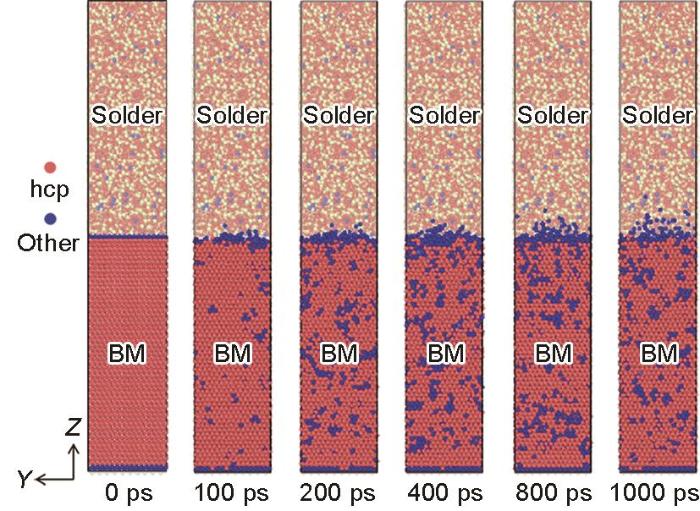
图2
在733 K下弛豫1 ns过程中Mg/Mg-Zn-Al体系的界面扩散过程
Fig.2
Interfacial diffusion processes of Mg/Mg-Zn-Al system during 1 ns relaxation at 733 K (Solder is Mg-Zn-Al, BM represents base metal Mg)
为了研究温度对Mg/Mg-Zn-Al界面扩散行为的影响,计算633~813 K钎焊温度下单晶Mg母材的结构变形状态,并分别统计从母材内扩散到钎料内的原子数相对于母材总体原子数比例(简称扩散原子比例)。结果表明,当钎焊温度为633、693、733、773和813 K时,扩散原子比例分别为0.19%、0.23%、0.38%、1.52%和2.90%。因此,为了增大结合层厚度并得到较为理想的钎焊界面,钎焊温度需保证在773 K及以上;为了最大限度降低温度对母材结构影响,此温度应在窗口范围内尽量小。
扩散系数是表征体系扩散能力的有效参数。在MD模拟中,可通过统计原子位置矢量随时间的变化来计算该参数,此种统计方法基于均方位移(mean square displacement,MSD)理论实现。以
式中,Ri (t)为原子i在t时刻的位移平方。
原子在体系内是不断移动的,因此可以将任意时刻认为是0时刻,当体系内有足够多原子时,在计算MSD时可以设定统计总时间步为n,步长为δt,则在前n / 2步时间内均方位移可以表示为[28]:
根据Einstein扩散定理,在包含N个原子的体系中,扩散系数(D)可通过统计全体原子的均方位移获得,表达式如下[28]:
图3为不同温度下母材和钎料以及钎料中Mg、Zn原子的MSD图。可见,在相同温度下,钎料中原子较母材中原子具有更大的均方位移,母材中原子处于固体扩散系数范围,而钎料部分已完全熔化,具有液相扩散特点,此种状态符合预先设计的固/液扩散特征,能够实现较好的界面钎焊效果。
图3

图3
不同温度下母材、钎料以及钎料中Mg、Zn原子的均方位移(MSD)图
Fig.3
Mean square displacement (MSD) diagrams of BM (a) and solder (b), and Mg (c) and Zn (d) atoms in solder at different temperatures
图4

图4
不同温度下母材和钎料的扩散系数(D)
Fig.4
Diffusion coefficients (D) of BM and solder at different temperatures (T—temperature)
扩散系数与扩散激活能(Q)及温度(T)存在以下关系[31]:
图5
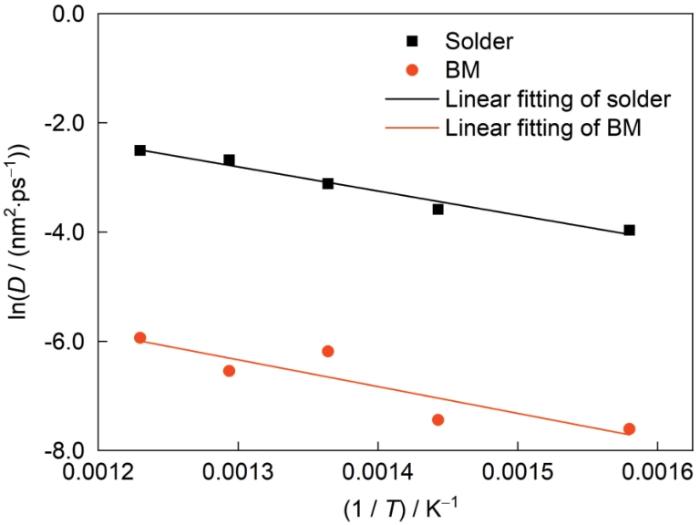
图5
通过lnD与1 / T的线性拟合计算母材及钎料的扩散激活能
Fig.5
Diffusion activation energies of BM and solder calculated by linear fitting of lnD and 1 / T
2.2 超声辅助对Mg/Mg-Zn-Al界面扩散的影响
沿Z方向温度测定Mg/Mg-Zn-Al界面扩展原子体系,得到界面不同位置的温度曲线,统计振动弛豫过程中每一时刻温度曲线,即可得到体系温度演化等高线图(图6a)。图6b为不同时刻原子结构图。当恒温弛豫完成且超声振动还未开始时,693 K系统温度下,母材内部原子体系hcp结构占比为90.3%。在超声振动开始后,100、500和1000 ps时刻对应的hcp结构占比分别为84.9%、82.8%和79.5%。振动过程中,活塞的高动能会在液相原子中大比例保留并传递,而未熔化母材的原子动能相对较低,因此可以通过统计液相及固相区域动能来确定不同原子区域的相变,从而反映超声振动过程中固/液分界面位置。如图6a所示,随着弛豫时间增加,可以观察到固/液界面明显下移,这反映了超声辅助能够有效提高界面母材与钎料结合厚度,从微观层面揭示了超声辅助钎焊的增强机制。
图6

图6
超声辅助下Mg/Mg-Zn-Al界面扩散过程中温度和原子结构演化图
Fig.6
Temperature variations (a) and atomic structure evolutions (b) during diffusion process of Mg/Mg-Zn-Al interface with ultrasonic assistance
图7为不同温度和超声振幅下Mg/Mg-Zn-Al界面处的温度演化情况。当温度较低(633 K)时,母材原子受影响区域较小,固/液分界线无明显移动,此时虽然超声能够在一定程度上提高母材钎料熔合,但由于系统温度较低,熔合比例并不高。当温度提高至693 K时,固/液分界线随弛豫时间下移明显,体系温度整体上升,其中钎料部分温度显著提高。在超声辅助条件下,钎料与母材有较大区域熔合,因此在超声辅助条件下,此温度是较为合适的钎焊温度。当温度较高(773 K)时,体系整体温度大幅提高,同时固/液界线大幅下移,这表示此温度下钎料与母材结合层厚度更大,且母材受影响区域也相对较大,母材初始结构发生了明显改变。此外,对比多种振幅条件下固/液分界线变化状态可知,振幅的增加对界面融合的影响相对较小。
图7

图7
不同温度和超声振幅下Mg/Mg-Zn-Al界面处的温度演化
Fig.7
Temperature variations at the Mg/Mg-Zn-Al interface at 633 K (a1-a4), 693 K (b1-b4), and 773 K (c1-c4) under different ultrasonic amplitudes
(a1-c1) 0.1 nm (a2-c2) 0.2 nm
(a3-c3) 0.3 nm (a4-c4) 0.4 nm
图8为不同超声振幅下充分振动1 ns后Mg/Mg-Zn-Al界面原子分布比例。可见,当温度为633 K时,引入超声辅助使Mg/Mg-Zn-Al结合界面向母材方向移动较小幅度,增大超声振幅使结合界面处原子分布更均匀,但结合层厚度变化不明显;当温度为693 K时,超声辅助使界面向母材方向显著移动,同时更多Mg原子由母材熔入液体钎料中,结合层厚度明显增加。当温度为773 K时,钎料流动性更强,在温度和超声振动的共同作用下,更多原子由母材熔入钎料,母材结构发生显著变形,此时界面层厚度较693 K时有一定程度的增加。当温度相对较高时,液相钎料对超声振幅响应较小,界面结合层对超声振幅敏感性较低。
图8

图8
不同超声振幅下充分振动1 ns后Mg/Mg-Zn-Al界面原子分布比例
Fig.8
Atomic distribution fractions at the Mg/Mg-Zn-Al interface after 1 ns oscillation at 633 K (a1-e1), 693K (a2-e2), and 773 K (a3-e3) under different ultrasonic amplitudes
(a1-a3) 0 nm (without ultrasonic assistance) (b1-b3) 0.1 nm (c1-c3) 0.2 nm (d1-d3) 0.3 nm (e1-e3) 0.4 nm
图9为不同温度和超声振幅下母材和钎料的原子MSD图和扩散系数。可见,引入超声辅助能大幅提高体系内的金属流动性,弛豫1 ns后,相较于无超声条件,超声辅助下钎料体系的扩散系数增大5~10倍。由扩散系数对温度和超声振幅的响应可知,界面体系对温度的敏感性明显高于振幅,在相同条件下,钎料相对于母材总是具有更高流动性。在低温条件下,增大振幅对母材流动性基本无影响,对钎料影响也相对较小;在高温条件下,母材流动性与振幅呈正相关,而钎料流动性却与振幅呈负相关,因此在钎焊工艺中,适当提高温度有助于母材/钎料界面的结合,在引入超声辅助的同时,并不需要较高的振动幅值。
图9

图9
不同温度和超声振幅下钎料和母材的MSD图及扩散系数
Fig.9
MSD (a1, a2) and diffusion coefficient (b1, b2) diagrams of solder (a1, b1) and BM (a2, b2) under different temperatures and amplitudes
对Mg/Mg-Zn-Al结合层厚度进行统计,结果如图10所示。可见,结合层厚度随温度变化明显,当温度从633 K提高到693 K时,平均结合层厚度提高58.65%;当温度从693 K提高到773 K时,平均结合层厚度提高28.67%。超声辅助的引入大幅提高了结合层厚度,在633、693和773 K温度下,与无超声条件相比,结合层厚度分别提高652%、756%和252%,即增大2.5~7.6倍,但振幅对其的影响相对较小。因此,在钎焊过程中引入超声辅助并提高钎焊温度能够有效提高界面结合厚度。
图10

图10
不同超声振幅下Mg/Mg-Zn-Al界面的厚度
Fig.10
Thicknesses of Mg/Mg-Zn-Al interface with different ultrasonic amplitudes
图11
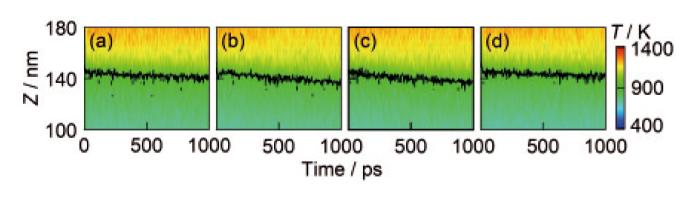
图11
不同超声频率下Mg/Mg-Zn-Al界面处的温度演化
Fig.11
Temperature variations at Mg/Mg-Zn-Al interface under ultrasonic frequencies of 125 GHz (a), 250 GHz (b), 500 GHz (c), and 1000 GHz (d)
图12

图12
不同超声频率下母材和钎料的扩散系数及Mg/Mg-Zn-Al界面厚度
Fig.12
Diffusion coefficients of solder (a) and BM (b) and thickness of Mg/Mg-Zn-Al interface (c) under different ultrasonic frequencies
图13为超声辅助下Mg/Mg-Zn-Al钎焊界面的SEM像。可以明显观察到钎料层、母材层和一条介于两者之间的结合层,界面层为部分母材进入液态钎料中混合凝固而成,与模拟计算结果一致。这表明,超声辅助钎焊可以有效提高钎料扩散系数,在钎料与母材间形成一定厚度的结合层,提高钎焊效果。
图13

图13
超声辅助下Mg/Mg-Zn-Al钎焊界面的SEM像
Fig.13
Low (a) and locally high (b) magnified SEM images of the Mg/Mg-Zn-Al brazing interface under ultrasonic assistance
2.3 超声辅助对Mg/Mg-Zn-Al界面力学性能的影响
图14

图14
不同超声参数下Mg/Mg-Zn-Al钎焊界面拉伸失效过程示意图及模拟应力-应变曲线
Fig.14
Schematics of tensile failure process of Mg/Mg-Zn-Al brazing interface under an ultrasonic amplitude of 0.2 nm and an ultrasonic frequency of 500 GHz at 693 K (ε—strain) (a) and simulated tensile stress-strain curves under different ultrasonic parameters (b)
图15为不同温度和应变率下Mg/Mg-Zn-Al钎焊界面的模拟拉伸应力-应变曲线。可见,在相同应变率下,界面拉伸强度与温度呈负相关;在相同温度下,界面的抗拉强度与应变率呈正相关。综合温度和应变率的影响可知,在低温条件下受到高应变率载荷时,接头具有更为良好的力学性能。此外,与应变率相比,钎焊界面的力学性能对温度变化更为敏感,不同温度下的应力-应变曲线清晰显示出强度随温度升高而下降的软化现象,这与金属及相关合金的物理特性相符。
图15

图15
不同温度和应变率下Mg/Mg-Zn-Al钎焊界面的模拟拉伸应力-应变曲线
Fig.15
Simulated tensile stress-strain curves of Mg/Mg-Zn-Al brazing interface with strain rates of 5 × 10⁸ s-1 (a), 1 × 10⁹ s-1 (b), 3 × 10⁹ s-1 (c), and 5 × 10⁹ s-1 (d) under different temperatures
为了定量分析钎焊界面的应变率敏感度,引入应变率敏感系数(m)表示不同温度下界面对应变率的响应程度,m可表示为:
式中,σ为应力,
图16为不同温度下钎焊界面强度随应变率的变化。可见,当温度由273 K增至600 K时,应变率敏感系数由6.76 × 10⁻⁴增至5.20 × 10⁻²,说明高温条件会增大钎焊界面的拉伸强度的应变率敏感度。
图16

图16
不同温度下Mg/Mg-Zn-Al钎焊界面强度随应变率的变化
Fig.16
Strength (σ) of the Mg/Mg-Zn-Al brazing interface as a function of strain rate (
3 结论
(1) 在高温钎焊工艺中,母材/钎料界面扩散行为表明,钎焊过程较为合适的系统温度为733~773 K,更低温度下钎料流动性较差,结合层厚度较小。更高温度虽然能够增大结合层厚度,但会破坏母材结构,并不适用于实际工程。
(2) 超声辅助的引入能够使体系扩散系数提高5~10倍,结合层厚度增加2.5~7.6倍,同时在超声辅助条件下,钎焊所需温度大幅降低,较为合适的系统温度在693 K附近。
(3) 在超声参数方面,相较于超声振幅,增大超声频率会加快界面趋衡速率,得到厚度更大、分布更均匀的界面结合层。模拟结果表明,高频超声辅助钎焊接头具有更为良好的力学性能。
(4) 超声辅助Mg/Mg-Zn-Al钎焊接头的模拟力学性能对温度的敏感性高于应变率,且该接头在高温下,接头的最大拉伸应力的应变率敏感性更高。
参考文献
Research progress on hot tearing behavior of Mg-Zn series alloys
[J].
Mg-Zn series alloys, an important alloy system among magnesium alloys, have garnered considerable attention due to their rich phase composition, outstanding deformability, and aging strengthening effects. These alloys demonstrate great potential for applications in the aerospace, automotive, and biomedical industries. However, the wide solidification temperature range and large shrinkage of these alloys render them largely susceptible to hot tearing, limiting their applications to a certain extent. Thus, investigating the hot tearing behavior of Mg-Zn series alloys is important. In this paper, a comprehensive summary of theories pertaining to hot tearing, the effects of alloying elements and casting process parameters on the susceptibility of Mg-Zn series alloys to hot tearing, and the current status of research on the numerical simulation of this phenomenon are presented. Furthermore, this article discusses the influence of microstructure and solidification parameters of Mg-Zn series alloys on their hot tearing susceptibility and proposes limitations and suggestions for the current research on the hot tearing behavior of magnesium alloys to guide the design and application of Mg-Zn series alloys.
Mg-Zn系合金热裂行为的研究进展
[J].
Research progress on the mechanisms controlling high-temperature oxidation resistance of Mg alloys
[J].This paper briefly reviews the progress on high-temperature oxidation mechanisms of pure Mg and Mg alloys, the thermodynamics and kinetics of high-temperature oxidation of Mg alloys, and the antioxidation mechanism of Mg alloys. The potential of applying advanced characterization techniques in studying the high-temperature oxidation of Mg alloys is envisaged. Finally, the development trends of the oxidation-resistant Mg alloy are also summarized. The main viewpoints are as follows: The protection of magnesium alloys at high temperatures is provided by the formation of a continuous, dense oxide scale that is a specific thickness and prevents the outward diffusion of magnesium vapor and the inward diffusion of oxygen; the oxidation resistance of Mg alloys is usually closely related to the thermal stability of the second phases; when the trace alloy elements are not enough to form the corresponding surface oxide scale, the oxidation resistance can be improved by creating a substitutional solid solution and using the reactive element effect; the size of the oxide grain size decreases and then enhances the oxidation resistance once the surface active elements is enriched on the surface of the alloys; the selective oxidation and synergistic effect of alloying elements are critical to the oxidation resistance of Mg alloys; the addition of nano or microparticles into the Mg alloys improve the high-temperature oxidation resistance of the Mg alloy by reducing the size of specific oxidation sensitive regions. In the future, the research on the high-temperature oxidation of Mg alloys can be based on the following aspects: Investigating the processes and nature of the oxidation resistance of Mg alloys using cutting-edge characterization techniques; constructing the underlying connections between the alloying elements and the oxide scale grain size and mechanical properties; designing and optimizing multi-alloying element composition systems.
镁合金抗高温氧化机理研究进展
[J].
Experimental study on brazing AZ31B magnesium alloy by magnalium alloys
[J].The Mg-68.5Al, Mg-37.5Al, and Mg-28.7Al brazing filler metals were used to braze AZ31B magnesium alloy. Microstructures of solders with different stoichiometries of Mg and Al were investigated. The brazing processes were carried out at 490 degrees C and held for 30 s in a resistance furnace. The microstructure evolution and mechanical properties of the three kinds of brazed joints were assessed. The effects of compositions on the performance of the joints were also summarized. Because of the melt of base metal into the brazing seam, the content of ?-Mg phase in the brazing seams was much higher than that in the filler metals. And then different solidification reaction occurred in the brazing seams. As the Mg content in the filler metal increased from 31.5 to 71.3 wt%, the microstructures of the filler metals and brazed joints changed markedly, the content of ?-Mg phase in brazing seams increased, and the joint shear strength increased from 17 to 75 MPa, which indicated that higher content of ?-Mg phase was beneficial to the joint property.
Interface structure and strength of fluxless ultrasonic soldered joints of magnesium alloy
[J].
Molecular dynamics study on microscopic mechanism for phase transformation of Ni-Ti alloy
[J].
A molecular dynamics study on the mechanical properties of Fe-Ni alloy nanowires and their temperature dependence
[J].Fe-Ni alloy nanowires are widely used in high-density magnetic memories and catalysts due to their unique magnetic and electrochemical properties. Understanding the deformation mechanism and mechanical property of Fe-Ni alloy nanowires is of great importance for the development of devices. However, the detailed deformation mechanism of the alloy nanowires at different temperatures is unclear. Herein, the deformation mechanism of Fe-Ni alloy nanowires and their mechanical properties were investigated the molecular dynamics simulation method. It was found that the local atomic pressure fluctuation of the Fe-Ni alloy nanowire surface became more prominent with an increase in the Ni content. At low temperature conditions (<50 K), the plastic deformation mechanism of the Fe-Ni alloy nanowires switched from the twinning mechanism to the dislocation slip mechanism with the increase in the Ni content from 0.5 at% to 8.0 at%. In the temperature range of 50-800 K, the dislocation slip mechanism dominated the deformation. Simulation results indicated that there was a significant linear relationship between the Ni content, temperature, and ultimate stress in the temperature range of 50-800 K. Our research revealed the association between the deformation mechanism and temperature in Fe-Ni alloy nanowires, which may facilitate new alloy nanowire designs.This journal is © The Royal Society of Chemistry.
Structure and chemistry of liquid Al-Cu alloys: Molecular dynamics study versus thermodynamics-based modelling
[J].
Dependence of the grain boundary energy on the alloy composition in the bcc iron-chromium alloy: A molecular dynamics study
[J].
Mechanical properties and deformation mechanisms in CoCrFeMnNi high entropy alloys: A molecular dynamics study
[J].
Molecular dynamic study of temperature dependence of mechanical properties and plastic inception of CoCrCuFeNi high-entropy alloy
[J].
First-principles molecular dynamics simulations to study the crystal-to-amorphous transition in the Mg-Zn system
[J].
The wetting characteristics of molten Ag-Cu-Au on Cu substrates: A molecular dynamics study
[J].Ag-Cu-Au ternary alloys are promising solder materials for wire bonding. Limited experimental studies on Ag-Cu-Au materials can be found due to the high cost of gold. In this study, face-centered-cubic Cu(100), Cu(111), and Cu(110) substrates wetted by molten Ag45Cu42Au13 were investigated via molecular dynamics (MD). As demonstrated by melting simulation results, the Ag45Cu42Au13 alloy has a lower melting temperature compared to the eutectic alloy, Ag60Cu40. MD methods were also used to investigate the dissolutive characteristics of Ag45Cu42Au13/Cu wetting. Density profiles and contact angles show an increase in wettability in the Ag45Cu42Au13/Cu(100) wetting system. For molten Ag60Cu40 and Ag45Cu42Au13 the spreading behavior on Cu(100) shows a promoted tendency, which contrasts with both Cu(111) and Cu(110). Solid-liquid adhesion is indicative of the comparative spreading degrees. The contact angles and PMF analysis of wetting behaviors on rough and smooth Cu substrates illustrate that solid-liquid adhesion in Wenzel states is stronger than in Cassie wetting states.
The wetting properties of Li droplet on Cu surfaces: A molecular dynamics study
[J].
Reactive wetting behaviors of Sn/Cu systems: A molecular dynamics study
[J].Influences of temperature and Sn-Cu droplet’s composition on reactive wettings of Cu(100), Cu(110), and Cu(111) surfaces were analyzed, by using molecular dynamics (MD) calculations. As a result, the spreading on Cu(110)(Cu(100)) has the fastest (slowest) wetting kinetics. A higher temperature or a diluter Cu content in the Sn-Cu alloy droplet results in a higher wettability. Moreover, this work has addressed a theory for positioning the interface separating the liquidus and solidus alloys in the spreading film to confirm the hypothesis that the reactive wetting will come to the end when the interface saturates with the temperature-dependent solidus weight fraction of Cu.
Anisotropy of wetting and spreading in binary Cu-Pb metallic system: Experimental facts and MD modeling
[J].
The wetting phenomenon and precursor film characteristics of Sn-37Pb/Cu under ultrasonic fields
[J].The wetting phenomenon of Sn-37Pb alloy solder spreading on Cu substrate under different ultrasonic fields was investigated. Sn-37Pb/Cu wetting systems showed significant precursor film characteristics with the assist of ultrasonic energy. A short-time ultrasonic field evidently enhanced the wettability of Sn-37Pb/Cu compare to a common wetting field which had no introduced ultrasonic. At the temperature of 213 degrees C, spreading area of a Sn-37Pb solder drop in a 20 kHz, 1000 W ultrasonic field reached maximum at 2 s, and showed significant precursor film characteristics. Atomistic dynamic models showed the relevance between wettability and precursor film formation. The observed dynamic results agreed with the experimental results. (C) 2018 Elsevier B.V.
Molecular dynamics analysis of the wetting front structure in metal/metal systems
[J].
Molecular dynamics simulations of reactive wetting
[J].
The role of liquid-substrate interactions on wetting in metallic embedded atom method systems
[J].
Nonreactive wetting kinetics of binary alloys: A molecular dynamics study
[J].
Structure and energetics of Ni and Au nanoclusters deposited on the (001), (110), and (111) surfaces of Au and Ni: A molecular dynamics study
[J].
Molecular dynamics study of high temperature wetting kinetics for Al/NiAl and Al/Ni3Al systems: Effects of grain boundaries
[J].
Molecular dynamics simulations on dissolutive wetting of Al-Ni alloy droplets on NiAl substrate
[J].
The wettability of molten aluminum droplets on the 3C-SiC surface: Molecular dynamics study
[J].
Molecular dynamics study on the contribution of 4H-SiC surface morphology and crystal orientation to the wetting behavior of molten Al droplet
[J].
Modified embedded-atom potentials for cubic materials and impurities
[J].
New interatomic potential for Mg-Al-Zn alloys with specific application to dilute Mg-based alloys
[J].
Molecular dynamics simulation of diffusion in supercooled Cu-Zr alloys
[J].
Molecular dynamics simulations and experimental investigations of atomic diffusion behavior at bonding interface in an explosively welded Al/Mg alloy composite plate
[J].
The self-diffusion coefficients of liquid binary M-Si (M = Al, Fe, Mg and Au) alloy systems by first principles molecular dynamics simulation
[J].
Predicting the temperature dependence of self-diffusion behavior in Ni-Cr alloys via molecular dynamics
[J].
Ab initio molecular dynamics simulation of interstitial diffusion in Ni-Cr alloys and implications for radiation induced segregation
[J].


