



以往关于稀土元素烧损的研究主要围绕稀土钢连铸工艺中连接中间包和结晶器的水口堵塞问题。国内外研究普遍认为稀土元素的烧损主要是由稀土元素与耐火材料反应造成。近期,Liang等[12]研究认为,由于边界层效应,浸入式水口表面的钢液流速较慢,钢液中的Ce2O3夹杂与浸入式水口耐火材料中的 Al2O3反应生成CeAlO3。Tian等[13]发现浸入式水口内壁上有结瘤物,成分同样为CeAlO3;随着结瘤物的生长,水口内壁的边界层效应加剧,进一步加速结瘤。Cao等[14]研究表明,在真空感应熔炼过程中,相比于传统Al2O3耐火材料,CeAlO3耐火材料与钢液接触后,钢液中Ce含量损失相对较少。余晓艳等[15]在真空感应熔炼+电渣重熔熔炼Fe-20Cr-5Al合金添加La的合金化工艺中,发现稀土元素的烧损量与坩埚成分有关,含30%La2O3 (质量分数,下同)较含30%Al2O3的坩埚更有利于减少La元素的烧损。上述研究均是围绕钢铁熔炼过程中“堵水口”现象开展的,而对于镍基高温合金熔炼系统中稀土元素烧损机制的研究较少;在研究方法上,侧重使用热力学方法定性分析稀土元素烧损机理,对稀土元素烧损后的生成物也只是推断,也缺乏微观尺度的定量表征。
鉴于此,本工作以添加Sc的镍基变形高温合金为例,在真空感应熔炼系统中可能存在烧损或挥发产物的位置取样,再利用电感耦合等离子体原子发射光谱仪(ICP-AES)、扫描电子显微镜(SEM)和透射电子显微镜(TEM),系统研究了稀土元素在镍基变形高温合金真空感应熔炼过程中的烧损路径和机理,为提升稀土元素在镍基高温合金生产中的利用率提供理论依据。
1 实验方法
1.1 实验原料
本实验选用的原料是一种具有良好高温强度、高温抗蠕变性能、高温持久性能及组织热稳定性的镍基变形高温合金BYG36,合金主要化学成分(质量分数,%)为:Cr 18~25,Ti 1.0~2.5,Al 1.0~2.5,Co 8~15,Mo 5~15,Sc ≤ 0.5,Ni余量。真空感应熔炼使用的坩埚主要成分为Al2O3,且不含Sc元素,经21个炉次的熔炼,测得Sc的收得率为23%~83%。在真空感应熔炼系统的6个主要位置获取熔炼残渣样品。图1a为真空熔炼系统装置示意图,6个取样位置依次为:(1) 在坩埚壁内侧铲掉一块坩埚内壁的渣块,如图1b所示;(2) 在坩埚上缘采集的大块残渣,如图1c所示;(3) 在漏斗和冒口砖之间的流钢口处采集的大块熔渣残留,如图1d所示;(4) 在冒口砖内侧壁上采集的残渣,如图1e所示;(5) 在观察窗的镜头上采集的镜头灰;(6) 在炉盖和炉体内壁上采集的炉膛灰。
图1

图1
真空感应熔炼系统示意图和样品实物照片
Fig.1
Schematic of the vacuum induction melting system (1—furnace cover, 2—crucible, 3—heater, 4—rotator, 5—liquid metal, 6—thermocouple, 7—observation window, 8—sprue, 9—entry nozzle, 10—mold) (a) and photos of samples taken from residue on the inner side surface of the crucible (b), residue on the crucible rim (c), residue on the inner side surface of the sprue (d), and residue on the inner surface of the entry nozzle (e)
1.2 样品表征
采用Agilent-725型ICP-AES定量分析镜头灰、炉膛灰和坩埚上缘碎渣中Sc元素的含量。使用配备能谱仪(EDS)的GeminiSEM-500型SEM对坩埚上缘残余渣块、坩埚壁内侧残余渣块和流钢口残余渣块进行组织形貌观察和元素分布检测。其中,坩埚壁内侧渣块接近坩埚的一侧呈紫色,接近合金熔体一侧呈绿色,采用冷镶嵌法将坩埚壁内侧的残余渣块嵌入树脂中,以分析样品截面。流钢口处的残余渣块,两面也呈不同颜色,同样采取冷镶嵌法制样分析。
对坩埚壁内侧残渣、流钢口残渣等存在Sc富集的样品,进一步使用Helios UX聚焦离子束(FIB)制作TEM样品。使用配备Super-X EDS的Spectra 300型扫描透射电镜(STEM)的高角环形暗场(HAADF)像及积分差分相位衬度(iDPC)成像模式分析富Sc相的原子尺度成分和结构。
2 实验结果与讨论
图2

图2
坩埚壁内侧残渣截面的SEM二次电子(SE)像和EDS元素面扫描图
Fig.2
Cross-sectional SEM-secondary electron (SE) image (a) and corresponding EDS elemental mapping results (b) of the residue on the inner side surface of the crucible
图3
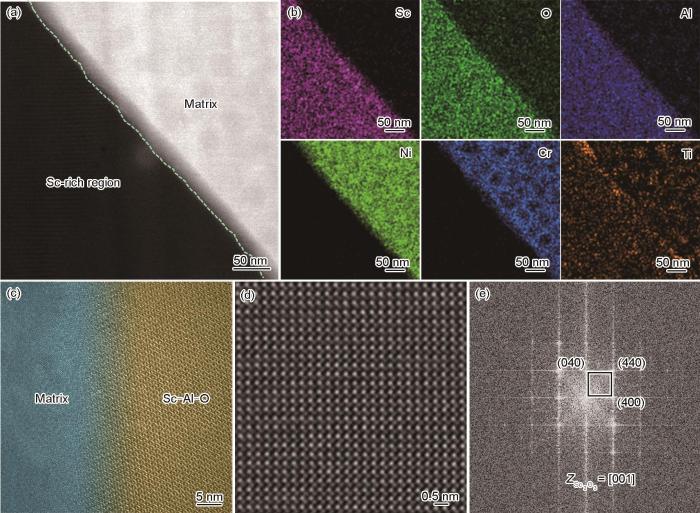
图3
坩埚壁内侧残渣截面富Sc区与基体分界处的STEM高角环形暗场(HAADF)像及EDS元素面分布图、HRTEM像、积分差分相位衬度(iDPC)像及快速Fourier变换(FFT)
Fig.3
Cross-sectional STEM high-angle annular dark field (HAADF) image (a) and corresponding EDS elemental mapping results (b), HRTEM image (c), integral differential phase contrast (iDPC) image (d), and fast Fourier transform (e) of the interface between matrix and Sc-rich region of the residue on the inner side surface of the crucible
图4

图4
坩埚壁内侧残渣截面富Sc区的原子级STEM-HAADF像和EDS元素面分布图;以及沿着图4a中黄色箭头提取的Sc、Al、O的EDS信号强度分布
Fig.4
Atomic resolution STEM-HAADF image (a) and corresponding EDS chemical images (b-f) of the Sc-rich region of the residue on the inner side surface of the crucible, and the EDS intensity of Sc, Al, and O along the yellow arrow in Fig.4a (g)
热力学计算结果[12]表明,在熔炼过程中稀土元素也可能与耐火材料中的Al2O3发生反应。如图2a所示,Al x Sc2 - x O3穿插于基体与耐火材料Al2O3之间,这与Liang等[12]的观点并不冲突。然而,本工作发现的Al1.3Sc0.7O3为立方晶体结构,与已证实存在的正交结构AlScO3不同,与理论预测的立方结构的Al2O3也不相同。这一新发现与He等[17]发现的钙钛矿结构中由于异质原子的代位引起的晶体结构转变(如Li x WO3)类似,表明Al x Sc2 - x O3的对称性与Sc的浓度密切相关,换言之,整体八面体结构框架的对称性很可能与ScO配位八面体数量密切相关。目前未查到相关Al-Sc-O相图的文献报道,这一异常产物表明Sc与耐火材料中Al2O3反应比过去认为的更复杂。由于Al2O3与Al1.3Sc0.7O3晶体结构的巨大差异,这一反应势必带来反应界面上的应变和化学-力学耦合效果。
图5为在坩埚上缘所取渣块截面的SEM-SE像和EDS面扫描元素分布图。从图5a可以看出,该处样品截面的微观形貌呈分层状,有清晰的衬度和致密度的差别。结合图5b的元素面扫描分布图,发现衬度较亮且致密的区域为合金基体;较疏松的区域主要为Cr、O元素,推测为Cr的氧化物;在富集Sc元素的层状区域处及其两侧出现Al、O元素的富集,在致密的基体中存在一些Sc、Al、O元素的富集。与上述坩埚内壁情形不同,EDS定量分析结果表明,该区域Sc、O、Al原子比约为1∶1.4∶0.02,与Sc2O3较符合,可能来源于熔体中Sc与游离O的反应。有趣的是,基体中游离的Sc2O3颗粒清晰可见,这与熔体倾倒过程中经过坩埚上缘的流速减慢有关。并未发现明显的Sc与耐火材料的反应产物,可能是因为浇注过程较快,合金熔体与耐火材料无充足时间发生反应。
图5

图5
坩埚上缘残渣截面的SEM-SE像和EDS元素面扫描图
Fig.5
Cross-sectional SEM-SE image (a) and corresponding EDS elemental mapping results (b) of the residue on the crucible rim
流钢口的情形与坩埚上缘类似。图6a和b分别为流钢口处残渣样品截面的SEM-SE像和EDS元素面扫描图。从图6a可以看出,流钢口处样品截面的衬度和致密度差异明显,其中衬度呈黑色且致密的部分为冷镶嵌制样所用的树脂,衬度较亮且致密的区域主要富集Ni、Cr元素,为合金基体;两者之间较为疏松的部分为耐火材料和富Sc相。如图6b所示,EDS元素面扫描分析发现,在耐火材料与基体之间的界面处出现了富集Sc元素的区域;与坩埚内壁残渣的情形不同,此处富Sc区并没有显著的Al富集。图6c和d为另一处Sc元素富集区的SEM-SE像及其放大图像,呈现疏松形貌。考虑到SEM-EDS定量分析的空间分辨率较低,为明确此富Sc区的物相组成和晶体结构,采用FIB技术在富Sc层与基体界面处提取、制备了TEM样品并进一步分析。
图6

图6
流钢口处残渣截面的SEM-SE像及EDS元素面扫描图,及富Sc区的SEM像
Fig.6
Cross-sectional SEM-SE image (a) and EDS elemental mapping results (b) of the residue on the inner side surface of the sprue, and a higher magnification SEM-SE image of the Sc-rich region (c) and locally enlarged SEM image of the square area in Fig.6c showing more details on the microstructure of Sc-rich region (d)
图7

图7
流钢口残渣截面富Sc区与基体界面处的STEM-HAADF像和EDS元素面分布图、HRTEM像及富Sc区的选区电子衍射花样
Fig.7
Cross-sectional STEM-HAADF image (a) and EDS elemental mapping results (b), HRTEM (c) and select area electron diffraction (SAED) pattern (d) of interface between matrix and Sc-rich region of the residue on the inner side surface of the sprue
图8
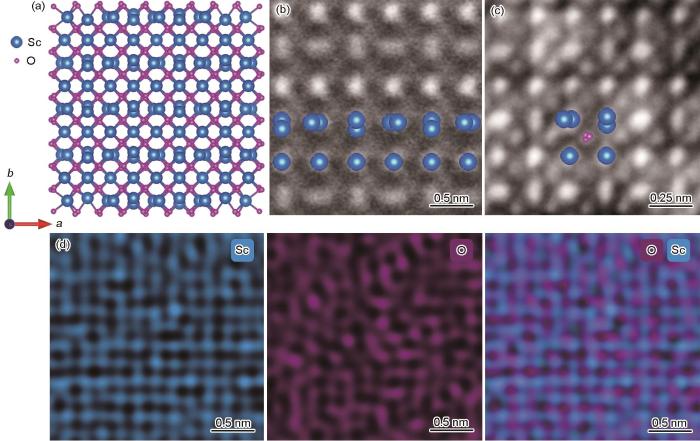
图8
Sc2O3的结构模型、原子级STEM-HAADF像、iDPC像和EDS元素面分布图
Fig.8
Atomic model (a), atomic resolution STEM-HAADF image (b), iDPC image (c), and EDS elemental mapping results (d) of the Sc2O3 (a, b—lattice constants)
由于稀土元素具有较低的电负性,其在金属熔炼过程中很容易与熔体中的N、O、S等杂质优先发生反应,进而减少金属中的杂质原子、改善夹杂物类型,实现性能提升[18]。本工作在镍基高温合金的真空高温熔炼时将Sc元素加入到合金熔体中,Sc与熔融合金中的杂质元素(O)发生反应生成Sc的氧化物夹杂。其中,部分Sc与O杂质反应生成Sc2O3夹杂颗粒,在合金溶液通过坩埚上缘和流钢口时挂壁在这些位置的耐火材料表面,还有部分Sc的夹杂物会以Sc-O化合物的形式存在于铸态合金的基体中。图9为铸态合金基体中夹杂物的SEM-SE像和EDS元素面分布图。结果表明,夹杂物颗粒富集Sc和O元素,应为Sc2O3。除了Sc2O3外,由于倾倒过程中合金熔体与耐火材料接触时间较短,并未发现Sc与耐火材料中Al2O3反应的明确证据。
图9

图9
合金基体中含Sc夹杂物的SEM-SE像和EDS元素面扫描图
Fig.9
SEM-SE image (a) and corresponding EDS elemental mapping results (b) on a typical Sc-containing inclusion in the alloy matrix
合金元素在高温条件下发生蒸发或升华是常见的烧损机制之一[19]。但围绕稀土在镍基合金熔炼过程中的蒸发或升华烧损鲜见报道。在本工作中,若发生Sc元素在熔炼过程中升华烧损,应在炉壁等处遇冷而凝固;但ICP-AES对炉膛和镜头表面灰尘中Sc元素含量的定量分析结果显示,2种样品的Sc元素含量均低于检测限水平,即< 0.005% (质量分数),说明这些样品中基本不存在Sc。此外,从图10冒口砖内侧残渣的SEM-SE像及EDS元素面分布图可以看出,冒口砖表面未发现Sc元素,而耐火材料的主要成分Cr、O、Al等的含量较高,说明所观察到的主要成分为冒口砖耐火材料。上述结果表明,该合金在真空感应熔炼过程中基本不存在Sc元素的蒸发或升华烧损。这与真空感应熔炼过程中的最高温度(1650 ℃)远低于Sc的沸点(2830 ℃)的情况一致。
图10

图10
冒口砖内侧残渣表面的SEM-SE像和EDS元素面扫描分布图
Fig.10
SEM-SE image (a) and corresponding EDS elemental mapping results (b) of the residue on the inner surface of the entry nozzle
综上所述,本工作从熔炼过程中可能存在烧损产物的6个位置取样,采用多种检测表征方法,系统研究了其中Sc元素的分布、含量和存在形式。与已有研究相比,本工作更加完整地覆盖了Sc元素的烧损路径,在明确烧损机理的同时,利用原子尺度精细表征发现Sc与耐火材料的实际反应产物与经典的预测结果并不相同。这一研究澄清了以往对烧损机制掌握不全面的问题,为控制合金中稀土元素的烧损奠定了基础。
3 结论
(1) 在坩埚壁内侧渣块近坩埚一侧发现大量含Sc烧损产物,源于真空感应熔炼中Sc元素与坩埚耐火材料中Al2O3发生反应。该反应产物为立方结构的Al1.3Sc0.7O3而非正交结构的AlScO3。
(2) 坩埚上缘和流钢口耐火材料表面也存在大量含Sc烧损产物,源于真空感应熔炼中Sc元素与合金熔体中的杂质O元素反应生成的立方结构的Sc2O3夹杂物。当合金熔体流经坩埚上缘和流钢口时,由于温度降低和边界层效应,靠近耐火材料表面的合金熔体流速减慢,导致Sc2O3夹杂物沉淀挂靠在耐火材料表面,部分Sc2O3夹杂物留存于铸态合金中。
(3) 镜头灰和炉膛灰中Sc元素的含量均小于0.005%,冒口砖处渣块中也未发现Sc元素的存在,而耐火材料的主要成分Cr、O、Al等的含量较高,说明在高温熔炼过程中添加的Sc元素基本没有通过升华而发生烧损。
参考文献
Effect of elements Y and Ce on high temperature oxidation behavior of directionally-solidified Ni-based superalloy
[J].
稀土元素Y和Ce对定向凝固镍基高温合金高温氧化行为的影响
[J].
Progress in application of rare metals in superalloys
[J].
Effects of rare earth yttrium on microstructure and properties of Ni-16Mo-7Cr-4Fe nickel-based superalloy
[J].
Study on influence of rare earth elements on properties of Ni-based superalloys through electron theory
[J].
稀土对镍基高温合金性能影响的电子理论研究
[J].
Research advances in high temperature corrosion of Ni-Cr alloys in CO2-rich environments
[J].
Ni-Cr合金在富CO2气氛中的高温腐蚀研究进展
[J].
Effect of rare earth elements on microstructure and properties of high chromium white iron
[J].
Evolution of strength with rare-earth content in highly-alloyed Mg-Gd-Y alloys
[J].
Effects of rare earth elements on inclusions and impact toughness of high-carbon chromium bearing steel
[J].
High-carbon chromium bearing steels with different rare earth (RE) contents were prepared to investigate the effects of RE on inclusions and impact toughness by different techniques. The results showed that RE addition could modify irregular Al2O3 and MnS into regular RE inclusions. With the increase of RE content, the reaction sequence of RE and potential inclusion forming elements should be O, S, As, P and C successively. RE inclusions containing C might precipitate in molten steel and solid state, but the precipitation temperature was significantly higher than that of carbides in high-carbon chromium bearing steel. For experimental bearing steels, the volume fraction of inclusions increased steadily with the increase of RE content, but smaller and more dispersed inclusions could be obtained by 0.018% RE content compared with bearing steel without RE, whereas the continuous increase of RE content led to an increasing trend for inclusion size and a gradual deterioration for inclusion distribution. RE addition could improve the transverse impact toughness and isotropy of bearing steel, and for modified high-carbon chromium bearing steel by RE alloying, the increase of RE content continuously increased both transverse and longitudinal impact toughness until excessive RE addition.
Influence of scandium addition on microstructure and mechanical properties in nickel-based superalloys: An integrated multiscale modeling and experimental approach
[J].
Effects of scandium on microstructure and mechanical properties of RR1000
[J].
Analysis on clogging of submerged entry nozzle in continuous casting of high strength steel with rare earth
[J].The type of inclusions in tundish steel and the formation mechanism of the submerged entry nozzle (SEN) clogging in the continuous casting of the rare earth (RE) high strength steel without calcium treatment were studied based on the plant trials and thermodynamic calculation. It was found that Ce2O3 and CeAlO3 in tundish molten steel were transformed into Ce2O2S ? CaO–Al2O3 with the size of 2–3 lm during cooling. When the flow velocity of molten steel on surface of the SEN was slow due to the boundary layer effect, Ce2O3 inclusion in molten steel reacted with Al2O3 in the SEN refractory to form CeAlO3. With the continuous erosion of molten steel and reaction, the compositions of CeAlO3, Al2O3 and CaO were aggregated, and the clogging layers with different zones were formed on surface of the SEN. Meanwhile, a small amount of molten steel remaining in the arc zone and corner zone of the SEN formed solidified steel. When calcium treatment is canceled, the reaction probability between inclusions in molten steel and refractory should be reduced by improving the material and shape of the SEN.
Effect of interfacial reaction behaviour on the clogging of SEN in the continuous casting of bearing steel containing rare earth elements
[J].
Effect of CeAlO3 refractories on the cleanliness of rare earth treated steel
[J].
Effect of adding rare earth element La alloying process for stainless steel Fe-20Cr-5Al on yield of La
[J].The effect of adding La alloying methods on yield of La in stainless steel Fe-20Cr-5Al (/%: 0. 004 ~0. 006C, 0. 18Si, 0. 08Mn, 20.25 ~ 20. 28Cr, 5. 06 ~5. 17Al) melting by 50 kg vacuum induction furnace + electroslag remelting process has been studied. Results show that with vacuum induction furnace (VIF) melting Fe-20Cr-5Al electrode (parent alloy) + rare earth (RE) oxide La<sub>2</sub>O<sub>3</sub> (/%: 50CaF<sub>2</sub>-20CaO-30La<sub>2</sub>O<sub>3</sub>) electroslag remelting (ESR) for La alloying, the average La content in steel is 0. 003%, indicated it is not obvious to La alloying by adding RE oxide during ESR; with VIF La alloying melting ESR electrode (0. 38% La in steel) + 70% CaF<sub>2</sub>-30% Al<sub>2</sub>O<sub>3</sub> electroslag remelting, the average La content in ESR steel is 0. 066%, and with VIF La alloying melting ESR electrode (0. 34% La in steel) + 50% CaF<sub>2</sub>- 20%CaO-30La<sub>2</sub>O<sub>3</sub> electroslag remelting, the average La content in ESR steel is 0. 032%, It is indicated that during ESR process of containing La parent alloy the oxidizing loss of La is larger, but as compared 30% La<sub>2</sub>O<sub>3</sub> remelting slag the 30% Al<sub>2</sub>O<sub>3</sub> remelting slag is more favorable to decrease the oxidizing loss of La in-parent alloy during ESR process. <br>
Fe-20Cr-5Al不锈钢加稀土元素La合金化工艺对La收得率的影响
[J].
Thermal expansion of alumnus perovskite ScAlO3
[J].
Atomistic conversion reaction mechanism of WO3 in secondary ion batteries of Li, Na, and Ca
[J].
Influence of yttrium on purification and carbide precipitation of superalloy K4169
[J].The effect of reactive element yttrium on purification and carbide precipitation of superalloy K4169 has been studied through vacuum induction melting. The results show that yttrium has a strong deoxidizing and desulfurizing ability, and the impurity elements of sulfur and oxygen in melting K4169 are greatly reduced to 2-5 ppm and 4-5 ppm, respectively. The metallurgical reaction product is mainly Y2O3 and yttrium containing sulfides have not been observed. With the increase of the content of yttrium from 0.005 wt.% to 0.033 wt.%, the morphology and size of MC carbides in casting are significantly influenced due to that the yttrium changes the diffusion of the carbide forming elements and solid fraction during solidification. In the alloys without yttrium, only isolated blocky or strip carbides exist, while skeleton-like carbides are observed in the alloys with yttrium. Both the average size and the number density of skeleton carbides decrease monotonously with yttrium content increasing. After yttrium increasing to 0.033 wt.%, a phase of hexagonal Ni17Y2 is observed to precipitate in the form of symbiosis with MC carbide and matrix. The addition of yttrium is not beneficial for the properties of K4169 alloys at the room temperature, which is quite related to the MC carbides with a large skeleton-like morphology through the analysis of tensile fracture.


