



镍基单晶高温合金由于其优异的力学性能,被广泛用于制造先进航空发动机涡轮叶片等热端部件。在极端高温条件下工作时,材料的氧化行为成为限制其寿命的主要因素之一。近年来,国内外广泛研究了镍基单晶高温合金的高温氧化行为[1,2]。Shi等[3]和Li等[4]研究了第二代单晶高温合金DD6的氧化行为,发现在1100 ℃下DD6合金的氧化增重与氧化时间的关系近似符合抛物线规律。其中,连续Al2O3层的形成成为合金氧化增重曲线进入稳态阶段的关键。王树森等[5]发现,加入0.01% (质量分数)稀土元素Y可以提高含Re镍基单晶高温合金氧化过程中Al2O3层的连续性,进而提高其高温抗氧化能力。张念学[6]研究了稀土元素La和Y对镍基单晶高温合金CMSX-4氧化行为的影响,发现适量La和Y的加入能够有效降低形成Al2O3的临界Al含量,促进α-Al2O3等保护性氧化膜快速形成,提高了合金的抗氧化性能。在低代次单晶高温合金中,稀土元素的主要作用是促进α-Al2O3等保护性氧化膜快速形成。随着镍基单晶高温合金中Re、Ru、W和Mo等难熔金属元素含量提高,容易形成易挥发的难熔金属氧化物,导致合金抗氧化性能有所下降[7]。王莉等[8]研究表明,第三代单晶高温合金DD33在1100 ℃氧化过程中由于发生严重的剥落,来不及形成连续的Al2O3层,导致合金氧化100 h后仍未进入稳态阶段。王效光等[9]在第三代单晶高温合金中发现中间氧化层主要由NiWO4、NiTa2O6和NiAl2O4等尖晶石氧化物构成。Tan等[10]研究表明,由NiWO4和NiMoO4等构成的尖晶石氧化层随着氧化时间延长而增厚,应力积累到一定程度后需要释放,从而导致氧化层发生剥落。另外,NiWO4和NiMoO4等尖晶石氧化物容易分解形成易挥发的WO3和MoO3,加剧氧化层的剥落,从而破坏Al2O3层的连续性,导致合金的氧化增重曲线偏离抛物线规律。Li等[11]在研究第四代镍基单晶高温合金氧化行为的过程中发现,样品表面出现WO3和MoO3,导致合金氧化增重曲线出现下降阶段;同时WO3和MoO3挥发导致氧化层剥落,使部分基体暴露在空气中,导致Al和Cr的选择性氧化受到抑制,从而导致合金的抗氧化性能低于低代次单晶高温合金。
因此,在Al和Cr选择性氧化受到抑制的情况下,稀土元素对第四代单晶高温合金氧化动力学和氧化膜演化过程的影响尚不清楚。理论上来说,第四代单晶高温合金中的稀土元素扩散至样品表面后能够快速形成氧化膜,从而降低O元素向内迁移速率,进而减少NiWO4和NiMoO4等难熔金属氧化物的生成,为α-Al2O3等保护性氧化膜的形成提供时间。基于这一假设,本工作针对添加稀土元素的新型第四代单晶高温合金开展了高温氧化实验,阐明其氧化动力学和氧化膜的演化及形成机理,为优化第四代单晶高温合金的高温氧化性能提供理论基础。
1 实验方法
采用一种新型第四代单晶高温合金为研究对象,其化学成分(质量分数,%)为:Al 5.99,Co 6.04,Cr 2.93,Mo 4,W 3.97,Ta 4.47,Ru 3.76,Re 5.97,Y 0.0094,Ce 0.012,La 0.031,Nd 0.012,Ni余量。其中,稀土元素(Y、La、Ce和Nd)的含量通过电感耦合等离子体发射光谱法(ICP)分析检测。采用液态金属Al定向凝固技术,以3 mm/min的抽拉速率生长单晶试棒。热处理工艺为先加热至1285 ℃保温2 h,再加热至1300 ℃,保温时间为2 h,随后加热至1325 ℃,保温20 h。然后冷却并重新加热至1100 ℃,保温4 h后冷却;最后加热至870 ℃,保温24 h后冷却至室温。
将热处理后的样品线切割出尺寸为20 mm × 10 mm × 2 mm的板状试样,经过水磨砂纸逐级打磨至2000号后,使用2.5 μm金刚石抛光膏抛光。随后使用酒精、丙酮(体积比为3∶1)溶液对样品进行超声波清洗。使用精度为0.01 mg的电子天平对样品和经1200 ℃处理后的坩埚一起称重,记为初始质量。采用静态称重方法进行1100 ℃的恒温氧化实验,分别恒温氧化2、3、5、9、13、25、35、60、71、83、94、100、106、118、124、130、140、150、165、180、190和200 h后从炉子取出,立即盖上盖子(防止氧化皮崩出),经过空冷(10 min)称重后重新放入炉子中,重复上述步骤直到总氧化时间为200 h。利用AXS D8型X射线衍射仪(XRD,CuKα )对样品表面产物进行分析,衍射角范围为10°~90°。使用Auriga型扫描电子显微镜(SEM)观察合金的表面形貌和横截面形貌,采用能谱仪(EDS)分析氧化膜的成分。
2 实验结果
2.1 微观组织
图1

图1
热处理后合金的SEM像和γ'相尺寸统计图
Fig.1
SEM image of γ/γ' microstructure after heat treatment (a) and γ' phase size statistics (b)
2.2 氧化增重曲线
图2为合金在1100 ℃非连续氧化200 h的增重曲线。可以看出,曲线可分为四个阶段。第一阶段(0~3 h),试样的氧化增重急剧增加;第二阶段(3~25 h),试样的氧化增重速率减缓;第三阶段(25~60 h),试样的氧化增重降低。在实验过程中,将氧化样品和剥落的氧化物一起称重,因此氧化增重的降低说明这个阶段发生了氧化物挥发,且氧化物挥发质量大于生成质量,导致这个阶段发生了质量损失现象[11]。这一现象说明合金的氧化过程不仅受到氧化物生长的控制,还存在氧化物挥发[10]。Li等[11]研究了1100 ℃下Mo含量对第四代镍基单晶高温合金循环氧化行为的影响,发现该合金氧化5 h后发生氧化物挥发,导致氧化增重显著降低。Li等[12]还针对不同热处理状态的第四代镍基单晶高温合金开展1100 ℃高温氧化实验,发现该合金在氧化10 h后发生质量损失现象。这种氧化物挥发发生时间的差异来源于不同体系合金的氧化膜结构和种类的差别[13]。第四阶段(60~200 h),试样的氧化增重速率进入稳态阶段。这种氧化增重行为与部分第四代单晶高温合金的高温氧化增重行为[14]存在明显差别。
图2
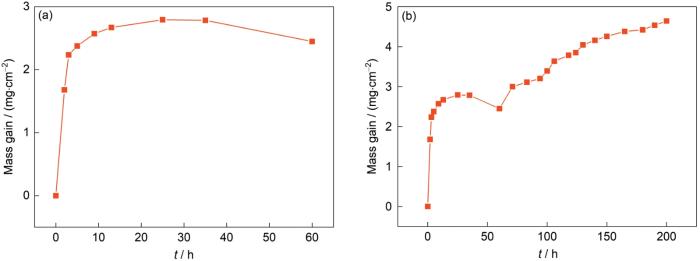
图2
合金在1100 ℃下氧化200 h的氧化增重曲线
Fig.2
Curves of mass gain vs oxidation time (t) in the early 60 h (a) and in 200 h (b) at 1100 oC
2.3 氧化产物XRD谱
图3为合金在1100 ℃氧化3、25、60、100和200 h后样品表面氧化物的XRD谱。氧化3 h时,NiO相和Al2O3相的衍射峰相对较强,说明该阶段合金表面氧化物以NiO和Al2O3为主,同时出现了TaO2和NiAl2O4等尖晶石氧化物;氧化25 h时,NiO衍射峰相对变弱,说明合金表面NiO开始发生剥落;氧化60 h时,TaO2、NiAl2O4和基体的衍射峰变强,说明这个阶段TaO2和NiAl2O4等尖晶石氧化物大量形成,并且部分氧化层发生了严重的剥落和挥发,使基体暴露在空气中;氧化200 h时,氧化层结构相对完整,以Al2O3为主,还有NiO、NiWO4、NiMoO4、NiAl2O4和TaO2等氧化物。
图3

图3
在1100 ℃下氧化3、25、60、100和200 h后合金表面氧化物的XRD谱
Fig.3
XRD patterns of oxides formed after oxidation at 1100 oC for 3, 25, 60, 100, and 200 h
2.4 表面氧化层
图4
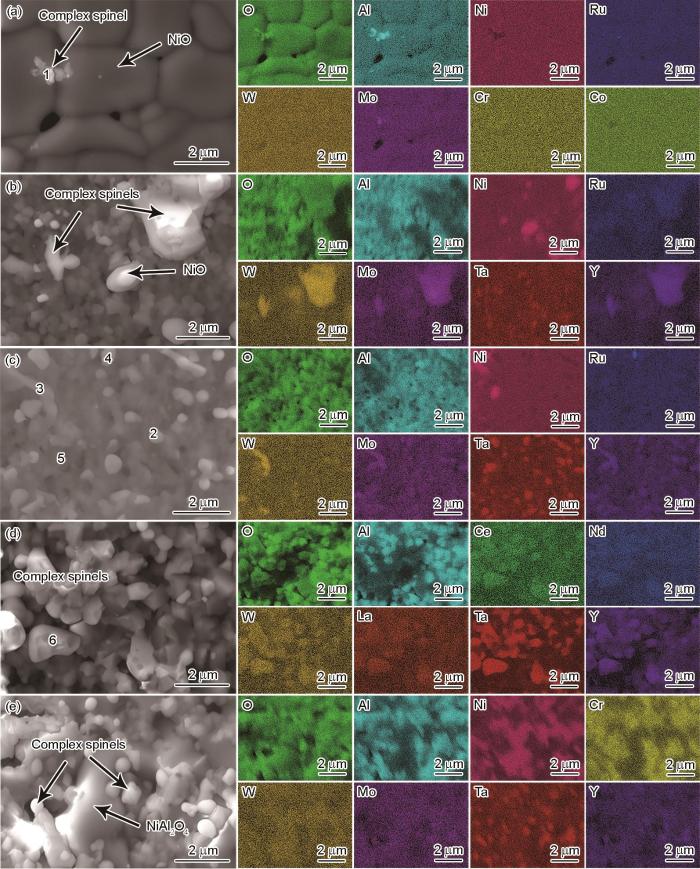
图4
合金在1100 ℃下氧化不同时间后表面氧化物形貌的SEM像和EDS元素面扫描结果
Fig.4
SEM images and corresponding EDS elemental maps of surface oxides formed on the alloy after oxidation at 1100 oC for 3 h (a), 25 h (b), 60 h (c), 100 h (d), and 200 h (e)
表1
Table 1
| Point | O | Ni | Al | W | Ta | Y | Ce | La | Nd | Ru | Oxide |
|---|---|---|---|---|---|---|---|---|---|---|---|
| 1 | 48.3 | 31.3 | 16.5 | - | 0.15 | 0.12 | - | - | - | 0.10 | Spinel |
| 2 | 69.3 | 8.6 | 7.7 | 0.8 | 8.40 | 0.60 | - | - | - | 0.08 | TaO2 |
| 3 | 60.4 | 13.3 | 7.6 | 7.3 | 3.20 | - | 0.06 | - | - | 0.09 | NiWO4 |
| 4 | 74.6 | 7.3 | 10.4 | 0.4 | 0.07 | 0.08 | - | - | - | 8.80 | RuO2 |
| 5 | 56.5 | 12.5 | 20.9 | 1.2 | 1.50 | 0.20 | - | - | - | 0.06 | NiAl2O4 |
| 6 | 53.6 | 15.9 | 2.5 | 2.6 | 18.50 | 0.40 | 0.09 | 0.1 | 0.05 | - | Spinel |
氧化60 h时(图4c),合金表面出现大量白色小颗粒,EDS成分分析结果(表1)表明点2成分主要包含Ta和O元素。结合XRD谱(图3)可确定这些白色小颗粒为TaO2,与Huang等[15]和杨依凡等[16]的研究结果一致。从表1可见,点3的成分主要包含W、O和Ni元素,氧化物为棒状NiWO4尖晶石。同时发现表面存在少量RuO2 (点4)。通过对点5进行成分测试(表1),发现尖晶石层的下方是一层NiAl2O4层。随着氧化时间进一步延长到100 h (图4d),结合点6的EDS成分分析(表1)可知,一些尖晶石氧化物中除了富含W、Mo和Ta等元素外,同时还富集La、Nd、Ce和Y稀土元素。Li等[11]发现,在质量损失阶段,不同Mo含量合金的质量损失都约为1 mg/cm2,而本工作中第三阶段合金质量损失只有约0.35 mg/cm2。这很可能是由于La、Nd、Ce和Y可以阻碍NiWO4和NiMoO4等尖晶石氧化物分解成WO3和MoO3,从而减少WO3和MoO3等氧化物挥发,下文将对此具体分析。当氧化时间达到200 h时(图4e),可以看到尖晶石层下方的NiAl2O4层变得更加连续且致密,这对O元素的内扩散以及合金元素的外扩散有着显著的阻碍作用,有助于降低合金的氧化速率,在氧化第三阶段发挥了关键作用。
2.5 横截面氧化层
图5为合金经1100 ℃氧化3、25、60、100和200 h后氧化层横截面形貌的SEM像和EDS元素面扫描结果。氧化3 h时(图5a),在Cr、Al、Mo、Ta和Ru等多种元素形成的复杂尖晶石结构上方形成一层稀土氧化膜,最下方为不连续的针状Al2O3层。氧化层上方还有残留的白色氧化物,EDS元素面扫描分析可知,其为Al、Cr、Co和Mo等元素形成的复杂尖晶石氧化物,这些氧化物应该是与NiO位于同一层,这与图4a观察结果基本一致。由于Cr、Co等难熔元素形成的氧化物易挥发[17],导致这些处于最表层的尖晶石氧化物挥发后产生孔洞,O元素通过孔洞快速进入合金,并与向外扩散的合金元素相遇,形成了复杂尖晶石层。这些相对连续的尖晶石层的形成可以降低O元素和其他合金元素的迁移率。随着氧化时间延长,氧化层结构发生了显著变化。由图5b可见,氧化25 h后,氧化层分为左、右2种结构:右侧由一层氧化层构成,通过EDS成分分析(表2)可知,点1位置是相对连续的NiO层,对O元素内扩散和合金元素外扩散具有一定的阻碍效果;左侧部分则相反,NiO层剥落后形成了尖晶石层和Al2O3层,并且相对于氧化3 h时的氧化层,氧化25 h时尖晶石层明显增厚,这将导致氧化层内应力积累。由于氧化层和基体界面的平衡氧压较低,Al元素发生了选择性氧化,内层由针状Al2O3层开始转化为部分连续的Al2O3层。氧化60 h时(图5c),氧化层仍然分为左、右两个区域,其中左侧形成了上、下两层氧化膜结构:上层是NiAl2O4尖晶石层,下层是Al2O3层。这与表面氧化层形貌观察结果(图4c)一致。右侧区域基本没有氧化层存在,使得基体表面裸露在空气中。结合EDS元素面扫描分析可以看出,氧化层中基本没有W、Mo和Ru等难熔元素,这也证实了氧化第三阶段发生了氧化物挥发。NiO层发生剥落有两个原因:其一是大量的孔洞产生,导致NiO晶粒之间结合力下降,加速NiO层剥落;其二是NiMoO4相存在两种形式,即α-NiMoO4和β-NiMoO4,它们在加热和冷却过程中可以相互转化,造成了显著的体积变化,从而导致氧化物从基体表面剥落[18]。除此之外,还可观察到在氧化层下方存在针状析出相,对点5的EDS成分分析结果(表2)表明该析出相为AlN。这是由于表面氧化层缺失,导致N元素向内扩散并与基体中的Al结合形成AlN,这种针状金属间化合物AlN的形成大量消耗Al元素,降低了合金的高温抗氧化能力[18,19]。氧化100和200 h时(图5d和e),根据点6~8的EDS成分分析结果(表2)可知,Al元素发生了选择性氧化,在最内层形成一层曲折的Al2O3层。Hindam和Smeltzer [20]指出,曲折的Al2O3层结构与基体的结合强度比平直的Al2O3层结构好。连续且致密的Al2O3膜阻碍N3-向内扩散形成AlN。由于后续氧化阶段形成连续致密Al2O3膜需要大量的Al元素,导致氧化前期在无γ'层已形成的AlN发生分解,因此100和200 h氧化样品中没有发现AlN[18,19]。次内层的NiAl2O4尖晶石层也变得连续起来,并且氧化200 h的NiAl2O4尖晶石层相比于氧化100 h不仅厚度有所增加,氧化层内的缺陷也变少,这都有助于减缓合金氧化200 h后的氧化速率。最外层则是由Cr、Al、W、Mo、Ni、Ta和Y等多种合金元素形成的复杂尖晶石层构成。氧化200 h后,外侧还形成少量NiO层,但由于NiO层易剥落基本没有保护性。完整氧化膜结构的形成也代表着合金的氧化增重进入了稳态阶段。
图5

图5
合金在1100 ℃下氧化不同时间后氧化层横截面形貌的SEM像和EDS元素面扫描结果
Fig.5
Cross-sectional SEM images and corresponding EDS elemental maps of oxide layer after oxidation at 1100 oC for 3 h (a), 25 h (b), 60 h (c), 100 h (d), and 200 h (e)
表2 图5中点1~8的EDS成分分析结果 (atomic fraction / %)
Table 2
| Point | O | Ni | Al | Co | Cr | W | Mo | Ta | Ru | N | Oxide |
|---|---|---|---|---|---|---|---|---|---|---|---|
| 1 | 61.1 | 35.6 | 0.8 | 0.7 | 0.4 | - | 0.4 | 0.2 | 0.40 | - | NiO |
| 2 | 57.7 | 12.4 | 24.4 | 3.2 | 2.8 | - | - | 0.4 | 0.05 | - | NiAl2O4 |
| 3 | 51.6 | 6.2 | 41.7 | 0.2 | 0.2 | - | - | - | - | - | Al2O3 |
| 4 | 4.2 | 94.0 | 0.2 | 0.3 | 0.3 | - | 0.2 | 0.4 | - | - | γ |
| 5 | 0.5 | 42.3 | 25.3 | 4.2 | 2.3 | 0.40 | 0.3 | 0.8 | 0.90 | 21.9 | AlN |
| 6 | 38.6 | 53.5 | 2.9 | 2.9 | 0.4 | 0.20 | - | 0.5 | - | - | NiO |
| 7 | 49.0 | 15.9 | 29.9 | 3.1 | 2.9 | 0.19 | - | 0.9 | 0.06 | - | NiAl2O4 |
| 8 | 56.6 | 1.6 | 41.0 | 0.2 | 0.3 | - | - | - | 0.06 | - | Al2O3 |
2.6 微观结构演变和稳定性
图6为合金在1100 ℃氧化3、25、60、100和200 h后邻近氧化层处整体形貌,距离无γ'区5~10 μm区域和30~50 μm区域组织形貌的SEM像及无γ'区的厚度。氧化3 h时(图6a),由图4a可知,氧化初期大量Ni和Al元素向外扩散,形成NiO和针状Al2O3层,消耗了大量Al元素[21],所以在氧化3 h的氧化层下方出现了无γ'区。在无γ'区附近,少部分γ'析出相回溶到基体中,不同程度地失去了立方体形状(图6a1),而内部区域的γ'相保留着原始立方结构(图6a2)[22]。氧化25 h时(图6b),无γ'层的厚度变化不大,但无γ'区附近区域有部分γ基体通道消失(图6b1),远离氧化层的γ'相仍然保持立方结构(图6b2)。其一是因为在氧化3~25 h期间仅有针状Al2O3层转化为部分连续的Al2O3层,Al元素的消耗较少;二是因为O元素与W、Mo和Ru等难熔元素之间反应剧烈,使得尖晶石层明显增厚,从而限制了Al元素的选择性氧化。因此,无γ'层的厚度并没有显著增加。氧化60 h时(图6c),无γ'层的厚度相较于氧化25 h时略有增加,而在无γ'区附近区域部分γ'相呈条状分布(图6c1),远离氧化层的γ'相仍然保持立方结构(图6c2)。这是由于该阶段NiAl2O4尖晶石层的形成消耗了Al元素。氧化100 h后(图6d),由于形成完整且连续的Al2O3层需要消耗大量的Al元素,导致无γ'层的厚度增加,在无γ'区附近区域大部分γ基体通道消失,γ'相呈条状分布(图6d1),远离氧化层的γ'相大部分保持立方结构,少部分γ'相出现筏化(图6d2)。而氧化200 h后(图6e),无γ'层的厚度约为74.3 μm,此时Al2O3层厚度达到2.1 μm,无γ'区附近区域γ'相筏化变得相当剧烈(图6e1),远离氧化层可见较长的γ'相(图6e2)。此外,在1100 ℃氧化200 h的过程中,在无γ'层和合金内部均没有发现拓扑密堆(TCP)相,这表明合金具有良好的组织稳定性[23,24]。合金在1100 ℃下氧化3、25、60、100和200 h后,无γ'区的厚度分别为17.5、18.4、21.3、44.6和74.3 μm,如图6f所示。
图6

图6
合金在1100 ℃下氧化不同时间后邻近氧化层处整体形貌,距离无γ'区5~10 μm区域和30~50 μm区域组织形貌的SEM像,及无γ'区的厚度
Fig.6
SEM images of overall morphologies near oxidation layer (a-e), 5-10 µm near the γ'-free zone (a1-e1), and 30-50 µm away from the γ'-free zone (a2-e2) after oxidizing at 1100 oC for 3 h (a, a1, a2), 25 h (b, b1, b2), 60 h (c, c1, c2), 100 h (d, d1, d2), and 200 h (e, e1, e2); and thicknesses of γ'-free zone vst (f)
3 分析与讨论
3.1 氧化动力学及机制
根据HB5258—2000 《钢及高温合金的抗氧化性测定试验方法》,高温合金的抗氧化等级可以通过平均氧化速率进行评定[25]:
式中,K'为平均氧化速率常数,g/(m2·h);m100为氧化100 h后试样和容器的总质量,g;m50为氧化50 h后试样和容器的总质量,g;S为试样的表面积,m2。当K' < 0.1 g/(m2·h)时,合金的抗氧化等级为完全抗氧化级(complete oxidation resistance);当0.1 g/(m2·h) ≤ K' ≤ 1 g/(m2·h)时,合金的抗氧化等级为抗氧化级(oxidation resistance);当1 g/(m2·h) < K' ≤ 3 g/(m2·h)时,合金的抗氧化等级为次抗氧化级(secondary oxidation resistance);当3 g/(m2·h) < K' ≤ 10 g/(m2·h)时,合金的抗氧化等级为弱抗氧化级(weak oxidation resistance);当K' > 10 g/(m2·h)时,合金的抗氧化等级为不抗氧化级(no oxidation resistance)。
表3对比了本工作合金和文献[4,11,17,26]中不同代次单晶高温合金在1100 ℃下的平均氧化速率和抗氧化等级。可见,在1100 ℃下二代单晶合金Alloy 3的抗氧化等级为完全抗氧化级。与其他4种合金相比,二代单晶合金Alloy 3没有添加难熔元素Mo,减少了氧化物挥发和氧化物层剥落,使得基体表面更早形成连续且致密的Al2O3层,阻碍合金元素向外扩散和O元素向内扩散,从而提高合金抗氧化性能。二代单晶合金Alloy 4的抗氧化等级为抗氧化级。Alloy 4虽然提高了Mo元素含量,但相对提高了Al元素的含量且添加了稀土元素Y。一方面,足够的Al含量可保证连续Al2O3层的快速形成,以减少氧化瞬态阶段的挥发;另一方面,Y元素的添加能促进Al元素的选择性氧化,更容易形成连续且致密的Al2O3层,所以Alloy 4具有较好的抗氧化性能。随着Mo、Re、W等难熔元素含量的增加和Cr含量的减少,高代次单晶高温合金的抗氧化性能有所下降。
表3 本工作合金与其他合金[4,11,17,26]在1100 ℃下的平均氧化速率常数(K')和抗氧化等级对比
Table 3
Alloy (mass fraction, %) | K' g·m-2·h-1 | Oxidation resistance level |
|---|---|---|
| Experimental alloy | 0.164 | Oxidation resistance |
Alloy 1[17] Ni-6.0Al-19.4(Ta + Mo + W + Cr)-12.0Co-5.4Re-3.0Ru | 0.318 | Oxidation resistance |
Alloy 2[11] Ni-12(Al + Ta)-3Mo-19.8(W + Cr + Co + Re)-2.5Ru | 0.420 | Oxidation resistance |
Alloy 3[4] Ni-5.7Al-7.0Ta-8.0W-4.8Cr-9.0Co-2.0Re | 0.075 | Complete oxidation resistance |
Alloy 4[26] Ni-7.1Al-3.0Ta-7.0Mo-2.2Cr-1.0Re-0.05Y | 0.146 | Oxidation resistance |
本工作合金的平均氧化速率优于同代次的Alloy 1和Alloy 2,接近于低代次的Alloy 3和Alloy 4。为了研究影响合金氧化速率的主要因素,利用以下速率方程来进一步分析氧化动力学[27]:
式中,Δm为合金单位面积的氧化增重,k为抛物线氧化速率常数,t为氧化时间,n为氧化反应指数,C为常数。
对
lnk + lnC并非固定常数,k随着氧化过程的推进而发生改变,且受称重时的冷却过程影响。图7a为ln(Δm)与lnt关系曲线。对曲线进行分阶段拟合,发现合金1100 ℃条件下的非连续氧化动力学主要包含四个阶段。在氧化开始前3 h内,n = 0.735,接近线性动力学规律的n = 1,说明此时合金的氧化行为主要受样品表面氧化产物的形成速率控制。结合样品表面和横截面氧化层结构(图4a和5a),可知合金氧化3 h时表面形成了由NiO、尖晶石和针状Al2O3组成的三层结构。由于NiO剥落和非连续针状Al2O3对元素扩散的阻碍作用有限,因此合金前3 h的氧化速率不受元素扩散控制。氧化3~25 h期间,合金氧化速率较低,按照次抛物线动力学规律变化,这是由于非连续针状Al2O3转化为部分连续的Al2O3,尖晶石层也增厚(图5b),O元素向合金内部扩散受到了尖晶石层和Al2O3层的阻碍,延缓了氧化层和基体的氧化反应进程,进而降低了氧化增重速率。氧化25~60 h期间,n = -0.143,结合图5c可知,这个阶段发生了氧化物的剥落和挥发,由于本工作将氧化样品和剥落的氧化物一起称重,当氧化物挥发质量大于氧化物生成质量时,合金质量减小,进而出现负的氧化增重速率情况。氧化60 h后,n = 0.457,接近抛物线动力学规律的n = 0.5。此时的NiAl2O4尖晶石层和Al2O3层相比于氧化60 h时变得更加连续,可以有效阻碍O元素向内扩散和W、Mo、Ru、Ta等难熔元素的向外扩散和氧化。
图7

图7
合金在1100 ℃下氧化200 h的氧化动力学曲线
Fig.7
Kinetic curves after oxidizing at 1100 oC for 200 h (Δm—oxidation weight gain mass per unit area, n—oxidation reaction index, k—parabolic oxidation rate constant)
(a) logarithmic Δmvst (b) (Δm)2vst
为了进一步研究合金的高温氧化动力学行为,将Δm进行平方处理[28]:
得到(Δm)2与t的关系曲线(图7b)。对曲线进行分段拟合可见,合金的氧化增重曲线可以分为四个阶段。氧化前3 h的k = 1.630 mg2/(cm4·h),氧化3~25 h的k = 0.199 mg2/(cm4·h),氧化25~60 h的k = -0.053 mg2/(cm4·h),氧化60 h后k减少至0.102 mg2/(cm4·h)。各阶段合金的k高于α-Al2O3的抛物线氧化速率常数(1.26 × 10-5 mg2/(cm4·h)),这意味着合金的氧化不受α-Al2O3控制[29]。因此,合金氧化60 h后的氧化速率将逐渐受元素通过NiAl2O4尖晶石层和Al2O3层的扩散速率控制。此后,合金的氧化增重随着NiAl2O4尖晶石层的缺陷减少和连续Al2O3层的变厚进入稳态阶段。
结合XRD、SEM和氧化动力学分析,合金在1100 ℃下的氧化机理示意图如图8所示。本工作合金与其他第四代单晶高温合金的Alloy 1、Alloy 2在高温氧化动力学上的差异主要体现在:(1) 氧化初期稀土元素(Y、La、Ce和Nd)快速扩散到表面,与O元素反应形成一层连续的氧化膜,抑制形成尖晶石的氧化反应,降低尖晶石层的增厚速率,延缓第三阶段质量损失到来的时间,给Al元素选择性氧化生成连续Al2O3层争取更多时间,导致第三阶段氧化物挥发带来的质量损失变小[30],从而提高合金抗氧化能力;(2) 合金氧化后期多形成一层连续且致密的NiAl2O4尖晶石层,增强了氧化层对O元素和合金元素迁移的阻碍效果,导致最终氧化增重较小。
图8
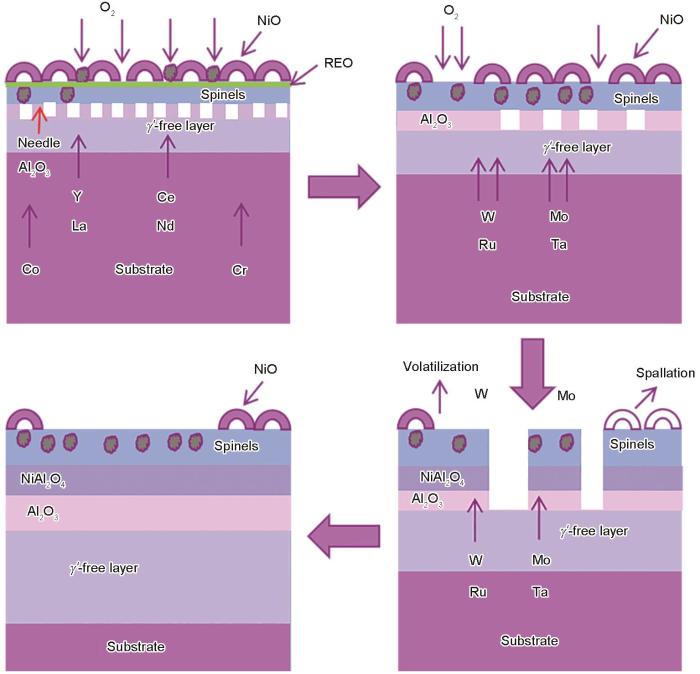
图8
合金在1100 ℃下氧化机理示意图
Fig.8
Schematics of oxidation mechanisms of alloy at 1100 oC (REO—rare earth oxide)
4 结论
(1) 新型第四代镍基单晶高温合金在1100 ℃氧化动力学主要分为四个阶段,初始阶段符合线性动力学规律,第二阶段接近次抛物线阶段,第三阶段属于质量损失阶段,最后阶段符合抛物线动力学规律。
(2) 氧化200 h后氧化膜形成了四层结构,最外层为NiO层,次外层为复杂的尖晶石层,次内层为NiAl2O4尖晶石层,最内层为Al2O3层。其中连续且致密的Al2O3层和NiAl2O4尖晶石层是氧化后期氧化速率降低的关键。
(3) 氧化初期稀土元素(Y、La、Ce和Nd)快速扩散到表面,与O元素反应形成一层保护性氧化膜,阻碍O元素向内扩散,从而降低尖晶石层的增厚速率,延缓第三阶段质量损失到来的时间,从而缓解第三阶段氧化增重的降低,提高合金的抗氧化能力。
(4) 随着氧化的进行,无γ'区Al元素的消耗使得无γ′区厚度逐渐增加,尤其是第四阶段Al元素的选择性氧化形成连续Al2O3层,无γ'区厚度开始迅速增加。此外,在1100 ℃氧化200 h的过程中,在无γ'层和合金内部均没有发现TCP相,表明合金具有良好的微观结构稳定性。
参考文献
High-temperature oxidation behavior and mechanism of second-generation nickel-based single crystal superalloy
[J].
第二代镍基单晶高温合金高温氧化行为及机制研究
[J].
Comparative study of the reactive elements effects on oxidation behavior of a Ni-based superalloy
[J].
Isothermal oxidation behavior of single crystal superalloy DD6
[J].
Oxidation behaviors and compressive strength evolution of DD6 Ni-based single-crystal superalloy at 1100 oC
[J].
Effects of yttrium on oxidation behavior of nickel-based single crystal superalloy containing Re
[J]
Y对含铼镍基单晶高温合金抗氧化行为的影响
[J].
研究了Y元素对含铼镍基单晶高温合金高温恒温氧化行为的影响。采用静态增重法研究了Y对900、1 000和1 100℃下合金的氧化动力学的影响,并采用扫描电镜和X射线衍射等手段分析了氧化产物的结构和形貌。结果表明,含Y和不含Y合金在900、1 000和1 100℃下的氧化级别均为完全抗氧化级。Y含量的增加虽然对900℃和1 000℃的氧化增重影响很小,但明显降低了1 100℃的氧化增重,这是由于Y的添加增加了α-Al<sub>2</sub>O<sub>3</sub>的连续性,提高了氧化膜保护效果。
Cyclic oxidation behavior of rare earth elements La and Y modified CMSX-4 single crystal superalloy
[D].
稀土元素La和Y改性CMSX-4镍基单晶高温合金的循环氧化行为研究
[D].
Influence of rare earth elements (Y, La and Ce) on the mechanical properties and oxidation resistance of nickel-based superalloys: A critical review
[J].Rare-earth elements (REEs) received special attention and widespread application because of their extremely active chemical property. Many researches demonstrated that doping of REEs (Y, La and Ce) in superalloys can significantly improve the high temperature oxidation resistance, corrosion resistance and mechanical properties, which are recognized as a promising route to broaden the manufacturing process window and enhance the overall performance of next-generation superalloys. The first part of this review described the special behavior of REEs during the metallurgical solidification process, including the REEs loss in the melt and the macro-segregation phenomenon. The second part summarized a broad spectrum of works reporting the dual role of REEs addition on the mechanical properties of superalloys. The third part overviewed the effect of REEs on the anti-oxidation resistance of the fourth and fifth nickel-based superalloys. Finally, the prospect of development of REEs-containing superalloys was discussed.
High temperature oxidation of a single crystal nickel-base superalloy
[J].
第三代单晶高温合金DD33的高温氧化行为
[J].
Effect of W content on oxidation resistance of experimental third generation single crystal superalloys
[J].
W对第三代单晶高温合金抗氧化性能的影响
[J].
Oxidation behavior of a novel nickel-based single crystal superalloy at elevated temperature
[J].
Effect of molybdenum on isothermal oxidation behavior of 4th generation nickel-based single crystal superalloys
[J].
Effect of elements distribution on oxidation behavior of a nickel-based single crystal superalloy
[J].
Oxidation behavior of a low-cost third-generation Ni-based single-crystal superalloy
[J].At present, the development of low-cost Ni-based single-crystal (SX) superalloys with excellent properties is urgently needed to address the increasing cost of advanced aero-engines. In this study, a novel low-cost, third-generation Ni-based SX superalloy containing 3%Re (mass fraction) was investigated to assess its oxidation behavior and γ′ phase degradation at 1120 oC. Results showed that during the first 5 h of oxidation, a continuous and uniform three-layer oxide film was formed on the surface of samples. Given the relatively thin oxide film, measured at approximately 5 μm, the experimental alloy followed sub-parabolic kinetics. Between 10 and 100 h of oxidation, the nucleation and propagation of cracks in the Al2O3 interlayer accelerated the spallation of protective oxide films. This event resulted in the increased oxidation of the matrix alloy, along with the formation of AlN and large areas in the oxidation reaction domain (ORD). These phenomena caused the transformation from sub-parabolic kinetics to linear kinetics. After 150 h of oxidation, a continuous and zigzagging Al2O3 layer was formed at the bottom of the ORD that could hinder the outward diffusion of alloy elements and the inward diffusion of oxygen. Consequently, the alloy gradually approached parabolic kinetics as the Al2O3 layer was thickened. In addition, the intense oxidation reaction on the surface accelerated the degradation of the γ′ phase and the precipitation of the topologically close pack phase near the surface. Therefore, the low bond strength between the surface oxide film and the alloy matrix primarily contributed to the deficiency of high-temperature oxidation resistance of this experimental alloy.
一种低成本第三代单晶高温合金的高温氧化行为
[J].为了应对先进航空发动机中材料研发成本大幅攀升的实际问题,亟需研发新型低成本高性能的镍基单晶高温合金。本工作以一种仅含3%Re (质量分数)的新型低成本第三代镍基单晶高温合金为研究对象,分析该合金1120 ℃高温下的氧化动力学行为与γ′相退化规律。结果表明:氧化前5 h,样品表面形成连续且均匀的三层氧化膜结构,此时氧化膜较薄(厚度仅约5 µm),合金的氧化增重遵循次抛物线动力学规律;氧化10~100 h,Al<sub>2</sub>O<sub>3</sub>层间裂纹的萌生与扩展加速表面保护性氧化膜的剥落,导致样品内部的氧化加剧,反应形成AlN以及大面积的氧化反应区(ORD),合金的氧化增重遵循线性动力学规律;氧化150 h后,ORD底部形成连续且曲折的Al<sub>2</sub>O<sub>3</sub>层,有效阻碍合金元素与O元素的扩散,并随着Al<sub>2</sub>O<sub>3</sub>层的增厚,合金的氧化增重逐渐接近抛物线动力学规律。此外,样品表面的高温氧化反应会加速合金中近表面γ′相的退化以及有害TCP相的析出。合金表面氧化膜与基体之间结合强度不足,是该基础合金非连续氧化条件下抗氧化性能低于连续氧化条件下的主要原因。
High temperature oxidation behavior of a Ru-containing Ni-based single-crystal superalloy
[J].
一种含Ru镍基单晶高温合金的高温氧化行为
[J].
Effect of rhenium addition on isothermal oxidation behavior of single-crystal Ni-based superalloy
[J].
Oxidation behavior of a single crystal Ni-based superalloy N5 and its nanocrystalline coating at 900 oC in O2 and O2 + 20%H2O environment
[J].
镍基单晶高温合金N5及其纳米晶涂层在900 ℃下O2和O2 + 20%H2O气氛中的氧化行为
[J].以镍基单晶高温合金N5为基体,采用磁控溅射技术在基体表面沉积与其成分相同的纳米晶涂层,并对比研究合金及其纳米晶涂层在900 ℃下O<sub>2</sub>和O<sub>2</sub>+20% (体积分数) H<sub>2</sub>O气氛中的氧化行为。结果表明,水蒸气加快了合金和涂层的氧化速率,促进合金表面氧化膜的剥落,并且影响了氧化膜的组成和结构。在O<sub>2</sub>和O<sub>2</sub>+H<sub>2</sub>O环境中,合金表面氧化膜都由外层NiO、中间层NiAl<sub>2</sub>O<sub>4</sub>和内层Al<sub>2</sub>O<sub>3</sub>组成;但在O<sub>2</sub>+H<sub>2</sub>O环境中,合金氧化速率较大,外层氧化膜发生剥落。纳米晶涂层显著提高了合金的抗高温氧化性能,在O<sub>2</sub>气氛中表面形成Al<sub>2</sub>O<sub>3</sub>,而在O<sub>2</sub>+H<sub>2</sub>O气氛中表面氧化膜主要为NiAl<sub>2</sub>O<sub>4</sub>。同时,纳米晶涂层表面氧化膜未发生开裂和剥落,起到良好的保护作用。
A study on the multiple stages of oxidation kinetics in a single crystal nickel-based superalloy
[J].
Formation of multilayered scale during the oxidation of NiAl-Mo alloy
[J].
Microstructural evolution of oxidation film on a single crystal nickel-based superalloy at 980 oC
[J].
Growth and microstructure of α-Al2O3 on Ni-Al alloys: Internal precipitation and transition to external scale
[J].
Oxidation behavior of micro-regions in multiphase Ni3Al-based superalloys
[J].
多相Ni3Al基高温合金微区氧化行为
[J].
In-phase thermal-mechanical fatigue behavior and damage mechanism of a fourth-generation Ni-based single-crystal superalloy
[J].During the service, the turbine blades of aero-engines are subjected to a complex and ever-changing combination of temperature and stress, resulting in severe cyclic temperature/strain damages and thermal-mechanical fatigue (TMF) failures of the alloy. In this work, in-phase (IP) TMF tests under 600-1000oC were conducted on a newly developed fourth-generation single-crystal superalloy. The alloy's fracture characteristics and comprehensive damage mechanisms were examined via SEM, EBSD, and TEM. The results showed that when the strain range increased, the fatigue life of the experimental alloy noticeably decreased, and the hysteresis loop clearly opened. Stress response behaviors shifted from cyclic softening at high temperatures and cyclic hardening at low temperatures into a dominant characteristic of cyclic stabilizing. The fracture surfaces of alloys displayed ductile features after fatigue fracture under various circumstances, and the area fraction of dimples reduced with increasing strain amplitude. When the strain amplitude was low, the alloy was mainly subjected to oxidation damage, accompanied with a certain degree of creep damage. In contrast, the dominant deformation mechanism of the alloy was dislocation slipping in γ matrix and Orowan by-passing through γ' particles. As the strain amplitude increased to higher levels, the alloy was subjected to severe plastic deformation damage, while the degree of oxidation damage had been alleviated. Under this condition, the interfacial dislocations could shear into the γ' phase with the generated stacking fault or anti-phase boundary. Notably, no recrystallization grains or deformation twins were formed in the DD91 alloy during the IP-TMF experiments at different mechanical strain amplitudes.
一种第四代镍基单晶高温合金的同相位热机械疲劳行为及损伤机制
[J].热机械疲劳是单晶高温合金在实际服役过程中的一种重要损伤模式,澄清合金的热机械疲劳行为及损伤机制对于提升单晶高温合金的服役可靠性具有重要意义。本工作以先进航空发动机高压涡轮叶片用第四代单晶高温合金DD91为对象,采用SEM、EBSD、TEM等手段研究了合金在600~1000℃下的同相位热机械疲劳断裂特征及损伤机理。结果表明,随应变幅的升高,合金的疲劳寿命大幅下降,迟滞曲线明显张开,且应力响应行为由高温半周循环软化和低温半周循环硬化转变为以循环稳定为主导的特征。在不同应变幅下疲劳断裂后,合金断口呈韧性断裂特征,随应变幅的升高,韧窝区面积分数不断下降。在低应变幅下,合金主要承受氧化损伤,并伴随一定程度的蠕变损伤,合金的主要变形机制为位错在γ基体中滑移,并以Orowan机制绕过γ'强化相;而在高应变幅下,合金承受严重的塑性变形损伤而氧化损伤程度减轻,此时界面位错能够以生成层错或反相畴界的形式切割γ'相。另外,合金在不同应变幅下循环至断裂后,均未出现再结晶晶粒和变形孪晶。
New single crystal superalloys—Overview and update
[J].
Microstructural evolution and element interdiffusion of NiAlHf and NiAlHfY coatings deposited on a Ni-based superalloy
[J].
Effects of trace aluminum and titanium on high temperature oxidation behavior of Inconel 690 alloy
[J].
微量Al、Ti对Inconel 690合金高温氧化行为的影响
[J].研究了微量Al、Ti元素对Inconel 690合金在850~1200℃下氧化行为的影响。结果表明,添加微量Al元素减小了Inconel 690合金在850~1200℃范围内的氧化增重,提高了合金的抗氧化性能。Al、Ti元素的复合添加提高了Inconel 690合金在850℃下的氧化速率。但在1000和1200℃下,该合金的平均氧化速率和氧化增重又均减小。添加微量Al元素后,晶界处形成的Al<sub>2</sub>O<sub>3</sub>颗粒阻碍了Cr<sup>3+</sup>的扩散,抑制Cr<sub>2</sub>O<sub>3</sub>膜的生长并减少合金内部孔洞的数量,从而提高氧化膜与基体的结合力,降低合金的氧化速率。当Al和Ti元素复合添加时,Ti<sup>4+</sup>在Cr<sub>2</sub>O<sub>3</sub>膜中作为高价离子掺杂,促进阳离子向外扩散,加快合金的氧化,导致合金在低温下的抗氧化性能略有下降。但Ti在氧化过程中倾向于向Cr<sub>2</sub>O<sub>3</sub>膜的表层偏聚,形成了不易挥发的富Ti氧化层,抑制高温下Cr<sub>2</sub>O<sub>3</sub>的挥发和剥落,提高合金在1000和1200℃下的抗氧化性能。
Role of volatilization of molybdenum oxides during the cyclic oxidation of high-Mo containing Ni-based single crystal superalloys
[J].
Effect of shot peening of substrate surface on cyclic oxidation behavior of sputtered nanocrystalline coating
[J].In addition to changing the surface roughness of the superalloy, the substrate surface treatment can also modify the microstructure of the surface, which affects the high-temperature oxidation behavior of the high-temperature protective coating. However, there are few reports about the effect of superalloy surface treatment on the oxidation behavior of nanocrystalline coatings. In this work, nanocrystalline coatings were sputtered on the nickel-based single crystal superalloy after two different surface treatments of polishing and shot peening, and their cyclic oxidation behavior at 1100oC was investigated. The phase composition and microstructure of nanocrystalline coatings were characterized by SEM, XRD, and EDS. The results indicated that the cyclic oxidation kinetics of both nanocrystalline coatings at 1100oC were similar. A dense oxide film could be formed on the surface of nanocrystalline coatings, showing excellent oxidation resistance. However, the microstructure evolution of the interface between the nanocrystalline coating and shot-peened superalloy substrate differed from that between the nanocrystalline coating and polished superalloy substrate. The sustained formation of the γ′ phase in the nanocrystalline coating near the polished substrate/coating interface was observed during high-temperature oxidation. This phenomenon was not found at the nanocrystalline coating near the shot peened substrate/coating interface, while the continuous growth of the γ' phase was observed at the substrate.
基体表面喷丸处理对纳米晶涂层循环氧化行为的影响
[J].
The oxidation behaviour of NiAl—I. Phase transformations in the alumina scale during oxidation of NiAl and NiAl-Cr alloys
[J].
Research progress on the mechanisms controlling high-temperature oxidation resistance of Mg alloys
[J].This paper briefly reviews the progress on high-temperature oxidation mechanisms of pure Mg and Mg alloys, the thermodynamics and kinetics of high-temperature oxidation of Mg alloys, and the antioxidation mechanism of Mg alloys. The potential of applying advanced characterization techniques in studying the high-temperature oxidation of Mg alloys is envisaged. Finally, the development trends of the oxidation-resistant Mg alloy are also summarized. The main viewpoints are as follows: The protection of magnesium alloys at high temperatures is provided by the formation of a continuous, dense oxide scale that is a specific thickness and prevents the outward diffusion of magnesium vapor and the inward diffusion of oxygen; the oxidation resistance of Mg alloys is usually closely related to the thermal stability of the second phases; when the trace alloy elements are not enough to form the corresponding surface oxide scale, the oxidation resistance can be improved by creating a substitutional solid solution and using the reactive element effect; the size of the oxide grain size decreases and then enhances the oxidation resistance once the surface active elements is enriched on the surface of the alloys; the selective oxidation and synergistic effect of alloying elements are critical to the oxidation resistance of Mg alloys; the addition of nano or microparticles into the Mg alloys improve the high-temperature oxidation resistance of the Mg alloy by reducing the size of specific oxidation sensitive regions. In the future, the research on the high-temperature oxidation of Mg alloys can be based on the following aspects: Investigating the processes and nature of the oxidation resistance of Mg alloys using cutting-edge characterization techniques; constructing the underlying connections between the alloying elements and the oxide scale grain size and mechanical properties; designing and optimizing multi-alloying element composition systems.
镁合金抗高温氧化机理研究进展
[J].


