




金属材料强度的提升使其构件能够在更高应力条件下服役,而改善其韧性/塑性对保障工程安全至关重要。过去半个世纪以来,材料科学领域已建立起经典的四大强化机制:固溶强化、位错强化、界面强化和析出强化[1,2]。基于这些机制,研究人员[3~6]在钢铁、铝合金、钛合金和铜合金等工程金属材料中实现了强度的显著突破。然而,通过引入点缺陷、位错、晶界和第二相等多尺度缺陷实现强化的同时,高强度金属材料普遍伴随着韧性/塑性的显著降低。大量实验研究[7,8]表明:金属材料强度与塑性之间存在着固有的权衡关系(trade-off relation)。这一现象不仅引发了广泛的科学兴趣,更使得突破强度-塑性权衡限制成为当前金属材料领域最具挑战性的国际前沿科学难题之一。
进入21世纪以来,材料科学家在突破金属材料强度-塑性权衡关系方面取得了一系列重要进展。Wang等[9]和Lu等[10]通过在纯Cu中构建双模晶粒组织和纳米孪晶界面,实现了拉伸强度与均匀延伸率协同提升。类似地,Wu等[11]在纯Ni中引入平均尺寸为7 nm的纳米团簇,也观察到强度和塑性的显著改善。Liu等[12]通过在钼合金中掺杂纳米粒子,利用其抑制晶粒长大与钉扎晶内位错的协同作用,成功提高了钼合金的强度和延伸率,综合性能良好。最近十年,这种强度-塑性协同提升的现象在钢铁材料[13,14]和高熵合金[15,16]等体系中也有发现。尽管这些突破性工作展示了特定条件下打破强度-塑性权衡关系的可能性,但通过对大量研究数据和工业标准手册进行系统分析发现,绝大多数工程金属材料的强度-塑性仍遵循典型的权衡关系。这一现象引出两个关键科学问题:(1) 对于给定成分的金属材料,是否可通过微观组织调控或晶粒尺寸分布优化实现强度-塑性关系根本性突破?(2) 如果强度-塑性权衡关系具有普适性,是否可建立相应的定量理论模型来描述这一权衡关系?
本文阐述了在金属材料强度-塑性、强度-电导率定量关系研究中的创新成果。基于本团队原创性提出的独立位错空间模型[19],从理论上阐明了金属材料强度-塑性权衡关系的本质机制:独立位错空间尺寸是决定性控制因素。研究[19]揭示:(1) 金属类型、合金成分、变形温度和应变速率是该空间尺寸的关键调控参数;(2) 微观组织或晶粒尺寸分布对其影响具有局限性。基于这一理论突破,建立了单相合金中强度-均匀延伸率权衡模型[20]。针对金属导线材料,提出了高强-高导三原则[21],据此构建了普适性强度-电导率定量关系模型[22]。该模型不仅揭示了不同金属导线中强度与电导率呈现协同提升或相互制约现象的内在物理机制,更为设计新型高性能导电材料提供了理论依据和设计准则。
1 金属材料强度-塑性定量关系
1.1 独立位错空间模型
1.1.1 分子静力学模拟:独立位错空间
图1
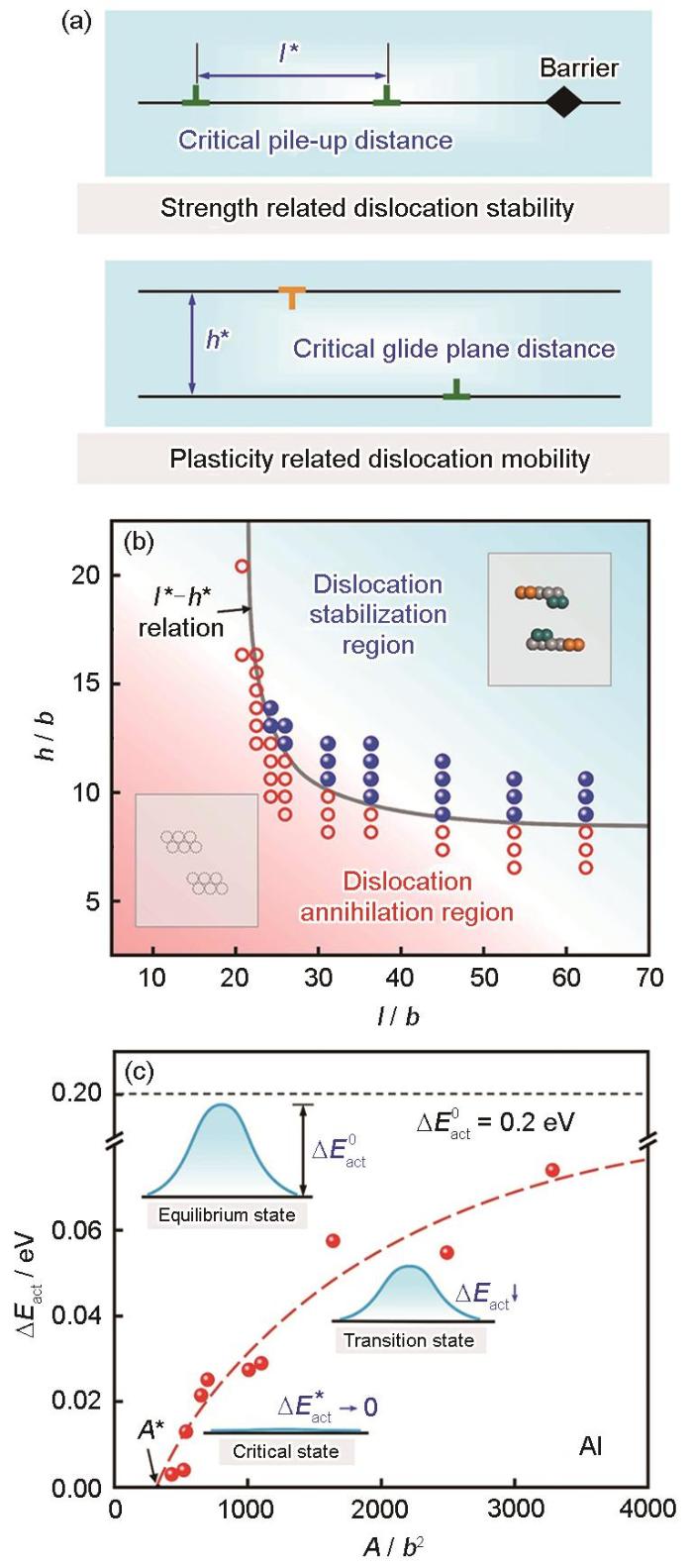
图1
独立位错空间及其物理机制[19]
Fig.1
Independent dislocation space and the physical mechanism[19](a) strength and plasticity related critical dislocation distances (l* and h*)(b) l*-h* relation of near saturated screw dislo-cations in Al (Inset in the lower left corner shows annihilation state of dislocations, while inset in the upper right corner shows stable state of disloca-tions. l—pipe-up distance, h—glide plane distance, b—Burgers vector modulus)(c) dislocation annihilation activation energy (ΔEact) changing with the dislocation space (A) in Al (ΔEact→0 when A = A* (A* = l* × h*). ΔE
金属种类不同,A*取值可产生较大差异。由于A*代表位错空间在垂直于位错线方向上的截面积,故而通过A*可环绕位错线划定一个区域:避免该区域重叠是螺位错能够相互独立存在的前提条件,否则会发生相互捕获或湮灭等作用;在此区域之外的位错则可保持独立存在和自由运动。因此,将A*定义为临界独立位错空间(independent dislocation space,IDS)[19],其存在意味着位错密度具有理论上的极限值,其大小反映了金属中位错保持稳定存在和独立运动的能力。
1.1.2 分子动力学模拟:临界湮灭能垒
为探讨独立位错空间的成因,进一步开展了分子动力学模拟。通过调整面内位错间距(l)和滑移面间距(h),获得了不同独立位错空间A (A = l × h)下位错湮灭反应的激活能(ΔEact)[19,30] (经检验,湮灭机制未发生改变)。如图1c[19]所示,位错在近平衡状态下的反应激活能(ΔE
1.1.3 强度-塑性关系:制约与突破
进一步结合A*的基本特征,可得到金属强度-塑性上限的基本关系。如图2a[19]所示,当位错属性不变时,A*保持恒定,l*与h*的反比关系导致强度-塑性上限呈倒置关系;当位错属性变化导致A*减小时,强度-塑性上限同时提升。需要说明的是,以上探讨均基于位错极限密度状态下的理想情况,材料的实际强度-塑性关系还会受到变形过程中的硬化行为及局部开裂机制的影响。上述分析重在反映金属材料强化及塑性变形的本征规律,这一规律在多个实际案例中得到印证,如通过调控合金成分降低层错能[24,33] (图2b[19])、提高短程有序程度[34] (图2c[19])等提升位错的本征稳定性,实现了A*的减小,使得金属材料的强度-塑性得以同步提高。此外,通过低温变形[35]降低位错反应频率,或通过提高应变速率[36]压缩位错反应时间等外部干预方式,也可减小A*从而实现强度-塑性同步提高。值得注意的是,在强度-塑性同步提升的趋势之下,原本的制约关系并未被“打破”,只是遵循如图2[19]中的基本规律,实现了强度-塑性上限的拓宽。综上所述,恒定A*的存在是强度-塑性倒置关系普遍存在的根本原因,减小A*是强度-塑性同步提高的通用思路;强度-塑性相互制约与同步提高在A*概念下实现了对立统一。
图2

图2
独立位错空间与强度-塑性基本关系[19]
Fig.2
Independent dislocation space and basic strength-plasticity relationship[19](a) principle of strength and plasticity constraints and synchronous improvement(b, c) practical cases of synchronous improvement in strength and plasticity by decreasing the stacking fault energy (SFE) (b) and increasing the degree of short-range order (SRO) (c)
1.2 强度-塑性权衡模型
图3

图3
强度-塑性权衡模型[20]
Fig.3
Strength-ductility trade-off model[20]
(a) under external loading, dislocations pile up at the grain boundaries. When the piling-up of dislocations triggers grain-boundary cracking, failure occurs to determine the critical applied stress (D—grain size, τc—critical applied stress, Hc—critical height of neighbor slip plane)
(b) accounting for the plastic deformation contributed by dislocation gliding at the critical failure state to calculate the uniform elongation (l'—shear distance of slip plane)
(c) summary of the trade-off model: strength and ductility follow an inverse proportionality. Tuning grain size provides different strength-ductility balances but makes simultaneous improvement. The model indicates three routes to achieve strength-ductility synergy: (1) increasing the intrinsic gliding resistance to dislocations, (2) strengthening interfaces, and
(3) promoting slip uniformity (σ0—intrinsic resistance to dislocation slip, Ec—critical strain energy density for interfacial cracking, ε0—elastic strain of about 0.5%)
(d) comparisons between the trade-off model and the experimental data (UTS—ultimate tensile strength, UE—uniform elongation)
式中,σ0为位错滑移本征阻力,M为Taylor因子,v为Poisson比,Ec为界面开裂需要的临界应变能密度。由此可见,σb与D-1/2成正比,这与经典的Hall-Petch关系一致。
式中,ε0为弹性应变,Hc为激活的滑移面间距。从
由于ε0远小于εU,可取ε0 ≈ 0.5%。从
界面强度提升使材料能够承受更多的位错塞积而不开裂,这同时意味着能够承受更大的外加应力,因此,改善界面强度能够同步提升强度与塑性。金属材料晶界开裂是一个常见失效机制,相关实验案例通过晶界结构设计[39]或元素偏析设计[40]有效提高了晶界强度,以此同步提升材料的强度与塑性。滑移面间距可以用来衡量变形均匀性,相同应变下滑移面间距越小,激活的滑移面越多,单个滑移面变形越小,变形越均匀,这意味着单个滑移面位错塞积数量减少,以此达到强度与塑性的同步提升。实验研究[4,24,41]发现,变形均匀性与层错能有密切关系,随着层错能降低,滑移带更加细密,变形更均匀,近期的分子动力学模拟结果[20]也与这一结论一致。大量实验数据表明,不同金属材料的强度-塑性均符合
2 强度-电导率定量关系
2.1 高强-高导三原则
2.1.1 细长晶粒原则
金属导线在服役状态下,导线的载流方向和受力方向均沿轴向分布,这为晶界设计提供了新思路:与轴向垂直的晶界会显著散射电子,降低电导率;与轴向平行的晶界则主要阻碍位错滑移,从而提高强度。基于此,将晶粒形态设计为长轴沿导线方向排列的细长纤维状(细长晶粒),即可在不同方向分别优化强度和电导率。如图4a所示,减小细长晶粒的宽度可显著增强晶界强化效果而基本不损害电导率;增加细长晶粒的长度则可降低垂直晶界密度、减弱电子散射,从而提升电导率而不影响强度。由此提出“细长晶粒”高强-高导设计原则,其核心思想是:通过减小晶粒宽度、增加晶粒长度,在横向方向增加晶界密度以强化强度,同时在轴向方向减少晶界数量以降低电子散射,提高电导率。
图4

图4
高强-高导金属导线微观组织设计三原则示意图,以及细长晶粒特征参数[22]和析出相半径与强度和电导率定量关系模型
Fig.4
Schematics of three principles including fine-long grains, hard texture (L—length of elongated grain, t—width of grain) (a) and nano-scale precipitates (b) for designing metallic conductors with high strength and high electrical conductivity; and quantitative models for strength and electrical conductivity (EC) relating to elongated grain parameters[22] (YS—yield strength) (c) and precipitate radius (r—radius of precipitate, rc—critical radius of precipitate) (d)
2.1.2 硬取向织构原则
除了晶粒形貌之外,晶体取向同样对材料的性能有重要影响。依据Schmid定律可知[45],单晶的屈服强度与Schmid因子密切相关,Schmid因子越小,屈服强度越高。对于fcc金属,<111>取向具有最小的Schmid因子(0.272),所以<111>取向可称作硬取向。因此,在径向形成<111>取向晶粒可有效提升屈服强度。同时,晶粒取向变化并不会引入额外的晶格缺陷,所以,形成<111>织构不会增加电子散射,从而可以在不牺牲电导率的前提下提升强度。由此提出“硬取向织构”高强-高导设计原则。
2.1.3 纳米相原则
综上所述,提出了改善金属导线强度与电导率制约关系的微观组织设计三原则[21]:细长晶粒、硬取向织构和纳米析出相,该原则为高强-高导金属导线的微观组织优化提供了明确方向。
2.2 导线强度-电导率定量关系模型
在明确了高强-高导金属导线微观组织优化原则的基础上,为了实现高强-高导微观组织的精确设计,需建立能够描述强度与电导率变化规律的定量化模型,揭示微观组织特征参数与强度和电导率之间的内在联系,为新型高强-高导材料微观组织的逆向设计和性能优化提供定量依据。基于此,进一步构建了针对细长晶粒特征参数及纳米析出相尺寸与强度-电导率关系的定量关系模型。
2.2.1 细长晶粒与强度和电导率定量关系
对于经过大变形量拉拔工艺制备的fcc金属导线,其径向晶粒主要呈现<001>和<111>两种择优取向,这使得晶界强化和织构强化两种机制共同作用。为建立晶界强化与细长晶粒的定量关系,首先需要解耦这两种强化机制。假设导线屈服强度(σy)由两类取向晶粒按混合定律叠加计算,可得:
式中,σ<001>和σ<111>分别为<001>和<111>取向晶粒贡献的强度,f<001>和f<111>分别为对应的体积分数。结合Schmid定律,可推导出导线内晶界强化计算公式:
式中,σgb为晶界强化贡献的强度,Ω<001>和Ω<111>分别为<001>和<111>取向的Schmid因子,M = 3.06。进一步将晶界强化与细长晶粒宽度进行Hall-Petch形式拟合,得到:
式中,
已有的电导率模型存在理论计算值与实测值偏差较大的问题,究其原因在于其基于晶界散射各向同性的假设,未能充分考虑平行晶界与垂直晶界对电子散射的差异。针对这一问题,提出了新的建模思路[22]:(1) 将晶粒单元分解为纯基体、平行晶界、垂直晶界三个部分;(2) 将纯基体与平行晶界并联处理,计算得到等效电导率;(3) 将该并联系统与垂直晶界进行串联处理,经推导得到了细长晶粒电导率(ω)的计算公式:
式中,ω0为纯基体的电导率,ωV和ωP分别为垂直晶界和平行晶界的电导率,δ为半个晶界厚度,L为晶粒长度。以纯Al导线为例,基于
式中,r为析出相半径,LP为析出相间距。结合LP与r和体积分数(F)的关系[50],可进一步得到析出强化与r的关系:
式中,ρAl为纯Al的电阻率,Δρeq为析出相半径无限大时的电阻率增量,γ为表面能,VM为摩尔体积,Rm为摩尔气体常数,T为热力学温度。
3 总结和展望
本文从位错运动及变形损伤角度阐明了金属材料强度-塑性制约与突破的本征关系;同时,基于典型缺陷(晶界、析出相)对位错运动及电子散射的差异性作用,探讨了金属导线强度-电导率制约关系及定量模型,主要结论如下。
(1) 通过fcc金属中螺位错湮灭行为的分子静力学/动力学模拟,发现近极限密度下位错保持独立存在与自由运动的临界空间尺寸恒定不变,据此提出临界独立位错空间(A*)的概念,揭示了A*恒定是金属强度-塑性倒置关系普遍存在的根本原因,提出改变合金成分、变形温度和应变速率等因素可减小A*,实现金属强度-塑性同步提高。通过考虑金属多晶体强度-塑性对晶粒尺寸的依赖性,建立了单相合金拉伸强度-均匀延伸率权衡关系的反比函数模型,在多种金属材料体系得到实验验证。模型表明,单纯调控晶粒尺寸难以同步提升强度与塑性,而通过增加位错滑移本征阻力、强化界面和促进滑移均匀性三种方式可实现强度-塑性协同提升。
(2) 提出高强-高导金属导线微观组织设计三原则:细长晶粒、硬取向织构和纳米析出相。细长晶粒可通过减小滑移距离提升强度、增加晶粒长度可提高电导率;硬取向织构在不降低电导率的条件下显著增强屈服强度;纳米析出相则兼具净化基体与析出强化作用,实现强度与电导率同步提升。建立了晶粒特征参数、析出相尺寸与强度和电导率定量关系模型,揭示了晶粒宽度、长度、体积和长径比以及析出相半径对强度和电导率影响的内在机制,为高强-高导金属导线微观组织优化提供了定量理论参考。
强度、塑性、电导率是金属材料三个关键性能,引入典型缺陷(固溶原子、位错、界面、第二相)可明显提高金属材料强度,而第二相是造成塑性和电导率下降的根本原因,因而强度-塑性、强度-电导率总是表现出相互制约关系。为突破金属材料强度-塑性制约关系,需针对控制强度、塑性的变形机制(位错、孪生)有针对性地设计缺陷类型。近期研究[55]表明,在高熵合金和多组元复杂合金中,可以通过控制制备工艺析出纳米团簇或短程有序,改变合金局域成分而改变位错滑移方式,实现强度-塑性协同提高。而金属强度-电导率制约关系中,提高强度需阻碍位错运动,提高电导率需降低电子散射,这是两个不同参量控制的制约关系,可分别考虑两个不同因素的协同作用。建立金属材料强度-塑性、强度-电导率定量关系模型,可以高效指导金属材料选材、成分设计及微观组织工艺控制,保证构件服役安全性。
参考文献
Ultrastrong steel via minimal lattice misfit and high-density nanoprecipitation
[J].
Significance of stacking fault energy in bulk nanostructured materials: Insights from Cu and its binary alloys as model systems
[J].
Additive manufacturing of ultrafine-grained high-strength titanium alloys
[J].
Mechanical behavior and strengthening mechanisms in ultrafine grain precipitation-strengthened aluminum alloy
[J].
Tailoring the strengthening mechanisms of high-entropy alloys toward excellent strength-ductility synergy by metalloid silicon alloying: A review
[J].
An overview of tailoring strain delocalization for strength-ductility synergy
[J].
High tensile ductility in a nanostructured metal
[J].
Ultrahigh strength and high electrical conductivity in copper
[J].
Methods used to strengthen metals generally also cause a pronounced decrease in electrical conductivity, so that a tradeoff must be made between conductivity and mechanical strength. We synthesized pure copper samples with a high density of nanoscale growth twins. They showed a tensile strength about 10 times higher than that of conventional coarse-grained copper, while retaining an electrical conductivity comparable to that of pure copper. The ultrahigh strength originates from the effective blockage of dislocation motion by numerous coherent twin boundaries that possess an extremely low electrical resistivity, which is not the case for other types of grain boundaries.
Nanodomained nickel unite nanocrystal strength with coarse-grain ductility
[J].Conventional metals are routinely hardened by grain refinement or by cold working with the expense of their ductility. Recent nanostructuring strategies have attempted to evade this strength versus ductility trade-off, but the paradox persists. It has never been possible to combine the strength reachable in nanocrystalline metals with the large uniform tensile elongation characteristic of coarse-grained metals. Here a defect engineering strategy on the nanoscale is architected to approach this ultimate combination. For Nickel, spread-out nanoscale domains (average 7 nm in diameter) were produced during electrodeposition, occupying only ~2.4% of the total volume. Yet the resulting Ni achieves a yield strength approaching 1.3 GPa, on par with the strength for nanocrystalline Ni with uniform grains. Simultaneously, the material exhibits a uniform elongation as large as ~30%, at the same level of ductile face-centered-cubic metals. Electron microscopy observations and molecular dynamics simulations demonstrate that the nanoscale domains effectively block dislocations, akin to the role of precipitates for Orowan hardening. In the meantime, the abundant domain boundaries provide dislocation sources and trapping sites of running dislocations for dislocation multiplication, and the ample space in the grain interior allows dislocation storage; a pronounced strain-hardening rate is therefore sustained to enable large uniform elongation.
Nanostructured high-strength molybdenum alloys with unprecedented tensile ductility
[J].The high-temperature stability and mechanical properties of refractory molybdenum alloys are highly desirable for a wide range of critical applications. However, a long-standing problem for these alloys is that they suffer from low ductility and limited formability. Here we report a nanostructuring strategy that achieves Mo alloys with yield strength over 800 MPa and tensile elongation as large as ~ 40% at room temperature. The processing route involves a molecular-level liquid-liquid mixing/doping technique that leads to an optimal microstructure of submicrometre grains with nanometric oxide particles uniformly distributed in the grain interior. Our approach can be readily adapted to large-scale industrial production of ductile Mo alloys that can be extensively processed and shaped at low temperatures. The architecture engineered into such multicomponent alloys offers a general pathway for manufacturing dispersion-strengthened materials with both high strength and ductility.
Facile route to bulk ultrafine-grain steels for high strength and ductility
[J].
High dislocation density-induced large ductility in deformed and partitioned steels
[J].A wide variety of industrial applications require materials with high strength and ductility. Unfortunately, the strategies for increasing material strength, such as processing to create line defects (dislocations), tend to decrease ductility. We developed a strategy to circumvent this in inexpensive, medium manganese steel. Cold rolling followed by low-temperature tempering developed steel with metastable austenite grains embedded in a highly dislocated martensite matrix. This deformed and partitioned (D and P) process produced dislocation hardening but retained high ductility, both through the glide of intensive mobile dislocations and by allowing us to control martensitic transformation. The D and P strategy should apply to any other alloy with deformation-induced martensitic transformation and provides a pathway for the development of high-strength, high-ductility materials.Copyright © 2017 The Authors, some rights reserved; exclusive licensee American Association for the Advancement of Science. No claim to original U.S. Government Works.
Metastable high-entropy dual-phase alloys overcome the strength-ductility trade-off
[J].
Gradient cell-structured high-entropy alloy with exceptional strength and ductility
[J].
Ultra-high strength, high conductivity Cu-Ag alloy wires
[J].
Dramatically enhanced combination of ultimate tensile strength and electric conductivity of alloys via machine learning screening
[J].
Independent dislocation space model for synchronous improvement of strength and plasticity in fcc metals
[J].In this study, the possible relationships between strength and plasticity are explored on the basis of the stability and mobility of dislocations. An independent dislocation space (IDS) model is proposed by molecular simulation of pilling-up and annihilation behaviors of screw dislocations in face-centered cubic (fcc) metals. It is revealed that there is an intrinsic driving mechanism for the restrictive strength-plasticity relation, and then the criterion for the synchronous improvement of strength and plasticity (SISP) in dislocation mechanism dominated fcc metals is proposed in terms of the IDS model. Finally, the IDS model has been verified in various practical cases and could help design high-performance metallic materials in future.
Trade-off model for strength-ductility relationship of metallic materials
[J].
Three principles for preparing Al wire with high strength and high electrical conductivity
[J].<p>The trade-off relation between the strength and the electrical conductivity has been a long-standing dilemma in metallic materials. In the study, three key principles, i.e. elongated grains, sharp texture and nano-scale precipitates, were presented for preparing Al wire with high strength and high electrical conductivity based on the specially designed experiments for breaking the mutually exclusive relation between the strength and the electrical conductivity. The results show that the elongated grains could lead to a higher electrical conductivity in Al wire without sacrificing the strength; while, the <111> sharp texture can efficiently strengthen the Al wire without influencing the electrical conductivity. Furthermore, nano-scale precipitates with proper size can simultaneously improve the strength and electrical conductivity of Al alloy wire. Under the guidance of the above three key principles, Al wires with high strength and high conductivity were prepared.</p>
Quantitative model for grain boundary effects on strength-electrical conductivity relation
[J].
Microstructural evolution and mechanical properties of Cu-Al alloys subjected to equal channel angular pressing
[J].
Simultaneous improvement of strength and plasticity: Additional work-hardening from gradient microstructure
[J].
Superior strength-ductility synergy in three-dimensional heterogeneous-nanostructured metals
[J].
Structural stability and lattice defects in copper: Ab initio, tight-binding, and embedded-atom calculations
[J].
Effective stacking fault energy in face-centered cubic metals
[J].
Determination of the of rate cross slip of screw dislocations
[J].The rate for cross slip of screw dislocations during annihilation of screw dipoles in copper is determined by molecular dynamics simulations. The temperature dependence of the rate is seen to obey an Arrhenius behavior in the investigated temperature range: 225-375 K. The activation energy and the effective attempt frequency can therefore be extracted from the simulations. The transition state energy for the annihilation process is calculated by identifying the transition state using the nudged elastic band path technique. The two activation energies agree very well, indicating that transition state theory is applicable for this type of process.
Calculation of cross-slip parameters in f.c.c. crystals
[J].
Physics and phenomenology of strain hardening: The FCC case
[J].
A general physics-based hardening law for single phase metals
[J].
A good strength-ductility match in Cu-Mn alloys with high stacking fault energies: Determinant effect of short range ordering
[J].
The influences of temperature and microstructure on the tensile properties of a CoCrFeMnNi high-entropy alloy
[J].
Strain rate effects on tensile de-formation behaviors for Fe-22Mn-0.6C-(1.5Al) twinning-induced plasticity steel
[J].
Shearing brittle intermetallics enhances cryogenic strength and ductility of steels
[J].Precipitates are crucial for crafting mechanically strong metallic materials. In this work, we report the dislocation cutting of B2 (ordered body-centered cubic) nanoprecipitates, typically considered nonshearable intermetallics, in a lightweight compositionally complex steel during cryogenic tensile loading. Shearing is enabled by the high strength level for dislocation glide within the austenitic matrix, attributed to the substantial strengthening from subnanoscale local chemical ordering zones and the pronounced solid solution strengthening from the multiprincipal elements in the matrix. This mechanism not only harnesses the intense strengthening and strain hardening provided by otherwise impenetrable brittle nanoprecipitates but also introduces ductility through their sequential shearing with ongoing deformation. Our steel thus showcases ultrahigh cryogenic tensile strength up to 2 gigapascal at a remarkable tensile elongation of 34%. This study reveals a new strategy for designing high-performance structural materials.
Chemical inhomogeneities in high-entropy alloys help mitigate the strength-ductility trade-off
[J].
The control of brittleness and development of desirable mechanical properties in polycrystalline systems by grain boundary engineering
[J].
Manipulating the interfacial structure of nanomaterials to achieve a unique combination of strength and ductility
[J].The control of interfaces in engineered nanostructured materials has met limited success compared with that which has evolved in natural materials, where hierarchical structures with distinct interfacial states are often found. Such interface control could mitigate common limitations of engineering nanomaterials. For example, nanostructured metals exhibit extremely high strength, but this benefit comes at the expense of other important properties like ductility. Here, we report a technique for combining nanostructuring with recent advances capable of tuning interface structure, a complementary materials design strategy that allows for unprecedented property combinations. Copper-based alloys with both grain sizes in the nanometre range and distinct grain boundary structural features are created, using segregating dopants and a processing route that favours the formation of amorphous intergranular films. The mechanical behaviour of these alloys shows that the trade-off between strength and ductility typically observed for metallic materials is successfully avoided here.
Effects of stacking fault energy on the deformation mechanisms and mechanical properties of face-centered cubic metals
[J].Stacking fault energy (SFE) can play a crucial role in plastic deformation and damage mechanisms of face-centered cubic (fcc) metals. This study mainly summarized the following results: (1) With the reduction of SFE, the slip mode of fcc metals gradually changes from a facile cross-slip wavy mode to a planar mode until deformation twinning occurs; (2) The concept of effective SFE is applied to investigate the variation of SFE with dislocation density in the fcc metals, with the increase in dislocation density, the effective SFE increases; (3) The reduction of SFE is not the only factor determining the formation of deformation twins in fcc metals. In terms of calculating the competition between simulated slipping and twinning using the first principles, the critical criterion for forming deformation twinning in fcc metals was established; (4) The fatigue dislocation configuration of high-, medium-, and low-SFE fcc metals were analyzed and the judgment conditions for forming regular persistent slip bands (PSBs) are proposed; (5) With the increase in Al content, the SFE of Cu-Al alloy decreases, resulting in a simultaneous increasing trend in the tensile strength and the uniform elongation due to the increasing planar slip degree; (6) The exponential strain-hardening model can accurately describe the tensile strain-hardening process of Cu-Al alloys. The quantitative relationship among yield strength, tensile strength, and uniform elongation of Cu-Al alloy with different alloy compositions and microstructure states was successfully predicted; (7) With the increase in Al content, the fatigue strength of Cu-Al alloy is improved. Increasing Al content at the same strain amplitude will enhance its low-cycle fatigue life. Based on the experimental results above, it is shown that the alloy composition affects the deformation and damage mechanisms, and the evolution process of microscopic defects (dislocations, twins) in fcc metals and alloys. Thus, it drastically affects the tensile and fatigue properties of the fcc metals and alloys. These results provide experimental evidence and a theoretical basis for improving the mechanical properties and service reliability of fcc metals and alloys via alloy designing.
层错能对面心立方金属形变机制与力学性能的影响
[J].层错能在面心立方(fcc)金属塑性变形和损伤过程中具有重要作用,本文主要总结了以下研究结果:(1) 随层错能降低,fcc金属滑移方式逐渐从易于交滑移的波状滑移方式转变为平面滑移方式,直至发生变形孪生;(2) 为了理解不同位错密度fcc金属中层错能的变化趋势,采用有效层错能的概念,随位错密度增加,有效层错能也随之升高;(3) 层错能降低不是决定fcc金属形变孪生发生的唯一因素,通过第一原理计算模拟滑移和孪生之间的竞争关系,建立了fcc金属形变孪生临界判据;(4) 通过对高层错能、中等层错能以及低层错能fcc金属疲劳位错组态的实验观察和分析,总结了fcc金属中形成规则驻留滑移带的判定条件;(5) 随Al含量增加,Cu-Al合金层错能降低导致平面滑移程度增加,其拉伸强度和均匀延伸率呈现同步提高趋势;(6) 采用指数应变硬化模型可精确描述Cu-Al合金拉伸加工硬化过程,进而预测了不同合金成分和微观组织状态Cu-Al合金屈服强度-抗拉强度-均匀延伸率之间的定量关系;(7) 随Al含量增加,Cu-Al合金疲劳强度升高;在相同应变幅下,随Al含量增加,其低周疲劳寿命也升高。表明合金成分明显影响fcc金属形变损伤机制及微观缺陷(位错、孪生)演变过程,进而显著影响fcc金属及合金拉伸性能和疲劳性能,这为通过合金设计和制备提高fcc金属力学性能及服役可靠性提供了实验证据和理论基础。
What is behind the inverse Hall-Petch effect in nanocrystalline materials?
[J].
The deformation and ageing of mild steel: III Discussion of results
[J].
Change in electrical resistivity of commercial purity aluminium severely plastic deformed
[J].
Optimization of electrical conductivity and strength combination by structure design at the nanoscale in Al-Mg-Si alloys
[J].
Coupled precipitation and yield strength modelling for non-isothermal treatments of a 6061 aluminium alloy
[J].
Consideration of Orowan strengthening effect in particulate-reinforced metal matrix nanocomposites: A model for predicting their yield strength
[J].
Precipitation strengthening at ambient and elevated temperatures of heat-treatable Al(Sc) alloys
[J].
Coarsening resistance at 400 oC of precipitation-strengthened Al-Zr-Sc-Er alloys
[J].
Modelling of the age hardening behaviour of Al-Mg-Si alloys
[J].
Sequential modeling of local precipitation, strength and strain hardening in friction stir welds of an aluminum alloy 6005A-T6
[J].
Achieving alloys with concurrent high strength and high ductility
[J].Increasing the yield strength of metallic materials is observed to almost always substantially reduce their tensile ductility. Here we unravel the origin of this perplexing “strength-ductility trade-off”, and conclude that this dilemma does not necessarily preclude concurrent high strength and high ductility. We discuss several strengthening and work hardening mechanisms that regulate dislocation behavior, including traditional ones that have been pushed to their extreme in recent years, as well as new ones that take advantage of the heightened structural and chemical heterogeneities; all these mechanisms are rendered more powerful by emerging complex concentrated alloys that bring in multiple principal elements. These mechanisms, while offering elevated strength, contribute to sustainable strain hardening under high flow stresses, delaying strain localization to allow prolonged uniform elongation. The current status in the pursuit for concurrent high strength and high ductility is reviewed. The goal we set for high yield strength ~2 GPa (rivaling super steels) together with large uniform elongation ~30% (much like un-strengthened elemental metals) is projected to be soon within reach. These take-home messages shed light on some existing puzzles regarding the strength-ductility synergy, and offer new insight into the innovative design of alloys.
如何使合金兼具高强度与高塑性
[J].


