耐热铝合金:组织设计与合金制备
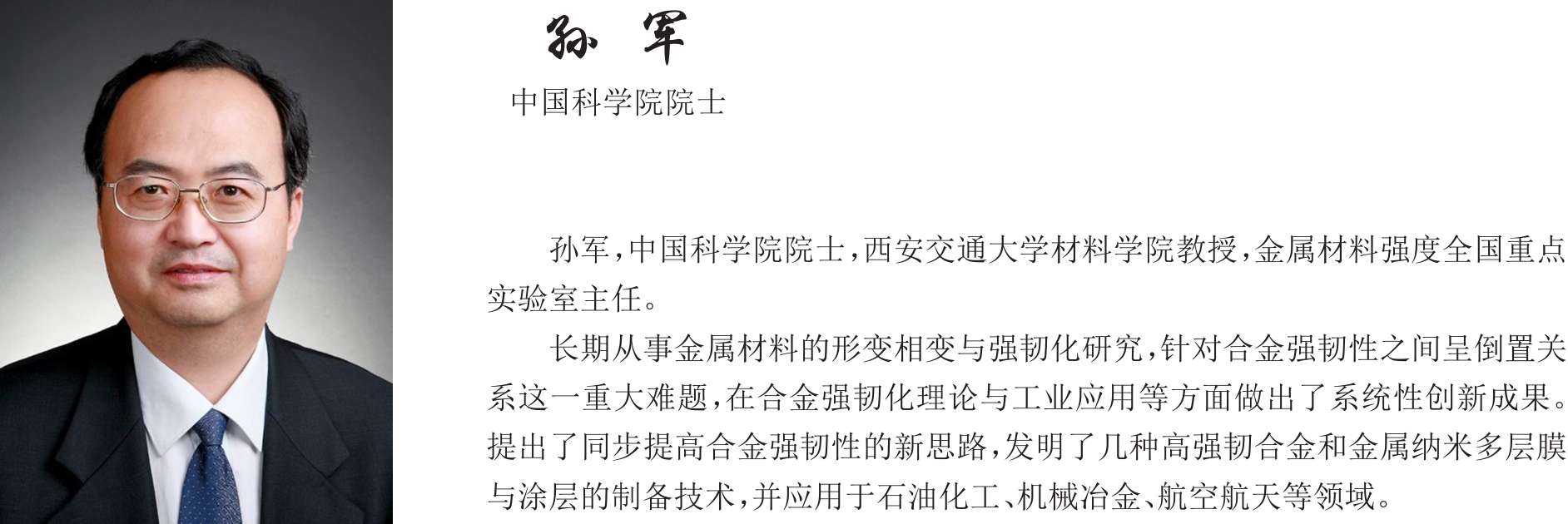
孙 军,junsun@mail.xjtu.edu.cn,主要从事金属材料形变与相变研究
收稿日期: 2024-10-14
修回日期: 2024-11-14
网络出版日期: 2024-12-10
基金资助
国家自然科学基金项目(U23A6013, 92360301, U2330203);高等学校学科创新引智计划项目(BP2018008)
Heat-Resistant Al Alloys: Microstructural Design and Preparation
Received date: 2024-10-14
Revised date: 2024-11-14
Online published: 2024-12-10
Supported by
National Natural Science Foundation of China(U23A6013, 92360301, U2330203);Programme of Introducing Talents of Discipline to Universities(BP2018008)
孙军 , 刘刚 , 杨冲 , 张鹏 , 薛航 . 耐热铝合金:组织设计与合金制备[J]. 金属学报, 2025 , 61(4) : 521 -525 . DOI: 10.11900/0412.1961.2024.00345
Aluminum (Al) alloys, a typical lightweight material, are limited to applications at temperatures below about 200 oC. The high-temperature range of 300-400 oC has been a longstanding bottleneck for traditional Al alloys. In this study, the underlying mechanisms of this service bottleneck are first discussed, and key scientific solutions aimed at overcoming the bottleneck are proposed. A new microstructure designing strategy is proposed to develop advanced heat-resistant Al alloys through phase transformation that couples rapidly diffusing solute atoms with slowly diffusing ones. This strategy leads to three design approaches for thermal stability: (1) interfacial solute segregation at the nanoprecipitate/matrix interfaces, (2) interstitial solute ordering within the coherent nanoprecipitates, and (3) multiple interfacial coherency coupling with multiscale microstructural features. By manipulating the microalloying effect at the atomic length scale, a series of 300-400 oC heat-resistant Al alloys were developed. Furthermore, the potential development directions of the heat-resistant Al alloys are also explored as possible references for future work.
| 1 | Shyam A, Bahl S. Heat-resistant aluminium alloys [J]. Nat. Mater., 2023, 22: 425 |
| 2 | Deschamps A, Hutchinson C R. Precipitation kinetics in metallic alloys: Experiments and modeling [J]. Acta Mater., 2021, 220: 117338 |
| 3 | Polmear I J, Couper M J. Design and development of an experimental wrought aluminum alloy for use at elevated temperatures [J]. Metall. Trans., 1988, 19A: 1027 |
| 4 | Yang C, Zhang P, Shao D, et al. The influence of Sc solute partitioning on the microalloying effect and mechanical properties of Al-Cu alloys with minor Sc addition [J]. Acta Mater., 2016, 119: 68 |
| 5 | Xue H, Yang C, De Geuser F, et al. Highly stable coherent nanoprecipitates via diffusion-dominated solute uptake and interstitial ordering [J]. Nat. Mater., 2023, 22: 434 |
| 6 | Rummel G, Zumkley T, Eggersmann M, et al. Diffusion of implanted 3D-transition elements in aluminum: 1. Temperature-dependence [J]. Z. Metallkd., 1995, 86:122 |
| 7 | Du Y, Chang Y A, Huang B Y, et al. Diffusion coefficients of some solutes in fcc and liquid Al: Critical evaluation and correlation [J]. Mater. Sci. Eng., 2003, A363: 140 |
| 8 | Calderon H A, Voorhees P W, Murray J L, et al. Ostwald ripening in concentrated alloys [J]. Acta Metall. Mater., 1994, 42: 991 |
| 9 | Chen B A, Liu G, Wang R H, et al. Effect of interfacial solute segregation on ductile fracture of Al-Cu-Sc alloys [J]. Acta Mater., 2013, 61: 1676 |
| 10 | Gao Y H, Guan P F, Su R, et al. Segregation-sandwiched stable interface suffocates nanoprecipitate coarsening to elevate creep resistance [J]. Mater. Res. Lett., 2020, 8: 446 |
| 11 | Yi M, Zhang P, Yang C, et al. Improving creep resistance of Al-12 wt.% Ce alloy by microalloying with Sc [J]. Scr. Mater., 2021, 198: 113838 |
| 12 | Yi M, Zhang P, Deng S H, et al. Atomic-scale compositional complexity ductilizes eutectic phase towards creep-resistant Al-Ce alloys with improved fracture toughness [J]. Acta Mater., 2024, 276: 120133 |
/
| 〈 |
|
〉 |