



为解决传统合金材料的性能局限,高熵合金(high-entropy alloy,HEA)应运而生[5],其通常由五种及以上元素以等原子比或接近等原子比组成(各元素原子分数在5%~35%之间),从而产生高的构型熵(ΔSconf)[6]。这从根本上突破了传统合金以1~2种元素为主、辅以添加微量元素的合金化模式,为提高金属材料性能开辟了新途径。与传统合金依赖单一元素主导材料性能不同,HEA通过多主元协同作用实现了材料性能的多元化调控,并在原子尺度上为微观结构的精准设计提供了可能。更重要的是,高熵体系所特有的高熵效应、晶格畸变效应、缓慢扩散效应及“鸡尾酒效应”[7],能够协同优化材料的综合性能,为开发高性能能源催化材料创造了新机遇[8]。
近年来,高熵概念已从合金体系拓展至金属氧化物[9]、碳化物[10]和硼化物[11]等金属化合物领域,其组织形貌由颗粒形貌延伸至二维层状结构[12],形成了丰富的高熵金属基材料体系。这类材料凭借多组分协同调控的电子结构和丰富的活性位点,为电解水、燃料电池和CO2还原反应等能源催化领域的性能突破提供了新途径[13,14]。值得关注的是,近期在熵驱动结构相变机理[15]、等温凝固合成方法[16]、机器学习辅助设计[17]及高强韧合金材料发展[18~20]等关键方向取得的突破性进展,不仅证实了高熵体系在材料创新中的独特价值,更推动了该研究领域向深层次发展。然而,当前高熵金属及其化合物的研究仍存在诸多挑战:在合成层面,多元素原子级均匀混合和特定纳米结构的精准可控合成仍存在较大难度,且缺乏普适性的制备方法;在机理层面,多组元引发的复杂协同效应使得活性中心的精准解析和构效关系的明确建立面临重大挑战。针对上述问题,本文基于作者课题组近年来的研究工作,系统阐述了高熵金属及其化合物的可控制备策略及性能调控机制。
1 高熵材料的可控制备策略
高熵材料的性能与多种因素密切相关,包括元素组成、颗粒尺寸和微观形貌等[21],随着能源技术对高性能催化剂材料的迫切需求,实现高熵材料的高效可控制备和精准调控已成为该领域亟待解决的关键科学问题。基于此,本课题组系统探索并优化了高熵材料的合成方法,成功实现了包括合金、碳化物、磷硫化物及氧化物在内的多体系高熵材料的可控制备。
1.1 熔体抽丝法制备高熵合金
尽管HEA催化剂的研究已取得显著进展,并已开发出高温还原[22]、液相还原[23]及磁控溅射等[24]多种制备策略以优化其性能,然而在高电位环境下实现高熵催化剂的高本征活性和结构稳定性仍面临严峻挑战,亟须发展一种能够兼顾高活性位点密度与优异导电性的新型HEA催化剂制备方法。为此,本研究团队提出了一种“两步法”制备HEA纤维策略:首先通过真空电弧熔炼实现热力学平衡态下的原子级均匀混熔,继而利用熔体抽丝技术实现极端非平衡快速凝固。最终将该HEA纤维脱合金处理,成功构筑出具有独特核壳结构的Fe20Co20Ni20Mo20Al20高熵合金纤维(图1a[25]),不仅显著提升了活性位点密度,还实现了催化界面间的高效电子转移。
图1
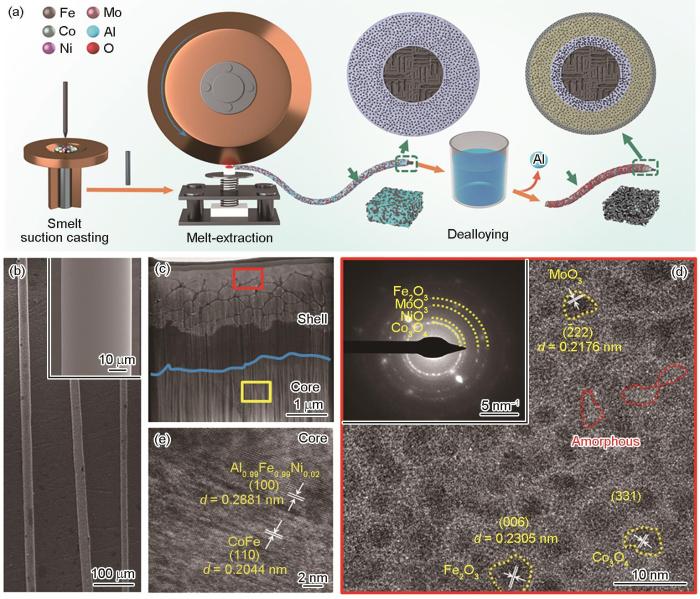
图1
Fe20Co20Ni20Mo20Al20高熵纤维材料的合成过程及形貌和结构表征[25]
Fig.1
Synthesis process, morphology, and structural characterization of Fe20Co20Ni20Mo20Al20 high-entropy fiber[25]
(a) synthesis pathway of the fiber (Step 1: smelt suction casting; Step 2: melt-extraction; Step 3: dealloying)
(b) SEM image of the fibers (Inset is magnified morphology)
(c) TEM image of Fe20Co20Ni20Mo20Al20 high-entropy fiber with core-shell structure, where the boundary of the core-shell structure is noted by the blue line
(d) HRTEM image of the shell indicated by red rectangle area in Fig.1c (Inset is corresponding selected area electron diffrac-tion (SAED) pattern, where yellow-colored dashed circles are used to emphasize the nano-crystallites of Fe, Co, Ni, and Mo oxides that are 3-4 nm in size. d—interplanar spacing)
(e) HRTEM image of the crystalline core indicated by yellow rectangle area in Fig.1c
该HEA制备方法将快速凝固冶金学原理融入高熵催化材料的设计之中。第一步的五元金属原料反复真空电弧熔炼,在高纯化学惰性气体保护下实现块体合金在热力学平衡态的极致均质化,消除宏观偏析,为后续处理提供了成分均匀的“理想前驱体”。第二步的熔体抽丝,是实现组织和形貌细化的关键。当高速旋转的冷水铜轮(线速度约30 m/s)接触均匀熔体表面时,极高的冷却速率(约106 K/s)迫使合金发生极端快速凝固,促使高混合熵效应主导下的单相固溶体在非平衡条件下被“冻结”于纤维基体(直径约30 μm)中,从而抑制成分偏析,形成结构稳定的高熵金属骨架(图1b[25])。在此基础上,通过温和酸洗选择性去除Al组分,通过控制刻蚀时间,在纤维表面原位构建出高比表面积的多孔壳层,而内部未被腐蚀的高熵合金芯则作为高导电骨架维持结构完整性(图1c~e[25])。所制备的高熵催化材料不仅提供了大量活性位点,而且优化了反应中间体的吸附行为,其纤维内部的高熵合金骨架更同步增强了材料的导电性和自支撑特性,从而为获得高效稳定的催化性能奠定了坚实的结构基础。
1.2 无压烧结制备高熵金属碳化物
过渡金属碳化物因具备超高硬度和优异的极端环境耐受性等特性,在超高温结构材料领域展现出重要潜力[26,27]。过渡金属碳化物的高熵化被视为进一步提升超高温碳化物综合性能的重要途径之一,然而高熵碳化物(high-entropy carbides,HECs)因强共价键、低原子扩散系数及高熔点等本征特性,导致利用常规无压烧结(pressureless sintering,PLS)难以实现有效致密化,使其内部存在大量孔隙,从而显著降低材料的强度、硬度等力学性能,并损害其结构完整性、环境屏障功能以及服役可靠性。在现有研究中,HECs的致密化通常依赖放电等离子烧结(spark plasma sintering,SPS)或热压(hot pressing,HP)等外加压力辅助手段实现。已有研究在2000 ℃以上通过SPS成功制备了数种致密的五元HECs,但此类方法存在着根本局限:(1) 所选用前驱体多为商用碳化物粉体,其O含量较高,易导致HECs中引入氧化物杂质相;(2) 高压过程抑制近净成形能力,限制复杂构件制造;(3) 高温高压虽能实现HECs的高度致密化,但也导致晶粒粗化(通常晶粒尺寸> 10 μm),损害材料力学性能[28,29]。
针对上述瓶颈,并基于PLS技术在降低制备成本及其近净成形方面的显著优势[30],本团队提出“成分设计与工艺耦合相结合”的策略,首次通过无压烧结实现了六元(TiZrHfVNbTa)C高熵碳化物的致密化制备[31],并系统研究了V含量对该材料单相形成能力、微观组织演变及力学性能的影响机制。首先,在粉体合成层面,摒弃商用碳化物,采用高纯氧化物为原料,通过真空碳热还原法自合成纳米级(65~92 nm)、低O含量(约0.2%,质量分数)混合碳化物粉末。该策略有效规避了商业粉体的杂质风险,并通过纳米尺度效应大幅提高比表面积和表面能,为无压烧结提供了驱动力。其次,在成分设计层面,引入V作为多维调控元素,系统揭示其在高熵体系中的作用。结果表明,V的引入可以优化体系的扩散动力学,加速烧结过程中的物质传输和孔隙排除,显著促进材料致密化进程:在2300 ℃烧结时,无V样品(HEC0V样品)的相对密度仅为85.7%,即使在2500 ℃烧结仍残留大量气孔;而含16.67%V (摩尔分数)的HEC16V样品在2300 ℃下已呈现高度致密的微观结构,其相对密度超过97.5% (图2a[31])。值得注意的是,V的引入还可以降低晶界迁移速率,有效抑制晶粒生长:HEC16V样品在2300 ℃下的平均晶粒尺寸仅为1.2 μm,优于传统方法制备的HECs (通常晶粒尺寸> 10 μm)。此外,V可以消除多元体系中的元素偏聚现象:HEC0V样品在2300 ℃烧结后存在明显的Nb元素偏析,局部Nb含量达27.0% (原子分数),显著偏离设计值20.0% (原子分数);而含V样品中,Ti、Zr、Hf、V、Nb、Ta六种元素在微观尺度上呈现高度均匀分布(图2b[31])。这表明V的加入能显著改善体系的元素扩散动力学,从而确保各元素在烧结过程中充分混合,最终形成成分均匀的单相固溶体结构。该研究证实利用无压烧结技术可成功制备兼具细晶粒和优异力学性能的(TiZrHfVNbTa)C材料,这一方法具有向其他高熵碳化物体系推广的重要价值。
图2
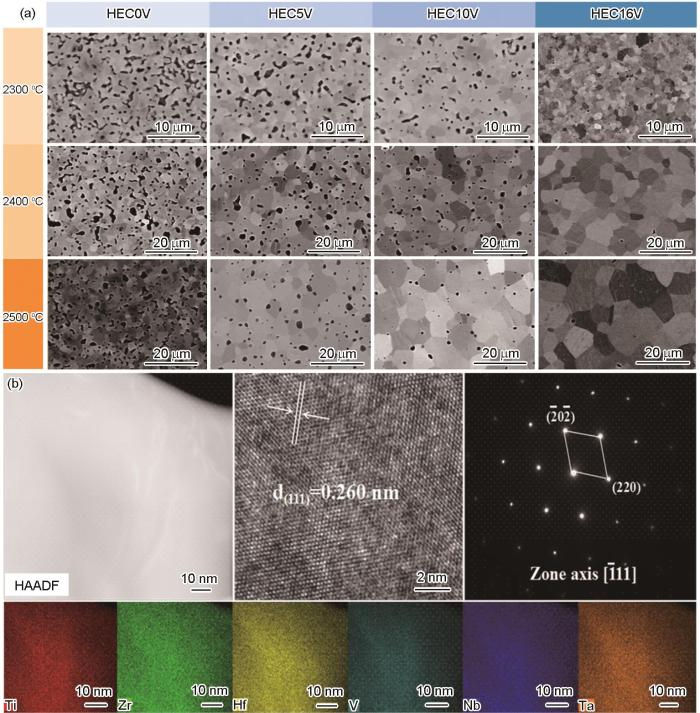
图2
(TiZrHfVNbTa)C高熵碳化物的微观形貌表征[31]
Fig.2
Microscopic morphology characterizations of (TiZrHfVNbTa)C high-entropy carbides (HECs)[31]
(a) SEM images of (TiZrHfVNbTa)C HECs with different V additions and sintering temperatures (Samples HEC0V, HEC5V, HEC10V, and HEC16V correspond to molar fractions of V in the HECs of 0%, 5%, 10%, and 16.67%, respectively)
(b) TEM characterizations of sample HEC16V at 2300 oC
1.3 固相合成辅以超声剥离制备二维高熵磷硫化物
能源催化本质上是界面过程,其效率高度依赖于活性位点的数量密度和本征活性。传统高熵材料虽凭借多组分协同效应展现出优异的吸附能调控能力,但其块体形态限制了活性位点的充分暴露。二维材料具有高比表面积和原子级厚度,为最大化暴露活性位点提供了理想平台。在各类过渡金属化合物中,二维金属磷硫化物(MPCh3)因其独特的层状结构、良好的物理化学特性和可调节的电荷态而被广泛研究[32]。然而,传统MPCh3的活性位点主要局限在材料边缘,基面则呈现较低的催化活性,这严重限制了其整体催化性能的进一步提升[32,33]。为解决上述难题,本团队提出“二维材料高熵化”的设计思想,将二维材料的结构效应与高熵材料中多元素协同的电子效应相结合,优化MPCh3的活性位点数量并提升其本征催化活性。然而,二维高熵磷硫化物的可控合成面临严峻挑战:一是在二维限域空间中实现多种金属元素的原子级均匀混合,避免相分离;二是传统合成方法(如溶剂热法、闪蒸Joule加热法、化学气相沉积等)难以同时实现对晶体结构、元素分布和二维形貌的精准调控。
本团队提出“固相合成辅以超声剥离”的策略,成功制备出系列二维高熵金属磷硫化物纳米片,如Co0.6(VMnNiZn)0.4PS3[12]、MnFeCuAgInPS3[34]等。该策略的核心在于:以层状CoPCh3晶体为结构模板,通过热力学驱动的固相反应实现多元素均匀固溶,获得高熵磷硫化物晶体,再通过动力学控制的超声过程实现二维层状结构的剥离。以Co0.6(VMnNiZn)0.4-PS3为例,首先通过理论计算筛选出离子半径相近、价态兼容的五种过渡金属元素(Co、V、Mn、Ni、Zn)建立材料模型(图3a[12]),确保其在PS3层内形成稳定的单相固溶体。在固相合成阶段,由于高温驱动及高熵体系显著增大的构型熵,可有效降低体系Gibbs自由能,使多组元原子均匀固溶,成功合成出单相、结晶性良好的块体高熵材料。值得注意的是,高熵掺杂不仅未破坏MPCh3的层状框架,反而可能通过晶格畸变引起层间Van der Waals力的改变,为后续剥离创造有利条件。在此基础上,采用液相超声辅助剥离技术,利用超声波在液体中产生的空化剪切力,克服层间Van der Waals力,成功将块体材料剥离为厚度为(2.8 ± 0.7) nm (对应3~4个原子层)、横向尺寸为400~500 nm的高熵Co0.6(VMnNiZn)0.4PS3纳米片(图3b和c[12])。该制备策略为二维层状高熵材料的开发提供了有效合成途径。
图3
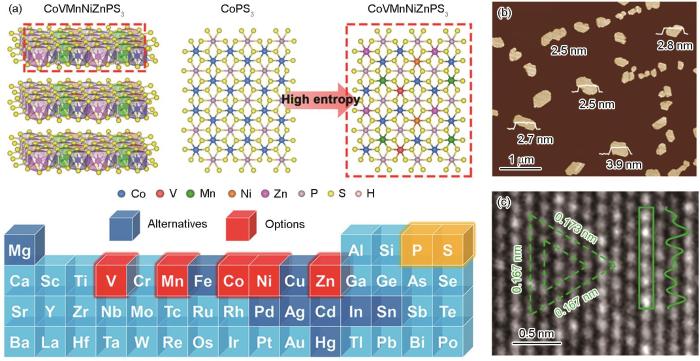
图3
CoVMnNiZnPS3二维高熵金属磷硫化物纳米片的理论计算、元素筛选策略及微观结构表征[12]
Fig.3
Theoretical calculations, element selection strategy, and microstructure characterization of CoVMnNiZnPS3 high-entropy metal phosphorus trichalcogenide nanosheets[12]
(a) density function theory (DFT)-calculated structure and element selection strategy
(b, c) AFM (b) and HRTEM (c) images
1.4 金属有机框架(MOF)衍生制备高熵金属氧化物
高熵氧化物(high-entropy oxides,HEOs)因其独特的多阳离子组成,能够稳定存在于单一晶体结构之中,近年来在功能材料领域备受关注[35]。此类材料的核心优势在于其高构型熵所引发的熵稳定效应,可显著增强材料的结构稳定性。此外,HEOs中多种金属元素之间的协同作用可有效调控电子结构及晶格应变,有利于其在关键反应中的性能优化。然而,传统HEOs合成方法(如固相反应)通常需要较高的反应温度(> 1000 ℃),易导致体系发生相分离或挥发性元素损失,难以获得成分均匀的单相高熵结构[36]。MOF材料具有原子级分散的金属节点、高度有序的孔道结构以及可定制的化学组成等特点,其出色的结构和组分可扩展性为多种金属元素在同一MOF晶体中的均匀组装创造了便利条件。因此,高熵MOF成为构建HEOs的理想前驱体平台[37]。MOF衍生法为HEOs的制备提供了一条兼具结构导向性与组分精准控制的技术路径。
普鲁士蓝类似物(prussian blue analogue,PBA)是一种典型的MOF材料,因其无机氰基桥连结构、开放骨架和优异的多金属兼容性,成为常见的衍生物前驱体。基于此,本团队提出以高熵化的PBA为前驱体,通过低温热解制备高熵尖晶石氧化物的方法。以高熵(CoFeNiMnW)3O4的合成为例[38],采用Co-PBA为前驱体结构主体,将Co部分替换为Fe、Ni、Mn、W等元素,通过共沉淀法同时将五种金属离子在分子尺度上均匀整合于Co-PBA骨架中,形成高熵CoFeNiMnW-PBA前驱体。此过程的关键在于,PBA的氰基桥连网络天然具备容纳不同价态和离子半径金属的能力,而柠檬酸钠等螯合剂的引入进一步调控了成核动力学,有效抑制了局部过饱和导致的成分偏析。其次,在热转化阶段,PBA前驱体中氰基配体在相对温和的温度下(400 ℃)完全分解,同时得益于MOF的限域效应,原子级混合的金属离子被原位氧化、成核,生长为单相尖晶石结构的高熵(CoFeNiMnW)3O4纳米晶,并较好地保持了PBA前驱体的立方形貌特征。该研究[38]表明,MOF衍生策略是制备组分均匀且结构可控的高熵氧化物的有效方法,这不仅为深入理解高熵材料的性能调控机制提供了重要依据,同时也为其他高熵化合物的制备开辟了新思路。
2 高熵材料的性能调控机制
在实现高熵金属及其化合物可控制备的基础上,深入理解其性能调控的内在机制对于材料设计和优化至关重要。高熵化不仅是一种成分设计策略,更通过多组元协同效应在原子尺度上调控材料的电子结构、晶格参数和热力学稳定性,从而赋予材料独特的物理化学特性。
2.1 金属高熵化激活材料惰性基面
高熵化通过引入多种金属阳离子诱发局部晶格畸变,能够显著调控材料活性位点的电子状态,进而影响其催化行为。以二维层状高熵金属磷硫化物为例[12],传统单金属磷硫化物(如CoPS3)的基面通常表现为催化惰性,仅边缘位点具有活性[39]。通过构建Co0.6(VMnNiZn)0.4PS3高熵体系,多重金属原子的随机分布会诱导产生明显的晶格畸变和拉伸应变,这一独特结构有效调控了材料表面的电荷分布,特别是优化了基面P位点和边缘S位点的电子结构。相较于单金属磷硫化物,高熵化使P和S位点的电子密度显著增加,从而优化了对氢中间体的吸附行为,成功将原本惰性的基面转变为高效催化活性位点(图4a~c[12])。该机制表明,高熵策略可通过调整局部应力应变和电子结构,有效增加二维材料的活性位点密度并提升其本征活性,为设计高效二维催化材料提供新途径。
图4

图4
Co0.6(VMnNiZn)0.4PS3的元素结合能、表面位点模型和析氢反应自由能[12]及Co3O4、(CoFeNi)3O4和(CoFeNiMnW)3O4的电子态特征分析[38]
Fig.4
Analyses of the elemental binding energy, surface site model, and hydrogen evolution reaction free energy of Co0.6-(VMnNiZn)0.4PS3[12]; and the electronic state characteristics of Co3O4, (CoFeNi)3O4, and (CoFeNiMnW)3O4[38] (a-c) binding energies of P and S 2p3/2 orbitals (a), basal-plane models of P sites (P1-P3) and S sites (S1-S9) (b), and H* adsorption free energy (ΔGH*) diagrams of corresponding sites in Fig.4b (c) in Co0.6(VMnNiZn)0.4PS3[12] (d, e) partial density of states (PDOS) (d) and energy gap between the average metal (M) d-band center (εd) and O p-band center (εp) (e) of Co3O4, (CoFeNi)3O4, and (CoFeNiMnW)3O4[38] (E—energy, Ef—Fermi level)
2.2 金属高熵化调节金属—氧(M —O)共价性
在氧化物催化体系中,M—O键的共价性强弱直接影响催化反应的路径和效率。高熵氧化物通过多组元协同效应,可在原子尺度调控M—O键的电子结构,进而影响其共价性。以尖晶石型高熵氧化物(CoFeNiMnW)3O4为例[38],高熵化可显著提升O位点的电子密度,增强M—O键的共价性,从而促进晶格O的活化。理论计算结果表明,多金属组分的引入导致d带中心分化,促使金属d轨道与O p轨道发生强杂化,从而增强M—O键的共价性。而相较于中熵结构,高熵化缩小了金属平均d带中心与O p带中心之间的能隙,使M—O键的整体共价性调至最优区间(图4d和e[38])。高熵化引起的M—O共价性优化不仅促进了晶格O的适度活化,还抑制了过度O流失所导致的结构失稳,为构建兼具高活性与高稳定性的氧化物催化剂提供了设计依据。
2.3 金属高熵化协同增强材料结构稳定性
3 结论和展望
本文针对高熵材料合成过程中面临的多组元易相分离难题,系统总结了近年来本课题组发展的创新合成策略:熔体抽丝法利用极端非平衡凝固的“冻结”效应,通过抑制组元扩散动力学克服高熵合金的热力学偏析倾向,实现了微观尺度组分均质化;无压烧结工艺通过引入纳米粉体与成分设计,优化体系的扩散动力学,消除元素偏聚,在相对较低的温度下获得了致密的单相高熵碳化物;固相合成结合超声剥离的策略,关键在于通过元素的筛选保障层内元素原子级混合,然后利用层状结构的空间约束和高熵稳定效应,制备出结构完整的二维高熵磷硫化物;MOF衍生法则借助分子级金属锚定和限域热解锁定多组分均匀分布,在低温下精准合成单相高熵尖晶石氧化物。基于上述可控合成,我们进一步揭示了高熵化对材料性能的调控机制:高熵磷硫化物中多元素引入引发的晶格畸变和电子结构调制,成功地将传统材料的惰性基面激活为高效催化中心;高熵尖晶石氧化物中多元金属的协同作用,将金属—O键的共价性调节至最优区间,平衡了反应活性和结构稳定性;而高熵合金的熵稳定效应和迟滞扩散效应则从热力学维度保障了材料在苛刻环境下的耐久性。因此,高熵化不仅是一种成分设计策略,更是一种能够同时调控材料电子状态、化学键合强度及相稳定性的有效手段。高熵材料可控制备策略的发展将极大拓展高熵材料的种类及组成,为其在能源催化领域的应用奠定坚实基础。
未来高熵材料的研究可从以下方向进一步拓展和深化。首先,在材料设计方面,当前高性能高熵材料的探索高度依赖经验试错和有限的组分筛选。借助数据驱动策略,构建“理论计算-机器学习-实验验证”相结合的研究范式,有望实现对材料性能的高效预测和结构优化,从而加速新材料的设计和发现。在材料合成方面,现有制备方法的原理可延伸至更多高熵体系(如氮化物、磷化物、硼化物等),推动具有新功能的高熵材料发展,拓展其在能源、催化等领域的应用空间。最后,在构效关系认知上,应深入探究反应过程中活性位点的动态演变、中间体在多重吸附位点的竞争机制,以及熵效应对相变行为的微观影响等关键科学问题,从而为理性设计高性能高熵催化材料提供重要的理论依据。
参考文献
Strategies for improving the sustainability of structural metals
[J].
Boosting hydrogen transfer during volmer reaction at oxides/metal nanocomposites for efficient alkaline hydrogen evolution
[J].
2D transition metal dichalcogenides: Design, modulation, and challenges in electrocatalysis
[J].
Modifying redox properties and local bonding of Co3O4 by CeO2 enhances oxygen evolution catalysis in acid
[J].
Developing efficient and stable earth-abundant electrocatalysts for acidic oxygen evolution reaction is the bottleneck for water splitting using proton exchange membrane electrolyzers. Here, we show that nanocrystalline CeO2 in a Co3O4/CeO2 nanocomposite can modify the redox properties of Co3O4 and enhances its intrinsic oxygen evolution reaction activity, and combine electrochemical and structural characterizations including kinetic isotope effect, pH- and temperature-dependence, in situ Raman and ex situ X-ray absorption spectroscopy analyses to understand the origin. The local bonding environment of Co3O4 can be modified after the introduction of nanocrystalline CeO2, which allows the CoIII species to be easily oxidized into catalytically active CoIV species, bypassing the potential-determining surface reconstruction process. Co3O4/CeO2 displays a comparable stability to Co3O4 thus breaks the activity/stability tradeoff. This work not only establishes an efficient earth-abundant catalysts for acidic oxygen evolution reaction, but also provides strategies for designing more active catalysts for other reactions.
Nanostructured high-entropy alloys with multiple principal elements: Novel alloy design concepts and outcomes
[J].
Alloy design strategies and future trends in high-entropy alloys
[J].
Clarifying the four core effects of high-entropy materials
[J].
High entropy oxides: The role of entropy, enthalpy and synergy
[J].
Strength enhancement and slip behaviour of high-entropy carbide grains during micro-compression
[J].Bulk polycrystalline high-entropy carbides are a newly developed group of materials that increase the limited compositional space of ultra-high temperature ceramics, which can withstand extreme environments exceeding 2000 °C in oxidizing atmospheres. Since the deformability of grains plays an important role in macromechanical performance, in this work we studied the strength and slip behaviour of grains of a spark-plasma sintered (Hf-Ta-Zr-Nb)C high-entropy carbide in a specific orientation during micropillar compression. For comparison, identical measurements were carried out on the monocarbides HfC and TaC. It was revealed that (Hf-Ta-Zr-Nb)C had a significantly enhanced yield and failure strength compared to the corresponding base monocarbides, while maintaining a similar ductility to the least brittle monocarbide (TaC) during the operation of [Formula: see text] slip systems. Additionally, it was concluded that the crystal orientation and stress conditions determine the operation of slip systems in mono- and high-entropy carbides at room temperature.
High-entropy monoborides: Towards superhard materials
[J].
Two-dimensional high-entropy metal phosphorus trichalcogenides for enhanced hydrogen evolution reaction
[J].
Sub-3 nm high-entropy alloy nanoparticles with triple functionalities for efficient electrolytic hydrogen production
[J].
Novel P2-type layered medium-entropy ceramics oxide as cathode material for sodium-ion batteries
[J].High-entropy oxides (HEOs) and medium-entropy oxides (MEOs) are new types of single-phase solid solution materials. MEOs have rarely been reported as positive electrode material for sodium-ion batteries (SIBs). In this study, we first proposed the concept of the application of MEOs in SIBs. P2-type 3-cation oxide Na2/3Ni1/3Mn1/3Fe1/3O2 (NaNMF) and 4-cation oxide Na2/3Ni1/3Mn1/3Fe1/3−xAlxO2 (NaNMFA) were prepared using the solid-state method, rather than the doping technology. In addition, the importance of the concept of entropy stabilization in material performance and battery cycling was demonstrated by testing 3-cation (NaNMF) and 4-cation (NaNMFA) oxides in the same system. Thus, NaNMFA can provide a reversible capacity of about 125.6 mAh·g−1 in the voltage range of 2–4.2 V, and has enhanced cycle stability. The capacity and decay law of the MEO batteries indicate that the configurational entropy (1.28 R (NaNMFA) > 1.10 R (NaNMF)) of the cationic system, is the main factor affecting the structural and cycle stability of the electrode material. This work emphasizes that the rational design of MEOs with novel structures and different electrochemically active elements may be the strategy for exploring high-performance SIB cathode materials in next-generation energy storage devices.
Order-to-disorder transition due to entropy in layered and 2D carbides
[J].\n In compositionally complex materials, there is controversy on the effect of enthalpy versus entropy on the structure and short-range ordering in so-called high-entropy materials. To help address this controversy, we synthesized and probed 40 M\n 4\n AlC\n 3\n layered carbide phases containing two to nine metals and found that short-range ordering from enthalpy was present until the entropy increased enough to achieve complete disordering of the transition metals in their atomic planes. We transformed all of these layered carbide phases into two-dimensional (2D) sheets and showed the effects of the order versus disorder on their surface properties and electronic behavior. This study suggests the key effect that the competition between enthalpy and entropy has on short-range order in multicompositional materials.\n
Isothermal solidification for high-entropy alloy synthesis
[J].
Machine-learning design of ductile FeNiCoAlTa alloys with high strength
[J].
Negative mixing enthalpy alloying to promote the development of alloys with high strength and ductility
[J].Achieving a synergistic improvement in the strength and ductility of metallic materials has long been a central challenge in materials science. Dislocation mobility limits both properties, making it difficult to strike a balance between them. The advent of multi-principal element alloys (also known as high-entropy alloys) offers a promising solution to this issue. Compared with conventional solid solution strengthened alloys, multi-principal element alloys exhibit greater lattice distortion. Consequently, dislocation movement must overcome higher and more frequent energy fluctuations, which consumes more energy. This increase in flow stress with increasing strain allows certain alloys to achieve enhanced work hardening capacity, leading to simultaneous improvements in both strength and ductility. However, two critical scientific questions in this area warrant further investigation: (1) Are multi-principal element alloys purely ideal random mixed structures, or is standardizing their local or multi-level microstructures necessary to achieve optimal performance? (2) How can we effectively standardize and regulate the microstructures of multi-principal element alloys? This study addresses these questions by proposing the concept of using negative mixing enthalpy (negative-enthalpy) alloying to standardize and regulate the microstructure of multi-principal element alloys. This study systematically explores how negative-enthalpy alloying can synergistically enhance strength and ductility while revealing new mechanisms of strengthening and toughening. Negative-enthalpy alloying affects the microstructure of metallic materials through three main effects: bond energy and slow diffusion, local chemical ordering, and interface and size effects. This approach provides a novel framework for designing and processing the microstructures of high-strength, high-ductility metallic materials at the atomic scale.
负混合焓合金化推动高强韧合金发展
[J].金属材料强度与塑性的协同提升始终是材料科学领域的核心挑战。由于材料的强度和塑性受位错可动性制约,2者通常难以协同兼顾,多主元合金(高熵合金)的出现为走出这一困境提供了新思路。相对于常规的固溶强化合金,多主元合金具有更大的晶格畸变,位错运动需要克服更高和更频繁的能量起伏,耗费更大的能量,合金流变应力随应变增加而增加,使得一些合金获得了较大加工硬化能力和强塑性协同提升。然而,该领域至少存在2个关键科学问题需要深入研究:(1) 多主元合金是完全理想的随机混合结构吗?是否需要规范其局域乃至多级微观结构来实现优异性能?(2) 如何规范和调控多主元合金微观结构?本文从规范和调控多主元合金微观结构出发,提出用负混合焓(负焓)合金化方法在原子尺度加工合金微观结构的学术思想,系统阐述利用负焓合金化方法实现合金强度与塑性协同提升,并揭示强韧化新机理。负焓合金化具有金属材料微观结构调控的3重效应:键能与慢扩散效应、局部化学有序效应、界面和尺寸效应,其为高强韧金属材料的微观结构在原子尺度设计加工提供了新维度和新范式。
Achieving alloys with concurrent high strength and high ductility
[J].Increasing the yield strength of metallic materials is observed to almost always substantially reduce their tensile ductility. Here we unravel the origin of this perplexing “strength-ductility trade-off”, and conclude that this dilemma does not necessarily preclude concurrent high strength and high ductility. We discuss several strengthening and work hardening mechanisms that regulate dislocation behavior, including traditional ones that have been pushed to their extreme in recent years, as well as new ones that take advantage of the heightened structural and chemical heterogeneities; all these mechanisms are rendered more powerful by emerging complex concentrated alloys that bring in multiple principal elements. These mechanisms, while offering elevated strength, contribute to sustainable strain hardening under high flow stresses, delaying strain localization to allow prolonged uniform elongation. The current status in the pursuit for concurrent high strength and high ductility is reviewed. The goal we set for high yield strength ~2 GPa (rivaling super steels) together with large uniform elongation ~30% (much like un-strengthened elemental metals) is projected to be soon within reach. These take-home messages shed light on some existing puzzles regarding the strength-ductility synergy, and offer new insight into the innovative design of alloys.
如何使合金兼具高强度与高塑性
[J].
Hierarchical lamellar heterostructure design renders metallic materials with ultrahigh strength-ductility combinations
[J].“Heterogeneous structures” or “heterostructures” have emerged as a cutting-edge paradigm in the field of mechanical strengthening and toughening, promising to overcome the long-standing trade-offs among strength, ductility, and toughness in metallic materials. Inspired by the multiscale design principle of natural materials, researchers have proposed a synergistic design of bioinspired “hierarchical lamellar heterostructures”, enabling exceptional and simultaneous enhancements in the strength, ductility, and toughness of metallic materials. This study reviews the theoretical foundations, design principles, and strengthening-toughening mechanisms underpinning several archetypal hierarchical lamellar heterostructures: bionic herringbone type, micro-lamellar heredity pattern, and cocoon-like dislocation network model. This review focuses on how these hierarchical lamellar heterostructures effectively overcome the strength-ductility trade-off limitations imposed by uncontrolled crack propagation, ultrafine grain structures, and high-density dislocations. It also elucidates how this heterostructure strategy and its remarkable efficacy have been successfully extended to multiple metal systems, enabling the design and fabrication of a new generation of key high-speed railway contact wires with internationally leading comprehensive performance. Finally, the review discusses the prospects for developing more advanced hierarchical lamellar heterostructured materials and explores their potential future directions.
多级层片异构设计构筑超高强塑性金属材料
[J].“异质结构”或“异构”作为强韧化领域前沿构型范式,为突破金属材料的强度、塑性与韧性等难以兼顾的矛盾提供了全新的解决思路。受天然材料的跨尺度构筑启发,本研究团队提出了仿生“多级层片异构”的协同设计策略,且实现了更突出的强-塑-韧性同步提升。本文主要聚焦本研究团队多年来在多级层片异构金属材料方面的研究进展,提炼了仿生鱼骨型、微层片遗传型、蚕茧位错网型等典型多级层片异质结构的理念、设计原理和强韧化机制,重点回顾了如何有效突破不可控裂纹、超细晶组织以及高密度位错诱导的强塑性掣肘难题,并将该新型异构策略和相应的突出性能改善成功拓展至多金属体系,制备出新一代高铁关键接触线材,综合性能国际领先。最后,展望了更先进的多级层片异构材料的开发及未来潜在发展方向。
High-entropy materials: From bulk to sub-nano
[J].
Facile and general method to synthesize Pt-based high-entropy-alloy nanoparticles
[J].Pt-based high-entropy-alloy nanoparticles (HEA-NPs) have excellent physical and chemical properties due to the diversity of composition, complexity of surface structure, high mixing entropy, and properties of nanoscale, and they are used in a wide range of catalytic applications such as catalytic ammoxidation, the electrolysis of water to produce hydrogen, CO/CO reduction, and ethanol/methanol oxidation reaction. However, offering a facile, low-cost, and large-scale method for preparing Pt-based HEA-NPs still faces great challenges. In this study, we employed a spray drying technique combined with thermal decomposition reduction (SD-TDR) method to synthesize a single-phase solid solution from binary nanoparticles to denary Pt-based HEA-NPs containing 10 dissimilar elements loaded on carbon supports in an H atmosphere with a moderate heating rate (3 °C/min), thermal decomposition temperature (300-850 °C), duration time (30 min), and low cooling rate (5-10 °C/min). The Pt autocatalytic behavior was found and investigated, confirming that Pt element could decrease the reduction temperature of other metals via autocatalytic behavior. Therefore, using the feature of Pt autocatalytic behavior, we have achieved Pt-based HEA-NPs at a minimum temperature of 300 °C. We not only prepared a series of Pt-based HEA-NPs with targetable ingredient, size, and phase using the SD-TDR method but also proved the expandability of the SD-TDR technique by synthesizing Pt-based HEA-NPs loaded on different supports. Moreover, we investigated methanol oxidation reaction (MOR) on as-synthesized senary PtCoCuRuFeNi HEA-NPs, which presented superior electrocatalytic performance over commercial Pt/C catalyst.
Continuous-flow reactor synthesis for homogeneous 1 nm-sized extremely small high-entropy alloy nanoparticles
[J].
Efficient FeCoNiCuPd thin-film electrocatalyst for alkaline oxygen and hydrogen evolution reactions
[J].
Cost-effective high entropy core-shell fiber for stable oxygen evolution reaction at 2 A cm-2
[J].
A novel strategy for preparing high-entropy ceramics through full glass crystallization
[J].
Phase stability and mechanical properties of novel high entropy transition metal carbides
[J].Twelve different equiatomic five-metal carbides of group IVB, VB, and VIB refractory transition metals are synthesized via high-energy ball milling and spark plasma sintering. Implementation of a newly developed ab initio entropy descriptor aids in selection of candidate compositions for synthesis of high entropy and entropy stabilized carbides. Phase formation and composition uniformity are analyzed via XRD, EDS, STEM-EDS, and EXAFS. Nine of the twelve candidates form true single-phase materials with the rocksalt (B1) structure when sintered at 2473 K and can therefore be investigated as high entropy carbides (HECs). The composition (V0.2Nb0.2Ta0.2Mo0.2W0.2)C is presented as a likely candidate for further investigation as an entropy stabilized carbide. Seven of the carbides are examined for mechanical properties via nanoindentation. The HECs show significantly enhanced hardness when compared to a rule of mixtures average of the constituent binary carbides and to the highest hardness of the binary constituents. The mechanical properties are correlated to the electronic structure of the solid solutions, offering a future route to tunability of the mechanical properties of carbide ceramics via exploration of a new complex composition space. (C) 2018 Acta Materialia Inc. Published by Elsevier Ltd.
High-entropy high-hardness metal carbides discovered by entropy descriptors
[J].High-entropy materials have attracted considerable interest due to the combination of useful properties and promising applications. Predicting their formation remains the major hindrance to the discovery of new systems. Here we propose a descriptor-entropy forming ability-for addressing synthesizability from first principles. The formalism, based on the energy distribution spectrum of randomized calculations, captures the accessibility of equally-sampled states near the ground state and quantifies configurational disorder capable of stabilizing high-entropy homogeneous phases. The methodology is applied to disordered refractory 5-metal carbides-promising candidates for high-hardness applications. The descriptor correctly predicts the ease with which compositions can be experimentally synthesized as rock-salt high-entropy homogeneous phases, validating the ansatz, and in some cases, going beyond intuition. Several of these materials exhibit hardness up to 50% higher than rule of mixtures estimations. The entropy descriptor method has the potential to accelerate the search for high-entropy systems by rationally combining first principles with experimental synthesis and characterization.
High entropy carbide ceramics from different starting materials
[J].
Pressureless sintering of submicron titanium carbide powders
[J].
Influence of vanadium content on the microstructural evolution and mechanical properties of (TiZrHfVNbTa)C high-entropy carbides processed by pressureless sintering
[J].A series of (TiZrHfVNbTa)C high-entropy ceramics with different vanadium contents have been fabricated by pressureless sintering at 2300 degrees C-2500 degrees C for 1 h, utilizing self-synthesized carbide powders obtained by carbothermal reduction. The addition of vanadium is beneficial to promote densification process and refine grain, as well as facilitate the homogeneous distribution of metal elements. The distribution of pores is also modified, almost entirely existing at grain boundary, and the integral mechanical properties achieve optimization. However, excess adding vanadium does not favor forming a single-phase (TiZrHfVNbTa)C high-entropy ceramic. The optimal (TiZrHfVNbTa)C high-entropy ceramic sintered at 2300 degrees C possesses a high relative density of 97.5 % and homogeneous microstructure with small grain size of 1.2 mu m. The flexural strength and Vickers hardness reach 473 MPa and 24.9 GPa, respectively. This work has established a cost-effective and convenient preparation of novel (TiZrHfVNbTa)C high-entropy carbide ceramics.
Metal phosphorous trichalcogenides (MPCh3): From synthesis to contemporary energy challenges
[J].Owing to their unique physical and chemical properties, layered two-dimensional (2D) materials have been established as the most significant topic in materials science for the current decade. This includes layers comprising mono-element (graphene, phosphorene), di-element (metal dichalcogenides), and even multi-element. A distinctive class of 2D layered materials is the metal phosphorous trichalcogenides (MPCh, Ch=S, Se), first synthesized in the late 1800s. Having an unusual intercalation behavior, MPCh were intensively studied in the 1970s for their magnetic properties and as secondary electrodes in lithium batteries, but fell from scrutiny until very recently, being 2D nanomaterials. Based on their synthesis and most significant properties, the present surge of reports related to water-splitting catalysis and energy storage are discussed in detail. This Minireview is intended as a baseline for the anticipated new wave of researchers who aim to explore these 2D layered materials for their electrochemical energy applications.© 2019 Wiley-VCH Verlag GmbH & Co. KGaA, Weinheim.
Tuning mixed nickel iron phosphosulfide nanosheet electrocatalysts for enhanced hydrogen and oxygen evolution
[J].
Entropy engineering on 2D metal phosphorus trichalcogenides for surface-enhanced Raman scattering
[J].
High-entropy oxides: Fundamental aspects and electrochemical properties
[J].
Rapid Joule-heating synthesis for manufacturing high-entropy oxides as efficient electrocatalysts
[J].High-entropy oxide (HEO) including multiple principal elements possesses great potential for various fields such as basic physics, mechanical properties, energy storage, and catalysis. However, the synthesis method of high-entropy compounds through the traditional heating approach is not conducive to the rapid properties screening, and the current elemental combinations of HEO are also highly limited. Herein, we report a rapid synthesis method for HEO through the Joule-heating of nickel foil with dozens of seconds. High-entropy rocksalt oxides (HERSO) with the new elemental combination, high-entropy spinel oxides (HESO), and high-entropy perovskite oxide (HEPO) have been synthesized through the Joule-heating. The synthesized HERSO with new elemental combinations proves to be a great promotion of OER activity due to the synergy of multiple components and the continuous electronic structure experimentally and theoretically. The demonstrated synthesis approach and the new component combination of HERSO provide a broad platform for the development of high-entropy materials and catalysts.
MOF derived metal oxide composites and their applications in energy storage
[J].
High-entropy engineering of cobalt spinel oxide breaks the activity-stability trade-off in oxygen evolution reaction
[J].
Activation of hidden catalytic sites in 2D basal plane via p-n heterojunction interface engineering toward efficient oxygen evolution reaction
[J].
Application and development of PEM water electrolysis technology in the aerospace field
[J].
PEM水电解技术在航天领域的应用与发展
[J].


