Additive manufacturing of 18% nickel maraging steels: Defect, structure and mechanical properties: A review
1
2022
... 马氏体时效不锈钢是一类高强度低碳钢,广泛应用于航空航天、汽车工业、海洋及船舶等领域[1,2].Cr-Ni-Co-Mo马氏体时效不锈钢是在析出强化型马氏体时效不锈钢基础上通过增加Co、Mo和Si等元素含量,并降低Ti元素含量而发展起来的固溶强化型马氏体时效不锈钢,其室温屈服强度可以达到1100~1300 MPa.同时,以固溶强化代替析出强化,在保证高强度的同时避免析出相作为裂纹源损伤材料的韧性.然而,与高强度低合金(HSLA)钢相比,马氏体时效不锈钢的组织演化复杂且在实际服役环境中易发生晶间腐蚀或点蚀[3,4].因此,合理地设计热处理工艺,调控马氏体时效不锈钢多级组织形态,阐明显微组织与耐腐蚀性能间的内在关联,对于其在恶劣环境下的长期服役具有重要意义. ...
Microstructural evolution and mechanical properties of a newly designed steel fabricated by laser powder bed fusion
1
2020
... 马氏体时效不锈钢是一类高强度低碳钢,广泛应用于航空航天、汽车工业、海洋及船舶等领域[1,2].Cr-Ni-Co-Mo马氏体时效不锈钢是在析出强化型马氏体时效不锈钢基础上通过增加Co、Mo和Si等元素含量,并降低Ti元素含量而发展起来的固溶强化型马氏体时效不锈钢,其室温屈服强度可以达到1100~1300 MPa.同时,以固溶强化代替析出强化,在保证高强度的同时避免析出相作为裂纹源损伤材料的韧性.然而,与高强度低合金(HSLA)钢相比,马氏体时效不锈钢的组织演化复杂且在实际服役环境中易发生晶间腐蚀或点蚀[3,4].因此,合理地设计热处理工艺,调控马氏体时效不锈钢多级组织形态,阐明显微组织与耐腐蚀性能间的内在关联,对于其在恶劣环境下的长期服役具有重要意义. ...
Beneficial effect of reversed austenite on the intergranular corrosion resistance of martensitic stainless steel
1
2019
... 马氏体时效不锈钢是一类高强度低碳钢,广泛应用于航空航天、汽车工业、海洋及船舶等领域[1,2].Cr-Ni-Co-Mo马氏体时效不锈钢是在析出强化型马氏体时效不锈钢基础上通过增加Co、Mo和Si等元素含量,并降低Ti元素含量而发展起来的固溶强化型马氏体时效不锈钢,其室温屈服强度可以达到1100~1300 MPa.同时,以固溶强化代替析出强化,在保证高强度的同时避免析出相作为裂纹源损伤材料的韧性.然而,与高强度低合金(HSLA)钢相比,马氏体时效不锈钢的组织演化复杂且在实际服役环境中易发生晶间腐蚀或点蚀[3,4].因此,合理地设计热处理工艺,调控马氏体时效不锈钢多级组织形态,阐明显微组织与耐腐蚀性能间的内在关联,对于其在恶劣环境下的长期服役具有重要意义. ...
Effect of chemical passivation treatment on pitting corrosion resistance of AISI 410 and 17-4 PH stainless steels
1
2017
... 马氏体时效不锈钢是一类高强度低碳钢,广泛应用于航空航天、汽车工业、海洋及船舶等领域[1,2].Cr-Ni-Co-Mo马氏体时效不锈钢是在析出强化型马氏体时效不锈钢基础上通过增加Co、Mo和Si等元素含量,并降低Ti元素含量而发展起来的固溶强化型马氏体时效不锈钢,其室温屈服强度可以达到1100~1300 MPa.同时,以固溶强化代替析出强化,在保证高强度的同时避免析出相作为裂纹源损伤材料的韧性.然而,与高强度低合金(HSLA)钢相比,马氏体时效不锈钢的组织演化复杂且在实际服役环境中易发生晶间腐蚀或点蚀[3,4].因此,合理地设计热处理工艺,调控马氏体时效不锈钢多级组织形态,阐明显微组织与耐腐蚀性能间的内在关联,对于其在恶劣环境下的长期服役具有重要意义. ...
Alloying element segregation effect in a multi-phase strengthened maraging stainless steel
1
2016
... 影响金属材料耐腐蚀性能的因素包括:(1) 合金元素的种类及含量,如添加Cr、Mo、Al等元素有助于提高表面钝化膜的致密性和稳定性,提高对基体的保护作用[5~7];(2) 晶粒尺寸,晶界可作为离子运动的快速通道,加速钝化膜的形成[8,9]或促进晶间腐蚀的发生[10];(3) 物相组成,如析出相周围形成贫Cr或Mo区,导致材料的选择性腐蚀[11].为改善马氏体时效不锈钢的耐腐蚀性能,研究人员[12~14]针对组织演变与耐腐蚀性能的关系展开了广泛研究,发现晶粒细化和逆转变奥氏体的引入可提高马氏体时效不锈钢的抗Cl-侵蚀能力.Zhang等[12]通过添加Co元素使得马氏体时效不锈钢的原始奥氏体晶粒尺寸降低1/2,马氏体板条块尺寸细化至纳米级,自腐蚀电流降低(2.47 μA→2.01 μA),点蚀电位提高(0.12 V→0.27 V).Wang等[13]研究了两步时效处理对13Cr马氏体时效不锈钢逆转变奥氏体体积分数及耐Cl-腐蚀性能的影响,发现随逆转变奥氏体体积分数的增加,材料的抗点蚀能力提高.Song等[15]研究了时效温度对6Cr13马氏体时效不锈钢逆转变奥氏体稳定性及耐腐蚀性能的影响,发现耐腐蚀性能与逆转变奥氏体稳定性呈正相关.然而,这种通过增加时效时间或提高时效温度来提高逆转变奥氏体体积分数的方法往往会引起组织软化,导致材料强度降低[16]. ...
多相强化型马氏体时效不锈钢中的合金元素偏聚效应
1
2016
... 影响金属材料耐腐蚀性能的因素包括:(1) 合金元素的种类及含量,如添加Cr、Mo、Al等元素有助于提高表面钝化膜的致密性和稳定性,提高对基体的保护作用[5~7];(2) 晶粒尺寸,晶界可作为离子运动的快速通道,加速钝化膜的形成[8,9]或促进晶间腐蚀的发生[10];(3) 物相组成,如析出相周围形成贫Cr或Mo区,导致材料的选择性腐蚀[11].为改善马氏体时效不锈钢的耐腐蚀性能,研究人员[12~14]针对组织演变与耐腐蚀性能的关系展开了广泛研究,发现晶粒细化和逆转变奥氏体的引入可提高马氏体时效不锈钢的抗Cl-侵蚀能力.Zhang等[12]通过添加Co元素使得马氏体时效不锈钢的原始奥氏体晶粒尺寸降低1/2,马氏体板条块尺寸细化至纳米级,自腐蚀电流降低(2.47 μA→2.01 μA),点蚀电位提高(0.12 V→0.27 V).Wang等[13]研究了两步时效处理对13Cr马氏体时效不锈钢逆转变奥氏体体积分数及耐Cl-腐蚀性能的影响,发现随逆转变奥氏体体积分数的增加,材料的抗点蚀能力提高.Song等[15]研究了时效温度对6Cr13马氏体时效不锈钢逆转变奥氏体稳定性及耐腐蚀性能的影响,发现耐腐蚀性能与逆转变奥氏体稳定性呈正相关.然而,这种通过增加时效时间或提高时效温度来提高逆转变奥氏体体积分数的方法往往会引起组织软化,导致材料强度降低[16]. ...
Multiple oxidation mechanism of Al and Ti doping Haynes244 alloy under elevated temperature
0
2025
Effect of Cr addition on the corrosion behavior of twinning-induced plasticity steel
1
2023
... 影响金属材料耐腐蚀性能的因素包括:(1) 合金元素的种类及含量,如添加Cr、Mo、Al等元素有助于提高表面钝化膜的致密性和稳定性,提高对基体的保护作用[5~7];(2) 晶粒尺寸,晶界可作为离子运动的快速通道,加速钝化膜的形成[8,9]或促进晶间腐蚀的发生[10];(3) 物相组成,如析出相周围形成贫Cr或Mo区,导致材料的选择性腐蚀[11].为改善马氏体时效不锈钢的耐腐蚀性能,研究人员[12~14]针对组织演变与耐腐蚀性能的关系展开了广泛研究,发现晶粒细化和逆转变奥氏体的引入可提高马氏体时效不锈钢的抗Cl-侵蚀能力.Zhang等[12]通过添加Co元素使得马氏体时效不锈钢的原始奥氏体晶粒尺寸降低1/2,马氏体板条块尺寸细化至纳米级,自腐蚀电流降低(2.47 μA→2.01 μA),点蚀电位提高(0.12 V→0.27 V).Wang等[13]研究了两步时效处理对13Cr马氏体时效不锈钢逆转变奥氏体体积分数及耐Cl-腐蚀性能的影响,发现随逆转变奥氏体体积分数的增加,材料的抗点蚀能力提高.Song等[15]研究了时效温度对6Cr13马氏体时效不锈钢逆转变奥氏体稳定性及耐腐蚀性能的影响,发现耐腐蚀性能与逆转变奥氏体稳定性呈正相关.然而,这种通过增加时效时间或提高时效温度来提高逆转变奥氏体体积分数的方法往往会引起组织软化,导致材料强度降低[16]. ...
Cr添加对孪生诱发塑性钢腐蚀行为的影响
1
2023
... 影响金属材料耐腐蚀性能的因素包括:(1) 合金元素的种类及含量,如添加Cr、Mo、Al等元素有助于提高表面钝化膜的致密性和稳定性,提高对基体的保护作用[5~7];(2) 晶粒尺寸,晶界可作为离子运动的快速通道,加速钝化膜的形成[8,9]或促进晶间腐蚀的发生[10];(3) 物相组成,如析出相周围形成贫Cr或Mo区,导致材料的选择性腐蚀[11].为改善马氏体时效不锈钢的耐腐蚀性能,研究人员[12~14]针对组织演变与耐腐蚀性能的关系展开了广泛研究,发现晶粒细化和逆转变奥氏体的引入可提高马氏体时效不锈钢的抗Cl-侵蚀能力.Zhang等[12]通过添加Co元素使得马氏体时效不锈钢的原始奥氏体晶粒尺寸降低1/2,马氏体板条块尺寸细化至纳米级,自腐蚀电流降低(2.47 μA→2.01 μA),点蚀电位提高(0.12 V→0.27 V).Wang等[13]研究了两步时效处理对13Cr马氏体时效不锈钢逆转变奥氏体体积分数及耐Cl-腐蚀性能的影响,发现随逆转变奥氏体体积分数的增加,材料的抗点蚀能力提高.Song等[15]研究了时效温度对6Cr13马氏体时效不锈钢逆转变奥氏体稳定性及耐腐蚀性能的影响,发现耐腐蚀性能与逆转变奥氏体稳定性呈正相关.然而,这种通过增加时效时间或提高时效温度来提高逆转变奥氏体体积分数的方法往往会引起组织软化,导致材料强度降低[16]. ...
Microstructure, microhardness, and corrosion properties of nanocrystalline 304 stainless steel plates
1
... 影响金属材料耐腐蚀性能的因素包括:(1) 合金元素的种类及含量,如添加Cr、Mo、Al等元素有助于提高表面钝化膜的致密性和稳定性,提高对基体的保护作用[5~7];(2) 晶粒尺寸,晶界可作为离子运动的快速通道,加速钝化膜的形成[8,9]或促进晶间腐蚀的发生[10];(3) 物相组成,如析出相周围形成贫Cr或Mo区,导致材料的选择性腐蚀[11].为改善马氏体时效不锈钢的耐腐蚀性能,研究人员[12~14]针对组织演变与耐腐蚀性能的关系展开了广泛研究,发现晶粒细化和逆转变奥氏体的引入可提高马氏体时效不锈钢的抗Cl-侵蚀能力.Zhang等[12]通过添加Co元素使得马氏体时效不锈钢的原始奥氏体晶粒尺寸降低1/2,马氏体板条块尺寸细化至纳米级,自腐蚀电流降低(2.47 μA→2.01 μA),点蚀电位提高(0.12 V→0.27 V).Wang等[13]研究了两步时效处理对13Cr马氏体时效不锈钢逆转变奥氏体体积分数及耐Cl-腐蚀性能的影响,发现随逆转变奥氏体体积分数的增加,材料的抗点蚀能力提高.Song等[15]研究了时效温度对6Cr13马氏体时效不锈钢逆转变奥氏体稳定性及耐腐蚀性能的影响,发现耐腐蚀性能与逆转变奥氏体稳定性呈正相关.然而,这种通过增加时效时间或提高时效温度来提高逆转变奥氏体体积分数的方法往往会引起组织软化,导致材料强度降低[16]. ...
纳米晶304不锈钢板材微观组织、显微硬度与腐蚀性能
1
... 影响金属材料耐腐蚀性能的因素包括:(1) 合金元素的种类及含量,如添加Cr、Mo、Al等元素有助于提高表面钝化膜的致密性和稳定性,提高对基体的保护作用[5~7];(2) 晶粒尺寸,晶界可作为离子运动的快速通道,加速钝化膜的形成[8,9]或促进晶间腐蚀的发生[10];(3) 物相组成,如析出相周围形成贫Cr或Mo区,导致材料的选择性腐蚀[11].为改善马氏体时效不锈钢的耐腐蚀性能,研究人员[12~14]针对组织演变与耐腐蚀性能的关系展开了广泛研究,发现晶粒细化和逆转变奥氏体的引入可提高马氏体时效不锈钢的抗Cl-侵蚀能力.Zhang等[12]通过添加Co元素使得马氏体时效不锈钢的原始奥氏体晶粒尺寸降低1/2,马氏体板条块尺寸细化至纳米级,自腐蚀电流降低(2.47 μA→2.01 μA),点蚀电位提高(0.12 V→0.27 V).Wang等[13]研究了两步时效处理对13Cr马氏体时效不锈钢逆转变奥氏体体积分数及耐Cl-腐蚀性能的影响,发现随逆转变奥氏体体积分数的增加,材料的抗点蚀能力提高.Song等[15]研究了时效温度对6Cr13马氏体时效不锈钢逆转变奥氏体稳定性及耐腐蚀性能的影响,发现耐腐蚀性能与逆转变奥氏体稳定性呈正相关.然而,这种通过增加时效时间或提高时效温度来提高逆转变奥氏体体积分数的方法往往会引起组织软化,导致材料强度降低[16]. ...
Mechanical and electrochemical behavior of nanocrystalline surface of 304 stainless steel
1
2002
... 影响金属材料耐腐蚀性能的因素包括:(1) 合金元素的种类及含量,如添加Cr、Mo、Al等元素有助于提高表面钝化膜的致密性和稳定性,提高对基体的保护作用[5~7];(2) 晶粒尺寸,晶界可作为离子运动的快速通道,加速钝化膜的形成[8,9]或促进晶间腐蚀的发生[10];(3) 物相组成,如析出相周围形成贫Cr或Mo区,导致材料的选择性腐蚀[11].为改善马氏体时效不锈钢的耐腐蚀性能,研究人员[12~14]针对组织演变与耐腐蚀性能的关系展开了广泛研究,发现晶粒细化和逆转变奥氏体的引入可提高马氏体时效不锈钢的抗Cl-侵蚀能力.Zhang等[12]通过添加Co元素使得马氏体时效不锈钢的原始奥氏体晶粒尺寸降低1/2,马氏体板条块尺寸细化至纳米级,自腐蚀电流降低(2.47 μA→2.01 μA),点蚀电位提高(0.12 V→0.27 V).Wang等[13]研究了两步时效处理对13Cr马氏体时效不锈钢逆转变奥氏体体积分数及耐Cl-腐蚀性能的影响,发现随逆转变奥氏体体积分数的增加,材料的抗点蚀能力提高.Song等[15]研究了时效温度对6Cr13马氏体时效不锈钢逆转变奥氏体稳定性及耐腐蚀性能的影响,发现耐腐蚀性能与逆转变奥氏体稳定性呈正相关.然而,这种通过增加时效时间或提高时效温度来提高逆转变奥氏体体积分数的方法往往会引起组织软化,导致材料强度降低[16]. ...
The corrosion behavior of Fe-10Cr nanocrystalline coating
1
2006
... 影响金属材料耐腐蚀性能的因素包括:(1) 合金元素的种类及含量,如添加Cr、Mo、Al等元素有助于提高表面钝化膜的致密性和稳定性,提高对基体的保护作用[5~7];(2) 晶粒尺寸,晶界可作为离子运动的快速通道,加速钝化膜的形成[8,9]或促进晶间腐蚀的发生[10];(3) 物相组成,如析出相周围形成贫Cr或Mo区,导致材料的选择性腐蚀[11].为改善马氏体时效不锈钢的耐腐蚀性能,研究人员[12~14]针对组织演变与耐腐蚀性能的关系展开了广泛研究,发现晶粒细化和逆转变奥氏体的引入可提高马氏体时效不锈钢的抗Cl-侵蚀能力.Zhang等[12]通过添加Co元素使得马氏体时效不锈钢的原始奥氏体晶粒尺寸降低1/2,马氏体板条块尺寸细化至纳米级,自腐蚀电流降低(2.47 μA→2.01 μA),点蚀电位提高(0.12 V→0.27 V).Wang等[13]研究了两步时效处理对13Cr马氏体时效不锈钢逆转变奥氏体体积分数及耐Cl-腐蚀性能的影响,发现随逆转变奥氏体体积分数的增加,材料的抗点蚀能力提高.Song等[15]研究了时效温度对6Cr13马氏体时效不锈钢逆转变奥氏体稳定性及耐腐蚀性能的影响,发现耐腐蚀性能与逆转变奥氏体稳定性呈正相关.然而,这种通过增加时效时间或提高时效温度来提高逆转变奥氏体体积分数的方法往往会引起组织软化,导致材料强度降低[16]. ...
Microstructure evolution and corrosion behavior of duplex stainless steel during isothermal aged at 650 oC
1
2016
... 影响金属材料耐腐蚀性能的因素包括:(1) 合金元素的种类及含量,如添加Cr、Mo、Al等元素有助于提高表面钝化膜的致密性和稳定性,提高对基体的保护作用[5~7];(2) 晶粒尺寸,晶界可作为离子运动的快速通道,加速钝化膜的形成[8,9]或促进晶间腐蚀的发生[10];(3) 物相组成,如析出相周围形成贫Cr或Mo区,导致材料的选择性腐蚀[11].为改善马氏体时效不锈钢的耐腐蚀性能,研究人员[12~14]针对组织演变与耐腐蚀性能的关系展开了广泛研究,发现晶粒细化和逆转变奥氏体的引入可提高马氏体时效不锈钢的抗Cl-侵蚀能力.Zhang等[12]通过添加Co元素使得马氏体时效不锈钢的原始奥氏体晶粒尺寸降低1/2,马氏体板条块尺寸细化至纳米级,自腐蚀电流降低(2.47 μA→2.01 μA),点蚀电位提高(0.12 V→0.27 V).Wang等[13]研究了两步时效处理对13Cr马氏体时效不锈钢逆转变奥氏体体积分数及耐Cl-腐蚀性能的影响,发现随逆转变奥氏体体积分数的增加,材料的抗点蚀能力提高.Song等[15]研究了时效温度对6Cr13马氏体时效不锈钢逆转变奥氏体稳定性及耐腐蚀性能的影响,发现耐腐蚀性能与逆转变奥氏体稳定性呈正相关.然而,这种通过增加时效时间或提高时效温度来提高逆转变奥氏体体积分数的方法往往会引起组织软化,导致材料强度降低[16]. ...
Effect of cobalt on the microstructure and corrosion behavior of martensitic age-hardened stainless steel
2
2019
... 影响金属材料耐腐蚀性能的因素包括:(1) 合金元素的种类及含量,如添加Cr、Mo、Al等元素有助于提高表面钝化膜的致密性和稳定性,提高对基体的保护作用[5~7];(2) 晶粒尺寸,晶界可作为离子运动的快速通道,加速钝化膜的形成[8,9]或促进晶间腐蚀的发生[10];(3) 物相组成,如析出相周围形成贫Cr或Mo区,导致材料的选择性腐蚀[11].为改善马氏体时效不锈钢的耐腐蚀性能,研究人员[12~14]针对组织演变与耐腐蚀性能的关系展开了广泛研究,发现晶粒细化和逆转变奥氏体的引入可提高马氏体时效不锈钢的抗Cl-侵蚀能力.Zhang等[12]通过添加Co元素使得马氏体时效不锈钢的原始奥氏体晶粒尺寸降低1/2,马氏体板条块尺寸细化至纳米级,自腐蚀电流降低(2.47 μA→2.01 μA),点蚀电位提高(0.12 V→0.27 V).Wang等[13]研究了两步时效处理对13Cr马氏体时效不锈钢逆转变奥氏体体积分数及耐Cl-腐蚀性能的影响,发现随逆转变奥氏体体积分数的增加,材料的抗点蚀能力提高.Song等[15]研究了时效温度对6Cr13马氏体时效不锈钢逆转变奥氏体稳定性及耐腐蚀性能的影响,发现耐腐蚀性能与逆转变奥氏体稳定性呈正相关.然而,这种通过增加时效时间或提高时效温度来提高逆转变奥氏体体积分数的方法往往会引起组织软化,导致材料强度降低[16]. ...
... [12]通过添加Co元素使得马氏体时效不锈钢的原始奥氏体晶粒尺寸降低1/2,马氏体板条块尺寸细化至纳米级,自腐蚀电流降低(2.47 μA→2.01 μA),点蚀电位提高(0.12 V→0.27 V).Wang等[13]研究了两步时效处理对13Cr马氏体时效不锈钢逆转变奥氏体体积分数及耐Cl-腐蚀性能的影响,发现随逆转变奥氏体体积分数的增加,材料的抗点蚀能力提高.Song等[15]研究了时效温度对6Cr13马氏体时效不锈钢逆转变奥氏体稳定性及耐腐蚀性能的影响,发现耐腐蚀性能与逆转变奥氏体稳定性呈正相关.然而,这种通过增加时效时间或提高时效温度来提高逆转变奥氏体体积分数的方法往往会引起组织软化,导致材料强度降低[16]. ...
Prominent role of reversed austenite on corrosion property of super 13Cr martensitic stainless steel
2
2023
... 影响金属材料耐腐蚀性能的因素包括:(1) 合金元素的种类及含量,如添加Cr、Mo、Al等元素有助于提高表面钝化膜的致密性和稳定性,提高对基体的保护作用[5~7];(2) 晶粒尺寸,晶界可作为离子运动的快速通道,加速钝化膜的形成[8,9]或促进晶间腐蚀的发生[10];(3) 物相组成,如析出相周围形成贫Cr或Mo区,导致材料的选择性腐蚀[11].为改善马氏体时效不锈钢的耐腐蚀性能,研究人员[12~14]针对组织演变与耐腐蚀性能的关系展开了广泛研究,发现晶粒细化和逆转变奥氏体的引入可提高马氏体时效不锈钢的抗Cl-侵蚀能力.Zhang等[12]通过添加Co元素使得马氏体时效不锈钢的原始奥氏体晶粒尺寸降低1/2,马氏体板条块尺寸细化至纳米级,自腐蚀电流降低(2.47 μA→2.01 μA),点蚀电位提高(0.12 V→0.27 V).Wang等[13]研究了两步时效处理对13Cr马氏体时效不锈钢逆转变奥氏体体积分数及耐Cl-腐蚀性能的影响,发现随逆转变奥氏体体积分数的增加,材料的抗点蚀能力提高.Song等[15]研究了时效温度对6Cr13马氏体时效不锈钢逆转变奥氏体稳定性及耐腐蚀性能的影响,发现耐腐蚀性能与逆转变奥氏体稳定性呈正相关.然而,这种通过增加时效时间或提高时效温度来提高逆转变奥氏体体积分数的方法往往会引起组织软化,导致材料强度降低[16]. ...
... 图11为用于分析材料腐蚀机理的等效电路图.根据钝化膜的完整性,溶液与试样界面接触方式可分为2种情况.(1) 马氏体时效不锈钢表面钝化膜具有良好的保护作用.等效电路中包括电荷转移电阻(Rpass)和钝化膜电容(Cpass),考虑到非均匀表面,用钝化恒定相位元件(CPEpass)代替Cpass.(2) 由于溶液中含有大量Cl-,钝化膜易被破坏.等效电路中包括局部腐蚀区电阻(Rel)、电荷转移电阻(Rpit)和点蚀坑恒定元件(CPEpit).基于等效电路拟合出的不同试样交流阻抗特征参数如表2所示.试样表面钝化膜的整体保护能力可用总电阻(Rtotal)表示[13],其表达式为: ...
Influence of build orientation and aging on corrosion behaviour of 18Ni300 maraging steel produced via powder bed fusion using Laser beam (PBF-LB)
1
2023
... 影响金属材料耐腐蚀性能的因素包括:(1) 合金元素的种类及含量,如添加Cr、Mo、Al等元素有助于提高表面钝化膜的致密性和稳定性,提高对基体的保护作用[5~7];(2) 晶粒尺寸,晶界可作为离子运动的快速通道,加速钝化膜的形成[8,9]或促进晶间腐蚀的发生[10];(3) 物相组成,如析出相周围形成贫Cr或Mo区,导致材料的选择性腐蚀[11].为改善马氏体时效不锈钢的耐腐蚀性能,研究人员[12~14]针对组织演变与耐腐蚀性能的关系展开了广泛研究,发现晶粒细化和逆转变奥氏体的引入可提高马氏体时效不锈钢的抗Cl-侵蚀能力.Zhang等[12]通过添加Co元素使得马氏体时效不锈钢的原始奥氏体晶粒尺寸降低1/2,马氏体板条块尺寸细化至纳米级,自腐蚀电流降低(2.47 μA→2.01 μA),点蚀电位提高(0.12 V→0.27 V).Wang等[13]研究了两步时效处理对13Cr马氏体时效不锈钢逆转变奥氏体体积分数及耐Cl-腐蚀性能的影响,发现随逆转变奥氏体体积分数的增加,材料的抗点蚀能力提高.Song等[15]研究了时效温度对6Cr13马氏体时效不锈钢逆转变奥氏体稳定性及耐腐蚀性能的影响,发现耐腐蚀性能与逆转变奥氏体稳定性呈正相关.然而,这种通过增加时效时间或提高时效温度来提高逆转变奥氏体体积分数的方法往往会引起组织软化,导致材料强度降低[16]. ...
Corrosion resistance improvement in 6Cr13 martensitic stainless steel via quenching-tempering and partitioning
1
2023
... 影响金属材料耐腐蚀性能的因素包括:(1) 合金元素的种类及含量,如添加Cr、Mo、Al等元素有助于提高表面钝化膜的致密性和稳定性,提高对基体的保护作用[5~7];(2) 晶粒尺寸,晶界可作为离子运动的快速通道,加速钝化膜的形成[8,9]或促进晶间腐蚀的发生[10];(3) 物相组成,如析出相周围形成贫Cr或Mo区,导致材料的选择性腐蚀[11].为改善马氏体时效不锈钢的耐腐蚀性能,研究人员[12~14]针对组织演变与耐腐蚀性能的关系展开了广泛研究,发现晶粒细化和逆转变奥氏体的引入可提高马氏体时效不锈钢的抗Cl-侵蚀能力.Zhang等[12]通过添加Co元素使得马氏体时效不锈钢的原始奥氏体晶粒尺寸降低1/2,马氏体板条块尺寸细化至纳米级,自腐蚀电流降低(2.47 μA→2.01 μA),点蚀电位提高(0.12 V→0.27 V).Wang等[13]研究了两步时效处理对13Cr马氏体时效不锈钢逆转变奥氏体体积分数及耐Cl-腐蚀性能的影响,发现随逆转变奥氏体体积分数的增加,材料的抗点蚀能力提高.Song等[15]研究了时效温度对6Cr13马氏体时效不锈钢逆转变奥氏体稳定性及耐腐蚀性能的影响,发现耐腐蚀性能与逆转变奥氏体稳定性呈正相关.然而,这种通过增加时效时间或提高时效温度来提高逆转变奥氏体体积分数的方法往往会引起组织软化,导致材料强度降低[16]. ...
Effect of aging temperature on the heterogeneous microstructure and mechanical properties of a 12Cr-10Ni-Mo-Ti maraging steel for cryogenic applications
1
2021
... 影响金属材料耐腐蚀性能的因素包括:(1) 合金元素的种类及含量,如添加Cr、Mo、Al等元素有助于提高表面钝化膜的致密性和稳定性,提高对基体的保护作用[5~7];(2) 晶粒尺寸,晶界可作为离子运动的快速通道,加速钝化膜的形成[8,9]或促进晶间腐蚀的发生[10];(3) 物相组成,如析出相周围形成贫Cr或Mo区,导致材料的选择性腐蚀[11].为改善马氏体时效不锈钢的耐腐蚀性能,研究人员[12~14]针对组织演变与耐腐蚀性能的关系展开了广泛研究,发现晶粒细化和逆转变奥氏体的引入可提高马氏体时效不锈钢的抗Cl-侵蚀能力.Zhang等[12]通过添加Co元素使得马氏体时效不锈钢的原始奥氏体晶粒尺寸降低1/2,马氏体板条块尺寸细化至纳米级,自腐蚀电流降低(2.47 μA→2.01 μA),点蚀电位提高(0.12 V→0.27 V).Wang等[13]研究了两步时效处理对13Cr马氏体时效不锈钢逆转变奥氏体体积分数及耐Cl-腐蚀性能的影响,发现随逆转变奥氏体体积分数的增加,材料的抗点蚀能力提高.Song等[15]研究了时效温度对6Cr13马氏体时效不锈钢逆转变奥氏体稳定性及耐腐蚀性能的影响,发现耐腐蚀性能与逆转变奥氏体稳定性呈正相关.然而,这种通过增加时效时间或提高时效温度来提高逆转变奥氏体体积分数的方法往往会引起组织软化,导致材料强度降低[16]. ...
Solid solution treatment for improving cryogenic temperature toughness of Cr-Ni-Mo-Ti maraging stainless steel
1
2022
... 固溶处理作为马氏体时效不锈钢的关键工艺,能够直接影响原始奥氏体的晶粒尺寸、位错密度及逆转变奥氏体形成能力等.邱旭扬帆等[17]研究了固溶温度对Cr-Ni-Mo-Ti马氏体时效不锈钢晶粒尺寸的影响,发现当固溶温度高于再结晶温度时,晶粒尺寸增大,基体内位错密度降低,时效后逆转变奥氏体体积分数降低.Zhang等[18]采用低温两步固溶工艺在析出强化型马氏体时效不锈钢(00Cr12Ni10MoTi)中引入了50% (体积分数)的逆转变奥氏体,发现两步固溶处理后的残余奥氏体可作为时效过程中逆转变奥氏体的形核位点,加速了逆转变奥氏体的生成.Leem等[19]指出,逆转变奥氏体的形成由Ni元素的扩散控制,Ni的富集为逆转变奥氏体形核和长大提供驱动力.此外,相关研究[20,21]表明,高密度位错可以提供短程扩散通道,加速元素配分.因此,通过在马氏体时效不锈钢基体中引入高密度位错可加速时效过程中逆转变奥氏体的形成.近期,循环固溶处理因其独特的“相变-缺陷累积”效应受到关注[22,23],通过多周期相变可调控基体缺陷密度与元素扩散行为,为逆转变奥氏体的形成提供动力学条件,但相关机制及其对耐腐蚀性能的影响规律仍不明确. ...
提高Cr-Ni-Mo-Ti马氏体时效不锈钢超低温韧性的固溶处理工艺
1
2022
... 固溶处理作为马氏体时效不锈钢的关键工艺,能够直接影响原始奥氏体的晶粒尺寸、位错密度及逆转变奥氏体形成能力等.邱旭扬帆等[17]研究了固溶温度对Cr-Ni-Mo-Ti马氏体时效不锈钢晶粒尺寸的影响,发现当固溶温度高于再结晶温度时,晶粒尺寸增大,基体内位错密度降低,时效后逆转变奥氏体体积分数降低.Zhang等[18]采用低温两步固溶工艺在析出强化型马氏体时效不锈钢(00Cr12Ni10MoTi)中引入了50% (体积分数)的逆转变奥氏体,发现两步固溶处理后的残余奥氏体可作为时效过程中逆转变奥氏体的形核位点,加速了逆转变奥氏体的生成.Leem等[19]指出,逆转变奥氏体的形成由Ni元素的扩散控制,Ni的富集为逆转变奥氏体形核和长大提供驱动力.此外,相关研究[20,21]表明,高密度位错可以提供短程扩散通道,加速元素配分.因此,通过在马氏体时效不锈钢基体中引入高密度位错可加速时效过程中逆转变奥氏体的形成.近期,循环固溶处理因其独特的“相变-缺陷累积”效应受到关注[22,23],通过多周期相变可调控基体缺陷密度与元素扩散行为,为逆转变奥氏体的形成提供动力学条件,但相关机制及其对耐腐蚀性能的影响规律仍不明确. ...
Ultrafine-grained dual-phase maraging steel with high strength and excellent cryogenic toughness
1
2021
... 固溶处理作为马氏体时效不锈钢的关键工艺,能够直接影响原始奥氏体的晶粒尺寸、位错密度及逆转变奥氏体形成能力等.邱旭扬帆等[17]研究了固溶温度对Cr-Ni-Mo-Ti马氏体时效不锈钢晶粒尺寸的影响,发现当固溶温度高于再结晶温度时,晶粒尺寸增大,基体内位错密度降低,时效后逆转变奥氏体体积分数降低.Zhang等[18]采用低温两步固溶工艺在析出强化型马氏体时效不锈钢(00Cr12Ni10MoTi)中引入了50% (体积分数)的逆转变奥氏体,发现两步固溶处理后的残余奥氏体可作为时效过程中逆转变奥氏体的形核位点,加速了逆转变奥氏体的生成.Leem等[19]指出,逆转变奥氏体的形成由Ni元素的扩散控制,Ni的富集为逆转变奥氏体形核和长大提供驱动力.此外,相关研究[20,21]表明,高密度位错可以提供短程扩散通道,加速元素配分.因此,通过在马氏体时效不锈钢基体中引入高密度位错可加速时效过程中逆转变奥氏体的形成.近期,循环固溶处理因其独特的“相变-缺陷累积”效应受到关注[22,23],通过多周期相变可调控基体缺陷密度与元素扩散行为,为逆转变奥氏体的形成提供动力学条件,但相关机制及其对耐腐蚀性能的影响规律仍不明确. ...
Amount of retained austenite at room temperature after reverse transformation of martensite to austenite in an Fe-13%Cr-7%Ni-3%Si martensitic stainless steel
2
2001
... 固溶处理作为马氏体时效不锈钢的关键工艺,能够直接影响原始奥氏体的晶粒尺寸、位错密度及逆转变奥氏体形成能力等.邱旭扬帆等[17]研究了固溶温度对Cr-Ni-Mo-Ti马氏体时效不锈钢晶粒尺寸的影响,发现当固溶温度高于再结晶温度时,晶粒尺寸增大,基体内位错密度降低,时效后逆转变奥氏体体积分数降低.Zhang等[18]采用低温两步固溶工艺在析出强化型马氏体时效不锈钢(00Cr12Ni10MoTi)中引入了50% (体积分数)的逆转变奥氏体,发现两步固溶处理后的残余奥氏体可作为时效过程中逆转变奥氏体的形核位点,加速了逆转变奥氏体的生成.Leem等[19]指出,逆转变奥氏体的形成由Ni元素的扩散控制,Ni的富集为逆转变奥氏体形核和长大提供驱动力.此外,相关研究[20,21]表明,高密度位错可以提供短程扩散通道,加速元素配分.因此,通过在马氏体时效不锈钢基体中引入高密度位错可加速时效过程中逆转变奥氏体的形成.近期,循环固溶处理因其独特的“相变-缺陷累积”效应受到关注[22,23],通过多周期相变可调控基体缺陷密度与元素扩散行为,为逆转变奥氏体的形成提供动力学条件,但相关机制及其对耐腐蚀性能的影响规律仍不明确. ...
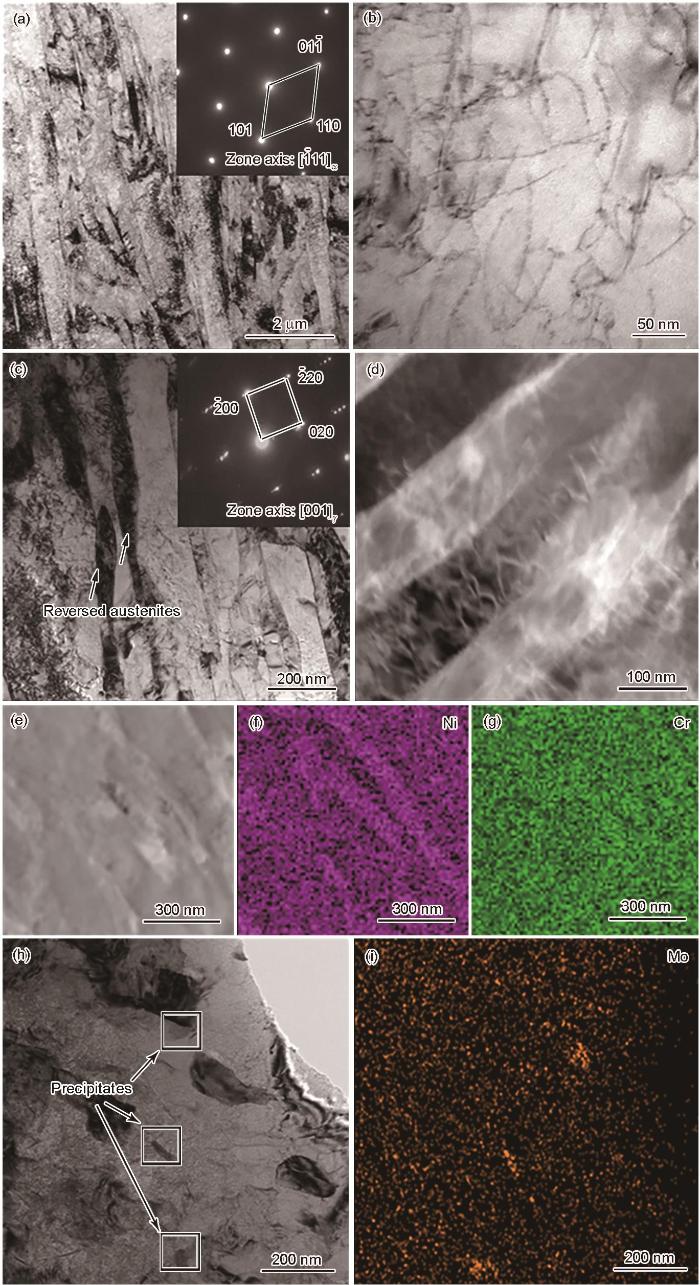
... 图3为HS和LS试样的TEM分析结果.HS和LS试样中均可观察到典型的板条马氏体(图3a和c).在垂直于板条长度方向对马氏体板条宽度进行测量,HS和LS试样马氏体板条宽度分别约为(326 ± 20)和(130 ± 15) nm,与图2a和b中马氏体板条块尺寸变化趋势一致.不同温度固溶处理后试样中位错的分布状态不同,HS试样中位错在高温(1000 ℃)下能快速滑移或攀移,当不同方向和类型的位错相遇时,形成了大量的位错缠结(图3b);LS试样中位错具有弥散、杂乱的分布状态(图3d).LS试样中逆转变奥氏体主要分布在马氏体板条间,Ni元素在奥氏体与马氏体板条间呈非均匀分布(图3e~g),这是由于时效过程中Ni元素向板条界扩散,随Ni含量增加,逆转变奥氏体的稳定性增加,冷却到室温后得以保留[19].此外,从图3h和i[25]中可观察到少量椭球状富Mo析出相,这主要是由于实验材料为固溶强化型马氏体时效不锈钢,其设计思路主要是去除Ti以避免析出高密度Ni3Ti金属间化合物,添加Si、Mo等元素降低Laves相的析出速率[26,27],同时通过添加Co、Mo元素提高固溶强化,在保证高强度的基础上避免析出相作为裂纹源损伤材料的韧性和疲劳性能.因此,固溶处理对析出相的影响基本可以忽略. ...
Ultrastrong steel via minimal lattice misfit and high-density nanoprecipitation
1
2017
... 固溶处理作为马氏体时效不锈钢的关键工艺,能够直接影响原始奥氏体的晶粒尺寸、位错密度及逆转变奥氏体形成能力等.邱旭扬帆等[17]研究了固溶温度对Cr-Ni-Mo-Ti马氏体时效不锈钢晶粒尺寸的影响,发现当固溶温度高于再结晶温度时,晶粒尺寸增大,基体内位错密度降低,时效后逆转变奥氏体体积分数降低.Zhang等[18]采用低温两步固溶工艺在析出强化型马氏体时效不锈钢(00Cr12Ni10MoTi)中引入了50% (体积分数)的逆转变奥氏体,发现两步固溶处理后的残余奥氏体可作为时效过程中逆转变奥氏体的形核位点,加速了逆转变奥氏体的生成.Leem等[19]指出,逆转变奥氏体的形成由Ni元素的扩散控制,Ni的富集为逆转变奥氏体形核和长大提供驱动力.此外,相关研究[20,21]表明,高密度位错可以提供短程扩散通道,加速元素配分.因此,通过在马氏体时效不锈钢基体中引入高密度位错可加速时效过程中逆转变奥氏体的形成.近期,循环固溶处理因其独特的“相变-缺陷累积”效应受到关注[22,23],通过多周期相变可调控基体缺陷密度与元素扩散行为,为逆转变奥氏体的形成提供动力学条件,但相关机制及其对耐腐蚀性能的影响规律仍不明确. ...
Ageing behaviour of an Fe-20Ni-1.8Mn-1.6Ti-0.59Al (wt%) maraging alloy: Clustering, precipitation and hardening
1
2004
... 固溶处理作为马氏体时效不锈钢的关键工艺,能够直接影响原始奥氏体的晶粒尺寸、位错密度及逆转变奥氏体形成能力等.邱旭扬帆等[17]研究了固溶温度对Cr-Ni-Mo-Ti马氏体时效不锈钢晶粒尺寸的影响,发现当固溶温度高于再结晶温度时,晶粒尺寸增大,基体内位错密度降低,时效后逆转变奥氏体体积分数降低.Zhang等[18]采用低温两步固溶工艺在析出强化型马氏体时效不锈钢(00Cr12Ni10MoTi)中引入了50% (体积分数)的逆转变奥氏体,发现两步固溶处理后的残余奥氏体可作为时效过程中逆转变奥氏体的形核位点,加速了逆转变奥氏体的生成.Leem等[19]指出,逆转变奥氏体的形成由Ni元素的扩散控制,Ni的富集为逆转变奥氏体形核和长大提供驱动力.此外,相关研究[20,21]表明,高密度位错可以提供短程扩散通道,加速元素配分.因此,通过在马氏体时效不锈钢基体中引入高密度位错可加速时效过程中逆转变奥氏体的形成.近期,循环固溶处理因其独特的“相变-缺陷累积”效应受到关注[22,23],通过多周期相变可调控基体缺陷密度与元素扩散行为,为逆转变奥氏体的形成提供动力学条件,但相关机制及其对耐腐蚀性能的影响规律仍不明确. ...
Inheritance and refinement of coarse grains in hot forging rings of a Cr-Ni-Mo-Ti maraging stainless steel
1
2025
... 固溶处理作为马氏体时效不锈钢的关键工艺,能够直接影响原始奥氏体的晶粒尺寸、位错密度及逆转变奥氏体形成能力等.邱旭扬帆等[17]研究了固溶温度对Cr-Ni-Mo-Ti马氏体时效不锈钢晶粒尺寸的影响,发现当固溶温度高于再结晶温度时,晶粒尺寸增大,基体内位错密度降低,时效后逆转变奥氏体体积分数降低.Zhang等[18]采用低温两步固溶工艺在析出强化型马氏体时效不锈钢(00Cr12Ni10MoTi)中引入了50% (体积分数)的逆转变奥氏体,发现两步固溶处理后的残余奥氏体可作为时效过程中逆转变奥氏体的形核位点,加速了逆转变奥氏体的生成.Leem等[19]指出,逆转变奥氏体的形成由Ni元素的扩散控制,Ni的富集为逆转变奥氏体形核和长大提供驱动力.此外,相关研究[20,21]表明,高密度位错可以提供短程扩散通道,加速元素配分.因此,通过在马氏体时效不锈钢基体中引入高密度位错可加速时效过程中逆转变奥氏体的形成.近期,循环固溶处理因其独特的“相变-缺陷累积”效应受到关注[22,23],通过多周期相变可调控基体缺陷密度与元素扩散行为,为逆转变奥氏体的形成提供动力学条件,但相关机制及其对耐腐蚀性能的影响规律仍不明确. ...
Cr-Ni-Mo-Ti马氏体时效不锈钢热锻环粗晶粒的遗传及细化
1
2025
... 固溶处理作为马氏体时效不锈钢的关键工艺,能够直接影响原始奥氏体的晶粒尺寸、位错密度及逆转变奥氏体形成能力等.邱旭扬帆等[17]研究了固溶温度对Cr-Ni-Mo-Ti马氏体时效不锈钢晶粒尺寸的影响,发现当固溶温度高于再结晶温度时,晶粒尺寸增大,基体内位错密度降低,时效后逆转变奥氏体体积分数降低.Zhang等[18]采用低温两步固溶工艺在析出强化型马氏体时效不锈钢(00Cr12Ni10MoTi)中引入了50% (体积分数)的逆转变奥氏体,发现两步固溶处理后的残余奥氏体可作为时效过程中逆转变奥氏体的形核位点,加速了逆转变奥氏体的生成.Leem等[19]指出,逆转变奥氏体的形成由Ni元素的扩散控制,Ni的富集为逆转变奥氏体形核和长大提供驱动力.此外,相关研究[20,21]表明,高密度位错可以提供短程扩散通道,加速元素配分.因此,通过在马氏体时效不锈钢基体中引入高密度位错可加速时效过程中逆转变奥氏体的形成.近期,循环固溶处理因其独特的“相变-缺陷累积”效应受到关注[22,23],通过多周期相变可调控基体缺陷密度与元素扩散行为,为逆转变奥氏体的形成提供动力学条件,但相关机制及其对耐腐蚀性能的影响规律仍不明确. ...
Cyclic quenching treatment doubles the Charpy V-notch impact energy of a 2.3 GPa maraging steel
1
2025
... 固溶处理作为马氏体时效不锈钢的关键工艺,能够直接影响原始奥氏体的晶粒尺寸、位错密度及逆转变奥氏体形成能力等.邱旭扬帆等[17]研究了固溶温度对Cr-Ni-Mo-Ti马氏体时效不锈钢晶粒尺寸的影响,发现当固溶温度高于再结晶温度时,晶粒尺寸增大,基体内位错密度降低,时效后逆转变奥氏体体积分数降低.Zhang等[18]采用低温两步固溶工艺在析出强化型马氏体时效不锈钢(00Cr12Ni10MoTi)中引入了50% (体积分数)的逆转变奥氏体,发现两步固溶处理后的残余奥氏体可作为时效过程中逆转变奥氏体的形核位点,加速了逆转变奥氏体的生成.Leem等[19]指出,逆转变奥氏体的形成由Ni元素的扩散控制,Ni的富集为逆转变奥氏体形核和长大提供驱动力.此外,相关研究[20,21]表明,高密度位错可以提供短程扩散通道,加速元素配分.因此,通过在马氏体时效不锈钢基体中引入高密度位错可加速时效过程中逆转变奥氏体的形成.近期,循环固溶处理因其独特的“相变-缺陷累积”效应受到关注[22,23],通过多周期相变可调控基体缺陷密度与元素扩散行为,为逆转变奥氏体的形成提供动力学条件,但相关机制及其对耐腐蚀性能的影响规律仍不明确. ...
The influence of tempering parameters on the microstructure, mechanical property, and the corresponding strengthening mechanism of metastable 301 austenitic stainless steel
1
2024
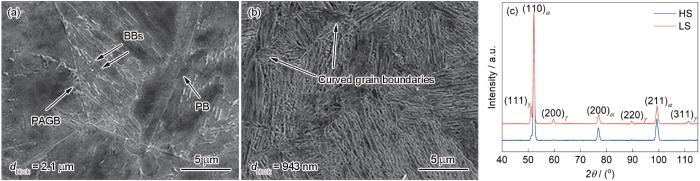
... 图2a和b分别为HS和LS试样的显微组织.由图可知,时效后的马氏体基体由原始奥氏体晶界、马氏体板条束和马氏体板条块的多级结构组成,2种试样的马氏体板条块尺寸(dblock)分别为2.1 μm和943 nm.HS试样中的原始奥氏体晶界具有“笔直”形貌,这表明在高温固溶处理(1000 ℃)过程中试样发生了再结晶及晶粒长大,因此冷却后马氏体板条块尺寸较大;而在低温固溶处理(750 ℃)过程中,试样通过剪切逆相变形成奥氏体(马氏体α→γ),未发生再结晶,晶界仍保持锻造态的“弯曲”特征,因此马氏体板条块尺寸保持为纳米级.图2c为2种试样的XRD谱.LS试样中出现了明显的奥氏体峰,奥氏体体积分数可根据式(1)计算[24]: ...
Solid solution strengthening type maraging stainless steel for low-temperature environment and preparation method of solid solution strengthening type maraging stainless steel
4
... 图3为HS和LS试样的TEM分析结果.HS和LS试样中均可观察到典型的板条马氏体(图3a和c).在垂直于板条长度方向对马氏体板条宽度进行测量,HS和LS试样马氏体板条宽度分别约为(326 ± 20)和(130 ± 15) nm,与图2a和b中马氏体板条块尺寸变化趋势一致.不同温度固溶处理后试样中位错的分布状态不同,HS试样中位错在高温(1000 ℃)下能快速滑移或攀移,当不同方向和类型的位错相遇时,形成了大量的位错缠结(图3b);LS试样中位错具有弥散、杂乱的分布状态(图3d).LS试样中逆转变奥氏体主要分布在马氏体板条间,Ni元素在奥氏体与马氏体板条间呈非均匀分布(图3e~g),这是由于时效过程中Ni元素向板条界扩散,随Ni含量增加,逆转变奥氏体的稳定性增加,冷却到室温后得以保留[19].此外,从图3h和i[25]中可观察到少量椭球状富Mo析出相,这主要是由于实验材料为固溶强化型马氏体时效不锈钢,其设计思路主要是去除Ti以避免析出高密度Ni3Ti金属间化合物,添加Si、Mo等元素降低Laves相的析出速率[26,27],同时通过添加Co、Mo元素提高固溶强化,在保证高强度的基础上避免析出相作为裂纹源损伤材料的韧性和疲劳性能.因此,固溶处理对析出相的影响基本可以忽略. ...
... [
25]的TEM分析
TEM analyses of HS (a, b) and LS (c-g) samples and Cr-Ni-Co-Mo maraging stainless steel<sup>[<xref ref-type="bibr" rid="R25">25</xref>]</sup> (h, i)(a, c) bright field (BF) TEM images and selected area electron diffraction (SAED) patterns (insets) (b, d) details of dislocation distributions (e-g) high-angle annular dark-field scanning transmission electron microscopy (HAADF-STEM) image (e) and corresponding EDS elemental maps (f, g) (h, i) BF image (h) and corresponding EDS elemental map (i) of precipitates[25] ...
... [
25] (h, i)
(a, c) bright field (BF) TEM images and selected area electron diffraction (SAED) patterns (insets) (b, d) details of dislocation distributions (e-g) high-angle annular dark-field scanning transmission electron microscopy (HAADF-STEM) image (e) and corresponding EDS elemental maps (f, g) (h, i) BF image (h) and corresponding EDS elemental map (i) of precipitates[25] ...
... (a, c) bright field (BF) TEM images and selected area electron diffraction (SAED) patterns (insets) (b, d) details of dislocation distributions (e-g) high-angle annular dark-field scanning transmission electron microscopy (HAADF-STEM) image (e) and corresponding EDS elemental maps (f, g) (h, i) BF image (h) and corresponding EDS elemental map (i) of precipitates[25] ...
一种低温环境用固溶强化型马氏体时效不锈钢及制备方法
4
... 图3为HS和LS试样的TEM分析结果.HS和LS试样中均可观察到典型的板条马氏体(图3a和c).在垂直于板条长度方向对马氏体板条宽度进行测量,HS和LS试样马氏体板条宽度分别约为(326 ± 20)和(130 ± 15) nm,与图2a和b中马氏体板条块尺寸变化趋势一致.不同温度固溶处理后试样中位错的分布状态不同,HS试样中位错在高温(1000 ℃)下能快速滑移或攀移,当不同方向和类型的位错相遇时,形成了大量的位错缠结(图3b);LS试样中位错具有弥散、杂乱的分布状态(图3d).LS试样中逆转变奥氏体主要分布在马氏体板条间,Ni元素在奥氏体与马氏体板条间呈非均匀分布(图3e~g),这是由于时效过程中Ni元素向板条界扩散,随Ni含量增加,逆转变奥氏体的稳定性增加,冷却到室温后得以保留[19].此外,从图3h和i[25]中可观察到少量椭球状富Mo析出相,这主要是由于实验材料为固溶强化型马氏体时效不锈钢,其设计思路主要是去除Ti以避免析出高密度Ni3Ti金属间化合物,添加Si、Mo等元素降低Laves相的析出速率[26,27],同时通过添加Co、Mo元素提高固溶强化,在保证高强度的基础上避免析出相作为裂纹源损伤材料的韧性和疲劳性能.因此,固溶处理对析出相的影响基本可以忽略. ...
... [
25]的TEM分析
TEM analyses of HS (a, b) and LS (c-g) samples and Cr-Ni-Co-Mo maraging stainless steel<sup>[<xref ref-type="bibr" rid="R25">25</xref>]</sup> (h, i)(a, c) bright field (BF) TEM images and selected area electron diffraction (SAED) patterns (insets) (b, d) details of dislocation distributions (e-g) high-angle annular dark-field scanning transmission electron microscopy (HAADF-STEM) image (e) and corresponding EDS elemental maps (f, g) (h, i) BF image (h) and corresponding EDS elemental map (i) of precipitates[25] ...
... [
25] (h, i)
(a, c) bright field (BF) TEM images and selected area electron diffraction (SAED) patterns (insets) (b, d) details of dislocation distributions (e-g) high-angle annular dark-field scanning transmission electron microscopy (HAADF-STEM) image (e) and corresponding EDS elemental maps (f, g) (h, i) BF image (h) and corresponding EDS elemental map (i) of precipitates[25] ...
... (a, c) bright field (BF) TEM images and selected area electron diffraction (SAED) patterns (insets) (b, d) details of dislocation distributions (e-g) high-angle annular dark-field scanning transmission electron microscopy (HAADF-STEM) image (e) and corresponding EDS elemental maps (f, g) (h, i) BF image (h) and corresponding EDS elemental map (i) of precipitates[25] ...
Effect of ageing on the microstructural evolution in a new design of maraging steels with carbon
1
2020
... 图3为HS和LS试样的TEM分析结果.HS和LS试样中均可观察到典型的板条马氏体(图3a和c).在垂直于板条长度方向对马氏体板条宽度进行测量,HS和LS试样马氏体板条宽度分别约为(326 ± 20)和(130 ± 15) nm,与图2a和b中马氏体板条块尺寸变化趋势一致.不同温度固溶处理后试样中位错的分布状态不同,HS试样中位错在高温(1000 ℃)下能快速滑移或攀移,当不同方向和类型的位错相遇时,形成了大量的位错缠结(图3b);LS试样中位错具有弥散、杂乱的分布状态(图3d).LS试样中逆转变奥氏体主要分布在马氏体板条间,Ni元素在奥氏体与马氏体板条间呈非均匀分布(图3e~g),这是由于时效过程中Ni元素向板条界扩散,随Ni含量增加,逆转变奥氏体的稳定性增加,冷却到室温后得以保留[19].此外,从图3h和i[25]中可观察到少量椭球状富Mo析出相,这主要是由于实验材料为固溶强化型马氏体时效不锈钢,其设计思路主要是去除Ti以避免析出高密度Ni3Ti金属间化合物,添加Si、Mo等元素降低Laves相的析出速率[26,27],同时通过添加Co、Mo元素提高固溶强化,在保证高强度的基础上避免析出相作为裂纹源损伤材料的韧性和疲劳性能.因此,固溶处理对析出相的影响基本可以忽略. ...
Development of Ni-free Mn-stabilised maraging steels using Fe2SiTi precipitates
1
2019
... 图3为HS和LS试样的TEM分析结果.HS和LS试样中均可观察到典型的板条马氏体(图3a和c).在垂直于板条长度方向对马氏体板条宽度进行测量,HS和LS试样马氏体板条宽度分别约为(326 ± 20)和(130 ± 15) nm,与图2a和b中马氏体板条块尺寸变化趋势一致.不同温度固溶处理后试样中位错的分布状态不同,HS试样中位错在高温(1000 ℃)下能快速滑移或攀移,当不同方向和类型的位错相遇时,形成了大量的位错缠结(图3b);LS试样中位错具有弥散、杂乱的分布状态(图3d).LS试样中逆转变奥氏体主要分布在马氏体板条间,Ni元素在奥氏体与马氏体板条间呈非均匀分布(图3e~g),这是由于时效过程中Ni元素向板条界扩散,随Ni含量增加,逆转变奥氏体的稳定性增加,冷却到室温后得以保留[19].此外,从图3h和i[25]中可观察到少量椭球状富Mo析出相,这主要是由于实验材料为固溶强化型马氏体时效不锈钢,其设计思路主要是去除Ti以避免析出高密度Ni3Ti金属间化合物,添加Si、Mo等元素降低Laves相的析出速率[26,27],同时通过添加Co、Mo元素提高固溶强化,在保证高强度的基础上避免析出相作为裂纹源损伤材料的韧性和疲劳性能.因此,固溶处理对析出相的影响基本可以忽略. ...
The Influence of tempering temperature on the reversed austenite formation and tensile properties in Fe-13%Cr-4%Ni-Mo low carbon martensite stainless steels
1
2011
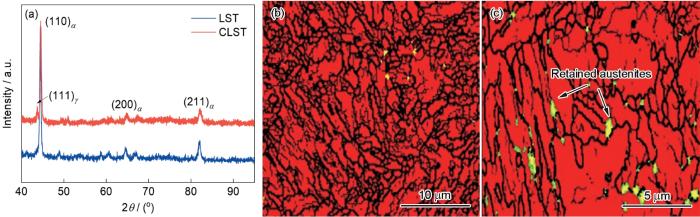
... 图4为LS和CLS试样的相分布图、反极图和晶界图.由图可知,2种试样的逆转变奥氏体体积分数分别为6%和33%,表明循环固溶处理促进了逆转变奥氏体的加速生成.需要说明的是,由于逆转变奥氏体尺寸较小且空间分辨率有限,因此由EBSD测得的逆转变奥氏体体积分数略小于XRD统计结果.根据生成位置的不同,逆转变奥氏体可分为沿原始奥氏体晶界或马氏体板条块界分布的块状奥氏体和沿马氏体板条界分布的薄膜状奥氏体.LS和CLS试样组织内部无择优取向,晶粒随机分布.CLS试样的dblock为746 nm,这是因为逆转变奥氏体的生成可以细化马氏体板条.当时效温度在Ac3温度以下时,奥氏体稳定化元素Ni、Cr等向板条界等缺陷密度高处扩散,由于成分起伏使得逆转变奥氏体的热稳定性增加[28],在马氏体板条界面形成γ-α相界[29].随时效时间增加,逆转变奥氏体相界向马氏体板条界推移,逆转变奥氏体宽度增加,马氏体板条尺寸降低[30].LS和CLS试样中大、小角度晶界的比例无显著差异,CLS试样中退火孪晶界占比为6.0%,这表明奥氏体的回复驱动力增加.因此,循环固溶处理可以增加逆转变奥氏体体积分数,而逆转变奥氏体会促进马氏体板条细化. ...
Two-stage tempering of steel 13%Cr6%Ni
1
1984
... 图4为LS和CLS试样的相分布图、反极图和晶界图.由图可知,2种试样的逆转变奥氏体体积分数分别为6%和33%,表明循环固溶处理促进了逆转变奥氏体的加速生成.需要说明的是,由于逆转变奥氏体尺寸较小且空间分辨率有限,因此由EBSD测得的逆转变奥氏体体积分数略小于XRD统计结果.根据生成位置的不同,逆转变奥氏体可分为沿原始奥氏体晶界或马氏体板条块界分布的块状奥氏体和沿马氏体板条界分布的薄膜状奥氏体.LS和CLS试样组织内部无择优取向,晶粒随机分布.CLS试样的dblock为746 nm,这是因为逆转变奥氏体的生成可以细化马氏体板条.当时效温度在Ac3温度以下时,奥氏体稳定化元素Ni、Cr等向板条界等缺陷密度高处扩散,由于成分起伏使得逆转变奥氏体的热稳定性增加[28],在马氏体板条界面形成γ-α相界[29].随时效时间增加,逆转变奥氏体相界向马氏体板条界推移,逆转变奥氏体宽度增加,马氏体板条尺寸降低[30].LS和CLS试样中大、小角度晶界的比例无显著差异,CLS试样中退火孪晶界占比为6.0%,这表明奥氏体的回复驱动力增加.因此,循环固溶处理可以增加逆转变奥氏体体积分数,而逆转变奥氏体会促进马氏体板条细化. ...
Effect of reversed austenite on mechanical and corrosion properties of 13Cr super martensitic stainless steel
1
2023
... 图4为LS和CLS试样的相分布图、反极图和晶界图.由图可知,2种试样的逆转变奥氏体体积分数分别为6%和33%,表明循环固溶处理促进了逆转变奥氏体的加速生成.需要说明的是,由于逆转变奥氏体尺寸较小且空间分辨率有限,因此由EBSD测得的逆转变奥氏体体积分数略小于XRD统计结果.根据生成位置的不同,逆转变奥氏体可分为沿原始奥氏体晶界或马氏体板条块界分布的块状奥氏体和沿马氏体板条界分布的薄膜状奥氏体.LS和CLS试样组织内部无择优取向,晶粒随机分布.CLS试样的dblock为746 nm,这是因为逆转变奥氏体的生成可以细化马氏体板条.当时效温度在Ac3温度以下时,奥氏体稳定化元素Ni、Cr等向板条界等缺陷密度高处扩散,由于成分起伏使得逆转变奥氏体的热稳定性增加[28],在马氏体板条界面形成γ-α相界[29].随时效时间增加,逆转变奥氏体相界向马氏体板条界推移,逆转变奥氏体宽度增加,马氏体板条尺寸降低[30].LS和CLS试样中大、小角度晶界的比例无显著差异,CLS试样中退火孪晶界占比为6.0%,这表明奥氏体的回复驱动力增加.因此,循环固溶处理可以增加逆转变奥氏体体积分数,而逆转变奥氏体会促进马氏体板条细化. ...
逆变奥氏体对13Cr超级马氏体不锈钢力学和腐蚀性能的影响
1
2023
... 图4为LS和CLS试样的相分布图、反极图和晶界图.由图可知,2种试样的逆转变奥氏体体积分数分别为6%和33%,表明循环固溶处理促进了逆转变奥氏体的加速生成.需要说明的是,由于逆转变奥氏体尺寸较小且空间分辨率有限,因此由EBSD测得的逆转变奥氏体体积分数略小于XRD统计结果.根据生成位置的不同,逆转变奥氏体可分为沿原始奥氏体晶界或马氏体板条块界分布的块状奥氏体和沿马氏体板条界分布的薄膜状奥氏体.LS和CLS试样组织内部无择优取向,晶粒随机分布.CLS试样的dblock为746 nm,这是因为逆转变奥氏体的生成可以细化马氏体板条.当时效温度在Ac3温度以下时,奥氏体稳定化元素Ni、Cr等向板条界等缺陷密度高处扩散,由于成分起伏使得逆转变奥氏体的热稳定性增加[28],在马氏体板条界面形成γ-α相界[29].随时效时间增加,逆转变奥氏体相界向马氏体板条界推移,逆转变奥氏体宽度增加,马氏体板条尺寸降低[30].LS和CLS试样中大、小角度晶界的比例无显著差异,CLS试样中退火孪晶界占比为6.0%,这表明奥氏体的回复驱动力增加.因此,循环固溶处理可以增加逆转变奥氏体体积分数,而逆转变奥氏体会促进马氏体板条细化. ...
Austenite reversion in 18-Ni Co-free maraging steel
1
1995
... 逆转变奥氏体的加速生成通常与元素扩散[31]和成核质点[32]有关,为了探究逆转变奥氏体加速生成的原因,基于局部取向差(KAM)图分析试样中基体缺陷密度变化[33].图5为LST和CLST试样的KAM图及其分布.使用对数正态(logNormal)函数计算得到2试样的平均KAM分别为0.54° ± 0.03°和0.68° ± 0.02°.CLST试样的KAM较大,表明其缺陷密度较高[34].此外,通过Williamson-Hall修正方法(即选用衍射峰(211) α 的半高峰宽(full-width at half-maximum,FWHM))对固溶处理后试样的位错密度进行半定量评估[35],如式(2)所示: ...
Aging reactions in a 17-4 PH stainless steel
1
2002
... 逆转变奥氏体的加速生成通常与元素扩散[31]和成核质点[32]有关,为了探究逆转变奥氏体加速生成的原因,基于局部取向差(KAM)图分析试样中基体缺陷密度变化[33].图5为LST和CLST试样的KAM图及其分布.使用对数正态(logNormal)函数计算得到2试样的平均KAM分别为0.54° ± 0.03°和0.68° ± 0.02°.CLST试样的KAM较大,表明其缺陷密度较高[34].此外,通过Williamson-Hall修正方法(即选用衍射峰(211) α 的半高峰宽(full-width at half-maximum,FWHM))对固溶处理后试样的位错密度进行半定量评估[35],如式(2)所示: ...
Orientation gradients and geometrically necessary dislocations in ultrafine grained dual-phase steels studied by 2D and 3D EBSD
1
2010
... 逆转变奥氏体的加速生成通常与元素扩散[31]和成核质点[32]有关,为了探究逆转变奥氏体加速生成的原因,基于局部取向差(KAM)图分析试样中基体缺陷密度变化[33].图5为LST和CLST试样的KAM图及其分布.使用对数正态(logNormal)函数计算得到2试样的平均KAM分别为0.54° ± 0.03°和0.68° ± 0.02°.CLST试样的KAM较大,表明其缺陷密度较高[34].此外,通过Williamson-Hall修正方法(即选用衍射峰(211) α 的半高峰宽(full-width at half-maximum,FWHM))对固溶处理后试样的位错密度进行半定量评估[35],如式(2)所示: ...
Effect of reduction in area per pass on strain distribution and microstructure during caliber rolling in twinning-induced plasticity steel
1
2020
... 逆转变奥氏体的加速生成通常与元素扩散[31]和成核质点[32]有关,为了探究逆转变奥氏体加速生成的原因,基于局部取向差(KAM)图分析试样中基体缺陷密度变化[33].图5为LST和CLST试样的KAM图及其分布.使用对数正态(logNormal)函数计算得到2试样的平均KAM分别为0.54° ± 0.03°和0.68° ± 0.02°.CLST试样的KAM较大,表明其缺陷密度较高[34].此外,通过Williamson-Hall修正方法(即选用衍射峰(211) α 的半高峰宽(full-width at half-maximum,FWHM))对固溶处理后试样的位错密度进行半定量评估[35],如式(2)所示: ...
Importance of cold rolling and tempering on the microstructure evolution, precipitation behavior and mechanical responses of 9Cr3Co3W1Cu ferritic/martensitic steel
1
2023
... 逆转变奥氏体的加速生成通常与元素扩散[31]和成核质点[32]有关,为了探究逆转变奥氏体加速生成的原因,基于局部取向差(KAM)图分析试样中基体缺陷密度变化[33].图5为LST和CLST试样的KAM图及其分布.使用对数正态(logNormal)函数计算得到2试样的平均KAM分别为0.54° ± 0.03°和0.68° ± 0.02°.CLST试样的KAM较大,表明其缺陷密度较高[34].此外,通过Williamson-Hall修正方法(即选用衍射峰(211) α 的半高峰宽(full-width at half-maximum,FWHM))对固溶处理后试样的位错密度进行半定量评估[35],如式(2)所示: ...
Effect of aging on microstructure and mechanical properties of cobalt free 18%Ni (250 Grade) maraging steel
1
1998
... 式中,ρ为位错密度,β为衍射峰的半高峰宽,b为Burgers矢量模(≈ 0.25 nm[36]).LST和CLST试样的位错密度分别为4.3 × 10¹⁴和5.5 × 10¹⁴ m-2,表明循环固溶处理可增加位错密度. ...
Study of the effects of stress and strain on martensite transformation: Kinetics and transformation plasticity
1
2000
... 图6为LST和CLST试样的XRD谱及相分布图.如图6b和c所示,LST试样的马氏体基体中基本不存在残余奥氏体,而CLST试样中分布着约3%的纳米级残余奥氏体,与图6a的XRD谱结果一致.在循环固溶处理过程中发生4次非扩散型马氏体相变,因此后一次切变的奥氏体会继承前一次马氏体的高位错密度,奥氏体和马氏体间的Gibbs自由能(ΔG)可表示为[37]: ...
Phase transformations in metals and alloys
1
1973
... 式中,ΔGS、ΔGSV、ΔGγ→α 分别为表面能、弹性变形能和化学驱动力,作为相变中的本征能力变化[38];ΔWe和ΔWp分别为应力引起的弹性及塑性功;ΔGt为剪切转变功,与奥氏体的屈服强度(σs)成正比.由图6可知,循环固溶处理可通过位错继承从而增加ΔGt,进而抑制马氏体转变.因此,相比于LST试样,CLST试样中残余奥氏体体积分数更大.残余奥氏体和高密度位错为时效过程中逆转变奥氏体生成提供了形核位点和元素扩散通道,导致时效后CLST试样的逆转变奥氏体体积分数相比于LST试样增加约5倍. ...
Comparative study of corrosion rates determined by several methods for Q235 steel
1
2021
... 通过上述高温固溶、低温固溶及循环固溶3种热处理工艺,制备了具有不同组织特征的马氏体时效不锈钢,即晶粒尺寸粗大的HS试样(dblock= 2.1 μm,fγ = 1.9%)、晶粒尺寸细小且逆转变奥氏体体积分数较少的LS试样(dblock= 943 nm,fγ = 7.8%)、晶粒尺寸细小且奥氏体体积分数较多的CLS试样(dblock= 746 nm,fγ = 33.0%),HS和LS试样的主要差异为晶粒尺寸不同,LS和CLS试样的主要差异为逆转变奥氏体体积分数不同.通过周期浸润和电化学实验评估上述3种试样的耐腐蚀性能,并探究晶粒尺寸和逆转变奥氏体体积分数对马氏体时效不锈钢耐腐蚀性能的影响机制.在3.5%NaCl溶液中循环142和284 cyc后的腐蚀速率(R,mm/a)可根据式(4)计算[39]: ...
表征Q235钢腐蚀速率的几种方法的比较研究
1
2021
... 通过上述高温固溶、低温固溶及循环固溶3种热处理工艺,制备了具有不同组织特征的马氏体时效不锈钢,即晶粒尺寸粗大的HS试样(dblock= 2.1 μm,fγ = 1.9%)、晶粒尺寸细小且逆转变奥氏体体积分数较少的LS试样(dblock= 943 nm,fγ = 7.8%)、晶粒尺寸细小且奥氏体体积分数较多的CLS试样(dblock= 746 nm,fγ = 33.0%),HS和LS试样的主要差异为晶粒尺寸不同,LS和CLS试样的主要差异为逆转变奥氏体体积分数不同.通过周期浸润和电化学实验评估上述3种试样的耐腐蚀性能,并探究晶粒尺寸和逆转变奥氏体体积分数对马氏体时效不锈钢耐腐蚀性能的影响机制.在3.5%NaCl溶液中循环142和284 cyc后的腐蚀速率(R,mm/a)可根据式(4)计算[39]: ...
Investigation on pitting corrosion behavior of ultrafine-grained 304L stainless steel in Cl- containing solution
1
2015
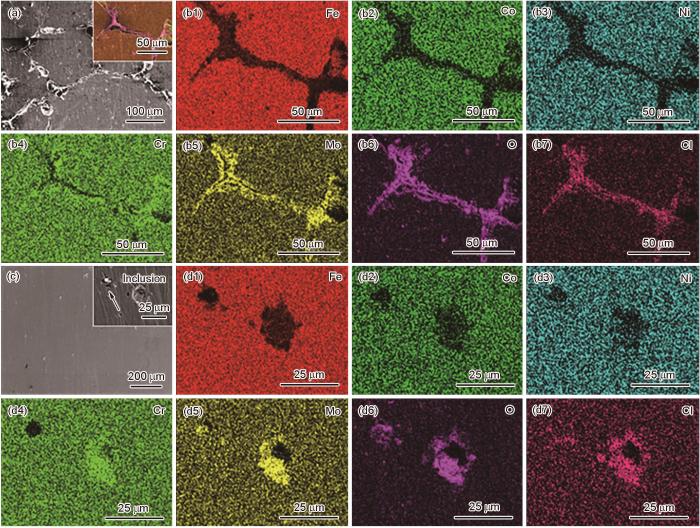
... 图8为HS和LS试样在3.5%NaCl溶液中循环284 cyc后的SEM像和EDS元素面扫描图.HS试样表面的腐蚀裂纹沿晶界扩展,发生了明显的晶间腐蚀,晶界贫Fe、Ni和Co,富Cr、Mo、O和Cl元素(图8a、b1-b7).通常,马氏体时效不锈钢表面会形成一层钝化膜,防止基体腐蚀[40].由于Cl-半径小且穿透能力强,能够破坏钝化膜并形成可溶性的氯化物,如FeCl2、FeCl3或CrCl3等,造成晶界贫化且容易发生晶间腐蚀[41].当新鲜基体暴露在表面后,又重新生成具有保护性质的钝化膜,如Cr2O3和MoO3等,增加局部的耐腐蚀性能.如此往复,材料最终发生腐蚀失效.不同于HS试样,LS试样并未发生明显的晶界腐蚀,而是主要发生了点蚀,其表面出现了少量由富Mo夹杂物引起的点蚀坑(图8c、d1~d7).点蚀通常起源于夹杂物或钝化膜局部破裂处[42].当钝化膜被Cl-局部破坏后,暴露的基体与介质反应形成局部微电池,阳极反应和阴极反应如下: ...
超细晶304L不锈钢在含Cl-溶液中点蚀行为的研究
1
2015
... 图8为HS和LS试样在3.5%NaCl溶液中循环284 cyc后的SEM像和EDS元素面扫描图.HS试样表面的腐蚀裂纹沿晶界扩展,发生了明显的晶间腐蚀,晶界贫Fe、Ni和Co,富Cr、Mo、O和Cl元素(图8a、b1-b7).通常,马氏体时效不锈钢表面会形成一层钝化膜,防止基体腐蚀[40].由于Cl-半径小且穿透能力强,能够破坏钝化膜并形成可溶性的氯化物,如FeCl2、FeCl3或CrCl3等,造成晶界贫化且容易发生晶间腐蚀[41].当新鲜基体暴露在表面后,又重新生成具有保护性质的钝化膜,如Cr2O3和MoO3等,增加局部的耐腐蚀性能.如此往复,材料最终发生腐蚀失效.不同于HS试样,LS试样并未发生明显的晶界腐蚀,而是主要发生了点蚀,其表面出现了少量由富Mo夹杂物引起的点蚀坑(图8c、d1~d7).点蚀通常起源于夹杂物或钝化膜局部破裂处[42].当钝化膜被Cl-局部破坏后,暴露的基体与介质反应形成局部微电池,阳极反应和阴极反应如下: ...
Critical pitting and repassivation temperatures for duplex stainless steel in chloride solutions
1
2008
... 图8为HS和LS试样在3.5%NaCl溶液中循环284 cyc后的SEM像和EDS元素面扫描图.HS试样表面的腐蚀裂纹沿晶界扩展,发生了明显的晶间腐蚀,晶界贫Fe、Ni和Co,富Cr、Mo、O和Cl元素(图8a、b1-b7).通常,马氏体时效不锈钢表面会形成一层钝化膜,防止基体腐蚀[40].由于Cl-半径小且穿透能力强,能够破坏钝化膜并形成可溶性的氯化物,如FeCl2、FeCl3或CrCl3等,造成晶界贫化且容易发生晶间腐蚀[41].当新鲜基体暴露在表面后,又重新生成具有保护性质的钝化膜,如Cr2O3和MoO3等,增加局部的耐腐蚀性能.如此往复,材料最终发生腐蚀失效.不同于HS试样,LS试样并未发生明显的晶界腐蚀,而是主要发生了点蚀,其表面出现了少量由富Mo夹杂物引起的点蚀坑(图8c、d1~d7).点蚀通常起源于夹杂物或钝化膜局部破裂处[42].当钝化膜被Cl-局部破坏后,暴露的基体与介质反应形成局部微电池,阳极反应和阴极反应如下: ...
Research on the corrosion resistance of hydraulic bracket cylinder barrel materials
1
2024
... 图8为HS和LS试样在3.5%NaCl溶液中循环284 cyc后的SEM像和EDS元素面扫描图.HS试样表面的腐蚀裂纹沿晶界扩展,发生了明显的晶间腐蚀,晶界贫Fe、Ni和Co,富Cr、Mo、O和Cl元素(图8a、b1-b7).通常,马氏体时效不锈钢表面会形成一层钝化膜,防止基体腐蚀[40].由于Cl-半径小且穿透能力强,能够破坏钝化膜并形成可溶性的氯化物,如FeCl2、FeCl3或CrCl3等,造成晶界贫化且容易发生晶间腐蚀[41].当新鲜基体暴露在表面后,又重新生成具有保护性质的钝化膜,如Cr2O3和MoO3等,增加局部的耐腐蚀性能.如此往复,材料最终发生腐蚀失效.不同于HS试样,LS试样并未发生明显的晶界腐蚀,而是主要发生了点蚀,其表面出现了少量由富Mo夹杂物引起的点蚀坑(图8c、d1~d7).点蚀通常起源于夹杂物或钝化膜局部破裂处[42].当钝化膜被Cl-局部破坏后,暴露的基体与介质反应形成局部微电池,阳极反应和阴极反应如下: ...
液压支架缸筒材料的耐蚀性研究
1
2024
... 图8为HS和LS试样在3.5%NaCl溶液中循环284 cyc后的SEM像和EDS元素面扫描图.HS试样表面的腐蚀裂纹沿晶界扩展,发生了明显的晶间腐蚀,晶界贫Fe、Ni和Co,富Cr、Mo、O和Cl元素(图8a、b1-b7).通常,马氏体时效不锈钢表面会形成一层钝化膜,防止基体腐蚀[40].由于Cl-半径小且穿透能力强,能够破坏钝化膜并形成可溶性的氯化物,如FeCl2、FeCl3或CrCl3等,造成晶界贫化且容易发生晶间腐蚀[41].当新鲜基体暴露在表面后,又重新生成具有保护性质的钝化膜,如Cr2O3和MoO3等,增加局部的耐腐蚀性能.如此往复,材料最终发生腐蚀失效.不同于HS试样,LS试样并未发生明显的晶界腐蚀,而是主要发生了点蚀,其表面出现了少量由富Mo夹杂物引起的点蚀坑(图8c、d1~d7).点蚀通常起源于夹杂物或钝化膜局部破裂处[42].当钝化膜被Cl-局部破坏后,暴露的基体与介质反应形成局部微电池,阳极反应和阴极反应如下: ...
Passive films on stainless steels-chemistry, structure and growth
1
2003
... 由于金属溶解产生的Fe2+ (或Fe3+)造成局部酸化,点蚀中心电流密度较高,进一步加剧了腐蚀进程.此外,当金属表面重新与O元素接触时发生钝化膜再生(Cr2O3和MoO3),钝化膜溶解与再生周期性进行,导致腐蚀进一步发展,形成更大的点蚀[43].He等[44]指出,晶粒细化有利于材料表面形成致密且稳定的钝化膜,提高材料的耐腐蚀性能.此外,位错密度和分布状态显著影响材料的耐腐蚀性能[45],固溶温度较低的LS试样中位错密度高,且弥散、均匀分布(图3d),高能量态位错为钝化膜的形成提供了额外的驱动力,使得钝化膜能够快速地在表面形核[46,47]. ...
M23C6 precipitation and Si segregation promoted by deep cryogenic treatment aggravating pitting corrosion of supermartensitic stainless steel
1
2021
... 由于金属溶解产生的Fe2+ (或Fe3+)造成局部酸化,点蚀中心电流密度较高,进一步加剧了腐蚀进程.此外,当金属表面重新与O元素接触时发生钝化膜再生(Cr2O3和MoO3),钝化膜溶解与再生周期性进行,导致腐蚀进一步发展,形成更大的点蚀[43].He等[44]指出,晶粒细化有利于材料表面形成致密且稳定的钝化膜,提高材料的耐腐蚀性能.此外,位错密度和分布状态显著影响材料的耐腐蚀性能[45],固溶温度较低的LS试样中位错密度高,且弥散、均匀分布(图3d),高能量态位错为钝化膜的形成提供了额外的驱动力,使得钝化膜能够快速地在表面形核[46,47]. ...
In situ AFM detection of pit onset location on a 304L stainless steel
1
2007
... 由于金属溶解产生的Fe2+ (或Fe3+)造成局部酸化,点蚀中心电流密度较高,进一步加剧了腐蚀进程.此外,当金属表面重新与O元素接触时发生钝化膜再生(Cr2O3和MoO3),钝化膜溶解与再生周期性进行,导致腐蚀进一步发展,形成更大的点蚀[43].He等[44]指出,晶粒细化有利于材料表面形成致密且稳定的钝化膜,提高材料的耐腐蚀性能.此外,位错密度和分布状态显著影响材料的耐腐蚀性能[45],固溶温度较低的LS试样中位错密度高,且弥散、均匀分布(图3d),高能量态位错为钝化膜的形成提供了额外的驱动力,使得钝化膜能够快速地在表面形核[46,47]. ...
Corrosion resistance of ultra fine-grained Ti
1
2004
... 由于金属溶解产生的Fe2+ (或Fe3+)造成局部酸化,点蚀中心电流密度较高,进一步加剧了腐蚀进程.此外,当金属表面重新与O元素接触时发生钝化膜再生(Cr2O3和MoO3),钝化膜溶解与再生周期性进行,导致腐蚀进一步发展,形成更大的点蚀[43].He等[44]指出,晶粒细化有利于材料表面形成致密且稳定的钝化膜,提高材料的耐腐蚀性能.此外,位错密度和分布状态显著影响材料的耐腐蚀性能[45],固溶温度较低的LS试样中位错密度高,且弥散、均匀分布(图3d),高能量态位错为钝化膜的形成提供了额外的驱动力,使得钝化膜能够快速地在表面形核[46,47]. ...
The effect of heat treatment on the passive property of maraging stainless steel
1
1989
... 由于金属溶解产生的Fe2+ (或Fe3+)造成局部酸化,点蚀中心电流密度较高,进一步加剧了腐蚀进程.此外,当金属表面重新与O元素接触时发生钝化膜再生(Cr2O3和MoO3),钝化膜溶解与再生周期性进行,导致腐蚀进一步发展,形成更大的点蚀[43].He等[44]指出,晶粒细化有利于材料表面形成致密且稳定的钝化膜,提高材料的耐腐蚀性能.此外,位错密度和分布状态显著影响材料的耐腐蚀性能[45],固溶温度较低的LS试样中位错密度高,且弥散、均匀分布(图3d),高能量态位错为钝化膜的形成提供了额外的驱动力,使得钝化膜能够快速地在表面形核[46,47]. ...
热处理对马氏体时效不锈钢钝化特牲的影响
1
1989
... 由于金属溶解产生的Fe2+ (或Fe3+)造成局部酸化,点蚀中心电流密度较高,进一步加剧了腐蚀进程.此外,当金属表面重新与O元素接触时发生钝化膜再生(Cr2O3和MoO3),钝化膜溶解与再生周期性进行,导致腐蚀进一步发展,形成更大的点蚀[43].He等[44]指出,晶粒细化有利于材料表面形成致密且稳定的钝化膜,提高材料的耐腐蚀性能.此外,位错密度和分布状态显著影响材料的耐腐蚀性能[45],固溶温度较低的LS试样中位错密度高,且弥散、均匀分布(图3d),高能量态位错为钝化膜的形成提供了额外的驱动力,使得钝化膜能够快速地在表面形核[46,47]. ...
The grain size effect on corrosion property of Al2Cr5Cu5Fe53Ni35 high-entropy alloy in marine environment
1
2022
... 为了进一步探究逆转变奥氏体对马氏体时效不锈钢耐腐蚀机理的影响,将LS和CLS试样在3.5%NaCl溶液中进行电化学实验,结果如图10所示.图10a为2种试样的动电位极化曲线,采用Tafel斜率法拟合的特征参数列于表1.可见,随逆转变奥氏体体积分数增加,与LS试样相比,CLS试样的自腐蚀电位(Ecorr)提高了109 mVSCE (SCE为饱和甘汞电极),自腐蚀电流密度(icorr)降低了86.25 μA/cm2,表明马氏体时效不锈钢在自发状态下的耐腐蚀性能得到改善[48].2种试样均具有明显的钝化区间,逆转变奥氏体体积分数较高的CLS试样钝化时的电流密度更小且点蚀电位(Epit)增加了26.82 mVSCE,表明其耐点蚀能力更高.图10b为2种试样的Nyquist图.由图可知,2种试样都由一个容抗弧组成,表明其均能形成钝化膜.CLS试样的容抗弧半径更大,对应于界面处的电荷转移更加困难,钝化膜对基体的保护作用增强[49].图10c为2种试样的阻抗-频率图,当频率为0.01 Hz时,随逆转变奥氏体体积分数从7.8%增加到33.0%,对应的阻抗从89900 Ω·cm2增加至203000 Ω·cm2,增幅约2.3倍.图10d为2种试样的相位角-频率图.由图可知,CLS试样的中频(101~102 Hz)相位角范围为70°~80°,说明溶液与试样界面不是纯电容界面.此外,CLS试样的相位角峰值高、宽度大,表明钝化膜更加稳定[50]. ...
Formation and behaviour study of an environment-friendly corrosion inhibitor by electrochemical methods
1
2005
... 为了进一步探究逆转变奥氏体对马氏体时效不锈钢耐腐蚀机理的影响,将LS和CLS试样在3.5%NaCl溶液中进行电化学实验,结果如图10所示.图10a为2种试样的动电位极化曲线,采用Tafel斜率法拟合的特征参数列于表1.可见,随逆转变奥氏体体积分数增加,与LS试样相比,CLS试样的自腐蚀电位(Ecorr)提高了109 mVSCE (SCE为饱和甘汞电极),自腐蚀电流密度(icorr)降低了86.25 μA/cm2,表明马氏体时效不锈钢在自发状态下的耐腐蚀性能得到改善[48].2种试样均具有明显的钝化区间,逆转变奥氏体体积分数较高的CLS试样钝化时的电流密度更小且点蚀电位(Epit)增加了26.82 mVSCE,表明其耐点蚀能力更高.图10b为2种试样的Nyquist图.由图可知,2种试样都由一个容抗弧组成,表明其均能形成钝化膜.CLS试样的容抗弧半径更大,对应于界面处的电荷转移更加困难,钝化膜对基体的保护作用增强[49].图10c为2种试样的阻抗-频率图,当频率为0.01 Hz时,随逆转变奥氏体体积分数从7.8%增加到33.0%,对应的阻抗从89900 Ω·cm2增加至203000 Ω·cm2,增幅约2.3倍.图10d为2种试样的相位角-频率图.由图可知,CLS试样的中频(101~102 Hz)相位角范围为70°~80°,说明溶液与试样界面不是纯电容界面.此外,CLS试样的相位角峰值高、宽度大,表明钝化膜更加稳定[50]. ...
Interface affected zone for optimal strength and ductility in heterogeneous laminate
1
2018
... 为了进一步探究逆转变奥氏体对马氏体时效不锈钢耐腐蚀机理的影响,将LS和CLS试样在3.5%NaCl溶液中进行电化学实验,结果如图10所示.图10a为2种试样的动电位极化曲线,采用Tafel斜率法拟合的特征参数列于表1.可见,随逆转变奥氏体体积分数增加,与LS试样相比,CLS试样的自腐蚀电位(Ecorr)提高了109 mVSCE (SCE为饱和甘汞电极),自腐蚀电流密度(icorr)降低了86.25 μA/cm2,表明马氏体时效不锈钢在自发状态下的耐腐蚀性能得到改善[48].2种试样均具有明显的钝化区间,逆转变奥氏体体积分数较高的CLS试样钝化时的电流密度更小且点蚀电位(Epit)增加了26.82 mVSCE,表明其耐点蚀能力更高.图10b为2种试样的Nyquist图.由图可知,2种试样都由一个容抗弧组成,表明其均能形成钝化膜.CLS试样的容抗弧半径更大,对应于界面处的电荷转移更加困难,钝化膜对基体的保护作用增强[49].图10c为2种试样的阻抗-频率图,当频率为0.01 Hz时,随逆转变奥氏体体积分数从7.8%增加到33.0%,对应的阻抗从89900 Ω·cm2增加至203000 Ω·cm2,增幅约2.3倍.图10d为2种试样的相位角-频率图.由图可知,CLS试样的中频(101~102 Hz)相位角范围为70°~80°,说明溶液与试样界面不是纯电容界面.此外,CLS试样的相位角峰值高、宽度大,表明钝化膜更加稳定[50]. ...
Determination of effective capacitance and film thickness from constant-phase-element parameters
1
2010
... 计算结果表明,Rtotal与Rpass接近,且随逆转变奥氏体体积分数增加而增大.根据Helmholtz模型[51],钝化膜的厚度(δ)可由下式计算: ...