



合金化是提高锌合金力学性能的主要方法之一。Mg、Mn等元素因具有良好的生物相容性而被添加到锌合金中。Mg是人体不可或缺的微量元素,在众多细胞中发挥至关重要的作用,包括参与能量代谢和细胞增殖等过程[5],且其植入生物体后不会产生毒害作用。此外,向Zn基体中添加Mg能够有效提高合金力学性能。Bagha等[6]研究表明,相比于纯Zn,添加4%Mg (质量分数,下同)可显著提高合金抗压强度,提高幅度可达257 MPa。Shi等[7]通过微合金化设计大幅提高了300 MPa级Zn-Mn-Mg合金的力学性能。结果表明,拉伸态Zn06Mn006Mg和Zn08Mn005Mg合金均表现出较高的综合力学性能,屈服强度为313~324 MPa,极限拉伸强度为345~356 MPa,失效伸长率为20%~28%。Mn元素是各种酶和人体免疫系统所必需的另一种微量元素。其作为一种无毒的合金元素,可以净化Fe等有害杂质,形成MnO膜,从而对锌合金的力学性能产生显著影响[8]。Li等[9]研究了铸态Zn-0.8Mn合金的等温压缩流应力行为,发现该合金在变形过程中晶粒发生细化,并且在不同温度和应变率下表现出较高的峰值应力,显著优于其他常见锌合金。Sun等[10]研究了Mn含量(0.2%、0.4%和0.6%)对挤压态Zn-Mn合金显微组织和力学性能的影响,发现随着Mn含量增加,合金的延伸率从48%显著提高到71%,但抗压强度略有下降。Li等[11]研究了微量Mn合金化对纯Zn高温压缩行为的影响,发现Mn的添加大幅提高了纯Zn的高温强度,在300 ℃、0.1 s-1条件下,纯Zn的峰值应力为46 MPa,添加0.8%Mn后增加到84 MPa。综上所述,Mg和Mn元素在提高锌合金力学性能方面展现出了巨大潜力。适量添加Mg、Mn元素可有效提升其生物医学应用的适用性。
机器学习(ML)作为一种数据驱动方法,是减少实验和计算样本数量的有效手段。大量研究表明,人工神经网络(ANN)[12,13]、随机森林(RF)算法[13]和极限梯度提升(XGBoost)模型[14]等ML方法可成功优化设计材料特性、加快材料设计进程[15],适用于预测材料特性和探索新材料。Suh等[13]利用ML方法预测了Mg合金的抗压屈服强度(CYS)和腐蚀速率,发现Zn元素对其有关键影响,并提出了适用于医用Mg植入物的成分设计指南,即镁合金的极限抗压强度需达到或超过240 MPa,体外腐蚀速率应控制在1 mm/a以下。Chang等[12]使用ANN模型预测了Al-Co-Cr-Fe-Mn-Ni高熵合金(HEA)的组成和硬度,并探究了材料成分与性能之间的联系。通过将固体的密度、硬度以及原子质量作为特征变量与实验数据进行对比研究,验证了ANN模型的预测准确率,成功证明了通过ML可以获得基于Al-Co-Cr-Fe-Mn-Ni高熵合金的新成分,且新合金的硬度高于相同合金体系的最佳值。Liu等[14]采用XGBoost算法,以老化参数为特征预测材料硬度,成功开发了一种新型Mg-Al-Sn-Zn-Ca-Mn合金,该合金的Vickers硬度明显超过现有文献中初始数据集的最高值,充分证明了数据驱动方法在材料开发设计中的显著潜力和应用价值。然而,目前关于利用ML方法指导锌合金成分设计和制备工艺的系统性研究相对匮乏,难以全面评估ML技术在锌合金性能设计中的有效性和适用性。
基于此,本工作采用7种ML算法预测了合金元素和制备工艺对锌合金抗压屈服强度和显微硬度的影响,并利用效果最佳的模型指导锌合金成分的选择,进一步探索了ML算法在锌合金性能设计中的应用。由于缺乏合金数据,本工作的关键思想之一是使用实验数据的平均值和标准差扩充数据,将原始样本数量放大17倍,增强了模型的预测准确率。在此基础上,通过SHapley additive explanations (SHAP)方法分析了输入与输出变量的相关性,以阐明影响锌合金抗压屈服强度和显微硬度的关键因素。最后,本工作提出了可生物降解锌合金植入物的设计指南,以期为合金性能优化提供更精确和高效的指导。
1 实验方法
1.1 原材料
分别选用Zn粉、Mg粉和Mn粉三种金属粉末用以制备Zn-Mg-Mn合金,表1为合金粉末参数。采用JSM7800F扫描电子显微镜(SEM)观察合金粉末颗粒的尺寸和形状。Zn粉的粒径均小于30 μm,呈球形,表面光滑;Mg粉的最大粒径为40 μm,呈球形,表面粗糙不平;Mn粉的最大粒径为30 μm,具有不规则形状,表面带有突出尖角。
表1 用于制备Zn-Mg-Mn合金的粉末参数
Table 1
| Powder | Shape | Particle size / μm | Purity % | Melting point / oC |
|---|---|---|---|---|
| Zn | Sphericity | < 30 | 99.9 | 419.5 |
| Mg | Sphericity | ≤ 40 | 99.9 | 648.9 |
| Mn | Irregular shape | < 30 | 99.9 | 1244.0 |
1.2 锌合金制备
采用粉末冶金法制备不同元素配比的锌合金。首先,使用FA2004电子天平称取20种不同比例的粉末混合物各50 g,Mg含量控制在0~3%范围内,Mn含量控制在0~4.2%范围内。将混合粉末倒入ZrO2球磨罐中并抽真空,然后将其放入KE-0.4L行星式球磨机中球磨混粉,球磨时间48 h,转速205 r/min,球料比16∶1。采用间歇式球磨工艺,球磨机每运行30 min后暂停10 min。
采用1600HT差示扫描量热分析仪(DSC)确定混合粉末的无压烧结温度(图1a和b)。然后使用CMT5305万能电子试验机在15 t压力下对装有Zn、Mg、Mn粉末的模具进行冷压,并保压5 min。随后,将压制成型的试样放入真空烧结炉中,采用两步烧结工艺制备锌合金成品[16,17]。图1c为Zn-Mg-Mn合金的烧结工艺曲线。首先,将冷压试样从室温开始以5 ℃/min的加热速率升温至250 ℃,并保温1.5 h,这一步在较低温度下进行烧结,以消除粉末颗粒之间的孔隙,促进合金由低致密化向高致密化转变,从而使其微观结构更加均匀[18]。随后,在4 ℃/min加热速率下升温至400 ℃,保温2 h后随炉冷却,这一步在较高温度下进行烧结,以促进晶粒生长与粉末聚合,从而提高合金的致密程度[16]。
图1
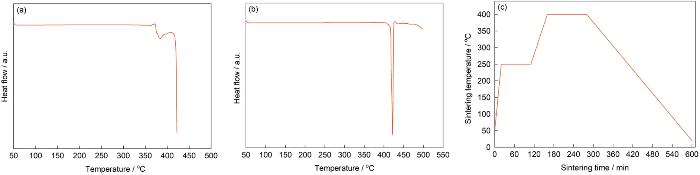
图1
Zn、Mg和Mn混合粉末的DSC曲线及烧结工艺曲线
Fig.1
DSC curves (a, b) and sintering process curve (c) of mixed powders
(a) Zn-Mg hybrid powder (b, c) Zn-Mg-Mn hybrid powder
1.3 力学性能测试
按照GB/T7314—2017标准,使用CMT5305万能试验机进行室温压缩实验,试样尺寸为直径10 mm、长15 mm。每种合金至少进行3次测试,计算平均值和标准偏差,以获得准确的抗压屈服强度。
依次使用120~2000号SiC砂纸对试样进行打磨和抛光处理,随后超声清洗5 min,以达到去污效果。采用HV-100IS显微硬度计测试锌合金的显微硬度,加载载荷200 g,加载时间15 s。为保证测量数据的准确性,对每个试样在相同条件下进行10次独立测试,剔除数据中的最高值和最低值,取剩余数据的平均值作为最终结果。
为了探究单个元素含量对目标变量的影响,将其他元素含量设为固定值。当研究Mg含量对合金屈服强度和硬度的影响时,Mn含量取固定值3.5%,Mg含量依次取0、1.0%、1.5%、2.5%。同样地,研究Mn含量影响时,取Mg含量为2.5%,Mn含量依次取0、1.0%、2.5%、3.5%。共确定了8个合金成分配比,分别研究Mg和Mn含量对合金力学性能的影响。
1.4 微观组织表征
采用线切割工艺将合金加工成直径10 mm、长4 mm的圆柱形试样。采用JDX-8030 X射线衍射仪(XRD,CuKα )对样品中的第二相种类进行分析,电压4 kV,电流40 mA,扫描范围20°~80°,步长0.02°,每步的测量时间为0.2 s。采用配有能谱仪(EDS)的JSM7800F SEM观察样品的显微组织及元素分布情况。
2 机器学习
2.1 数据描述
本工作使用的数据包括:利用粉末冶金工艺制备的Zn-Mg-Mn合金的元素种类与含量、抗压屈服强度和显微硬度,以及搜集到的通过挤压和铸造制备的Zn-Mg-Mn合金的元素种类与含量、抗压屈服强度和显微硬度数据。Mg和Mn含量及制备工艺是合金设计中的关键参数,这些参数与室温下合金的抗压屈服强度密切相关。基于此,可以得到3个输入变量(Mg含量、Mn含量和制备工艺)和2个输出变量(抗压屈服强度和硬度)的35个数据点。将Mg、Mn的具体含量作为数值特征输入模型,同时将制备工艺作为一个特征量运用到机器学习模型中。为实现上述目的,采用一种数值化处理方法,即对不同的制备工艺赋予独特的数值编码(粉末冶金工艺为3,挤压工艺为2,铸造工艺为1),从而构建出一个数值化的特征集,并以此为基础输入模型中。
表2 输入和输出变量范围
Table 2
| Statistic | Input | Output | ||
|---|---|---|---|---|
| Mg % | Mn % | CYS MPa | Hardness HV | |
| Minimum | 0.0 | 0.0 | 81.0 | 38.0 |
| Maximum | 3.0 | 4.2 | 325.0 | 177.6 |
| Average | 1.1 | 0.5 | 217.2 | 87.3 |
| Standard deviation | 0.9 | 0.7 | 48.4 | 25.3 |
2.2 数据扩展
图2
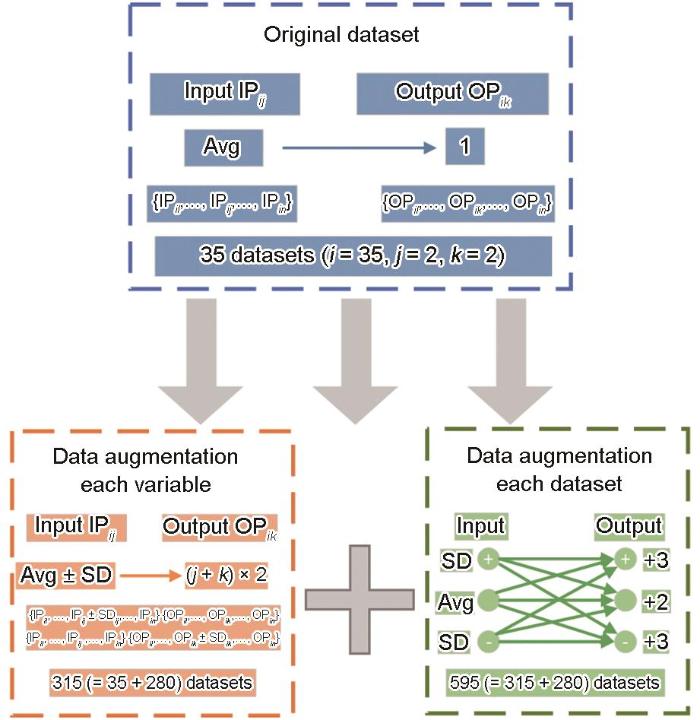
图2
使用平均值和标准差扩展数据流程图
Fig.2
Flowcharts for data extension using mean and standard deviation methods (IP and OP are matrices of input and output variables, respectively; i, j, and k are the number of data points, input variables, and output variables, respectively; SD is standard deviation)
2.3 模型构建
采用随机森林、逻辑回归(LR)、最小近邻(KNN)、决策树(DT)、梯度提升、深度神经网络以及卷积神经网络(CNN)共7种算法对模型进行训练。为了减少非线性回归中的过拟合现象,采用了10倍交叉验证法。训练集与测试集的比例为8∶2,从595个样本中随机抽取80%的原始数据作为训练集进行模型训练,20%的数据作为测试集来验证模型的预测能力[24]。最终结果为10个测试结果的平均值。
对所用模型进行超参数调优,即对不同模型算法中重要的超参数进行选择和调优。具体步骤为:使用网格搜索得到多种参数组合结果,然后筛选出表现最优的参数配置。基于测量输出与预测输出之间的差异,采用3个常见指标评估回归模型的性能,分别为:决定系数(R2)、均方根误差(RMSE)及平均绝对误差(MAE),可通过下式分别表示:
式中,
3 结果
3.1 模型选择
图3
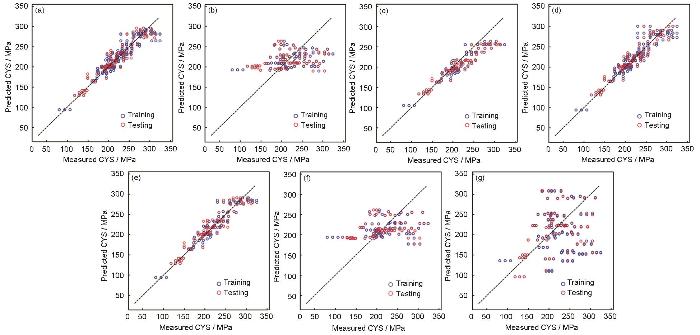
图3
Zn-Mg-Mn合金抗压屈服强度预测值及相应实验数据
Fig.3
Compressive yield strengths of Zn-Mg-Mn alloy predicted by seven algorithms and corresponding experimental values
(a) random forest (RF) (b) logistic regression (LR)
(c) k-nearest neighbors (KNN) (d) decision tree (DT)
(e) extreme gradient boosting (XGBoost) (f) deep neural network (DNN)
(g) convolutional neural network (CNN)
图4
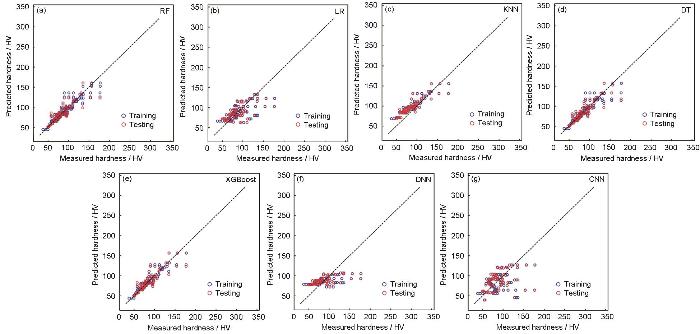
图4
Zn-Mg-Mn合金硬度的预测值及相应实验数据
Fig.4
Hardnesses of Zn-Mg-Mn alloy predicted by seven algorithms and corresponding experimental values
(a) RF (b) LR (c) KNN (d) DT (e) XGBoost (f) DNN (g) CNN
图5为7种机器学习算法的R2、RMSE和MAE对比图。与模型训练阶段的拟合结果一致,KNN模型性能最佳,其R2、RMSE值与MAE值分别为0.90、13.54、8.36。KNN模型的R2大于其他模型,RMSE和MAE低于其他模型。综上所述,KNN模型最为适合预测抗压屈服强度和硬度。
图5
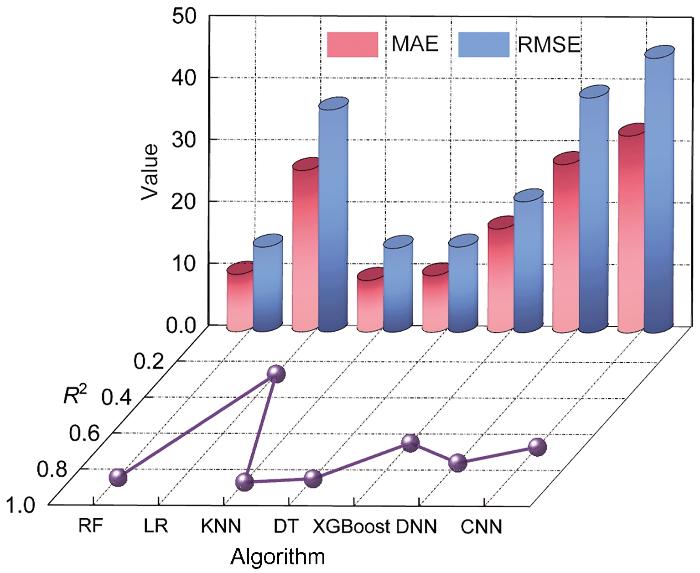
图5
基于7种算法得到的决定系数(R2)、均方根误差(RMSE)及平均绝对误差(MAE)对比图
Fig.5
Comparisons of coefficient of determination (R2), root mean squared error (RMSE), and mean absolute error (MAE) for the seven algorithms
3.2 模型验证
表3 KNN算法验证集的预测值与实验值对比[19,26,27]
Table 3
| No. | Processing technique | Mg | Mn | Predicted value | Experimental value | Ref. | ||
|---|---|---|---|---|---|---|---|---|
| % | % | CYS MPa | Hardness HV | CYS MPa | Hardness HV | |||
| 1 | PM | 1.10 | 0.85 | 200 | 79 | 203 | 81 | This work |
| 2 | PM | 2.75 | 1.02 | 201 | 120 | 198 | 120 | This work |
| 3 | PM | 1.57 | 0.42 | 190 | 84 | 189 | 84 | This work |
| 4 | PM | 0.52 | 0.15 | 221 | 118 | 216 | 115 | This work |
| 5 | PM | 0.22 | 0.52 | 190 | 63 | 193 | 64 | This work |
| 6 | Cast | 1.00 | 0.10 | - | 92 | - | 98 | [19] |
| 7 | Cast | 1.50 | 0.10 | - | 154 | - | 149 | |
| 8 | HE | 0 | 0.40 | 136 | 56 | 136 | 58 | [26] |
| 9 | Cast | 1.20 | 0 | - | 85 | - | 93 | [27] |
图6
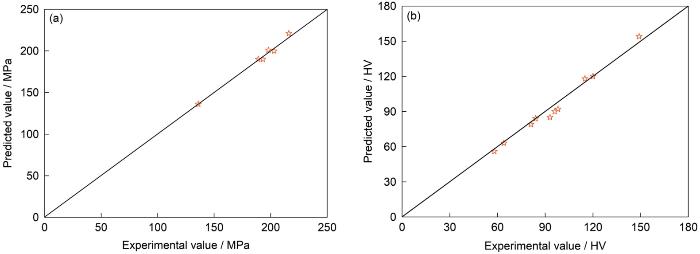
图6
KNN算法得到的抗压屈服强度、硬度预测值与实验值对比图
Fig.6
Comparisons of predicted values by KNN algorithm and experimental values
(a) CYS (b) hardness
3.3 特征变量相关性排序
虽然ML具有强大的数据挖掘能力,但缺乏对特征变量与目标变量之间关系的理论解释。本工作利用SHAP方法进一步分析了特征优化模型中各特征变量的作用机理。SHAP法是一种基于合作博弈理论的加法解释模型。SHAP值为正和负时分别表示特征变量对目标特性有积极和负面影响。
图7
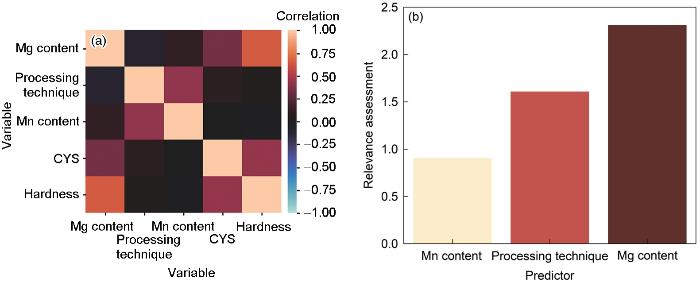
图7
特征相关性热图及统计图
Fig.7
Heat map (a) and statistical chart (b) of feature importance assessments
图8为特征值对抗压屈服强度与硬度综合影响的相关性分析图。根据SHAP值对主要特征变量的相关性进行排序,特征变量从上到下排列。可以看出,两个元素特征变量(Mg和Mn)及制备工艺是影响CYS和硬度的主要因素,且这两个元素特征变量的相关性排序与图7一致。图8还揭示了各特征变量对CYS和硬度的影响。随着Mg含量增加,SHAP值从负值变为正值,表明Mg含量增加对CYS和硬度有正面影响。Mn含量增加同样展现出对CYS和硬度的正面影响。但SHAP图表明,当Mn含量较低时,其对CYS和硬度的影响是负面的,导致合金的CYS和硬度显著下降。值得注意的是,本工作在探讨制备工艺时,主要以粉末冶金工艺为研究对象,其他制备工艺作为参考项。在此基础上,重点研究元素含量对合金性能的影响。
图8
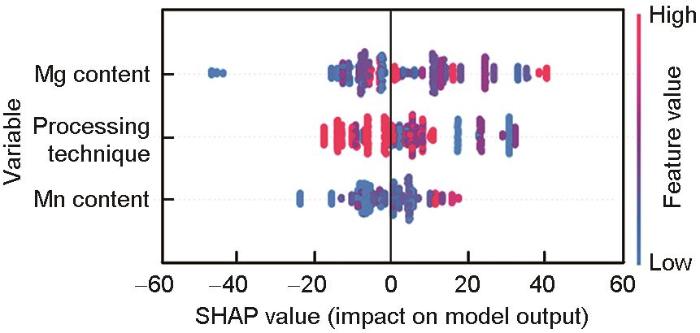
图8
特征值对抗压屈服强度与硬度的综合相关性分析
Fig.8
Analysis of the comprehensive importance of eigenvalues on compressive yield strength and hardness (SHAP—SHapley additive explanations)
图9
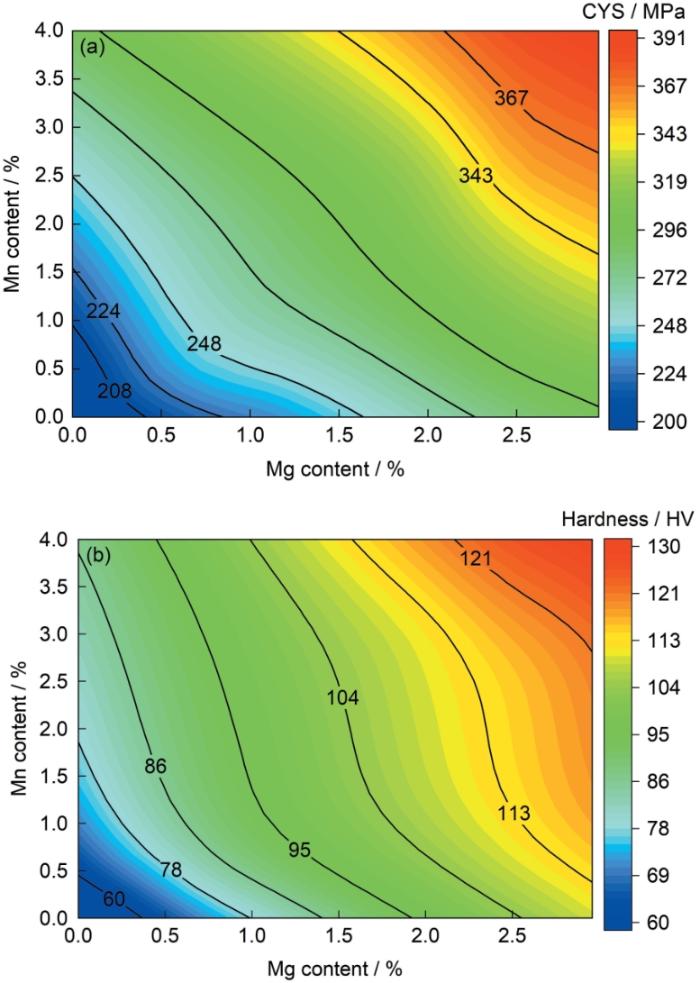
图9
合金元素对抗压屈服强度和硬度影响的预测值
Fig.9
Predicted results of effects of alloying element content on CYS (a) and hardness (b)
4 分析与讨论
4.1 Mg含量对合金抗压屈服强度与硬度的影响
为了探究Mg含量(0、1.0%、1.5%、2.5%)对合金性能的影响,设计了一种以Zn-3.5Mn为标称成分的合金体系。图10a为Mg含量对合金CYS与硬度的影响。向Zn-3.5Mn-xMg合金中添加2.5%Mg后,合金的CYS增加了约200 MPa,硬度增加了约40 HV。随着Mg含量增加,CYS与硬度均呈现出上升趋势,并且在Mg含量为2.25%时,CYS超过300 MPa,硬度也超过100 HV。其中,CYS的增长幅度大于硬度。添加Mg元素有助于细化晶粒,尤其是在粉末烧结过程中,较高的Mg含量可促进生成更多细小晶粒。根据Hall-Petch关系,晶界会阻碍位错运动,因此晶粒尺寸减小会显著提高材料强度,而细晶强化机制对CYS的提升尤为显著[28]。
图10
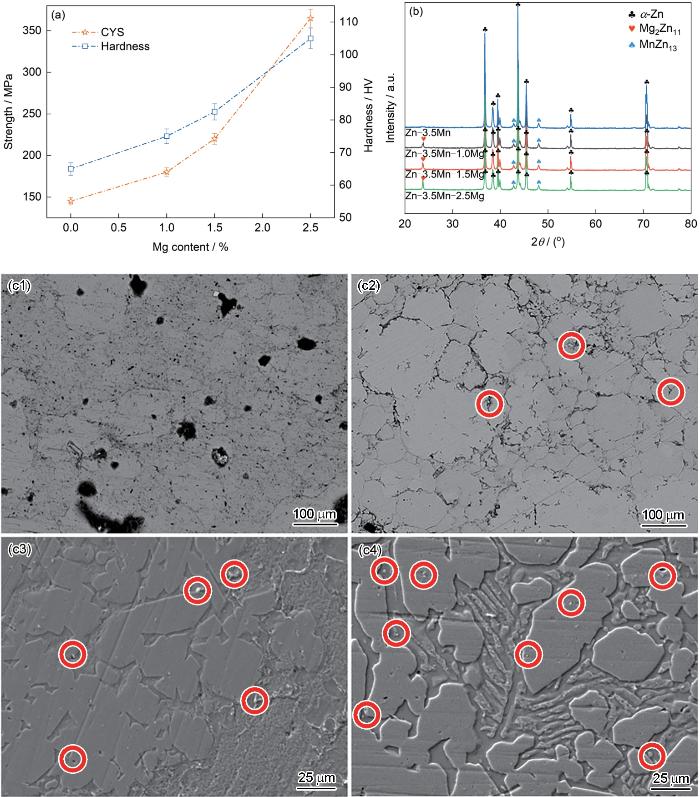
图10
不同Mg含量下Zn-3.5Mn-xMg合金的力学性能、XRD谱及OM和SEM像
Fig.10
Mechanical properties (a), XRD patterns (b), and OM (c1, c2) and SEM (c3, c4) images of Zn-3.5Mn-xMg alloys (Red circles in Figs.10c2-c4 represent Mg2Zn11 phases)
(c1) Mg = 0 (c2) Mg = 1.0% (c3) Mg = 1.5% (c4) Mg = 2.5%
如图10c2~c4所示,合金中析出了富Zn和Mg的二次相,其主要为Mg2Zn11相。添加Mg元素对合金CYS和硬度的改善效果主要取决于Mg2Zn11相的生成。特别地,当Mg含量为2.5%时,生成的Mg2Zn11相最多,合金的力学性能最好。基于KNN算法预测结果,当Mg含量在0~3.0%范围内时,Mg含量与合金力学性能呈现正相关。然而,关于更高含量的Mg元素对合金力学性能的影响仍需进一步探索。
4.2 Mn含量对合金抗压屈服强度与硬度的影响
图11
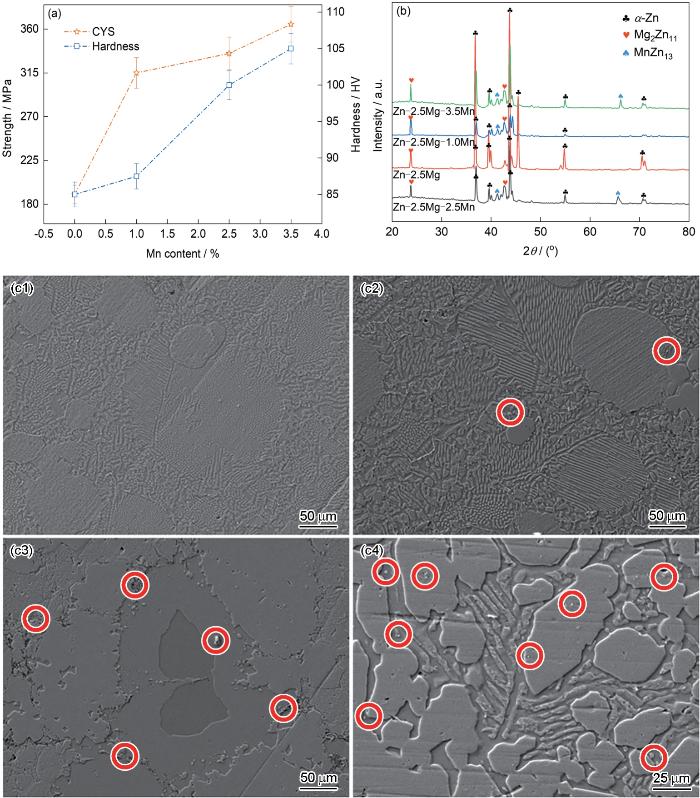
图11
不同Mn含量下Zn-2.5Mg-xMn合金的力学性能、XRD谱和SEM像
Fig.11
Mechanical properties (a), XRD patterns (b), and SEM images (c1-c4) of Zn-2.5Mg-xMn alloys (Red circles in Figs.11c2-c4 represent MgZn13 phases)
(c1) Mn = 0 (c2) Mn = 1.0% (c3) Mn = 2.5% (c4) Mn = 3.5%
图11b为Zn-2.5Mg-xMn合金的XRD谱。可以看出,合金由Zn基体及MnZn13与Mg2Zn11第二相组成。随着Mn含量从0逐渐增加至3.5%,MnZn13含量也随之增加。如图11c2~c4所示,随着Mn元素的增加,锌合金晶界逐渐清晰,MnZn13的数量和尺寸也随着Mn含量增加而逐渐增加,与XRD结果一致。MnZn13相通常沿晶界分布,只有极少部分在晶粒内部。在常温条件下,微量的Mn不足以形成MnZn13相。Wang等[32]研究了挤压态Zn-0.2Mg-(0.1~0.8)Mn合金的显微结构与物相组成,在Zn-0.2Mg-0.1Mn合金中未观察到MnZn13相。随着Mn含量的增加,MnZn13相逐渐析出并呈条状分布于晶界处。
MnZn13相的形成与合金力学性能存在密切关联性。适量的MnZn13相可作为硬质第二相起到析出相强化作用,从而提高合金的抗压屈服强度。然而,当MnZn13含量超出一定限度时,这种强化效果会逐渐减弱甚至发生逆转,这是由于过量的脆性相可能诱发应力集中,促使微裂纹的萌生与扩展。因此,利用机器学习预测材料中适宜的元素范围尤为重要。
4.3 合金设计指南
锌合金作为医用植入器械,其力学性能应满足一定设计标准。然而,关于Zn-Mg-Mn体系合金在生物医学中应用的系统性研究较少。研究[33,34]表明,当CYS大于200 MPa、硬度大于100 HV时,合金满足作为医用植入物的要求。本工作通过实验数据和ML分析,提出当2.25% ≤ Mg ≤ 2.50%、2.50% ≤ Mn ≤ 3.50%时,锌合金的力学性能满足医用植入器械的标准。尽管本工作确定的合金成分范围已满足医用植入材料的要求,但对于该范围外的合金成分组成,其力学性能否满足医用标准仍需进一步研究。此外,鉴于当前特征变量的数量相对有限,对合金力学性能的预测准确性仍需进一步提高。因此,应拓宽合金成分范围并引入新的特征变量以扩充数据集,并发掘和构建与力学性能相关的非结构化数据特征,以期通过此方法更准确地预测Zn-Mg-Mn合金的力学性能。
综上所述,采用KNN算法能够在既定元素成分范围内准确预测锌合金的力学性能(CYS与硬度),从而更有效地适配医用植入材料所需服役性能,并使所设计的合金更适合作为植入器械应用于生物医学领域。
5 结论
(1) 通过实验结果和文献数据共获得了35个样本数据,利用平均值和标准差两种数据扩展方式将数据扩展了17倍,以此提高了数据分析的准确性,并帮助模型更好地泛化,降低了过拟合的风险。
(2) 在构建的7种模型中,KNN模型表现最佳,R2最高,RMSE和MAE最小。KNN模型预测的CYS及硬度与实验数据吻合较好,误差分别小于2%和9%。ML预测模型具有高可靠性。
(3) SHAP分析表明,Mg是影响锌合金CYS和硬度的关键因素。CYS和硬度随Mg元素含量增加基本呈现线性增加趋势,且其CYS和硬度的增加主要与Mg2Zn11相的析出有关。此外,Mn元素可以通过固溶强化和析出MnZn13相提高合金的CYS和硬度。
(4) 通过实验结果和ML分析,提出了满足生物可降解医用器械的植入标准(2.25% ≤ Mg ≤ 2.50%、2.50% ≤ Mn ≤ 3.50%),展现了ML应用于生物医学领域的潜力。
参考文献
Challenges in the use of zinc and its alloys as biodegradable metals: Perspective from biomechanical compatibility
[J].
To date, more than fifty articles have been published on the feasibility studies of zinc and its alloys as biodegradable metals. These preliminary in vitro and in vivo studies showed acceptable biodegradability and reasonable biocompatibility in bone and blood microenvironments for the experimental Zn-based biodegradable metals and, for some alloy systems, superior mechanical performance over Mg-based biodegradable metals. For instance, the Zn-Li alloys exhibited higher UTS (UTS), and the Zn-Mn alloys exhibited higher elongation (more than 100%). On the one hand, similar to Mg-based biodegradable metals, insufficient strength and ductility, as well as relatively low fatigue strength, may lead to premature failure of medical devices. On the other hand, owing to the low melting point of the element Zn, several new uncertainties with regard to the mechanical properties of biomedical zinc alloys, including low creep resistance, high susceptibility to natural aging, and static recrystallization (SRX), may lead to device failure during storage at room temperature and usage at body temperature. This paper comprehensively reviews studies on these mechanical aspects of industrial Zn and Zn alloys in the last century and biomedical Zn and Zn alloys in this century. The challenges for the future design of biomedical zinc alloys as biodegradable metals to guarantee 100% mechanical compatibility are pointed out, and this will guide the mechanical property design of Zn-based biodegradable metals. STATEMENT OF SIGNIFICANCE: Previous studies on mechanical properties of industrial Zn and Zn alloys in the last century and biomedical Zn and Zn alloys in this century are comprehensively reviewed herein. The challenges for the future design of zinc-based biodegradable materials considering mechanical compatibility are pointed out. Common considerations such as strength, ductility, and fatigue behaviors are covered together with special attention on several new uncertainties including low creep resistance, high susceptibility to natural aging, and static recrystallization (SRX). These new uncertainties, which are not significantly observed in Mg-based and Fe-based materials, are largely due to the low melting point of the element Zn and may lead to device failure during storage at room temperature and clinical usage at body temperature. Future studies are urgently needed on these topics.Copyright © 2019 Acta Materialia Inc. Published by Elsevier Ltd. All rights reserved.
Fabrication of cellular Zn-Mg alloy foam by gas release reaction via powder metallurgical approach
[J].By using CaCO3 as the “blowing agent”, Zn-(10-50) wt% Mg alloy foams with close-pore structure were fabricated by the powder metallurgical route. The key of successful foaming is Mg addition and the proper sintering treatment, which lead to the formation of intermetallic compounds and can make the gas release reaction between Mg melt and CaCO3 happen the during foaming process.
Degradation behavior, cytotoxicity, hemolysis, and antibacterial properties of electro-deposited Zn-Cu metal foams as potential biodegradable bone implants
[J].Zinc (Zn) alloys have attracted much attention for biomedical applications due to their biodegradability, biocompatibility, and biological functionalities. Zn alloy foams have high potential to be used as regenerative medical implants by virtue of their porous structure, which allows new bone tissue ingrowth, their low elastic modulus approximating that of natural bone, and their biodegradation, which eliminates the need for follow-up surgery to remove the implants after bone tissue healing. In this context, a biodegradable Zn-Cu foam was fabricated by electrochemical deposition on a foamed Cu template and given a subsequent diffusion heat treatment. The microstructure, mechanical properties, degradation behavior, toxicity, hemolysis percentages, and antibacterial effects of the Zn-Cu foams were assessed for biomedical applications. The Zn-Cu foams exhibited a yield strength of ~12.1 MPa, a plateau strength of 16.8 MPa, and a strain over 50% under compression tests. The corrosion rate of the Zn-Cu foams measured by electrochemical polarization testing was 0.18 mm/y. The Zn-Cu foams showed good blood compatibility with a hemolysis percentage of less than 5%. Cytotoxicity assessment indicated that a 100% concentration of the Zn-Cu foam extract showed clear cytotoxicity against MC3T3-E1 osteoblast cells, but a 12.5% concentration of the extract showed > 90% cell viability. Moreover, the Zn-Cu foams showed good antibacterial effects. STATEMENT OF SIGNIFICANCE: This work reportsa biodegradable Zn-Cu foam with high mechanical strength and ductility, suitable degradation rate, good antibacterial capacity, and good hemolysis property and biocompatibility. The Zn-Cu foam exhibited a yield strength of ~12.1 MPa, a plateau strength of 16.8 MPa, and a strain over 50% under compression tests. The corrosion rate of the Zn-Cu foam measured by electrochemical polarization testing was 0.18 mm/y in Hanks' Solutions. The Zn-Cu foam showed good blood compatibility with a hemolysis percentage of less than 5%. Cytotoxicity assessment indicated that a 12.5% concentration of the foam extract showed > 90% cell viability. Moreover, the Zn-Cu foam showed good antibacterial effects against S. aureus.Copyright © 2019. Published by Elsevier Ltd.
Fabrication, mechanical properties and in vitro degradation behavior of newly developed Zn-Ag alloys for degradable implant applications
[J].
Magnesium: An update on physiological, clinical and analytical aspects
[J].There is an increased interest in the role of magnesium ions in clinical medicine, nutrition and physiology. The characteristics of the binding of magnesium and calcium ions to various components, macromolecules and biological membranes are described. Magnesium affects many cellular functions, including transport of potassium and calcium ions, and modulates signal transduction, energy metabolism and cell proliferation. The mechanism of cellular uptake and efflux of magnesium, its intracellular transport, intestinal absorption, renal excretion and the effect of hormones on these are reviewed. Magnesium deficiency is not uncommon among the general population: its intake has decreased over the years especially in the western world. The magnesium supplementation or intravenous infusion may be beneficial in various diseased states. Of special interest is the magnesium status in alcoholism, eclampsia, hypertension, atherosclerosis, cardiac diseases, diabetes, and asthma. The development of instrumentation for the assay of ionized magnesium is reviewed, as are the analytical procedures for total magnesium in blood and free magnesium in the cytosol. The improved procedures for the assay of different magnesium states are useful in understanding the role of magnesium in health and disease.
Characterization of nanostructured biodegradable Zn-Mn alloy synthesized by mechanical alloying
[J].
300 MPa grade biodegradable high-strength ductile low-alloy (BHSDLA) Zn-Mn-Mg alloys: An in vitro study
[J].
Effect of Mn addition on corrosion properties of biodegradable Mg-4Zn-0.5Ca-xMn alloys
[J].
Zn-0.8 Mn alloy for degradable structural applications: Hot compression behaviors, four dynamic recrystallization mechanisms, and better elevated-temperature strength
[J].
Abnormal effect of Mn addition on the mechanical properties of as-extruded Zn alloys
[J].
High temperature strengthening mechanism of pure Zn with trace Mn addition
[J].
Prediction of the composition and hardness of high-entropy alloys by machine learning
[J].
Machine learning-based design of biodegradable Mg alloys for load-bearing implants
[J].
Accelerated development of high-strength magnesium alloys by machine learning
[J].
Application of machine learning methods for predicting new superhard materials
[J].
Pressureless sintered silicon carbide with enhanced mechanical properties obtained by a two-step sintering method
[J].
由两步烧结法获得的机械性能增强的无压烧结碳化硅
[J].
Preparation of ZrO2(3Y) nanoceramics under two-stage non-pressurized sintering
[J].
两段式无压烧结制备纳米二氧化锆(3Y)材料
[J].
A review of two-step sintering for ceramics
[J].
Micro-alloying with Mn in Zn-Mg alloy for future biodegradable metals application
[J].
Evaluation of as‐extruded ternary Zn-Mg-Zr alloys for biomedical implantation material: In vitro and in vivo behavior
[J].
Effects of alloying elements (Ca and Sr) on microstructure, mechanical property and in vitro corrosion behavior of biodegradable Zn-1.5 Mg alloy
[J].
A combined strategy to enhance the properties of Zn by laser rapid solidification and laser alloying
[J].The orthopedic application of Zn is limited owing to the poor strength and low plasticity. In this study, a novel strategy by combining rapid solidification obtained by selective laser melting (SLM) and alloying with Mg was proposed to improve the mechanical properties of Zn. The microstructures, mechanical properties, as well as in vitro cytocompatibility of SLM processed Zn-xMg (x = 0-4 wt%) were studied systematically. Results shown that SLM processed Zn-xMg alloys consisted of fine equiaxed α-Zn grains with homogeneously precipitated MgZn along grain boundaries. More importantly, the grains size of α-Zn was decreased from 104.4 ± 30.4 µm to 4.9 ± 1.4 µm with Mg increasing. And Mg mainly dissolved in α-Zn developing into supersaturated solid solution due to rapid solidification effect. As a consequence, the ultimate tensile strength and elongation were enhanced by 361% and 423%, respectively, with Mg containing up to 3 wt%. Meanwhile, alloying with Mg enhanced the corrosion resistance of Zn, with the degradation rate decreasing from 0.18 ± 0.03 mm year to 0.10 ± 0.04 mm year. Furthermore, SLM processed Zn-xMg exhibited good biocompatibility. This research suggested that SLM processed Zn-3Mg alloy was a potential biomaterial for orthopedic applications.Copyright © 2018 Elsevier Ltd. All rights reserved.
Alloying design of biodegradable zinc as promising bone implants for load-bearing applications
[J].Magnesium-based biodegradable metals (BMs) as bone implants have better mechanical properties than biodegradable polymers, yet their strength is roughly less than 350 MPa. In this work, binary Zn alloys with alloying elements Mg, Ca, Sr, Li, Mn, Fe, Cu, and Ag respectively, are screened systemically by in vitro and in vivo studies. Li exhibits the most effective strengthening role in Zn, followed by Mg. Alloying leads to accelerated degradation, but adequate mechanical integrity can be expected for Zn alloys when considering bone fracture healing. Adding elements Mg, Ca, Sr and Li into Zn can improve the cytocompatibility, osteogenesis, and osseointegration. Further optimization of the ternary Zn-Li alloy system results in Zn-0.8Li-0.4Mg alloy with the ultimate tensile strength 646.69 ± 12.79 MPa and Zn-0.8Li-0.8Mn alloy with elongation 103.27 ± 20%. In summary, biocompatible Zn-based BMs with strength close to pure Ti are promising candidates in orthopedics for load-bearing applications.
A novel approach to predict green density by high-velocity compaction based on the materials informatics method
[J].
In vitro and in vivo studies of Zn-Mn biodegradable metals designed for orthopedic applications
[J].In recent years, Zn-based materials provide a new option as biodegradable metals for orthopedic applications. To improve the low strength and brittle nature of pure Zn, small amounts of alloying element Mn (0.1, 0.4 and 0.8 wt.%) were added into Zn to fabricate binary Zn-Mn alloys. An extremely high elongation (83.96 ± 2.36%) was achieved in the resulting Zn-0.8 wt.%Mn alloy. Moreover, Zn-Mn alloys displayed significantly improved cytocompatibility as compared to pure Zn, according to cell proliferation and morphology analyses. More importantly, a significantly improved osteogenic activity was verified after adding Mn regarding ALP activity and osteogenic expression. Furthermore, Zn-0.8 wt.%Mn alloy scaffolds were implanted into the rat femoral condyle for repairing bone defects with pure Ti as control. Enhanced osteogenic activities were confirmed for Zn-0.8Mn alloy in contrast to pure Ti based on Micro-CT and histological results, and favorable in vivo biosafety of Zn-0.8Mn alloy was verified by H&E staining and blood tests. The exceptional mechanical performance and favorable osteogenic capability render Zn-Mn alloy a promising candidate material in the treatment of bone defects or fracture repair. STATEMENT OF SIGNIFICANCE: The element Mn, on the one hand, as an essential trace element in the human body, promotes cell proliferation, adhesion, spreading, and regulates bone metabolism; on the other hand, it could significantly improve the ductility of Zn alloys. Here, we systematically reported the biocompatibility and biofunctionality of binary biodegradable Zn-Mn alloys in the bone environment. The Zn-Mn alloys promoted MC3T3-E1 cell proliferation, adhesion, spreading, and osteogenic differentiation in vitro. Furthermore, a rat femoral condyle defect model was established; porous Zn-Mn alloy scaffolds were manufactured to repair the bone defects. Significant bone regenerations, considerable bone ingrowth, and desirable biosafety were confirmed in vivo. Therefore, biodegradable Zn-Mn with promising osteogenic properties may become new options for orthopedic implant materials.Copyright © 2020. Published by Elsevier Ltd.
Mechanical properties, in vitro degradation behavior, hemocompatibility and cytotoxicity evaluation of Zn-1.2Mg alloy for biodegradable implants
[J].
Grain growth and Hall-Petch relationship in Ti37V15Nb22Hf23W3 refractory high-entropy alloys
[J].
Current status and perspectives of zinc-based absorbable alloys for biomedical applications
[J].Absorbable metals have the potential to serve as the next generation of temporary medical implant devices by safely dissolving in the human body upon vascular tissue healing and bone regeneration. Their implementation in the market could greatly reduce the need of costly and risky additional surgeries for either implant replacement or removal, often required in current permanent implants. Despite the extensive research done over the last two decades on magnesium (Mg) and iron (Fe) based alloys, they have not generally shown a satisfactory combination of mechanical properties, biocompatibility and controlled degradation rate in the physiological environment. Consequently, zinc (Zn) based alloys were introduced in the last few years as alternative materials to overcome the limitations of Fe and Mg-based alloys. The blend of different alloying elements and processing conditions have led to a wide variety of Zn-based alloys having tunable mechanical properties and corrosion rates. This review provides the most recent progress in the development of absorbable Zn-based alloys for biomedical implant applications, primarily for cardiovascular and orthopedic devices. Their biocompatibility, processability and metallurgical aspects, as well as their mechanical behavior and corrosion properties are presented and discussed, including their opportunities, limitations and future research directions. STATEMENT OF SIGNIFICANCE: Temporary orthopedic bioimplants have become increasingly popular as they offer an alternative to prevent complications, like infections or secondary surgeries, often related to the implantation of permanent devices. Iron and magnesium alloys were extensively studied as candidates for absorbable medical applications, but they generally failed to provide a desirable mechanical performance and corrosion characteristics in the physiological environment. Zinc was introduced in the last decade as a potential implant material after showing outstanding biocompatibility and biodegradability. This review summarizes the research advances to date and provides a thorough discussion of the future challenges of absorbable zinc alloys to satisfy the demanding clinical benchmarks for absorbable medical applications. Their biocompatibility, mechanical, and corrosion aspects, both in vitro and in vivo, are comprehensively reviewed and assessed accordingly.Copyright © 2019 Acta Materialia Inc. Published by Elsevier Ltd. All rights reserved.
Improved mechanical properties and strengthening mechanism with the altered precipitate orientation in magnesium alloys
[J].
Fabrication, microstructures, and mechanical properties of Zn-0.1Mg-1Mn (wt.%) alloy tube
[J].
Effect of Mn content on the microstructure and mechanical properties of as-extruded Zn-0.2Mg-Mn (wt%) alloys
[J].
Zinc exhibits ideal physiological corrosion behavior for bioabsorbable stents
[J].
A comprehensive review of the current research status of biodegradable zinc alloys and composites for biomedical applications
[J].Zinc (Zn)-based biodegradable materials show moderate degradation rates in comparison with other biodegradable materials (Fe and Mg). Biocompatibility and non-toxicity also make them a viable option for implant applications. Furthermore, Pure Zn has poor mechanical behavior, with a tensile strength of around 100–150 MPa and an elongation of 0.3–2%, which is far from reaching the strength required as an orthopedic implant material (tensile strength is more than 300 MPa, elongation more than 15%). Alloy and composite fabrication have proven to be excellent ways to improve the mechanical performance of Zn. Therefore, their alloys and composites have emerged as an innovative category of biodegradable materials. This paper summarizes the most important recent research results on the mechanical and biological characteristics of biodegradable Zn-based implants for orthopedic applications and the most commonly added components in Zn alloys and composites.


