), 张旭, 胡冰晖, 双思垚, 于峻石, 熊宇凯, 宋世杰
), ZHANG Xu, HU Binghui, SHUANG Siyao, YU Junshi, XIONG Yukai, SONG Shijie
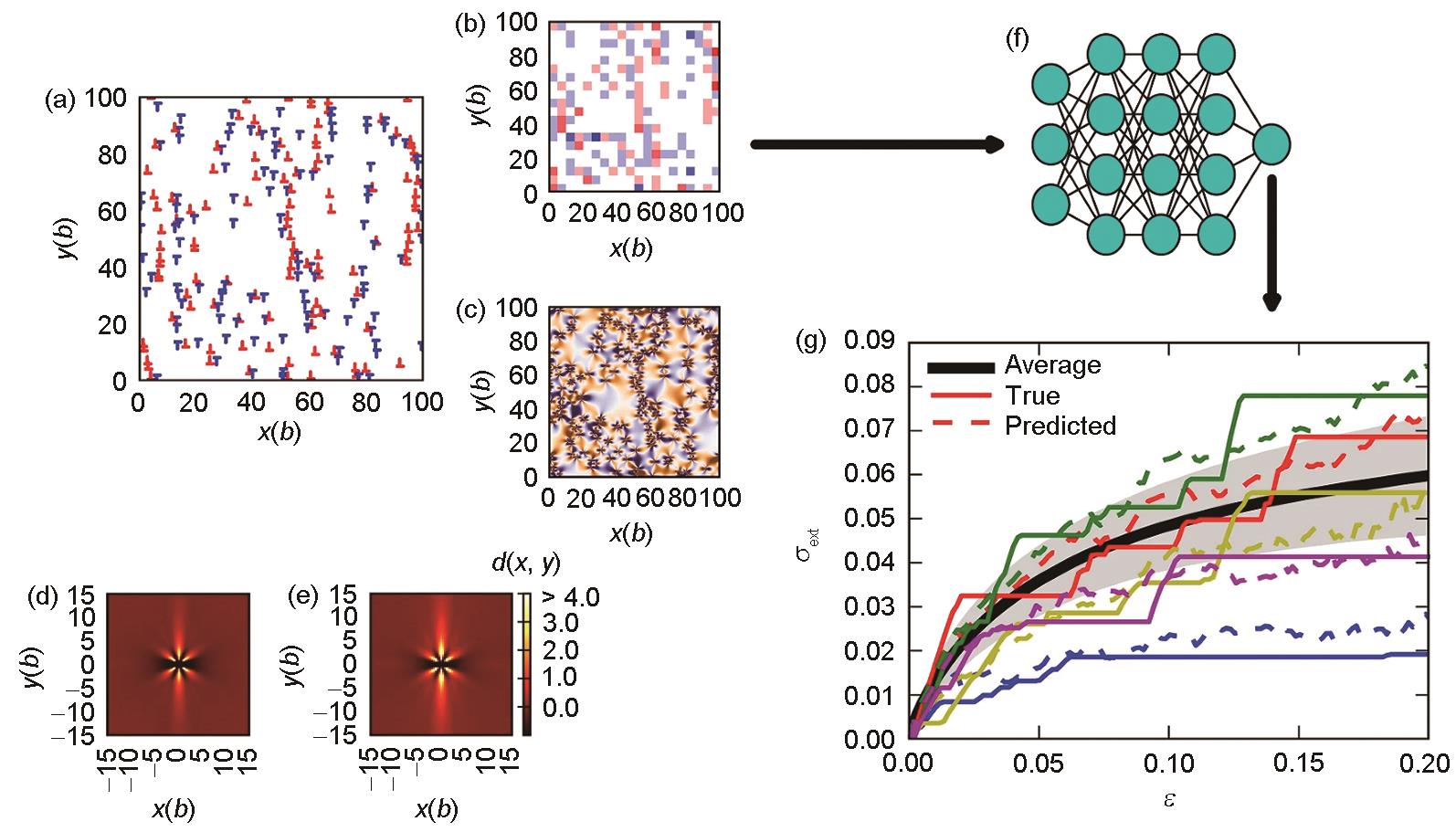
图3. 基于机器学习方法预测微米尺度晶体材料应力-应变响应[
Fig.3. Machine learning-based prediction of stress-strain responses in micron-scale crystalline materials[
(a) initial dislocation configuration (Red and blue symbols corresponding to positive and negative Burgers vectors, respectively)
(b) geometrically necessary dislocation density (ρGND) distribution (Red and blue corresponding to positive and negative values of ρGND, respectively)
(c) internal stress field distribution (σsf) (Orange corresponding to positive and purple to negative σsf)
(d, e) two types of initial states were used randomly relaxed configurations (d) and pre-deformed dislocation configurations (e) (d(x, y)—dislocation pair correlation function)
(f) a trained neural network was used to establish the mapping between features of the initial dislocation configuration and the subsequent stress-strain curves
(g) the figure shows true stress-strain curves (solid lines) and neural network predictions (dashed lines) for selected samples, along with the average of all true curves (thick black line) and the standard deviation band (shaded area) (σext—external applied stress)