基于机器学习的金属材料多尺度塑性力学研究进展
康国政( ), 张旭, 胡冰晖, 双思垚, 于峻石, 熊宇凯, 宋世杰
Advances in Machine Learning-Based Multiscale Plasticity Mechanics of Metallic Materials
KANG Guozheng(), ZHANG Xu, HU Binghui, SHUANG Siyao, YU Junshi, XIONG Yukai, SONG Shijie
), ZHANG Xu, HU Binghui, SHUANG Siyao, YU Junshi, XIONG Yukai, SONG Shijie
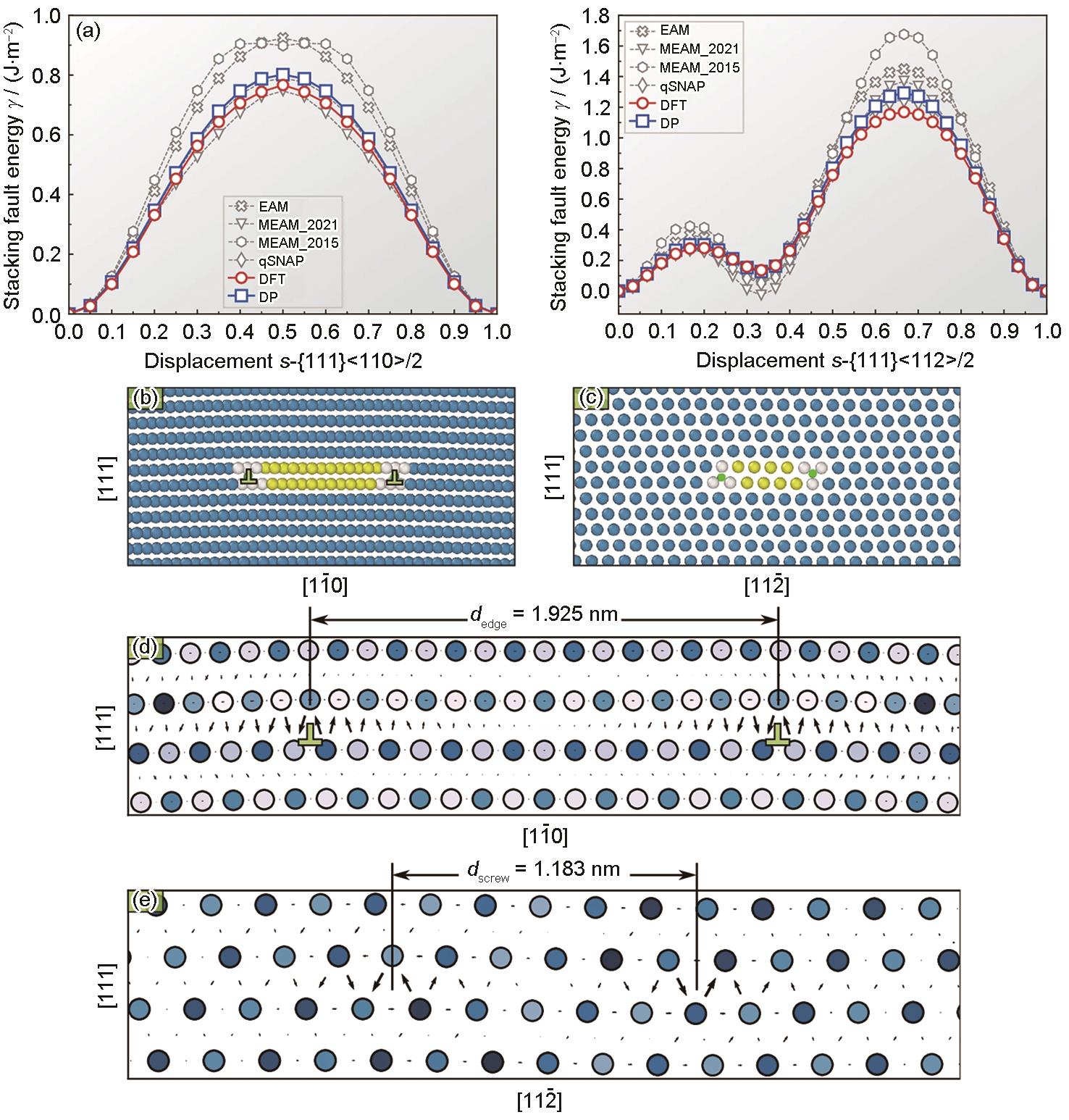
图1. 基于机器学习势函数探究纯Ni位错芯结构[
Fig.1. Exploration of dislocation core for pure Ni based on machine learning potential[
(a) generalized stacking fault energies along the <110>/2 and <112>/2 directions, respectively (EAM—embedded atom method, MEAM—modified embedded atom method, qSNAP—quadratic spectral neighbor analysis potential, DFT—density functional theory)
(b-e) atomic configurations of edge and screw dislocations (b, c) and the corresponding differential displacement plots (d, e) (The blue, yellow, and white circles in Figs.1b and c represent fcc, hcp, and other local atoms, respectively. dedge and dscrew—the partial core separations of edge and screw configurations, respectively)